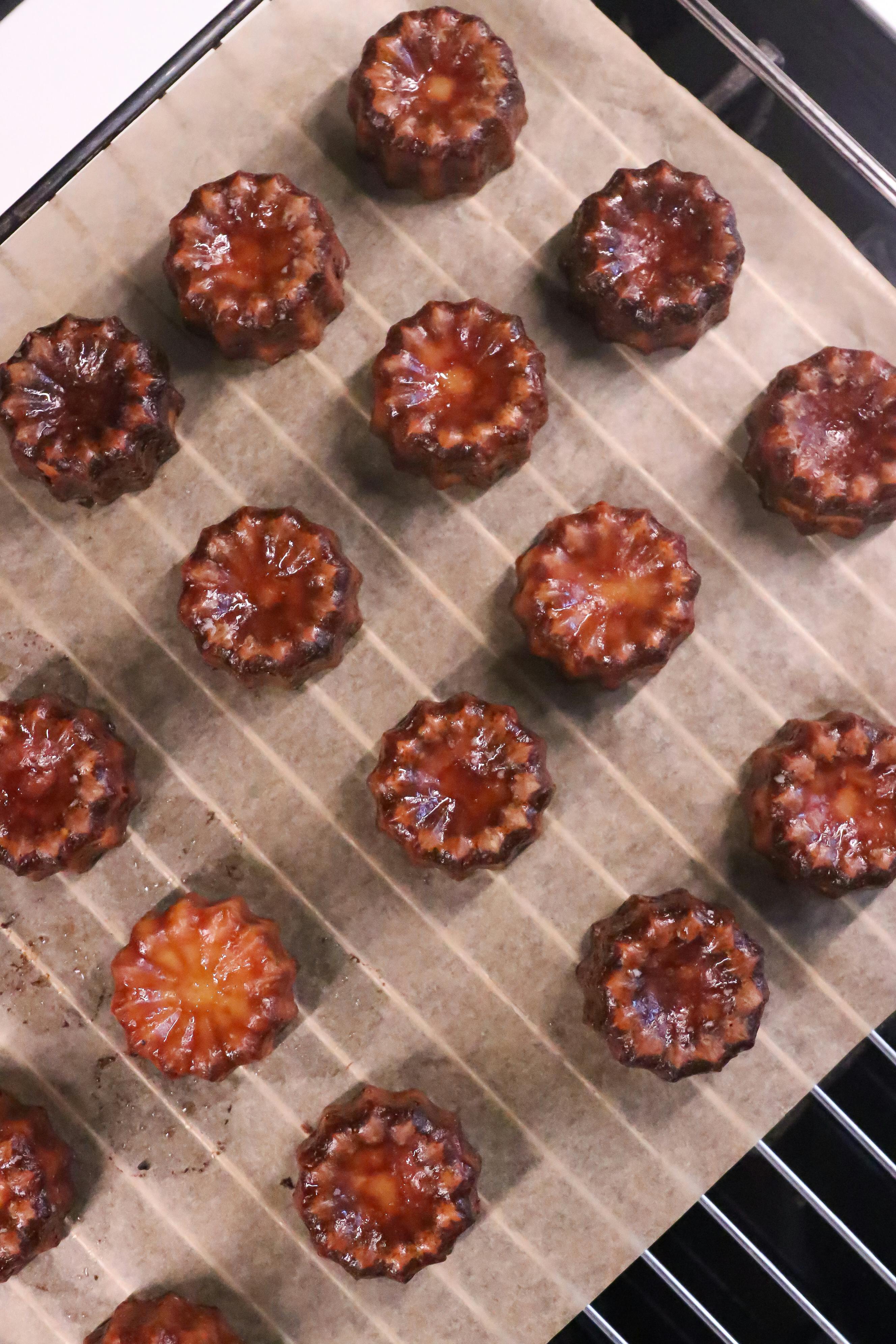
Photo: Geraud pfeiffer / Pexels
The diets react (see scores below)
Common Ingredients
- milk
- egg yolks
- sugar
- flour
- butter
- vanilla
- rum
Specific recipes may vary.
Incompatible with 11 of 11 diets
Diet Ratings
Canelé is a classic French pastry that is fundamentally incompatible with ketogenic dietary requirements. Its primary ingredients are sugar and flour, both of which are high-carbohydrate, keto-forbidden components. A single canelé contains approximately 20-30g of net carbs, which alone can meet or exceed the entire daily carb allowance for strict keto. The sugar provides pure glucose and the wheat flour adds significant starch, both of which will immediately disrupt ketosis. There is no meaningful way to consume a traditional canelé within keto guidelines.
Canelé is a classic French pastry that contains multiple animal-derived ingredients: milk (dairy), egg yolks (animal product), and butter (dairy fat). All three are explicitly excluded under vegan dietary rules. There is no ambiguity here — this dish is fundamentally incompatible with a vegan diet in its traditional form. A vegan version could theoretically be made using plant-based milk, vegan butter, and egg substitutes, but the standard recipe as presented is clearly not vegan.
Canelé is a French pastry that contains multiple non-paleo ingredients. Flour (wheat grain) and milk (dairy) are strict paleo exclusions, and sugar (refined) is also prohibited. Butter is a dairy product excluded under paleo rules. There is no paleo-compliant path for this dish — it is fundamentally built on grains, dairy, and refined sugar, all of which are core exclusions with high consensus in the paleo community.
Canelé is a French pastry that conflicts with Mediterranean diet principles on multiple fronts. It is built around refined white flour and significant added sugar, both of which are minimized in the Mediterranean diet. Butter is the primary fat rather than olive oil, representing a direct substitution of the diet's core fat source with a saturated animal fat. While eggs and milk are acceptable in moderation, here they serve as vehicles for a high-sugar, refined-grain treat rather than nutritious whole foods. Rum adds alcohol and empty calories beyond any traditional moderate wine allowance. As a processed sweet snack with no whole grains, vegetables, legumes, or olive oil, it offers virtually nothing aligned with Mediterranean diet priorities.
Canelé is a French pastry that is fundamentally incompatible with the carnivore diet. It is composed almost entirely of plant-derived and processed ingredients: flour (grain), sugar (processed plant), vanilla (plant extract), and rum (plant-derived alcohol). While it does contain some animal-derived components — milk, egg yolks, and butter — these are minor in context and the dish as a whole is a baked good/pastry, which is categorically excluded from any tier of the carnivore diet. There is no version of carnivore that permits grain-based baked goods.
Canelé is a French pastry that contains multiple Whole30-excluded ingredients. Milk is dairy (excluded), sugar is added sugar (excluded), flour is a grain (excluded), butter is dairy (excluded), and rum is alcohol (excluded). Beyond the individual ingredient violations, a canelé is a classic baked good/pastry that falls squarely under the Whole30 rule against recreating baked goods and treats. This dish fails on nearly every level of the Whole30 program.
Canelé contains two high-FODMAP ingredients that make it unsuitable during the elimination phase. First, wheat flour is the primary structural ingredient and is high in fructans — a major FODMAP — at any realistic serving size. Second, whole milk is high in lactose, and while egg yolks are used rather than whole eggs (which slightly reduces the dairy protein load), the recipe relies on a significant quantity of milk as a core ingredient. Sugar (sucrose), butter, vanilla extract, and rum are generally low-FODMAP at typical quantities used in baking. However, the combination of wheat flour and milk creates a compounded high-FODMAP load per standard serving of even one or two canelés. There is no realistic portion reduction that would make this dish low-FODMAP without reformulation using gluten-free flour and lactose-free milk.
Canelé is a French pastry that is fundamentally at odds with DASH diet principles. It is composed primarily of sugar, butter (saturated fat), egg yolks, and white flour — all ingredients DASH explicitly limits or discourages. The high added sugar content places it firmly in the 'sweets' category that DASH restricts to 5 or fewer servings per week (and only in small portions). Butter contributes saturated fat, which DASH limits to reduce cardiovascular risk. White flour offers no meaningful fiber, and the rum adds empty calories. There are no significant sources of potassium, magnesium, calcium, or dietary fiber. While milk and egg yolks provide some protein and calcium, the overall nutritional profile is dominated by saturated fat and added sugar, making this an occasional indulgence at best and an avoid under DASH guidelines.
A canelé is a French pastry that is essentially a sugar-and-flour delivery vehicle with minimal nutritional redeeming qualities from a Zone perspective. The macronutrient profile is dominated by high-glycemic carbohydrates (white flour, significant sugar) and saturated fat (butter, egg yolks), with virtually no lean protein and no favorable fat sources. There is no meaningful fiber to mitigate the glycemic impact. The sugar-to-flour base creates a rapid insulin spike, directly contradicting the Zone's core goal of controlling insulin response. As a snack, it provides no protein block contribution and no favorable fat, making it essentially impossible to fit into a Zone-balanced eating pattern without completely undermining the 40/30/30 ratio. Unlike some caution-category sweets that can be consumed in tiny portions within a larger balanced meal, a canelé's entire identity is built around its high-glycemic, high-saturated-fat composition. This is among the clearest 'avoid' cases in Zone methodology — not because the food is banned, but because it contributes nothing toward Zone balance and actively works against it.
Canelé is a classic French pastry with virtually no redeeming anti-inflammatory qualities. Its ingredient list reads like a checklist of foods to limit or avoid on an anti-inflammatory diet: refined white flour (refined carbohydrate with no fiber, high glycemic), added sugar (a primary driver of inflammatory cytokine release), butter (saturated fat), egg yolks in large quantity, and full-fat dairy milk. Rum adds alcohol, which outside of moderate red wine is flagged as pro-inflammatory. Vanilla is the only neutral-to-mildly-beneficial ingredient. There are no omega-3 sources, no meaningful antioxidants, no polyphenols, no fiber, and no anti-inflammatory spices or herbs present. The combination of refined carbohydrates and added sugar promotes spikes in blood glucose and insulin, both of which are associated with upregulation of inflammatory markers like CRP and IL-6. Butter contributes saturated fat, which at high intake is associated with increased inflammatory signaling. This dish is essentially a concentrated delivery vehicle for the exact macronutrient and ingredient profile that anti-inflammatory frameworks consistently advise against.
A canelé is a French pastry that is essentially pure empty calories — it is high in sugar, refined flour, butter (saturated fat), and contains alcohol (rum), all of which are explicitly problematic for GLP-1 patients. It offers virtually no protein, no fiber, and no meaningful micronutrient density. The combination of high sugar and butter can worsen nausea, reflux, and GI discomfort caused by slowed gastric emptying. Rum, even in small baked quantities, is a concern given GLP-1 patients' heightened alcohol sensitivity and liver considerations. As a snack, it provides no satiety value and displaces nutritionally critical foods in an already calorie-restricted eating window. Every calorie on a GLP-1 regimen needs to count — this one does not.
*See how scores were generated at our methodology page.
Nutritional profile
Six traits that cut across every diet.
Fiber & Plants
How much whole-plant food and fiber it delivers.
Healthy Fats
The quality of its fats (unsaturated, omega-3).
Whole / Unprocessed
How close it is to its natural, unprocessed form.
Gut Gentle
How easy it is on digestion (low FODMAP, few irritants).
Low Glycemic
How little it spikes your blood sugar.
Protein Density
How much protein it packs per calorie.
Controversy Index
Higher controversy = more disagreement between diets.