French
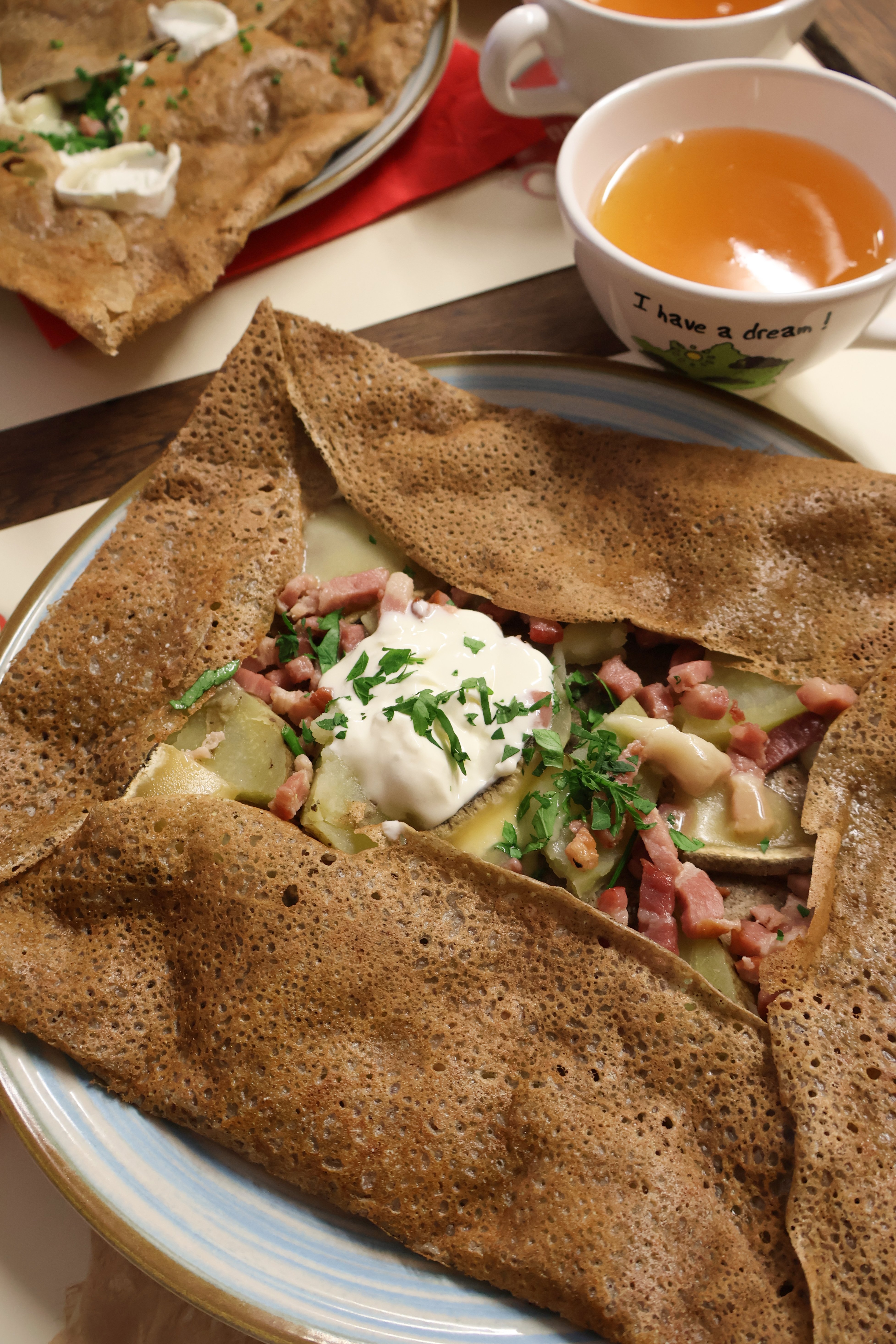
Galette Bretonne
The diets react (see scores below)
Common Ingredients
- buckwheat flour
- eggs
- ham
- gruyere cheese
- butter
- milk
- salt
Specific recipes may vary.
Incompatible with 5 of 11 diets
Diet Ratings
Galette Bretonne is fundamentally built on buckwheat flour, which is a grain-based ingredient with significant net carbohydrates (approximately 60-70g net carbs per 100g). A single galette typically uses 30-50g of buckwheat flour, contributing 18-35g of net carbs from the crepe alone — enough to potentially break ketosis on its own. While the fillings (eggs, ham, gruyere, butter) are excellent keto foods, the buckwheat flour base makes this dish incompatible with a ketogenic diet. Despite buckwheat having slightly more fiber than refined wheat flour, it is still a starchy grain that drives net carbs well above keto thresholds for a single serving.
Galette Bretonne contains multiple animal-derived ingredients, making it entirely incompatible with a vegan diet. Eggs and butter are direct animal products, ham is animal flesh (pork), Gruyère cheese and milk are dairy products. Every major ingredient beyond buckwheat flour and salt is animal-derived. There is no vegan version of this dish that would still qualify as a traditional Galette Bretonne.
Galette Bretonne is fundamentally incompatible with the paleo diet. The dish contains multiple hard-excluded ingredients: buckwheat flour (a grain/pseudocereal, excluded regardless of being gluten-free), gruyere cheese (dairy), milk (dairy), ham (processed meat with added salt and preservatives), butter (dairy), and added salt. While eggs are paleo-approved, they cannot salvage a dish where virtually every other core ingredient violates paleo principles. This is not a borderline case — the majority of ingredients fall squarely into the 'avoid' category with high paleo community consensus.
Galette Bretonne is a traditional French buckwheat crepe, and its Mediterranean compatibility is mixed. Buckwheat flour is a whole grain and nutritionally positive, aligning well with Mediterranean principles. Eggs and dairy (gruyere, milk) are acceptable in moderation under Mediterranean guidelines. However, butter is used instead of olive oil as the primary fat, which deviates from a core Mediterranean principle. Ham (processed pork) is a red/processed meat that the diet discourages. Overall, this is an occasional, moderate dish rather than a staple.
Some Mediterranean diet interpreters note that traditional regional French cuisines, including Breton cooking, share qualities with Mediterranean eating patterns (whole grains, eggs, dairy in moderation). From this perspective, a galette made with whole-grain buckwheat and eggs could be considered acceptable comfort food if ham is minimized or replaced with vegetables, and butter use is limited.
Galette Bretonne is fundamentally incompatible with the carnivore diet. The defining ingredient is buckwheat flour, a plant-derived grain (technically a pseudocereal) that forms the crepe batter — this alone disqualifies the dish entirely. While several individual ingredients (eggs, ham, gruyere, butter, milk) are animal-derived and would be acceptable to varying degrees on carnivore, the dish cannot be separated from its buckwheat base. There is no version of a Galette Bretonne without buckwheat flour — it is the dish. The plant grain content dominates the composition and represents a core excluded food category with universal consensus across all carnivore tiers.
Galette Bretonne contains multiple excluded ingredients. Buckwheat flour is explicitly listed as an excluded grain on Whole30. Gruyère cheese is dairy (excluded). Butter is dairy (excluded — only ghee/clarified butter is the dairy exception). Milk is dairy (excluded). Additionally, even if all ingredients were compliant, this dish is a crepe/galette — a flatbread/pancake analog that falls squarely under the Rule 4 prohibition against recreating baked goods and pancake-style foods with compliant ingredients. This dish fails on multiple fronts simultaneously.
Galette Bretonne is made primarily with buckwheat flour, which is naturally gluten-free and low-FODMAP — a significant advantage. Eggs, butter, and ham are all low-FODMAP ingredients with no FODMAP concerns. The key issues are gruyere cheese and milk. Gruyere is a hard, aged cheese and is considered low-FODMAP at a standard serving (~40g), as aging significantly reduces lactose. However, milk is high in lactose and high-FODMAP unless used in very small quantities. A traditional galette recipe typically uses enough milk in the batter to raise concern, though the amount per serving may be diluted across multiple crepes. The combination of milk and gruyere could push total lactose to a problematic level depending on preparation quantities and portion size.
Monash University rates hard aged cheeses like gruyere as low-FODMAP at ~40g, and buckwheat is clearly safe, but clinical FODMAP practitioners often flag recipes containing cow's milk in batter as risky during the elimination phase unless lactose-free milk is substituted — the milk quantity per galette serving is preparation-dependent and may cross the threshold for sensitive individuals.
Galette Bretonne contains a mix of DASH-friendly and DASH-problematic ingredients. Buckwheat flour is a DASH-positive whole grain offering fiber, magnesium, and potassium. Eggs are an acceptable lean protein in moderation. However, the combination of ham (high sodium, processed meat), Gruyère cheese (high in saturated fat and sodium), and butter (saturated fat) creates meaningful concerns. Ham alone can contribute 500-800mg sodium per serving, and Gruyère adds both saturated fat and additional sodium. Butter adds saturated fat contrary to DASH principles. As commonly prepared and consumed, this dish likely exceeds DASH targets for sodium and saturated fat in a single serving, placing it in the caution zone rather than a firm avoid — the buckwheat base and egg protein are genuine positives. A modified version using low-sodium ham, reduced cheese, and minimal butter would score higher.
NIH DASH guidelines explicitly limit processed meats and full-fat dairy due to sodium and saturated fat concerns, which would push this dish toward avoid. However, some updated clinical interpretations note that Gruyère, being a naturally aged cheese consumed in modest portions, has a lower sodium profile than processed cheeses, and recent research has softened the stance on full-fat dairy's cardiovascular impact — leading some DASH-oriented dietitians to allow this dish occasionally within an otherwise adherent dietary pattern.
Galette Bretonne presents a mixed Zone Diet profile. On the positive side, buckwheat flour is a relatively low-glycemic whole grain carbohydrate with fiber, and eggs plus ham provide reasonable lean protein. The dish has a natural protein-carb-fat structure that can loosely mirror Zone ratios. However, several concerns arise: Gruyère cheese and butter contribute significant saturated fat, which conflicts with Zone's emphasis on monounsaturated fats. The dish is carbohydrate-forward (buckwheat crepe as the base) with limited vegetable content, making it harder to hit Zone's recommended vegetable servings. Milk adds additional carbs and some saturated fat. Portion size is critical — a standard full galette likely delivers too many carb blocks and fat blocks skewed toward saturated. With careful portioning (smaller galette, reduced cheese and butter, paired with a large green salad), it can be incorporated into a Zone meal, but as typically served it drifts out of ideal Zone ratios.
Some Zone practitioners note that buckwheat is actually favorable in Zone terms — it has a lower glycemic index than wheat flour, higher fiber, and a better amino acid profile. Dr. Sears' later writings (The Anti-Inflammation Zone) also softened the strict position on saturated fat, acknowledging that when overall inflammation markers are managed through omega-3s and polyphenols, moderate saturated fat from whole food sources like cheese is less problematic than processed foods. From this perspective, a half-galette with added vegetables could score closer to a 6.
Galette Bretonne has a mixed anti-inflammatory profile. On the positive side, buckwheat is a notable strength: it is a gluten-free pseudo-grain rich in rutin (a flavonoid with antioxidant and anti-inflammatory properties), magnesium, and fiber — it fits well within anti-inflammatory whole grain guidance. Eggs provide choline, selenium, and some anti-inflammatory nutrients, and are acceptable in moderation. Ham contributes protein but is a processed red meat with added sodium and preservatives, placing it in the 'limit' category. Gruyère is a full-fat dairy cheese (saturated fat, limit category), and butter is a saturated fat that anti-inflammatory frameworks advise limiting. Milk is lower-fat dairy and more acceptable in moderation. Overall, the dish pairs a genuinely anti-inflammatory base (buckwheat) with a combination of processed meat, full-fat dairy, and saturated fat that blunts its benefits. It is not a pro-inflammatory dish outright, but it is not a strong anti-inflammatory choice either — moderate consumption is reasonable.
Some anti-inflammatory practitioners, particularly those following stricter protocols (e.g., AIP or low-saturated-fat approaches), would rate this lower due to the combination of processed ham, full-fat Gruyère, and butter, all of which can raise inflammatory markers like CRP in excess. Conversely, traditionalist and Mediterranean-adjacent frameworks (e.g., Dr. Weil's pyramid) would view moderate amounts of full-fat dairy and eggs as acceptable within an otherwise balanced diet, and would highlight buckwheat's strong polyphenol content as a meaningful offset.
A Galette Bretonne (complete/complète style with egg, ham, and Gruyère) has a genuinely mixed nutritional profile for GLP-1 patients. On the positive side: buckwheat flour is a whole grain with meaningful fiber content and is naturally gluten-free, making it easier to digest than refined wheat; eggs and ham contribute solid protein; and the dish is cooked flat rather than fried in deep oil. However, Gruyère is a high-fat, high-saturated-fat cheese, and butter is used both in the batter and to grease the pan, adding saturated fat that can worsen GLP-1 GI side effects (nausea, reflux, bloating). Milk adds modest additional fat. A standard galette complète delivers roughly 20–25g protein (good) but also 15–25g fat depending on cheese and butter generosity — that fat load is the primary concern. Portion size matters significantly: a full restaurant-sized galette may be too heavy for a GLP-1 patient's slowed gastric emptying, while a smaller home portion is more manageable. The dish is not fried, not sugary, and not ultra-processed, which keeps it out of 'avoid' territory.
Some GLP-1-focused dietitians would rate this higher, noting that buckwheat's fiber and low glycemic index, combined with the protein from eggs and ham, make it a reasonable whole-food meal — and that Gruyère, used in typical amounts, is a meaningful protein contributor despite its fat content. Others would caution more strongly, pointing out that the combined saturated fat from butter, cheese, and whole milk is likely to slow gastric emptying further and increase nausea risk, particularly in the early weeks of GLP-1 therapy or after a dose increase.
*See how scores were generated at our methodology page.
Nutritional profile
Six traits that cut across every diet.
Fiber & Plants
How much whole-plant food and fiber it delivers.
Healthy Fats
The quality of its fats (unsaturated, omega-3).
Whole / Unprocessed
How close it is to its natural, unprocessed form.
Gut Gentle
How easy it is on digestion (low FODMAP, few irritants).
Low Glycemic
How little it spikes your blood sugar.
Protein Density
How much protein it packs per calorie.
Controversy Index
Higher controversy = more disagreement between diets.
Diet-Specific Tips
 Mediterranean — 5/10
View tips
- Buckwheat flour is a whole grain — a positive Mediterranean ingredient
- Eggs and dairy (gruyere, milk) are acceptable in moderation
- Butter replaces olive oil as the primary fat, which is discouraged in Mediterranean diet
- Ham is a processed red meat, which should be minimized or avoided
- Dish is not plant-forward; animal products dominate the filling
- Not a traditional Mediterranean dish; French/Breton origin outside canonical Mediterranean food culture
 Low-FODMAP — 5/10
View tips
- Buckwheat flour is naturally gluten-free and low-FODMAP — safe base ingredient
- Eggs, butter, and ham are all low-FODMAP with no concerns
- Gruyere is an aged hard cheese — low-FODMAP at standard ~40g serving due to minimal residual lactose
- Milk is high-lactose and high-FODMAP; quantity used in batter per serving is the critical variable
- Total lactose load from milk plus any gruyere could be problematic depending on recipe ratios
- Substituting lactose-free milk would make this dish much more reliably low-FODMAP
 DASH — 4/10
View tips
- Ham is a processed meat high in sodium — a primary DASH concern
- Gruyère cheese adds saturated fat and moderate sodium
- Butter contributes saturated fat, which DASH limits
- Buckwheat flour is a DASH-positive whole grain with fiber and magnesium
- Eggs are an acceptable protein source in moderation under current DASH interpretations
- Overall sodium load per serving likely approaches or exceeds DASH daily limits
- Portion size and frequency of consumption are critical for acceptability
 Zone — 5/10
View tips
- Buckwheat is a relatively favorable whole grain carb with lower glycemic index than wheat
- Eggs and ham provide lean protein that fits Zone protein block targets
- Gruyère cheese and butter add significant saturated fat — unfavorable in Zone
- Dish is carbohydrate-heavy with no vegetable component, missing Zone's vegetable emphasis
- Milk adds additional carbohydrates and saturated fat
- Portion control critical — standard serving likely exceeds Zone carb and fat blocks
- Can be Zone-adapted by reducing cheese/butter and pairing with colorful vegetables
 Anti-Inflammatory — 5/10
View tips
- Buckwheat is anti-inflammatory: rich in rutin, magnesium, and fiber — a positive anchor ingredient
- Ham is processed red meat with sodium/nitrates — pro-inflammatory, should be limited
- Gruyère is full-fat dairy (saturated fat) — anti-inflammatory frameworks advise limiting
- Butter adds saturated fat — limit category in anti-inflammatory guidelines
- Eggs are acceptable in moderation with mixed but generally neutral-to-positive profile
- Milk (low-fat dairy) is acceptable in moderation
- No omega-3 sources, antioxidant-rich vegetables, or herbs/spices present to boost anti-inflammatory score
 GLP-1 Friendly — 5/10
View tips
- Buckwheat flour provides fiber and has a low glycemic index — a digestive positive
- Eggs and ham contribute ~20–25g protein per serving — meets per-meal protein target
- Gruyère cheese adds significant saturated fat — a meaningful GLP-1 side effect risk
- Butter in batter and cooking adds additional saturated fat load
- Milk adds modest fat; whole milk is less favorable than low-fat alternatives
- Not fried, not high-sugar, not ultra-processed — avoids worst GLP-1 offenders
- Portion-sensitive: a full restaurant galette may exceed comfortable gastric capacity
- Relatively easy to modify at home (reduce butter, use less cheese, low-fat milk)