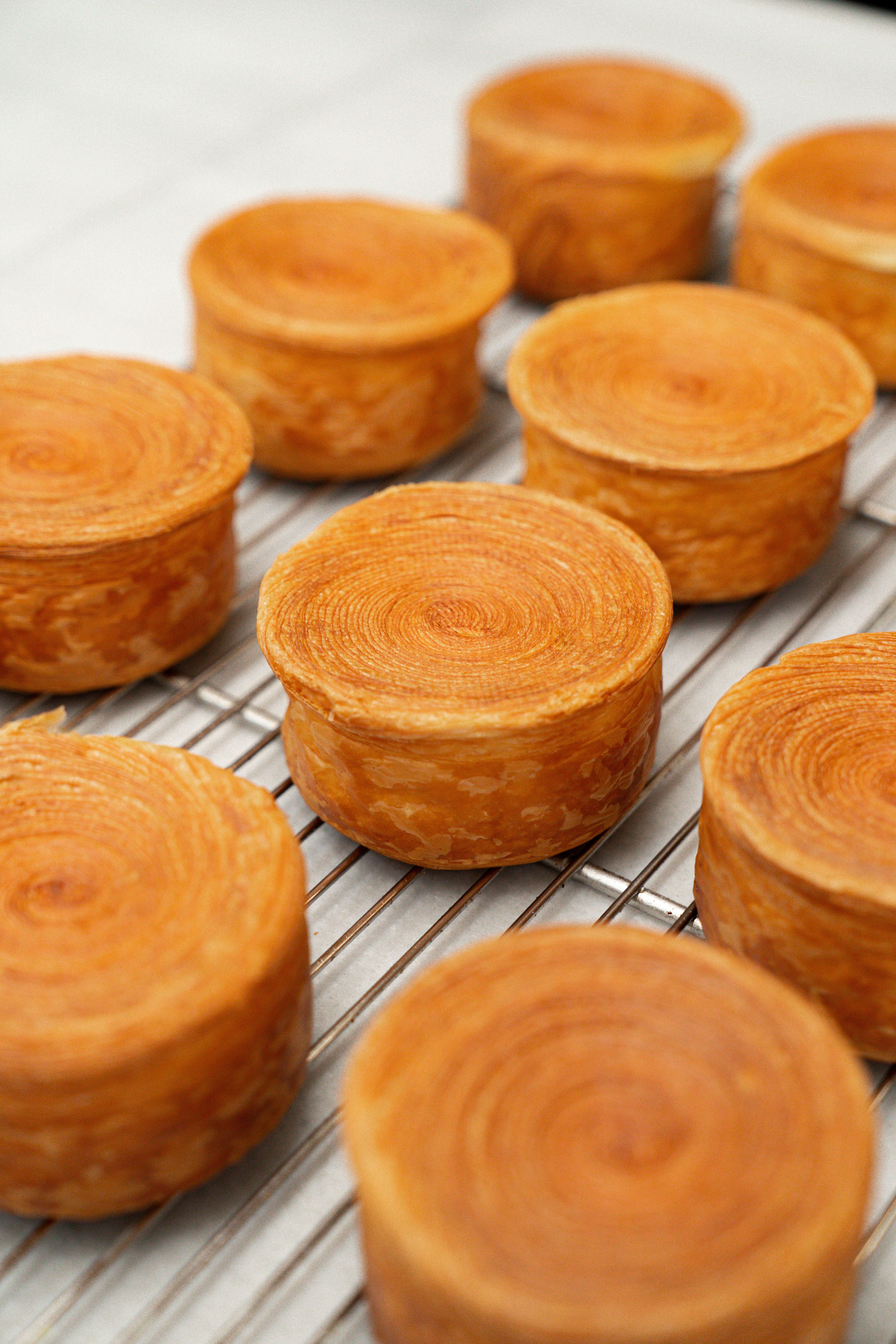
Photo: Amine Kübranur Çakıroğlu / Pexels
French
Kouign Amann
The diets react (see scores below)
Common Ingredients
- flour
- butter
- sugar
- yeast
- salt
- water
Specific recipes may vary.
Incompatible with 11 of 11 diets
Diet Ratings
Kouign Amann is a Breton pastry built almost entirely on keto-incompatible ingredients. Flour (wheat) provides dense starchy carbohydrates, and sugar is folded and caramelized throughout the dough in large quantities. A single serving can easily contain 50-70g of net carbs, which alone exceeds or matches the entire daily keto budget. While butter is keto-friendly, it is a minor player here compared to the flour and sugar base. Yeast contributes negligibly but the grain and sugar content make this categorically incompatible with ketosis.
Kouign Amann is a traditional Breton pastry whose defining characteristic is a generous quantity of butter laminated into the dough. Butter is a dairy product derived from cow's milk, making this dish clearly non-vegan. The remaining ingredients — flour, sugar, yeast, salt, and water — are all plant-based and unobjectionable, but butter is a core, irreplaceable structural element of the recipe, not a minor additive. A vegan version could theoretically be made by substituting plant-based butter, but the traditional and default preparation is firmly non-vegan.
Kouign Amann is a Breton pastry built almost entirely on non-paleo ingredients. Flour (wheat) is a grain and one of the most strictly excluded foods in any version of paleo. Refined sugar is explicitly prohibited. Salt (added) is excluded. Butter is dairy, which is also avoided. Yeast, while not inherently problematic on its own, is irrelevant here given the cascade of disqualifying ingredients. There is virtually no paleo-compatible ingredient in this dish — water is the only neutral component. This is a textbook example of a modern agricultural, grain-and-dairy-based processed food that would have been entirely unavailable to Paleolithic humans.
Kouign Amann is a Breton pastry built almost entirely around refined white flour, large amounts of butter, and added sugar — three ingredients that directly contradict Mediterranean diet principles. Butter is a saturated animal fat, the opposite of the extra-virgin olive oil that anchors the Mediterranean dietary pattern. Refined white flour and generous added sugar represent the processed, high-glycemic carbohydrates the diet minimizes. The dish provides no vegetables, legumes, whole grains, or plant-based nutrients of note. Even as an occasional treat it stacks multiple problematic elements simultaneously, making it a poor fit at any frequency beyond an extremely rare indulgence.
Kouign Amann is a Breton butter cake made primarily of flour, sugar, and yeast — all plant-derived or non-animal ingredients that are strictly excluded on the carnivore diet. While butter is an animal product, it is a minor component in a dish that is fundamentally a grain-based, sugar-laden pastry. There is no animal protein whatsoever. This is one of the clearest possible violations of carnivore principles: a processed baked good combining a grain (flour), sugar, and yeast with negligible animal content.
Kouign Amann is a Breton butter cake that contains multiple excluded ingredients. Flour is a grain (wheat), which is explicitly excluded on Whole30. Butter is dairy, which is excluded (only ghee/clarified butter is the allowed exception). Sugar is an added sugar, which is explicitly excluded. Additionally, even if somehow the individual ingredients could be substituted, Kouign Amann is fundamentally a baked good — a laminated pastry/cake — which falls squarely under the Whole30 prohibition on recreating baked goods and junk food with compliant ingredients. There is no compliant version of this dish possible within Whole30 guidelines.
Kouign Amann is a Breton pastry made primarily from wheat flour, which is high in fructans — one of the main FODMAP triggers. Standard wheat-based flour is a clear high-FODMAP ingredient during the elimination phase. While the laminated dough technique involves some yeast activity, this is not a long-fermented sourdough process, so there is no meaningful fructan reduction from fermentation as seen in true sourdough. Butter, sugar, yeast, salt, and water are all low-FODMAP ingredients, but the wheat flour alone makes a standard serving of Kouign Amann high-FODMAP and unsuitable during elimination. A standard serving (one portion, roughly 80-100g) would contain a significant quantity of wheat flour, well above any safe fructan threshold.
Some FODMAP practitioners note that the yeast fermentation in the dough may slightly reduce fructan content compared to unleavened wheat products, but Monash University does not classify standard yeasted wheat breads or pastries as low-FODMAP — only certain long-fermented spelt sourdoughs meet that threshold. There is no clinical evidence that Kouign Amann's shorter fermentation process reduces fructans to a safe level.
Kouign Amann is a Breton pastry defined by its high butter and sugar content — it is essentially a caramelized, laminated dough where butter and sugar are folded repeatedly into a yeasted dough. This makes it fundamentally incompatible with DASH diet principles. The dish is high in saturated fat (from substantial butter), high in added sugar (caramelized throughout), refined carbohydrates (white flour with no whole grain benefit), and contains added salt. It provides none of the key DASH nutrients — no meaningful potassium, calcium, magnesium, or fiber. DASH guidelines explicitly limit saturated fat, added sugars, and sweets, all of which are the defining characteristics of this pastry. As a snack category item, it offers no redeeming nutritional profile in the context of DASH eating.
Kouign Amann is a Breton pastry built almost entirely from high-glycemic refined flour and substantial amounts of sugar and butter. Its macronutrient profile is essentially the opposite of Zone ideals: it is carbohydrate-dominant with high-glycemic, refined carbs (white flour + caramelized sugar), rich in saturated fat from butter, and contains virtually zero protein. There are no low-glycemic vegetables, no lean protein, and no monounsaturated fat. Even a small portion would deliver a carbohydrate and saturated-fat spike with nothing to balance the Zone ratio. Incorporating it into a Zone-compliant meal would require pairing it with an unusually large protein portion and would still leave the carbohydrate quality unfavorable. It has no meaningful nutritional density (fiber, polyphenols, omega-3s) that Zone's anti-inflammatory focus values. This is one of the rare cases where the food provides no functional Zone building blocks whatsoever.
Kouign Amann is a Breton pastry defined by its high butter and sugar content — both primary ingredients are flagged under anti-inflammatory guidelines. Butter is a significant source of saturated fat, which at high intake levels is associated with elevated inflammatory markers in research. The large quantity of refined sugar drives rapid glycemic spikes, promotes advanced glycation end-products (AGEs), and directly stimulates pro-inflammatory cytokine production. The base is refined white flour, which lacks fiber and has a high glycemic index, further compounding the inflammatory load. There are no anti-inflammatory offsetting ingredients — no omega-3s, no polyphenols, no antioxidants, no fiber-rich whole grains. This is essentially a concentrated delivery of three pro-inflammatory drivers (saturated fat, refined carbohydrates, added sugar) in a single pastry. Occasional consumption is unlikely to cause meaningful harm for a healthy individual, but it contributes nothing positive to an anti-inflammatory dietary pattern and should be treated as a rare indulgence rather than a regular snack.
Kouign Amann is a Breton butter cake built almost entirely from refined flour, large amounts of butter, and caramelized sugar. It offers virtually no protein, no meaningful fiber, and delivers its calories almost entirely from saturated fat and simple carbohydrates. This is the opposite of what GLP-1 patients need: every bite is nutritionally empty relative to calorie load, the high fat content is likely to worsen nausea, bloating, and reflux caused by slowed gastric emptying, and the sugar spike followed by a crash works against stable blood glucose and sustained satiety. With reduced appetite being the primary mechanism of action for GLP-1 medications, spending limited caloric budget on a food with zero protein and zero fiber is especially counterproductive. There is no meaningful serving size adjustment that redeems it nutritionally.
*See how scores were generated at our methodology page.
Nutritional profile
Six traits that cut across every diet.
Fiber & Plants
How much whole-plant food and fiber it delivers.
Healthy Fats
The quality of its fats (unsaturated, omega-3).
Whole / Unprocessed
How close it is to its natural, unprocessed form.
Gut Gentle
How easy it is on digestion (low FODMAP, few irritants).
Low Glycemic
How little it spikes your blood sugar.
Protein Density
How much protein it packs per calorie.
Controversy Index
Higher controversy = more disagreement between diets.