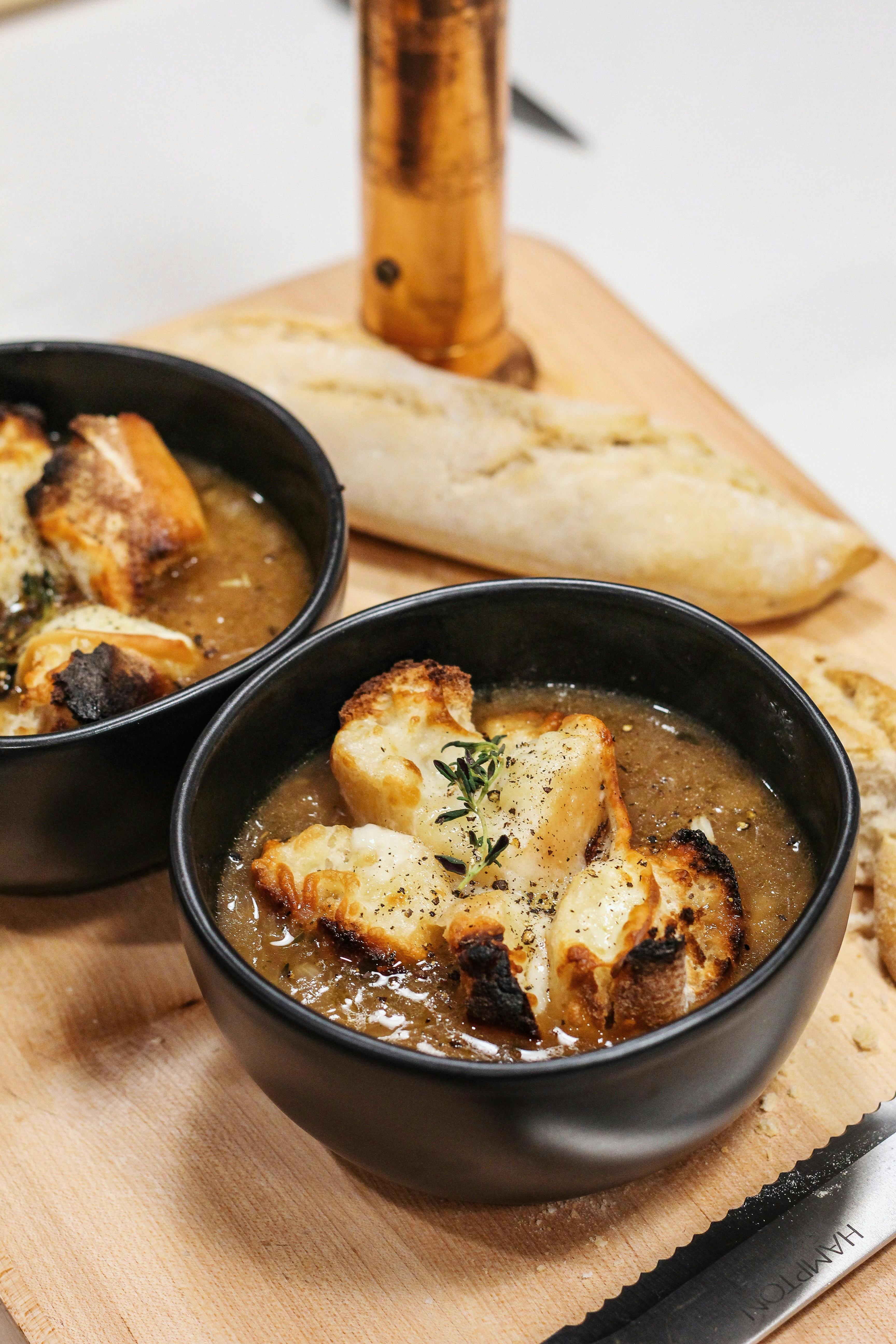
French
Soupe a l'Oignon
The diets react (see scores below)
Common Ingredients
- onions
- beef broth
- butter
- white wine
- baguette
- gruyere cheese
- thyme
Specific recipes may vary.
Incompatible with 7 of 11 diets
Diet Ratings
Soupe à l'Oignon is fundamentally incompatible with ketogenic eating in its traditional form. The baguette crouton topping is a direct grain-based carb source and must be excluded entirely. Beyond that, caramelized onions — the heart of the dish — are high in natural sugars; a typical serving uses 2-3 large onions, contributing 20-30g of net carbs before any other ingredients. White wine adds further sugar and residual carbs. Even stripped of the baguette, a full serving would almost certainly exceed the daily keto net carb limit on its own. The Gruyère cheese and butter are keto-friendly, and beef broth is acceptable, but these positives cannot offset the carb load from the onions, wine, and bread. A heavily modified version — very small portion, no baguette, wine reduced or omitted — might approach the 'caution' threshold, but the dish as traditionally prepared is not keto-compatible.
Soupe à l'Oignon contains multiple animal-derived ingredients, making it clearly incompatible with a vegan diet. Beef broth is a direct animal product derived from simmering beef bones and meat. Butter is a dairy product made from cow's milk. Gruyère cheese is an animal-derived dairy product. These three ingredients are unambiguous animal products with no debate within the vegan community. The dish as traditionally prepared is not vegan in any interpretation.
Soupe à l'Oignon contains multiple non-paleo ingredients that make it incompatible with the diet. The baguette is a wheat-based grain product, which is strictly excluded. Gruyère cheese is a dairy product, also excluded. Butter is a dairy derivative. While onions, beef broth, white wine, and thyme are paleo-friendly (wine in moderation as caution), the baguette and cheese are foundational to this dish and cannot be considered incidental — the crouton-and-cheese gratin topping is definitively what defines French onion soup. The majority of the ingredient list violates core paleo principles.
Soupe à l'Oignon has several elements at odds with Mediterranean diet principles, but also some redeeming qualities. Onions are a Mediterranean staple and form the nutritious base. However, the dish uses butter as the primary fat rather than olive oil, includes a refined grain (baguette/white bread), and is topped with Gruyère cheese — all of which push it away from core Mediterranean principles. The beef broth, while not a direct red meat serving, is derived from red meat. The white wine is a minor ingredient used in cooking. Overall, the dish is more of a French bistro preparation than a Mediterranean-aligned one, though it can be consumed occasionally in moderation.
Some Mediterranean diet interpretations, particularly those rooted in Southern French and Provençal traditions, would view this soup more favorably — onions are nutrient-dense, dairy is acceptable in moderation, and the wine reflects traditional Mediterranean culinary practice. Substituting olive oil for butter and using a whole-grain bread could bring it closer to Mediterranean standards.
Soupe à l'Oignon is fundamentally incompatible with the carnivore diet. While it does contain some carnivore-friendly components — beef broth and butter — the dish is overwhelmingly plant-based and grain-inclusive. Onions are a plant food and the primary ingredient by volume and flavor. White wine is plant-derived and contains sugar and fermentation byproducts. The baguette crouton is a grain/gluten product, one of the most excluded foods on carnivore. Thyme is a plant spice. Gruyère cheese adds a debated dairy component, but it is buried under multiple disqualifying plant ingredients. The dish cannot be salvaged within carnivore guidelines without removing so many ingredients that it would no longer resemble the dish. This is a classic French bistro soup built around caramelized onions — a plant food — as its entire identity.
Soupe à l'Oignon contains multiple Whole30-excluded ingredients. Butter is excluded dairy (only ghee/clarified butter is allowed). Gruyère cheese is excluded dairy. The baguette is excluded as a grain-based bread product. White wine is excluded as alcohol. While the core of onions, beef broth, and thyme would be compliant, the dish as classically prepared fails on at least four separate Whole30 rules simultaneously, making it clearly non-compliant.
Soupe à l'Oignon is fundamentally incompatible with the low-FODMAP elimination diet. Onions are one of the highest-FODMAP foods in the Monash database, being extremely rich in fructans. They form the entire flavor base of this dish — typically 4-6 large onions per pot — and there is no safe serving size of onions during elimination. Beyond onions, the baguette (made from wheat) contributes additional fructans. Gruyère cheese is generally low-FODMAP in small amounts as a hard/aged cheese. Butter, white wine (in small quantities), beef broth, and thyme are low-FODMAP. However, the onion issue alone makes this dish a clear avoid — no reasonable serving of French onion soup can be made FODMAP-safe without fundamentally changing the recipe.
Soupe à l'Oignon is problematic for the DASH diet on multiple fronts. Beef broth is typically very high in sodium (often 800–1,000mg per cup), and the dish commonly contains 2+ cups of broth per serving, potentially consuming the majority of the daily sodium allowance in a single bowl. Gruyère cheese adds significant saturated fat and additional sodium. Butter further increases saturated fat content. The baguette is a refined grain with minimal fiber. While onions, thyme, and white wine are individually DASH-compatible, they cannot offset the combined sodium and saturated fat burden of the broth, cheese, and butter. As traditionally prepared, this dish is essentially incompatible with DASH dietary targets.
French onion soup presents several Zone challenges but isn't categorically off-limits. The base ingredients — onions (a reasonable low-glycemic vegetable), beef broth, thyme, and even wine in small amounts — are workable in the Zone framework. However, the dish as traditionally served has serious macro imbalance issues: the baguette crouton is a high-glycemic refined carb (one of Zone's most 'unfavorable' carb sources), the Gruyère adds significant saturated fat without a lean protein counterpart, and butter compounds the saturated fat load. The dish also lacks meaningful protein — it's classified as having 'none' — making it essentially a carb-and-fat combination with no protein block to balance it. Onions are higher in natural sugars than most Zone-favorable vegetables, though not disqualifying. The baguette is the biggest single offender: white flour, high GI, easy to over-portion. With heavy modifications — omitting or minimizing the baguette, reducing cheese, adding a lean protein — the soup's base could contribute to a Zone meal, but as traditionally served it skews heavily toward unfavorable carbs and saturated fat with no protein anchor.
Some Zone practitioners would argue that a small portion of this soup as a starter, paired with a lean protein main course, could fit within a Zone meal plan — particularly in Sears' later anti-inflammatory writing where context and meal composition matter more than individual food scores. The onions and broth do provide polyphenols and low-calorie volume. The cheese provides some protein, though fatty. In this framing, a cautious small serving is acceptable rather than problematic.
Soupe à l'Oignon has a mixed anti-inflammatory profile. On the positive side, onions are rich in quercetin, a potent flavonoid with well-documented anti-inflammatory and antioxidant properties — caramelizing concentrates them. Thyme contributes anti-inflammatory polyphenols including thymol and rosmarinic acid. White wine in cooking amounts contributes minimal resveratrol but also minimal harm. However, several ingredients pull in the opposite direction: butter is a saturated fat that anti-inflammatory frameworks recommend limiting; Gruyère cheese is a high-fat, full-fat dairy product also flagged for limitation; the baguette is a refined white bread with a high glycemic index that promotes inflammatory signaling; and beef broth, while not inherently harmful, often comes from sources associated with pro-inflammatory saturated fat intake. The dish is not aggressively pro-inflammatory, but the combination of butter, full-fat cheese, and refined bread crosses into caution territory. A modified version — using olive oil instead of butter, a whole-grain bread crouton, and a lighter sprinkle of cheese — would score meaningfully higher. As prepared traditionally, this is a moderate dish best consumed occasionally rather than regularly.
Some anti-inflammatory practitioners would score this higher, emphasizing the quercetin load from large quantities of slow-cooked onions as genuinely beneficial for inflammatory markers; Dr. Weil's framework permits moderate amounts of full-fat cheese and does not strictly ban refined bread. Conversely, stricter anti-inflammatory protocols (such as AIP-adjacent approaches) would flag both the dairy and refined grain more harshly, potentially pushing this toward 'avoid.'
French onion soup presents a mixed nutritional profile for GLP-1 patients. The broth base provides hydration and is easy to digest, and onions offer modest fiber and micronutrients. However, the dish is critically low in protein for a meal — the primary protein sources are the Gruyère cheese topping and beef broth, which together contribute limited protein relative to the 15–30g per-meal target. The butter adds saturated fat, the baguette crouton is a refined grain with low fiber and nutrient density, and the Gruyère is high in saturated fat. The white wine, while used in cooking (alcohol largely cooks off), adds minimal nutritional value. The combination of melted cheese, butter, and refined bread creates a moderately high-fat, high-calorie serving relative to its protein and fiber yield. GLP-1 patients eating small portions will fill up on low-nutrient-density calories. The soup can be tolerated as a starter in small amounts but should not serve as a primary meal without significant protein augmentation.
Some GLP-1-focused RDs consider broth-based soups broadly favorable due to their high water content, ease of digestion, and satiety from volume — and may allow French onion soup occasionally as a comfort food in small portions, accepting the low protein as a trade-off for tolerability on high-side-effect days. Others flag the saturated fat from butter and Gruyère as a consistent GI trigger that outweighs the hydration benefit, particularly in patients prone to nausea or reflux.
*See how scores were generated at our methodology page.
Nutritional profile
Six traits that cut across every diet.
Fiber & Plants
How much whole-plant food and fiber it delivers.
Healthy Fats
The quality of its fats (unsaturated, omega-3).
Whole / Unprocessed
How close it is to its natural, unprocessed form.
Gut Gentle
How easy it is on digestion (low FODMAP, few irritants).
Low Glycemic
How little it spikes your blood sugar.
Protein Density
How much protein it packs per calorie.
Controversy Index
Higher controversy = more disagreement between diets.
Diet-Specific Tips
 Mediterranean — 4/10
View tips
- Onions are a Mediterranean-approved vegetable base
- Butter used instead of olive oil as primary fat — not Mediterranean-aligned
- Baguette is a refined grain, discouraged in favor of whole grains
- Gruyère cheese adds saturated fat; dairy is only moderate in Mediterranean diet
- Beef broth is red-meat-derived, adding further concern
- White wine is a traditional ingredient, minor concern
- No olive oil, no legumes, no whole grains present
 Zone — 4/10
View tips
- Baguette crouton is a high-glycemic refined carb — one of Zone's most 'unfavorable' carb sources
- No lean protein component; dish is protein-deficient for Zone block balancing
- Gruyère and butter contribute primarily saturated fat, not Zone-preferred monounsaturated fat
- Onions are a usable Zone vegetable but higher in sugar than leafy or cruciferous alternatives
- Beef broth and thyme are Zone-neutral to positive ingredients
- As traditionally served, macro ratio skews heavily toward carbs and fat with minimal protein
- Could be partially rehabilitated by omitting baguette and reducing cheese portion
 Anti-Inflammatory — 5/10
View tips
- Onions are high in quercetin, a potent anti-inflammatory flavonoid
- Thyme contributes thymol and rosmarinic acid — anti-inflammatory polyphenols
- Butter is a saturated fat flagged for limitation in anti-inflammatory diets
- Gruyère is full-fat dairy, also recommended to limit
- Baguette is refined white bread with high glycemic index — promotes inflammatory response
- Caramelization of onions preserves and concentrates beneficial flavonoids
- Traditional preparation relies heavily on butter and cheese, reducing net anti-inflammatory value
 GLP-1 Friendly — 4/10
View tips
- Very low protein per serving — falls well short of 15–30g per meal target
- Refined baguette crouton adds low-fiber, low-nutrient-density carbohydrates
- Gruyère and butter contribute saturated fat, which can worsen GLP-1 GI side effects
- Broth base is hydrating and easy to digest — a positive for GLP-1 tolerability
- Onions provide modest fiber and beneficial polyphenols
- White wine used in cooking — alcohol content largely evaporates, minimal concern
- Small portion friendliness is moderate — satisfying as a starter but insufficient as a standalone meal
- Would require significant protein pairing (e.g., grilled chicken, eggs, legumes) to meet GLP-1 meal targets