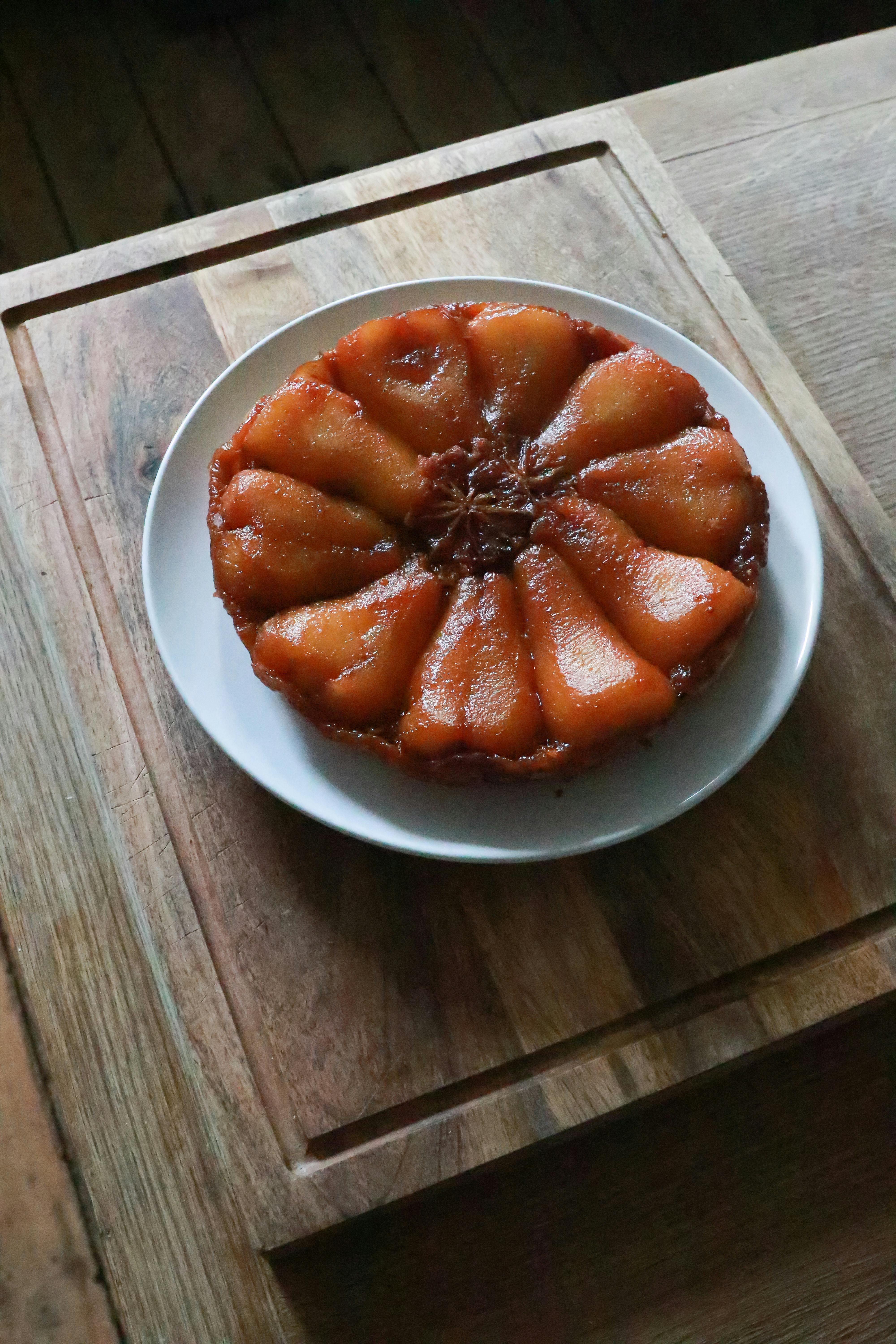
Photo: Geraud pfeiffer / Pexels
The diets react (see scores below)
Common Ingredients
- apples
- sugar
- butter
- puff pastry
- vanilla
Specific recipes may vary.
Incompatible with 11 of 11 diets
Diet Ratings
Tarte Tatin is fundamentally incompatible with a ketogenic diet. It combines three major keto-violating ingredients: apples (high in natural sugars and net carbs, roughly 14g net carbs per 100g), added sugar (used in significant quantities to create the caramel), and puff pastry (made from refined flour, one of the most carb-dense foods possible). A single typical serving could easily contain 50-70g of net carbs, which exceeds the entire daily carb allowance for ketosis in one snack. Butter is the only keto-friendly ingredient present. There is no meaningful portion size that would make this dish compatible with ketogenic macros.
Tarte Tatin contains butter, a dairy product derived from cow's milk, which is explicitly excluded under vegan dietary rules. Traditional puff pastry is also typically made with butter, compounding the issue. The remaining ingredients — apples, sugar, and vanilla — are plant-based, but the presence of butter makes this dish non-vegan as standardly prepared. A vegan version could be made using plant-based butter and vegan puff pastry, which are widely available.
Tarte Tatin is fundamentally incompatible with the paleo diet. Puff pastry is made from wheat flour and butter, making it a grain-based product — one of the clearest violations of paleo principles. Refined sugar is an explicit exclusion from paleo eating. Butter is dairy, which is also excluded. While apples and vanilla are paleo-approved ingredients, they are minor components in a dish dominated by three non-paleo ingredients. No reasonable interpretation of the paleo diet would accommodate this classic French pastry.
Tarte Tatin is a French caramelized apple tart that fundamentally conflicts with Mediterranean diet principles. It combines added sugar (caramelized), butter (saturated fat replacing olive oil), and puff pastry (refined, processed flour with high butter content) — three major red flags in a single dish. While apples themselves are a Mediterranean-friendly fruit, they are buried under ingredients that directly contradict core dietary guidelines. This is a high-sugar, high-saturated-fat, refined-grain dessert with no redemptive Mediterranean characteristics beyond the fruit component.
Tarte Tatin is entirely incompatible with the carnivore diet. Every single ingredient — apples, sugar, puff pastry (wheat flour), and vanilla — is plant-derived or a processed plant product. Butter is the only animal-derived ingredient, but it is entirely secondary and insufficient to redeem the dish. Apples are a fruit explicitly excluded from carnivore, sugar is a processed plant-derived sweetener, puff pastry is a grain-based product, and vanilla is a plant spice. This dish has no meaningful animal protein content and is essentially a dessert built entirely on foods the carnivore diet categorically rejects. There is zero ambiguity here across any tier of carnivore practice.
Tarte Tatin contains multiple excluded ingredients and violates core Whole30 principles. Sugar is explicitly excluded as an added sugar. Butter (not ghee or clarified butter) is excluded dairy. Puff pastry is a grain-based product (wheat flour), making it doubly excluded as both a grain and a baked good/pastry. Even if compliant substitutes were used for sugar and butter, recreating a pastry/tart falls squarely under the 'no recreating baked goods' rule, which explicitly prohibits this category of food regardless of ingredient swaps.
Tarte Tatin is problematic for the low-FODMAP elimination phase for two main reasons. First, apples are high-FODMAP due to excess fructose and sorbitol (polyols), and a standard serving of Tarte Tatin typically includes a substantial portion of cooked apple — well above Monash's very small low-FODMAP threshold for apple (less than around 20g or roughly 1/4 of a very small apple). Cooking concentrates the apple, compounding the issue. Second, standard puff pastry is made with wheat flour, which is high in fructans and must be avoided during elimination. Sugar (sucrose), butter (trace lactose, generally tolerated), and vanilla are low-FODMAP at typical amounts and do not add concern. The combination of high-FODMAP fruit and wheat pastry makes this dish a clear avoid during the elimination phase.
Monash rates small portions of apple as moderate-FODMAP (around 20–30g), and some FODMAP practitioners acknowledge that gluten-free puff pastry could substitute for the wheat version to address the fructan issue. However, the realistic serving size of Tarte Tatin contains far more apple than any safe threshold allows, and gluten-free puff pastry is rarely used in traditional preparation, making this dish problematic in standard form during elimination.
Tarte Tatin is a classic French caramelized apple tart that conflicts with DASH diet principles on multiple fronts. While apples themselves are a DASH-approved fruit, the dish is dominated by high amounts of added sugar (used for caramelization), butter (high in saturated fat), and puff pastry (made from refined white flour and large quantities of butter, contributing significant saturated fat and sodium). The combination of high saturated fat from butter and puff pastry, high added sugar from the caramel base, and refined carbohydrates from the pastry shell makes this a poor fit for DASH guidelines. DASH explicitly limits sweets, added sugars, saturated fats, and refined grains — all of which are core components of this dessert. The fruit component is the only redeeming DASH-aligned ingredient, but it is far outweighed by the problematic elements.
Tarte Tatin is a French caramelized apple tart that presents nearly every red flag in Zone Diet methodology simultaneously. The dish is built around added sugar (caramelized), butter (saturated fat), and puff pastry (refined white flour with additional saturated fat from lamination). As a snack category item with no protein source, it is structurally incapable of approaching a 40/30/30 block balance. The carbohydrate load is high-glycemic due to the sugar and refined pastry, the fat profile is dominated by saturated fat from butter, and there is essentially zero lean protein. Even if portions were minimized, the macro ratios would be wildly skewed: nearly all calories come from carbohydrates and saturated fat, with negligible protein. The apples themselves are a favorable Zone carbohydrate, but they are a minor redemptive factor overwhelmed by the sugar and pastry. This dish cannot be made Zone-compliant without fundamentally reconstructing it into a different dish entirely.
Tarte Tatin is a classic French caramelized apple tart that, from an anti-inflammatory standpoint, is largely problematic. While apples themselves contain quercetin, fiber, and polyphenols with anti-inflammatory potential, the overall dish is dominated by pro-inflammatory components. Butter (saturated fat) is used generously to caramelize the apples and forms the base of the pastry. Puff pastry is made from refined white flour and large quantities of butter, providing refined carbohydrates with a high glycemic load and significant saturated fat. The sugar required to caramelize the apples adds substantial amounts of added sugar, which directly promotes inflammatory pathways (NF-κB activation, elevated insulin, increased CRP). Vanilla is neutral. The apples offer a small antioxidant benefit, but it is thoroughly outweighed by the refined flour, added sugar, and saturated fat load. This dish is a concentrated source of three key anti-inflammatory diet concerns simultaneously: refined carbohydrates, added sugar, and saturated fat. It would be an occasional indulgence at best and is not compatible with an anti-inflammatory dietary pattern.
Tarte Tatin is a poor fit for GLP-1 patients across nearly every priority dimension. It is high in sugar (caramelized sugar base), high in saturated fat (butter and puff pastry), and made with refined, laminated pastry dough — all of which worsen common GLP-1 side effects including nausea, bloating, and reflux. Slowed gastric emptying means a heavy, buttery, sugar-dense dessert will sit in the stomach far longer than usual, amplifying discomfort. The dish provides virtually no protein, negligible fiber relative to its calorie load, and its calories are almost entirely from sugar and fat — the definition of low nutrient density per calorie. Apples do contribute some fiber and micronutrients, but the quantity of apple per serving is modest and far outweighed by the sugar and butter used in preparation. As a snack category item with no protein anchor, it offers nothing to support the muscle-preservation goals critical during GLP-1-driven weight loss.
*See how scores were generated at our methodology page.
Nutritional profile
Six traits that cut across every diet.
Fiber & Plants
How much whole-plant food and fiber it delivers.
Healthy Fats
The quality of its fats (unsaturated, omega-3).
Whole / Unprocessed
How close it is to its natural, unprocessed form.
Gut Gentle
How easy it is on digestion (low FODMAP, few irritants).
Low Glycemic
How little it spikes your blood sugar.
Protein Density
How much protein it packs per calorie.
Controversy Index
Higher controversy = more disagreement between diets.