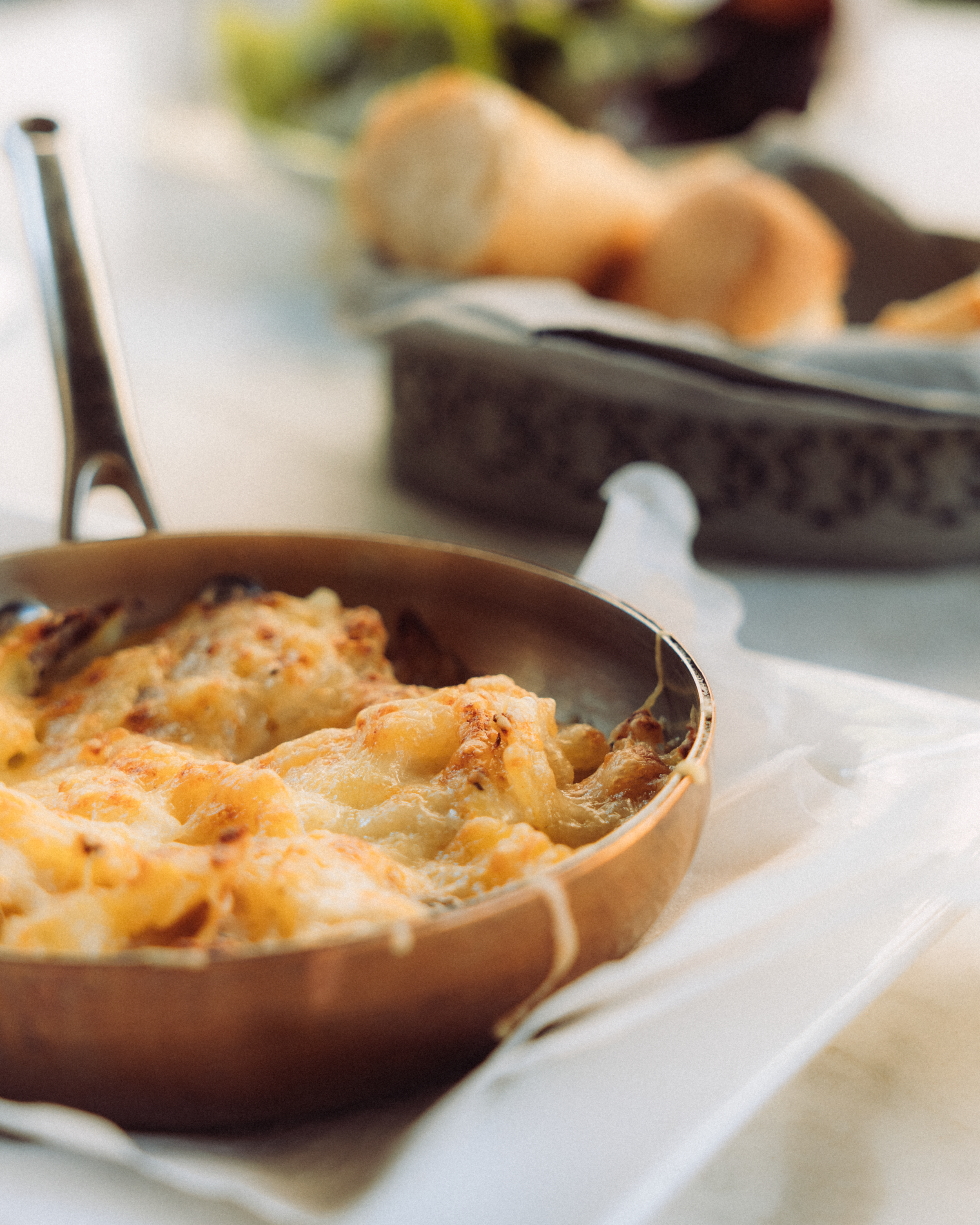
Photo: Anh Nguyen / Pexels
The diets react (see scores below)
Common Ingredients
- potatoes
- reblochon cheese
- bacon
- onion
- white wine
- cream
- garlic
Specific recipes may vary.
Incompatible with 11 of 11 diets
Diet Ratings
Tartiflette is fundamentally incompatible with a ketogenic diet. The primary ingredient — potatoes — is a high-starch vegetable delivering roughly 15-17g net carbs per 100g. A typical serving of tartiflette contains a substantial potato base, easily pushing net carbs well above the entire daily keto limit in a single dish. While some ingredients (reblochon cheese, bacon, cream, garlic) are keto-friendly, they cannot offset the carbohydrate load from the potatoes. The white wine adds minor additional carbs. There is no meaningful way to consume a standard portion of tartiflette and maintain ketosis.
Tartiflette is a traditional French Alpine dish that is fundamentally incompatible with a vegan diet. It contains multiple animal-derived ingredients: reblochon cheese (dairy), bacon (pork meat), and cream (dairy). These are not incidental or trace ingredients — they are structural components of the dish. There is no vegan version of tartiflette; the dish is defined by its use of reblochon cheese in particular. The potatoes, onion, white wine, and garlic are plant-based, but they are minor supporting ingredients in a dish whose identity is built around animal products.
Tartiflette is fundamentally incompatible with the paleo diet. The dish contains multiple hard-excluded ingredients: Reblochon cheese and cream are dairy products (not debated forms like ghee), and bacon is a processed meat with added salt and often preservatives. White wine, while derived from grapes, is an alcoholic processed product. White potatoes are themselves debated in paleo circles. With dairy and processed meat as core, non-negotiable components of this dish, it cannot be considered paleo in any mainstream interpretation.
Tartiflette is a rich Alpine French dish that substantially contradicts Mediterranean diet principles across multiple dimensions. The primary protein is bacon (processed red meat), which Mediterranean guidelines restrict to only a few times per month. Reblochon is a high-fat washed-rind cheese consumed in a large, dominant quantity rather than as a condiment or moderate accompaniment. Heavy cream is added on top of the cheese, compounding the saturated fat load. The dish contains no olive oil, no vegetables beyond onion and garlic, no legumes, and no whole grains. While potatoes are a whole plant food, they serve here as a base for an overwhelmingly rich, processed-meat-and-dairy-dominated dish. The overall nutritional profile — high saturated fat from multiple sources, processed pork, minimal plant diversity — is firmly at odds with Mediterranean dietary patterns.
Tartiflette is fundamentally incompatible with the carnivore diet. The dish is dominated by plant-based ingredients: potatoes (a starchy tuber), onion, garlic, and white wine are all explicitly excluded plant foods. While bacon, reblochon cheese, and cream are animal-derived components, they are minor elements within a predominantly plant-based dish. Even the most permissive carnivore practitioners who include dairy would need to strip this dish down to just the bacon and cream to make it remotely acceptable — at which point it is no longer Tartiflette. The potatoes alone are a definitive disqualifier, being a high-carbohydrate plant food central to the dish's identity.
Tartiflette contains multiple Whole30-excluded ingredients. Reblochon cheese is a dairy product (excluded), cream is dairy (excluded), and alcohol in white wine — even though most of it may cook off, the wine itself is an excluded ingredient. Bacon may also contain added sugar in most commercial versions. This dish is fundamentally incompatible with Whole30 as written and cannot be made compliant without completely restructuring its core ingredients.
Tartiflette contains multiple high-FODMAP ingredients that make it unsuitable during the elimination phase. Onion is one of the highest-FODMAP foods tested by Monash University, rich in fructans, and there is no safe serving size — even small amounts can trigger symptoms. Garlic is similarly high in fructans and must be completely avoided during elimination. Reblochon is a soft, washed-rind cheese with relatively high moisture content, meaning it retains significant lactose — unlike hard aged cheeses (cheddar, parmesan) which are low-FODMAP. Cream is low-FODMAP at small portions (1 tablespoon) but typical recipe quantities push it into high-FODMAP territory for lactose. Potatoes and bacon are low-FODMAP. White wine is low-FODMAP at ~150ml. However, the presence of onion and garlic alone — both structural ingredients in this dish that cannot be omitted without fundamentally changing the recipe — makes Tartiflette a clear 'avoid' during elimination.
Tartiflette is a French Alpine dish built around ingredients that directly conflict with core DASH diet principles. Reblochon is a full-fat washed-rind cheese with high saturated fat and significant sodium content. Bacon is a processed red meat — high in sodium and saturated fat — which DASH explicitly limits. Heavy cream adds substantial saturated fat. Together, these three ingredients push this dish well beyond DASH thresholds for saturated fat (target <6% of total calories) and sodium (<2,300mg/day on standard DASH). While potatoes, onion, and garlic are DASH-friendly vegetables, they are prepared in a context that negates their benefit. The dish as commonly prepared could easily deliver 800–1,200mg of sodium and 15–25g of saturated fat per serving, both disqualifying under DASH guidelines.
Tartiflette is extremely difficult to reconcile with Zone Diet principles. The dish is dominated by potatoes, which are explicitly listed as a high-glycemic carbohydrate to avoid in Zone methodology — they cause rapid blood sugar spikes and are categorized as 'unfavorable' carbs. The fat profile is equally problematic: reblochon cheese, bacon, and cream are all high in saturated fat, the opposite of the monounsaturated fats Dr. Sears recommends. The macronutrient ratio is heavily skewed toward high-GI carbohydrates and saturated fats, with very little lean protein relative to the overall caloric density. Even aggressive portioning cannot salvage the dish because its core ingredients are the very foods Zone methodology most discourages — potatoes as the primary carb source and cream/cheese/bacon as the dominant fat sources. There is no realistic Zone-compatible version of this dish without fundamentally replacing its defining ingredients.
Tartiflette is a rich Savoyard gratin built almost entirely on ingredients that anti-inflammatory guidelines flag as problematic. Reblochon is a high-fat, full-fat washed-rind cheese — a significant source of saturated fat. Bacon is processed red meat, combining saturated fat, sodium, and nitrites/nitrates, all associated with elevated inflammatory markers (CRP, IL-6). Heavy cream adds further saturated fat. Together, these three ingredients form the backbone of the dish and represent a concentrated pro-inflammatory load. While potatoes, onion, garlic, and white wine offer modest antioxidant or prebiotic value, they are wholly insufficient to offset the dominant inflammatory components. The dish contains no omega-3 sources, no meaningful polyphenols or carotenoids, and no fiber-rich whole grains or legumes. It is the antithesis of an anti-inflammatory meal: high in saturated fat, processed meat, and full-fat dairy — all in the 'limit' or 'avoid' categories. Occasional indulgence in a real-food dish like this differs from daily processed food consumption, but from a strict anti-inflammatory assessment, Tartiflette scores very poorly.
Tartiflette is a calorie-dense, high-fat Alpine gratin built around ingredients that are fundamentally incompatible with GLP-1 dietary priorities. Reblochon cheese and cream contribute large amounts of saturated fat per serving, bacon adds both saturated fat and processed-meat concerns, and white wine adds alcohol — all three of which are explicitly flagged to avoid on GLP-1 therapy. The dish provides virtually no meaningful fiber despite containing potatoes and onion, and the protein present (primarily from bacon and cheese) arrives packaged with very high fat loads, making the protein-per-calorie ratio poor. Slowed gastric emptying on GLP-1 medications means a heavy, cream- and fat-laden dish like this is very likely to cause prolonged nausea, bloating, and reflux. There is no realistic small-portion version of tartiflette that rescues its nutritional profile — the problematic ingredients are structural, not incidental.
*See how scores were generated at our methodology page.
Nutritional profile
Six traits that cut across every diet.
Fiber & Plants
How much whole-plant food and fiber it delivers.
Healthy Fats
The quality of its fats (unsaturated, omega-3).
Whole / Unprocessed
How close it is to its natural, unprocessed form.
Gut Gentle
How easy it is on digestion (low FODMAP, few irritants).
Low Glycemic
How little it spikes your blood sugar.
Protein Density
How much protein it packs per calorie.
Controversy Index
Higher controversy = more disagreement between diets.