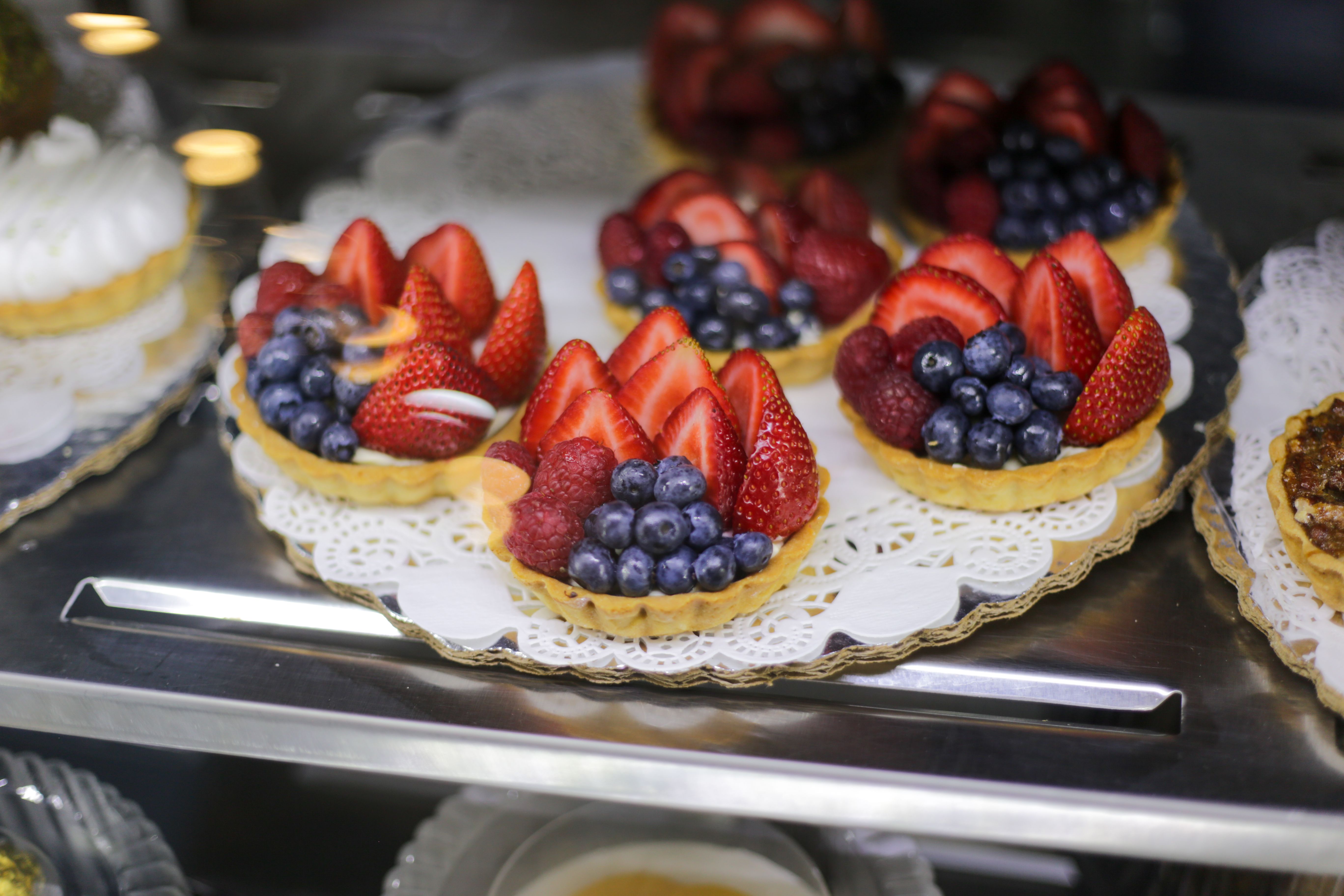
Photo: Gonzalo 8a / Pexels
The diets react (see scores below)
Common Ingredients
- flour
- butter
- sugar
- eggs
- milk
- vanilla
- fresh fruit
- apricot jam
Specific recipes may vary.
Incompatible with 9 of 11 diets
Diet Ratings
A French fruit tart is fundamentally incompatible with ketogenic diet principles on multiple levels. The pastry shell is made from wheat flour, a grain that is strictly prohibited on keto and delivers high net carbs. The filling contains sugar and milk (added sugars and lactose), the topping uses fresh fruit (high in fructose and net carbs), and the glaze is apricot jam — essentially concentrated sugar. This dish is a convergence of nearly every category that keto explicitly excludes: grains, added sugars, and high-sugar fruits. There is no meaningful portion size that would make this compatible with maintaining ketosis.
A classic French fruit tart contains multiple animal-derived ingredients that make it entirely incompatible with a vegan diet. Butter (dairy fat), milk (dairy), and eggs are all direct animal products used structurally in both the pastry crust (pâte sucrée/sablée) and the custard cream filling (crème pâtissière). These are not trace contaminants or processing aids — they are primary, load-bearing ingredients in the recipe. Fresh fruit and apricot jam are plant-based, but they cannot offset the fundamental non-vegan nature of this dish. A vegan fruit tart can be made using plant-based substitutes (vegan butter, plant milk, aquafaba or flax eggs), but the dish as described is clearly not vegan.
A French fruit tart contains multiple non-paleo ingredients that are clearly excluded by all paleo frameworks. Flour (wheat grain) is one of the most universally rejected foods in paleo — it is a refined grain product. Butter and milk are dairy, excluded under strict paleo rules. Refined sugar is explicitly off-limits. Apricot jam typically contains added refined sugar and is a processed product. The only paleo-compliant components are the eggs, vanilla, and fresh fruit, but these are minor elements in a dish fundamentally built on a grain-based pastry crust, dairy custard filling, and sugar. No serious paleo authority would consider this dish acceptable in any form.
A French fruit tart is built on a refined flour pastry shell with butter and sugar, a custard filling of eggs, milk, and sugar, and a sugary apricot jam glaze. While fresh fruit is a genuinely Mediterranean ingredient, it is a minor component overwhelmed by refined grains, added sugars, and saturated fat from butter — all of which the Mediterranean diet minimizes. The refined flour crust replaces whole grains, butter replaces olive oil as the fat, and the overall sugar load is high. This is a Western-style dessert, not a Mediterranean staple, and should be treated as a rare indulgence at best.
Some Mediterranean diet practitioners argue that traditional desserts made with eggs, dairy, and fruit — consumed occasionally and in small portions — fit within the dietary pattern's flexible, enjoyment-oriented philosophy. The fresh fruit component is genuinely valued, and moderate egg and dairy use is accepted; a small slice shared socially could be considered compatible with the diet's cultural emphasis on pleasurable, balanced eating.
A French fruit tart is fundamentally incompatible with the carnivore diet. The pastry crust is made from flour (a grain), sugar, and butter — flour and sugar are strictly excluded plant-derived and processed ingredients. The custard filling contains milk, eggs, vanilla (a plant spice), and sugar. The topping consists of fresh fruit (plant-derived) and apricot jam (fruit-based, high-sugar). The only carnivore-compatible ingredients in this dish are eggs, butter, and milk — all of which are minor components and outweighed by numerous disqualifying plant-based and processed ingredients. This dish is essentially a showcase of everything excluded on the carnivore diet: grains, sugar, fruit, and plant-derived flavoring.
A fruit tart contains multiple excluded ingredients and also violates the 'no recreating baked goods' rule. Flour (a grain), butter (dairy — only ghee/clarified butter is allowed), sugar (added sugar), and milk (dairy) are all explicitly excluded on Whole30. Additionally, apricot jam almost certainly contains added sugar. Beyond the individual ingredients, a fruit tart is fundamentally a pastry/baked good, which Whole30 explicitly prohibits even when made with compliant ingredients. This dish fails on nearly every axis of the program.
A French fruit tart contains multiple high-FODMAP ingredients that make it unsuitable during the elimination phase. The pastry crust is made with wheat flour, which is high in fructans — a primary FODMAP trigger. The custard filling (crème pâtissière) contains milk, which is high in lactose. Apricot jam is a significant concern: apricots are high-FODMAP stone fruits containing polyols (sorbitol), and jam concentrates these sugars; standard commercial apricot jams also often contain high-fructose corn syrup or large amounts of fructose. The 'fresh fruit' topping is unspecified — common tart fruits like peaches, nectarines, or blackberries are high-FODMAP, though strawberries and kiwi are low-FODMAP options. Even with low-FODMAP fruit chosen, the wheat crust, lactose from milk, and apricot jam together make this dish high-FODMAP at any realistic serving size. No straightforward substitution can rescue this dish without fundamentally altering the recipe (e.g., gluten-free flour, lactose-free milk, strawberry jam).
The score could theoretically improve with ingredient-by-ingredient substitution (GF flour, lactose-free milk, low-FODMAP fruit, strawberry jam), and some FODMAP practitioners note that very small tart portions may reduce fructan load from wheat crust — but at a standard serving, the cumulative FODMAP stacking from multiple sources makes avoidance the clear clinical guidance during elimination phase.
A French fruit tart contains several DASH-unfriendly components alongside DASH-friendly ones. The pastry crust is made with refined white flour (not a whole grain) and a significant amount of butter, contributing saturated fat — both of which DASH discourages. The custard filling (milk, eggs, sugar, vanilla) adds moderate saturated fat and added sugar. The apricot jam glaze adds more refined sugar. On the positive side, fresh fruit is a core DASH food, rich in potassium, fiber, and antioxidants, and dairy (milk) provides calcium and magnesium. The overall dish is moderately high in added sugar and saturated fat, and uses refined rather than whole grains, making it a treat rather than a DASH staple. Occasional, portion-controlled consumption is acceptable, but it cannot be considered a core DASH food.
A French fruit tart is structurally incompatible with Zone Diet principles across all three macronutrient categories. The pastry shell is made from refined white flour and butter, delivering high-glycemic, nutritionally empty carbohydrates alongside significant saturated fat — both unfavorable in Zone terminology. Sugar appears twice (in the pastry dough and the apricot jam glaze), compounding the glycemic load. The custard filling (milk, eggs, vanilla) offers some protein and fat, but the ratio is overwhelmed by carbohydrates and saturated fat. There is no lean protein source present at all, making it impossible to achieve the 40/30/30 block balance. The apricot jam glaze is essentially pure sugar with negligible fiber to offset its glycemic impact. While the fresh fruit component is a favorable Zone carbohydrate source, it is a minor element in an otherwise high-glycemic, high-saturated-fat preparation. Unlike many foods where portioning can bring a dish into Zone balance, the foundational architecture of this dessert — a pastry shell + sugar + jam — cannot be portion-corrected into Zone compliance without deconstructing the dish entirely.
A classic French fruit tart has a mixed anti-inflammatory profile. On the positive side, fresh fruit contributes antioxidants, polyphenols, vitamin C, and fiber — genuinely anti-inflammatory components. Eggs provide choline and some beneficial nutrients. However, the foundation of this dessert — refined white flour, butter, and added sugar (both in the pastry cream/crust and the apricot jam glaze) — runs counter to anti-inflammatory principles. Refined carbohydrates spike blood glucose and promote inflammatory cytokine release. Butter is a source of saturated fat, which at regular consumption is associated with elevated inflammatory markers. Apricot jam adds additional refined sugar on top of the base. The vanilla is neutral. The dish is not inherently harmful and avoids truly egregious ingredients like trans fats, seed oils, or artificial additives, but it is fundamentally a refined-carb, saturated-fat, added-sugar dessert with a modest fruit benefit. Occasional consumption is acceptable, but it should not be a regular part of an anti-inflammatory eating pattern.
A classic French fruit tart is a poor fit for GLP-1 patients across nearly every priority dimension. The buttery shortcrust pastry (pâte sablée) is high in saturated fat and refined flour, offering minimal protein and fiber. The pastry cream filling (crème pâtissière) adds sugar, butter, and milk with negligible protein density per calorie. The apricot jam glaze contributes additional refined sugar. Fresh fruit on top provides some micronutrients and a small amount of fiber, but not enough to offset the overall nutritional profile. Total protein per serving is essentially zero from a meaningful standpoint — the egg in the pastry cream is minimal and dispersed. The high sugar and fat content is likely to worsen GLP-1 side effects including nausea, reflux, and bloating. The refined carbohydrate base causes rapid blood sugar spikes, which is especially counterproductive given that many GLP-1 patients have insulin resistance or type 2 diabetes. As a snack specifically, it delivers almost entirely empty calories at a time when every bite needs to count nutritionally. The only partial credit is the fresh fruit component, which is wholly insufficient to change the overall rating.
*See how scores were generated at our methodology page.
Nutritional profile
Six traits that cut across every diet.
Fiber & Plants
How much whole-plant food and fiber it delivers.
Healthy Fats
The quality of its fats (unsaturated, omega-3).
Whole / Unprocessed
How close it is to its natural, unprocessed form.
Gut Gentle
How easy it is on digestion (low FODMAP, few irritants).
Low Glycemic
How little it spikes your blood sugar.
Protein Density
How much protein it packs per calorie.
Controversy Index
Higher controversy = more disagreement between diets.
Diet-Specific Tips
 DASH — 4/10
View tips
- Refined flour crust — not a whole grain, DASH emphasizes whole grains
- Butter in pastry shell contributes saturated fat, which DASH limits
- Added sugar from granulated sugar and apricot jam glaze
- Fresh fruit topping is a DASH-positive ingredient (potassium, fiber, antioxidants)
- Milk provides calcium and magnesium, aligned with DASH dairy goals
- Moderate sodium — not a primary concern for this dish
- High overall caloric density from fat and sugar limits portion compatibility with DASH
 Anti-Inflammatory — 4/10
View tips
- Fresh fruit provides antioxidants, polyphenols, and fiber — genuinely anti-inflammatory
- Refined white flour (crust) is a pro-inflammatory refined carbohydrate
- Butter contributes saturated fat, associated with increased inflammatory markers
- Added sugar in pastry cream and apricot jam glaze raises glycemic load
- No trans fats or artificial additives — less harmful than many processed desserts
- Overall: modest anti-inflammatory upside from fruit, offset by refined base ingredients