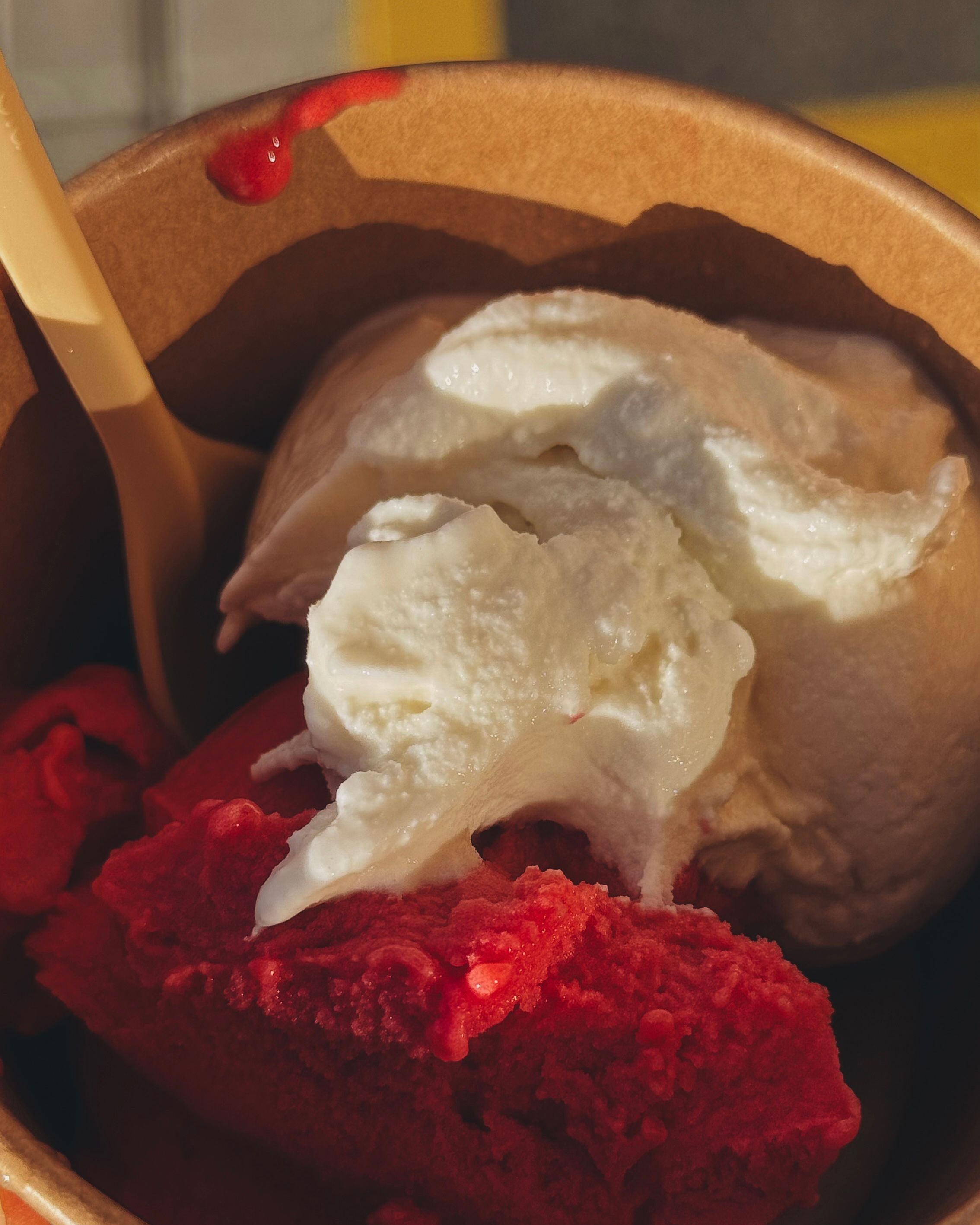
Photo: Iryna Varanovich / Pexels
The diets react (see scores below)
Common Ingredients
- milk
- cream
- egg yolks
- sugar
- vanilla
Specific recipes may vary.
Incompatible with 9 of 11 diets
Diet Ratings
Gelato is fundamentally incompatible with a ketogenic diet. A standard serving (100g) contains approximately 20-25g of net carbs, primarily from added sugar, which alone can meet or exceed the entire daily carb allowance. Unlike ice cream, gelato is made with more milk than cream, making it lower in fat and higher in carbohydrates — the opposite of keto macros. The explicit inclusion of sugar as a core ingredient makes this a clear avoid, as sugar directly disrupts ketosis. While the egg yolks and cream are keto-friendly components, the sugar and milk ratios render the dish incompatible in any standard serving size.
Traditional gelato contains multiple animal-derived ingredients: milk and cream (dairy), and egg yolks. All three are explicitly excluded under vegan dietary rules. This is unambiguously non-vegan with no meaningful debate within the vegan community. Note that vegan gelato alternatives do exist, made with plant-based milks (oat, almond, coconut) and without eggs, but the traditional recipe as described here is not vegan-compatible.
Gelato contains multiple non-paleo ingredients that are clearly excluded under paleo guidelines. Milk and cream are dairy products, which are excluded across virtually all paleo frameworks due to their casein and lactose content. Refined sugar is explicitly prohibited as a processed, non-ancestral sweetener. While egg yolks and vanilla are paleo-approved, they cannot redeem a dish where the foundational ingredients — dairy and refined sugar — are both firmly off-limits. This is not a gray-area food; gelato is a modern, heavily processed dessert with no place in a paleo diet.
Gelato is a sugar-rich, dairy-heavy frozen dessert that conflicts with core Mediterranean diet principles. Added sugar is a primary ingredient, and the combination of cream, egg yolks, and sugar produces a high saturated fat and high glycemic load treat. The Mediterranean diet discourages added sugars and treats sweets as rare indulgences — 'eat sparingly, a few times per week at most' per traditional guidelines. While dairy and eggs are permitted in moderation, gelato's dominant ingredient by caloric impact is sugar, pushing it firmly into the 'avoid' category for regular consumption.
Traditional Italian and broader Mediterranean culinary culture does include gelato as an occasional, small-portion indulgence, and some Mediterranean diet frameworks (such as those rooted in Southern European food traditions) tolerate modest sweets eaten socially and infrequently. Authentic gelato also uses less cream and fat than ice cream, and a small serving a few times per month might be acceptable within a flexible interpretation.
Gelato is incompatible with the carnivore diet. While it contains some animal-derived ingredients (milk, cream, egg yolks), it is fundamentally disqualified by sugar and vanilla — both plant-derived or processed non-animal additives. Sugar is explicitly excluded from carnivore as a processed, plant-derived sweetener, and vanilla is a plant-based flavoring. Even practitioners who include dairy in their carnivore approach would not consume a sweetened, flavored dessert like gelato. The animal-derived components (dairy, eggs) are buried in a vehicle of sugar and plant additives, making the dish as a whole firmly in avoid territory.
Gelato contains multiple excluded ingredients. Milk and cream are dairy products, which are explicitly excluded on Whole30 (only ghee and clarified butter are permitted dairy exceptions). Sugar is an added sweetener, also explicitly excluded. These are clear, unambiguous violations of the Whole30 program with no workarounds or compliant substitutions that would still qualify the dish as gelato.
Traditional gelato is made primarily with whole milk and cream as its base, both of which are significant sources of lactose. Unlike ice cream, gelato uses a higher proportion of milk to cream, making lactose the dominant FODMAP concern. A standard serving of gelato (approximately 100-150g) contains enough lactose from the milk base to be high-FODMAP during the elimination phase. Egg yolks, sugar, and vanilla are all low-FODMAP and pose no concern. The critical issue is the milk — Monash University rates regular cow's milk as high-FODMAP at servings above 100ml due to lactose content, and gelato is milk-dense by design. Cream alone is lower in lactose per gram, but in combination with a large milk base, the total lactose load in a standard gelato serving is problematic.
Monash University rates small portions of some dairy-based frozen desserts as potentially tolerable depending on exact lactose content, and some FODMAP practitioners note that the freezing process doesn't reduce lactose. However, a minority of practitioners suggest that individual lactose tolerance varies enough that some IBS patients may tolerate small scoops — this is considered a reintroduction-phase assessment, not appropriate for elimination. Lactose-free gelato (made with lactose-free milk) would be low-FODMAP and fully approved.
Gelato conflicts with core DASH diet principles on multiple fronts. It contains cream (high saturated fat), egg yolks (dietary cholesterol and fat), and significant added sugar — all of which DASH explicitly limits. DASH calls for fat-free or low-fat dairy, not full-fat cream, and restricts sweets and foods high in saturated fat. While gelato typically contains less fat than American ice cream due to a higher milk-to-cream ratio and less air, it still qualifies as a sweet/dessert food that DASH recommends limiting to 5 or fewer servings per week (and those servings should be small and low in fat/sugar). The combination of saturated fat from cream, cholesterol from egg yolks, and high added sugar makes gelato a poor fit for the DASH eating plan as a regular snack.
Gelato is a high-sugar, high-fat frozen dessert that poses significant challenges for Zone balance. The primary issue is the substantial added sugar content, which is high-glycemic and provides essentially empty carbohydrate blocks with no fiber, no polyphenols, and no nutritional value beyond calories. The cream and egg yolks add saturated fat, which Sears historically discouraged (especially in early Zone writings). Milk does contribute some protein and favorable dairy carbohydrates (lactose is lower-GI than sucrose), and egg yolks provide some monounsaturated fat, but these positives are overwhelmed by the sugar load. A small portion (roughly 1/3 cup) could theoretically be worked into a Zone snack block framework — providing approximately 1 carb block and fractional fat blocks — but it would consume nearly an entire carb block allocation with nothing but sugar calories, leaving little room for fiber-rich, low-GI carbohydrates. It scores at the very low end of 'caution' rather than 'avoid' only because small portions are technically incorporable and it is not nutritionally empty in the way soda or candy is (it contains protein and fat alongside the sugar). Zone practitioners would strongly prefer a small portion of full-fat Greek yogurt with berries as a dessert alternative.
Some Zone practitioners in Sears' later anti-inflammatory framework note that the egg yolks provide arachidonic acid concerns but also some beneficial nutrients, and that full-fat dairy in small amounts is less alarming than earlier Zone editions suggested. A very small gelato serving (2-3 oz) used as an occasional treat within a otherwise well-structured Zone day is not categorically forbidden — the ratio framework allows for unfavorable foods in strict moderation. However, the high added sugar remains the central objection across all editions of Zone methodology.
Traditional gelato contains full-fat dairy (milk and cream), egg yolks, and significant added sugar — three ingredients that anti-inflammatory frameworks flag with caution or recommend limiting. Full-fat dairy contributes saturated fat, which is associated with increased inflammatory markers at high intake. Added sugar is one of the more well-established pro-inflammatory dietary components, linked to elevated CRP and IL-6. Egg yolks are more neutral in modern anti-inflammatory thinking (choline and selenium have anti-inflammatory properties), but in this context they are a minor contributor amid more concerning ingredients. Vanilla is mildly beneficial as a polyphenol-containing spice. Gelato does have less fat than ice cream due to a higher milk-to-cream ratio and less air, which is a slight relative advantage, but this does not meaningfully change its inflammatory profile. As an occasional treat it is less harmful than heavily processed desserts with trans fats or HFCS, but its combination of saturated fat and added sugar places it firmly in the 'limit' category of anti-inflammatory eating. A score of 3 reflects that it edges toward 'avoid' territory due to the sugar and saturated fat combination, while stopping short because it lacks processed additives, trans fats, or HFCS.
Gelato is a high-sugar, moderate-to-high fat dessert with negligible fiber and very low protein relative to its calorie load. A standard serving (approximately 100g) delivers roughly 20-25g of sugar, 5-8g of fat from cream and egg yolks, only 3-4g of protein, and virtually no fiber. This profile fails on nearly every GLP-1 dietary priority: it is calorie-dense with minimal nutritional return, the fat content from cream can worsen nausea and slow already-delayed gastric emptying further, and it offers no meaningful contribution toward the 100-120g daily protein or 25-30g fiber targets. While gelato contains less fat than traditional ice cream due to a higher milk-to-cream ratio, this distinction does not meaningfully change its suitability for GLP-1 patients. It represents a near-textbook example of empty calories at a time when every bite must be nutritionally justified.
*See how scores were generated at our methodology page.
Nutritional profile
Six traits that cut across every diet.
Fiber & Plants
How much whole-plant food and fiber it delivers.
Healthy Fats
The quality of its fats (unsaturated, omega-3).
Whole / Unprocessed
How close it is to its natural, unprocessed form.
Gut Gentle
How easy it is on digestion (low FODMAP, few irritants).
Low Glycemic
How little it spikes your blood sugar.
Protein Density
How much protein it packs per calorie.
Controversy Index
Higher controversy = more disagreement between diets.
Diet-Specific Tips
 Zone — 5/10
View tips
- High added sugar content is high-glycemic and provides empty carbohydrate blocks with no fiber
- Cream contributes significant saturated fat, which early Zone methodology discouraged
- No favorable low-GI carbohydrates, polyphenols, or omega-3s present
- Small portions (2-3 oz) could technically fit as a partial carb+fat block in a Zone snack
- Egg yolks and milk provide minor protein and nutrient value, distinguishing it from pure sugar sources
- Zone-preferred dessert alternatives (Greek yogurt, berries) far outperform gelato on the block system
 Anti-Inflammatory — 5/10
View tips
- High added sugar content — pro-inflammatory, raises CRP and IL-6
- Full-fat dairy (cream) contributes saturated fat — flagged as limit/avoid in anti-inflammatory frameworks
- Egg yolks are nutritionally mixed but not the primary concern here
- Lower fat than ice cream (more milk than cream) is a minor relative benefit
- No trans fats, HFCS, or artificial additives — prevents a score of 1–2
- Vanilla offers trace polyphenol benefit, negligible at culinary doses