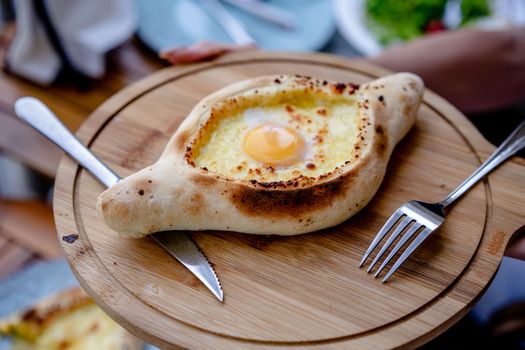
Photo: Atlantic Ambience / Pexels
Georgian
Adjaruli Khachapuri
The diets react (see scores below)
Common Ingredients
- wheat flour
- sulguni cheese
- imeruli cheese
- eggs
- butter
- yeast
- milk
- salt
Specific recipes may vary.
Incompatible with 11 of 11 diets
Diet Ratings
Adjaruli Khachapuri is a Georgian cheese-filled bread boat made with wheat flour dough as its primary base. Wheat flour is a high-carbohydrate grain that is fundamentally incompatible with ketogenic eating. A single serving of this dish contains an estimated 50-80g of net carbs from the bread alone, far exceeding the entire daily keto carb budget. While the filling ingredients — sulguni cheese, imeruli cheese, eggs, and butter — are all keto-friendly, they are encased in and inseparable from the high-carb bread shell in the traditional dish. Yeast and milk add minor additional carbohydrates. The dish cannot be made keto-compatible without completely replacing the wheat flour base, at which point it becomes an entirely different dish.
Adjaruli Khachapuri is a Georgian cheese-filled bread boat containing multiple animal products. Sulguni and imeruli are both traditional Georgian dairy cheeses. The dish also includes eggs (cracked on top as a signature element), butter, and milk in the dough. This dish is fundamentally defined by its animal-derived ingredients and cannot be considered vegan in any meaningful sense. There are no contested ingredients here — every non-flour, non-yeast, non-salt component is clearly animal-derived.
Adjaruli Khachapuri is fundamentally incompatible with the paleo diet. The dish is built on wheat flour (a grain, strictly excluded), dairy cheese (sulguni and imeruli, both full dairy products), butter (dairy), milk (dairy), yeast (a processed leavening agent), and added salt — every single core ingredient violates paleo principles. There are no paleo-compliant substitutes that could salvage this dish in its traditional form; it is essentially a bread-and-cheese dish, two of the most excluded food categories in paleo. The eggs are the only ingredient that would be paleo-approved.
Adjaruli Khachapuri is a Georgian cheese-filled bread boat topped with an egg and butter, which conflicts with core Mediterranean diet principles on multiple fronts. The base is refined wheat flour (white bread dough), not a whole grain. The dish is dominated by high-fat cheeses (sulguni and imeruli) in large quantities, plus added butter — saturated fat sources that are not the Mediterranean-endorsed primary fat (extra virgin olive oil). Eggs and dairy in moderation are acceptable in the Mediterranean pattern, but here they are the entire dish in excess quantities. There are no vegetables, legumes, or plant-based components. The caloric density comes almost entirely from refined carbohydrates and saturated fats, which directly contradicts Mediterranean diet priorities.
Some Mediterranean diet scholars note that traditional dairy fermentation — as in aged or brined cheeses like feta or halloumi — has regional acceptance in Eastern Mediterranean and Caucasian culinary traditions. A small portion of khachapuri could be interpreted similarly to a Greek cheese pie (tiropita), which uses phyllo and feta and is occasionally permitted in moderate, traditional Mediterranean eating patterns.
Adjaruli Khachapuri is fundamentally incompatible with the carnivore diet. The dish is built on a wheat flour bread base leavened with yeast — both plant-derived and strictly excluded. While it does contain animal-derived ingredients (cheese, eggs, butter, milk), these are secondary to a dominant grain foundation. Even if one were to argue the dairy and egg components are acceptable under a liberal carnivore framework, the wheat flour alone makes this dish an unambiguous 'avoid.' There is no version of carnivore — not even the most lenient 'animal-based' approach — that permits wheat flour or leavened bread.
Adjaruli Khachapuri is a Georgian cheese-filled bread that violates multiple core Whole30 rules simultaneously. It contains wheat flour (a grain, explicitly excluded), dairy cheese — sulguni and imeruli (dairy, explicitly excluded), butter (regular butter, not ghee, is excluded dairy), milk (excluded dairy), and yeast-leavened bread dough. Even setting aside the individual excluded ingredients, the dish itself is a bread/baked good, which falls squarely into the 'no recreating baked goods' rule. There is no compliant version of this dish possible while retaining its fundamental character.
Adjaruli Khachapuri contains multiple high-FODMAP ingredients that make it unsuitable during the elimination phase. The primary base is wheat flour, which is high in fructans — a major FODMAP. The dough also contains yeast and milk, adding potential lactose. The cheese filling includes sulguni and imeruli, which are Georgian brined/fresh-style cheeses with significant moisture content, indicating they likely retain lactose (unlike aged hard cheeses which are low-FODMAP). The egg topping is low-FODMAP, but it cannot offset the combined FODMAP load of wheat dough and fresh cheeses. There is no realistic reduced-portion workaround for a dish where the entire structure is wheat-based bread filled with fresh cheese.
Adjaruli Khachapuri is a Georgian cheese-filled bread boat topped with a raw egg and butter, and it is fundamentally incompatible with DASH diet principles. The dish is dominated by full-fat Georgian cheeses (sulguni and imeruli), which are high in saturated fat and sodium. Sulguni is a brined cheese with significant sodium content, and imeruli cheese also contributes substantially to the sodium load. The addition of butter on top further increases saturated fat content. The bread base is made from refined white flour, which lacks the fiber and nutrients of whole grains emphasized by DASH. The overall dish is high in sodium (likely exceeding 800-1200mg per serving), high in saturated fat, and made with full-fat dairy — all categories explicitly limited by NIH/NHLBI DASH guidelines. This dish conflicts with DASH on multiple fronts simultaneously, warranting a strong avoid rating.
Adjaruli Khachapuri is a Georgian bread boat filled with melted cheese, eggs, and butter — a dish that conflicts with Zone Diet principles on nearly every dimension. The foundation is a leavened wheat flour bread (high-glycemic refined carbohydrate), which represents the dominant macronutrient and drives a massive glycemic spike. The protein sources — sulguni and imeruli cheeses — are high in saturated fat, not lean proteins favored by the Zone. Butter adds further saturated fat, not the preferred monounsaturated fats like olive oil or avocado. There are essentially zero low-glycemic vegetables or fruits present. The macronutrient ratio is heavily skewed: carbohydrates from white flour dominate, fat (saturated) is very high, and protein quality is poor from a Zone perspective. Even with extreme portion control, the ratio cannot be corrected without fundamentally deconstructing the dish — at which point it is no longer Khachapuri. This dish combines two of the Zone's most discouraged elements: refined high-glycemic carbohydrates and saturated fat, with no balancing low-GI carbs, lean protein, or monounsaturated fat to speak of.
Adjaruli Khachapuri is a Georgian cheese-filled bread boat topped with egg and butter — a dish that stacks multiple pro-inflammatory ingredients. Refined wheat flour (white flour used in traditional khachapuri) is a refined carbohydrate with a high glycemic load that can spike blood sugar and promote inflammatory cytokines. Sulguni and imeruli cheeses are full-fat dairy products high in saturated fat, which anti-inflammatory frameworks consistently flag as pro-inflammatory at the quantities present in this dish. Butter compounds the saturated fat load significantly. The overall macronutrient profile is dominated by refined carbs, saturated fat, and sodium, with essentially no anti-inflammatory offsets — no omega-3s, no meaningful antioxidants, no polyphenols, no fiber from whole grains, legumes, or vegetables. The egg is the only mildly redeeming ingredient, offering choline and some selenium, but its contribution is negligible in context. This dish is the opposite of the anti-inflammatory plate: it combines the two most consistently flagged food categories (refined carbohydrates and saturated fat) in large portions.
Adjaruli Khachapuri is a poor fit for GLP-1 patients. The dish is essentially a bread boat filled with two high-fat cheeses (sulguni and imeruli), topped with a raw egg and a generous pat of butter melted in at serving. The macronutrient profile is dominated by refined carbohydrates (white wheat flour dough), saturated fat (butter plus full-fat Georgian cheeses), and moderate protein — but that protein comes bundled with a very high fat load. A standard serving delivers roughly 700-900+ kcal, 40-55g of fat (largely saturated), and relatively modest fiber (near zero). High saturated fat content directly worsens the most common GLP-1 side effects: nausea, reflux, bloating, and prolonged gastric discomfort, since GLP-1 medications already slow gastric emptying significantly. The refined flour base offers no meaningful fiber. Nutrient density per calorie is low. The large serving size works against GLP-1 patients who are eating small volumes — a partial portion still delivers a heavy fat hit without compensating protein density. This is the type of rich, greasy, heavy dish that obesity medicine dietitians consistently flag as poorly tolerated on GLP-1 therapy.
*See how scores were generated at our methodology page.
Nutritional profile
Six traits that cut across every diet.
Fiber & Plants
How much whole-plant food and fiber it delivers.
Healthy Fats
The quality of its fats (unsaturated, omega-3).
Whole / Unprocessed
How close it is to its natural, unprocessed form.
Gut Gentle
How easy it is on digestion (low FODMAP, few irritants).
Low Glycemic
How little it spikes your blood sugar.
Protein Density
How much protein it packs per calorie.
Controversy Index
Higher controversy = more disagreement between diets.