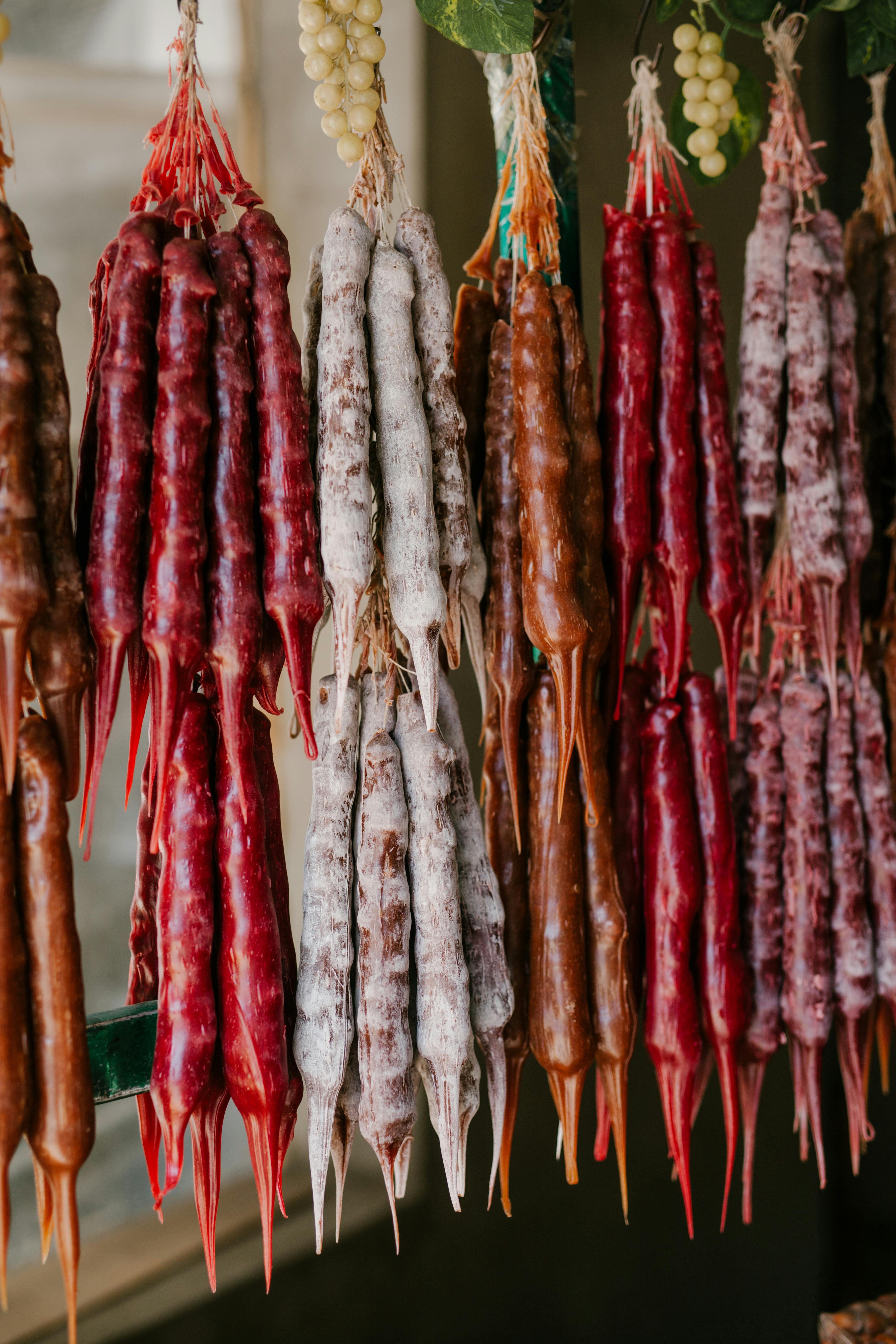
Photo: Julia Volk / Pexels
Georgian
Churchkhela
The diets react (see scores below)
Common Ingredients
- walnuts
- grape juice
- wheat flour
- sugar
- hazelnuts
Specific recipes may vary.
Incompatible with 7 of 11 diets
Diet Ratings
Churchkhela is fundamentally incompatible with a ketogenic diet. It is made by dipping walnuts and hazelnuts into a thick syrup of grape juice, sugar, and wheat flour, then drying it into a dense, candy-like snack. The three core non-nut ingredients are all major keto violations: grape juice is extremely high in sugar and fructose, added sugar is explicitly forbidden on keto, and wheat flour is a grain-based carbohydrate. A single piece of churchkhela can contain 40-60g of net carbs, easily exceeding the entire daily keto carb budget. While the walnuts and hazelnuts at the core are keto-friendly, they are entirely encased in high-carb, high-sugar coating that cannot be separated. There is no meaningful way to portion-control this food within keto limits.
Churchkhela is a traditional Georgian confection made by threading walnuts and/or hazelnuts on a string, dipping them repeatedly in a thickened grape juice and flour mixture (called tatara or pelamushi), and drying them. All listed ingredients — walnuts, grape juice, wheat flour, sugar, and hazelnuts — are entirely plant-based with no animal products or animal-derived ingredients. The dish is predominantly whole-food in character: nuts and grape juice are minimally processed, and the flour and sugar serve as functional binders/sweeteners in modest quantities. This makes it a relatively wholesome vegan snack rather than a heavily processed product, warranting a high score within the approve range.
Churchkhela contains two clear paleo violations: wheat flour (a grain, strictly excluded from all paleo frameworks) and refined sugar (excluded as a processed, non-ancestral sweetener). These are not gray-area ingredients — both are universally rejected across all major paleo authorities. The walnuts and hazelnuts are paleo-approved, and grape juice is a natural fruit-derived liquid (caution-level due to concentrated sugar), but the wheat flour alone is sufficient to disqualify this dish entirely. There is no version of strict or moderate paleo that permits wheat flour.
Churchkhela contains walnuts and hazelnuts, which are excellent Mediterranean diet foods, and grape juice, which provides antioxidants in line with the diet's emphasis on plant-based foods. However, added sugar and refined wheat flour are ingredients that the Mediterranean diet discourages, as they represent refined grains and added sugars. The concentrated grape juice also adds significant natural sugar load. The nut base keeps this from being an outright avoid, but the refined and sugary components prevent a full approval. As an occasional snack in small portions, it is acceptable but not a staple.
Some Mediterranean diet practitioners would note that traditional whole-food sweets made primarily from nuts and fruit juice — without industrial processing — are closer in spirit to traditional Mediterranean confections like pasteli (sesame-honey bars) and could be viewed more favorably as a minimally processed, plant-based treat when consumed sparingly.
Churchkhela is entirely plant-based and incompatible with the carnivore diet. It contains no animal products whatsoever. Every single ingredient — walnuts, grape juice, wheat flour, sugar, and hazelnuts — is explicitly excluded from the carnivore diet. Walnuts and hazelnuts are nuts (plant seeds), grape juice is fruit-derived sugar, wheat flour is a grain, and sugar is a refined plant carbohydrate. This Georgian confection is essentially a candy made from nuts dipped in thickened grape juice and flour, representing exactly the type of food the carnivore diet eliminates.
Churchkhela contains multiple excluded ingredients: wheat flour (a grain, explicitly excluded on Whole30) and sugar (added sugar, explicitly excluded). These are clear violations of Whole30 rules with no ambiguity. The grape juice and nuts would otherwise be compliant, but the wheat flour and sugar make this dish entirely off-limits.
Churchkhela contains wheat flour as a key ingredient, which is high in fructans — one of the primary FODMAPs restricted during the elimination phase. Wheat flour is a well-established high-FODMAP ingredient per Monash University, and there is no realistic way to consume this dish without ingesting a meaningful amount of it, as the flour forms the thickened grape juice coating around the nuts. Grape juice in concentrated or large quantities can also be problematic due to excess fructose load. Walnuts and hazelnuts are individually low-FODMAP at small servings (per Monash: walnuts ~10 halves, hazelnuts ~10 nuts), but the wheat flour coating makes the entire dish unsuitable for the elimination phase regardless of nut portion size.
Churchkhela is a traditional Georgian snack made by dipping walnuts and hazelnuts into a thickened grape juice and flour mixture (tatara), then drying. From a DASH perspective, it presents a mixed profile. The nuts (walnuts, hazelnuts) are explicitly encouraged on the DASH diet as sources of healthy unsaturated fats, magnesium, and fiber. Grape juice provides potassium and some beneficial polyphenols. However, the added sugar content and concentrated grape juice contribute significant natural and added sugars, which DASH recommends limiting. The wheat flour component is acceptable if from whole grain sources but is often refined. There is no added sodium of concern. Overall, the nuts are a strong positive, but the sugar load from grape juice concentrate and added sugar pushes this into caution territory — acceptable occasionally in small portions but not a DASH staple.
Some DASH-aligned clinicians note that the sugars in Churchkhela come primarily from grape juice (a fruit-derived source) with relatively modest added sugar per small serving, and that the dominant ingredient by caloric density is nuts — a DASH-approved food. Updated interpretations of DASH that focus more on overall dietary pattern rather than strict sugar limits might view a small serving more favorably, particularly given the absence of sodium, saturated fat, or processed ingredients.
Churchkhela is a Georgian candy made by repeatedly dipping strings of walnuts or hazelnuts into thickened grape juice (tatara) mixed with flour and sugar. While the nuts provide some monounsaturated and polyunsaturated fats, the dominant macronutrient profile is high-glycemic carbohydrates from concentrated grape juice and added sugar, with wheat flour as a binder. The carbohydrate load is extremely high-glycemic — grape juice concentrate and sugar are essentially two of the worst carbohydrate sources in Zone terminology, causing rapid insulin spikes. There is no meaningful lean protein component whatsoever. The macronutrient ratio is wildly skewed: very high carbs (primarily high-GI sugars), moderate fat from nuts, and negligible protein. This makes it nearly impossible to incorporate into a Zone-balanced meal or snack without dramatically distorting the 40/30/30 ratio. Even small portions deliver a concentrated sugar hit with no protein anchor to moderate the insulin response. This is fundamentally a confection, and its core ingredients (grape juice concentrate, added sugar) are explicitly among the most unfavorable carbohydrate sources in Dr. Sears' Zone framework.
Churchkhela is a traditional Georgian snack made by dipping walnuts (and sometimes hazelnuts) on a string into a thickened grape juice (tatara) mixture made with flour and sugar. The profile is genuinely mixed. On the positive side, walnuts are among the best plant-based sources of omega-3 fatty acids (ALA) and polyphenols, and hazelnuts provide oleic acid, vitamin E, and proanthocyanidins — both are strongly anti-inflammatory nuts. Grape juice contributes resveratrol, quercetin, and anthocyanins from the grape skins, all well-studied anti-inflammatory polyphenols. On the negative side, the tatara coating adds refined wheat flour and sugar, both of which are pro-inflammatory in the anti-inflammatory framework due to their glycemic impact and potential to raise inflammatory markers like CRP. The sugar content in particular is a concern — churchkhela can be quite sweet. The balance between the genuinely beneficial nut core and the refined carbohydrate/sugar coating places this firmly in 'caution' territory. It is a meaningfully better snack than most processed confections due to its nut base and grape polyphenols, but the flour-and-sugar coating prevents an 'approve' rating. Portion size matters considerably here.
Some anti-inflammatory practitioners might rate this more favorably, noting that grape-derived polyphenols and whole nuts together represent a nutrient-dense traditional food far superior to modern processed snacks, and that small portions would keep glycemic impact modest. Conversely, stricter anti-inflammatory frameworks (such as those emphasizing low glycemic load) might push this toward a 3-4 score given the added sugar and refined flour content.
Churchkhela is a traditional Georgian confection made by dipping strings of walnuts or hazelnuts in thickened grape juice (tatara) mixed with flour and sugar, then drying them. While it contains nuts — which offer unsaturated fats and modest protein — the overall profile is highly problematic for GLP-1 patients. The dish is dominated by concentrated grape juice sugar and added sugar, making it a high-glycemic, calorie-dense food with very low protein content and negligible fiber relative to its sugar load. The nut content does contribute healthy fats, but the high fat combined with high sugar in a small, dense serving is exactly the type of food that can worsen GLP-1 side effects including nausea and delayed gastric emptying discomfort. It offers essentially no protein — the primary nutritional priority for GLP-1 patients — and every calorie comes from fat or simple sugar, making it a textbook example of low nutrient density per calorie. Even as an occasional snack, the sugar concentration and caloric density make it a poor fit for patients eating significantly reduced volumes who need every bite to count nutritionally.
*See how scores were generated at our methodology page.
Nutritional profile
Six traits that cut across every diet.
Fiber & Plants
How much whole-plant food and fiber it delivers.
Healthy Fats
The quality of its fats (unsaturated, omega-3).
Whole / Unprocessed
How close it is to its natural, unprocessed form.
Gut Gentle
How easy it is on digestion (low FODMAP, few irritants).
Low Glycemic
How little it spikes your blood sugar.
Protein Density
How much protein it packs per calorie.
Controversy Index
Higher controversy = more disagreement between diets.
Diet-Specific Tips
 Vegan — 8/10
View tips
- All ingredients are fully plant-based
- Walnuts and hazelnuts provide healthy fats and protein
- Grape juice is the primary sweetener — a whole-food-adjacent ingredient
- Wheat flour used as a thickener in small amounts — not a concern for vegan compliance
- Sugar is present but in a functional role; refined sugar is vegan-compliant
- No animal products, dairy, eggs, honey, gelatin, or animal-derived additives
 Mediterranean — 5/10
View tips
- Walnuts and hazelnuts are strongly approved Mediterranean diet foods
- Added sugar contradicts Mediterranean diet principles
- Refined wheat flour is a discouraged ingredient
- Grape juice provides plant-based antioxidants but adds sugar density
- Traditional preparation is minimally processed, which is a positive factor
- Should be treated as an occasional treat rather than a regular snack
 DASH — 5/10
View tips
- Walnuts and hazelnuts are DASH-approved: rich in healthy fats, magnesium, and fiber
- Significant sugar content from grape juice concentrate and added sugar conflicts with DASH limits on sweets
- No sodium of concern — a positive attribute
- Wheat flour is likely refined, not whole grain — a moderate negative
- Grape juice provides potassium and polyphenols but lacks the fiber of whole fruit
- Calorie-dense snack requiring strict portion control on DASH
 Anti-Inflammatory — 5/10
View tips
- Walnuts are a top anti-inflammatory nut — high in ALA omega-3s and polyphenols
- Hazelnuts provide anti-inflammatory vitamin E, oleic acid, and proanthocyanidins
- Grape juice contributes resveratrol, quercetin, and anthocyanins — beneficial polyphenols
- Wheat flour (refined) is a pro-inflammatory refined carbohydrate
- Added sugar raises glycemic load and is associated with increased CRP and IL-6
- Traditional whole-food preparation with no artificial additives or trans fats
- Net profile is mixed: beneficial nut-and-grape core offset by refined carbohydrate coating