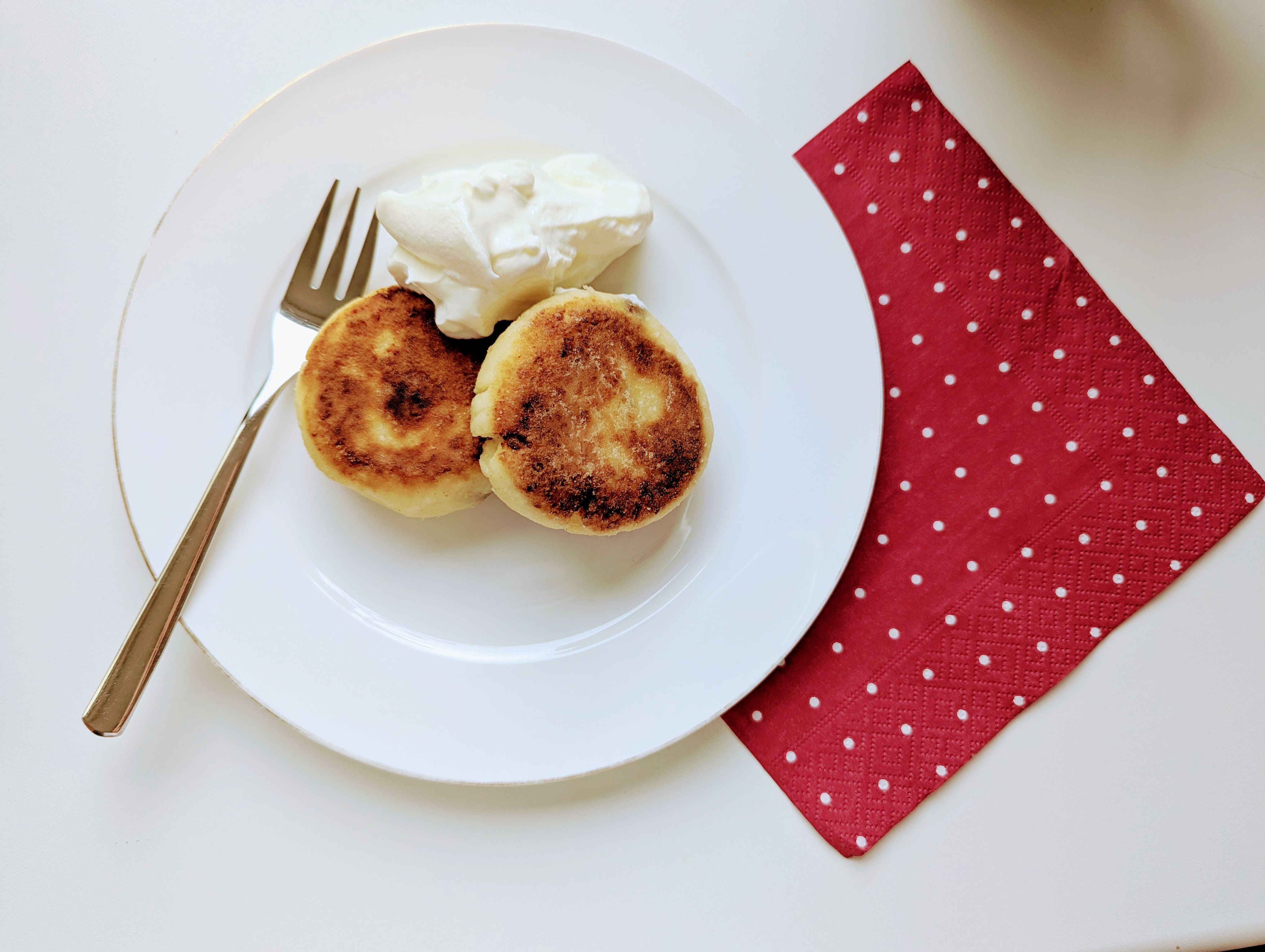
Photo: Sveta Moisseyeva / Pexels
The diets react (see scores below)
Common Ingredients
- cornflour
- sulguni cheese
- cornmeal
- water
- salt
- butter
Specific recipes may vary.
Incompatible with 8 of 11 diets
Diet Ratings
Chvishtari is a Georgian cornbread made primarily from cornflour and cornmeal, which are extremely high in net carbohydrates. A standard serving of cornmeal alone contains roughly 25-30g of net carbs per 1/4 cup, making even a small portion of this dish sufficient to break ketosis. While sulguni cheese and butter are keto-friendly ingredients, they are vastly outweighed by the dominant grain base. There is no meaningful way to portion-control this dish into keto compatibility — the cornmeal/cornflour combination is the structural foundation of the recipe, not a minor additive.
Chvishtari is a traditional Georgian cornmeal bread stuffed with sulguni cheese, a brined Georgian dairy cheese made from cow's or buffalo's milk. The dish also contains butter, another animal-derived dairy product. Both sulguni cheese and butter are unambiguously non-vegan ingredients. The primary protein source is explicitly cheese, making this dish incompatible with a vegan diet. There is no meaningful debate within the vegan community about dairy cheese or butter — both are clearly animal products that vegans exclude.
Chvishtari is a Georgian cornbread made primarily from cornflour and cornmeal, both of which are grains explicitly excluded from the paleo diet. Sulguni cheese is a dairy product, also excluded under strict paleo guidelines. Salt and butter add further non-compliant elements. The dish is fundamentally built on multiple core paleo violations — it is essentially a grain-and-dairy-based food with no paleo-compatible substitute pathway in its traditional form.
Chvishtari is a Georgian cheese-filled cornbread made primarily from cornmeal/cornflour, sulguni cheese, and butter. While cheese and cornmeal are not inherently forbidden, this dish contradicts Mediterranean diet principles in several ways: butter is the fat source rather than olive oil (the canonical Mediterranean fat), refined cornflour offers little fiber or micronutrient value compared to encouraged whole grains, and the dish is essentially a refined grain bread heavily loaded with full-fat cheese and saturated fat from butter. There are no vegetables, legumes, or other plant-forward elements. Dairy (cheese) is acceptable in moderation in the Mediterranean diet, but this dish centers it as the primary component alongside refined grain and saturated fat — making it more of an occasional indulgence than a Mediterranean-compatible food.
Some Mediterranean diet interpreters note that traditional regional breads and dairy-based dishes can fit within a flexible framework in small portions — cornmeal is a whole grain in its less-refined forms, and full-fat dairy like cheese is consumed in moderation across Mediterranean cultures including Greek and Southern Italian cuisines. Swapping butter for olive oil would meaningfully improve compatibility.
Chvishtari is a Georgian cheese-filled cornbread. Despite containing sulguni cheese and butter (animal products), the dominant ingredients are cornflour and cornmeal — both plant-derived grains that are strictly excluded on the carnivore diet. Plant-based grains are among the clearest 'avoid' foods in carnivore eating, regardless of tier or practitioner. The dish is fundamentally a grain-based bread product with cheese inside; the presence of animal-derived ingredients does not redeem it when the structural base is entirely plant-derived.
Chvishtari is a Georgian cornbread made with cornflour, cornmeal, sulguni cheese, and butter. It contains multiple excluded ingredients. Corn (cornflour and cornmeal) is explicitly excluded as a grain on Whole30. Sulguni is a dairy cheese, which is excluded (dairy is not allowed except ghee/clarified butter). Regular butter is also excluded — only ghee or clarified butter is permitted. Additionally, even if somehow all ingredients were made compliant, Chvishtari is essentially a cheese-filled cornbread, which falls squarely under the 'no recreating baked goods/bread' rule (Rule 4). This dish fails on multiple counts simultaneously.
Chvishtari is a Georgian cornmeal and cheese bread. Most ingredients are low-FODMAP: cornmeal, cornflour (corn-based, not wheat), water, salt, and butter are all safe during elimination. The key concern is sulguni cheese, a Georgian brined, stretched-curd cheese similar to mozzarella. Fresh, low-lactose cheeses like mozzarella are generally considered low-FODMAP at standard servings because most lactose is expelled during processing, and sulguni follows a similar production method. However, sulguni has not been directly tested by Monash University, so its lactose content is estimated by analogy. At a standard serving of chvishtari (one piece with a moderate amount of cheese), the dish is likely low-FODMAP for most people, but the unverified lactose content of sulguni introduces uncertainty. Portion size matters — a large serving with significant cheese could push lactose into problematic territory for sensitive individuals.
Monash University has not specifically tested sulguni cheese, so its FODMAP status relies on analogy to similar stretched-curd cheeses like mozzarella (rated low-FODMAP). Some clinical FODMAP practitioners advise caution with any untested dairy cheese during strict elimination, particularly for patients with known lactose sensitivity, as lactose content can vary between cheese styles and batches.
Chvishtari is a Georgian cheese-filled cornbread made with cornmeal/cornflour, sulguni cheese, water, salt, and butter. From a DASH perspective, it has mixed qualities. The cornmeal base provides whole grain fiber and is a reasonable grain choice. However, sulguni is a brined, full-fat Georgian cheese with relatively high sodium and saturated fat content — both of which DASH emphasizes limiting. Butter adds additional saturated fat. The dish is not heavily processed, but the combination of a salty full-fat cheese and butter pushes it into caution territory. A single piece could contribute meaningfully to both daily saturated fat and sodium limits. It is not categorically off-limits but requires strict portion control and would benefit from low-sodium cheese substitutions. It lacks the potassium, magnesium, and fiber richness that DASH-approved foods emphasize.
NIH DASH guidelines specify low-fat dairy and limited saturated fat, which would flag sulguni cheese and butter as problematic. However, updated clinical interpretations note that fermented full-fat dairy (such as aged or brined cheeses) may have a more neutral cardiovascular effect than previously thought, and some DASH-oriented clinicians allow small portions of full-fat cheese within an otherwise DASH-compliant dietary pattern.
Chvishtari is a Georgian cornmeal-and-cheese bread, essentially a high-glycemic starch base (cornflour/cornmeal) stuffed or mixed with sulguni cheese and cooked in butter. From a Zone perspective, this dish is heavily carbohydrate-dominant and those carbs come from cornmeal, which is a high-glycemic grain — exactly the type of unfavorable carb Dr. Sears warns against. The protein source (sulguni, a brined Georgian cheese) is moderately decent but comes packaged with significant saturated fat. Butter adds more saturated fat rather than the preferred monounsaturated fats. The macro balance is badly skewed: the dish is primarily starch-fat with modest protein, the opposite of the 40/30/30 Zone target. There are no low-glycemic vegetables, no lean protein, no omega-3s or polyphenols of note. While technically one could eat a very small portion alongside lean protein and vegetables to complete a Zone meal, the dish itself as a side offers almost no Zone-compatible building blocks — the carb block value from cornmeal is high-GI, the fat block is saturated-heavy, and the protein block from cheese is paired with substantial fat. It is not categorically impossible to incorporate a few bites into a Zone-structured plate, but as a side dish in any meaningful portion it will disrupt Zone ratios significantly.
Some Zone practitioners note that cheese, including full-fat varieties like sulguni, has been increasingly tolerated in Sears' later anti-inflammatory writings where the emphasis shifted toward overall inflammatory load rather than strict saturated fat limits. A very small portion of chvishtari (one or two bites) alongside a large serving of non-starchy vegetables and lean protein could theoretically be shoehorned into a Zone meal's fat and protein blocks, though the cornmeal carbs remain problematic as an unfavorable high-GI source regardless of era.
Chvishtari is a Georgian cheese-filled cornbread made from cornmeal/cornflour, sulguni cheese, water, salt, and butter. From an anti-inflammatory perspective, this dish is largely neutral to mildly pro-inflammatory. Cornmeal is a whole grain with moderate fiber and some beneficial nutrients, and is not inherently inflammatory — though it lacks the antioxidant richness of more colorful whole grains. Sulguni is a full-fat brined Georgian cheese; full-fat dairy is in the 'limit' category due to saturated fat content, though it contains some conjugated linoleic acid (CLA) which may have modest anti-inflammatory properties. Butter is a saturated fat that anti-inflammatory guidelines recommend limiting. The dish has no meaningful omega-3s, antioxidants, polyphenols, or other anti-inflammatory agents. It is not processed in a harmful way and contains no trans fats, refined sugars, or artificial additives, which keeps it from the 'avoid' category. Overall, this is a calorie-dense, starchy, saturated-fat-containing dish with neutral-to-mildly-unfavorable inflammatory characteristics — acceptable occasionally but not aligned with anti-inflammatory dietary principles as a regular food.
Chvishtari is a Georgian cheese-filled cornbread, typically pan-fried or cooked with butter. The dish is composed almost entirely of refined cornmeal/cornflour (a refined grain with minimal fiber and high glycemic load), sulguni cheese (a brined, moderately high-fat cheese), and butter. It offers very little protein relative to its calorie density — sulguni cheese contributes some protein but not in meaningful quantities per typical serving compared to the fat load from both the cheese and the butter used in cooking. The cooking method adds further fat. For GLP-1 patients, this combination is problematic on multiple fronts: (1) low protein density per calorie, (2) high saturated fat from cheese and butter likely to worsen nausea, bloating, and reflux, (3) refined corn-based carbohydrates with negligible fiber, (4) high caloric density in a small portion with poor nutritional return, and (5) greasy/heavy texture that conflicts with slowed gastric emptying. As a side dish it displaces higher-priority foods without contributing meaningfully to protein or fiber targets.
Some GLP-1-focused RDs note that sulguni cheese does provide a modest protein contribution and that small portions of culturally significant foods can support dietary adherence, which itself is a clinical priority. However, the overall macronutrient profile and cooking method make this difficult to recommend even in moderation for most GLP-1 patients, particularly those experiencing active GI side effects.
*See how scores were generated at our methodology page.
Nutritional profile
Six traits that cut across every diet.
Fiber & Plants
How much whole-plant food and fiber it delivers.
Healthy Fats
The quality of its fats (unsaturated, omega-3).
Whole / Unprocessed
How close it is to its natural, unprocessed form.
Gut Gentle
How easy it is on digestion (low FODMAP, few irritants).
Low Glycemic
How little it spikes your blood sugar.
Protein Density
How much protein it packs per calorie.
Controversy Index
Higher controversy = more disagreement between diets.
Diet-Specific Tips
 DASH — 4/10
View tips
- Sulguni cheese is high in sodium due to brining process
- Full-fat cheese contributes saturated fat, which DASH limits
- Butter adds additional saturated fat
- Cornmeal base provides some whole grain fiber — a DASH positive
- No vegetables, fruits, or lean protein to offset DASH deficiencies
- Portion size is critical — small servings are more acceptable
- Low-sodium cheese alternatives would improve DASH compatibility
 Zone — 5/10
View tips
- Cornmeal and cornflour are high-glycemic carbohydrate sources explicitly unfavorable in Zone methodology
- No low-glycemic vegetables present — dish lacks the colorful vegetable base Zone recommends
- Sulguni cheese provides some protein but is high in saturated fat, not lean protein
- Butter adds saturated fat rather than preferred monounsaturated fat (olive oil, avocado)
- Macro ratio is heavily carb-and-fat dominant with insufficient lean protein for Zone balance
- No omega-3s, polyphenols, or anti-inflammatory components present
- As a side dish, it does not anchor a Zone-balanced plate — it disrupts it
 Anti-Inflammatory — 4/10
View tips
- Cornmeal is a whole grain but low in antioxidants and anti-inflammatory phytonutrients
- Sulguni is a full-fat dairy cheese — anti-inflammatory guidelines recommend limiting full-fat dairy due to saturated fat
- Butter is a saturated fat that is in the 'limit' category for anti-inflammatory eating
- No omega-3 fatty acids, polyphenols, or meaningful antioxidants present
- No processed ingredients, trans fats, refined sugars, or artificial additives — avoids worst inflammatory triggers
- High caloric density and saturated fat load makes this unsuitable for regular consumption on an anti-inflammatory diet