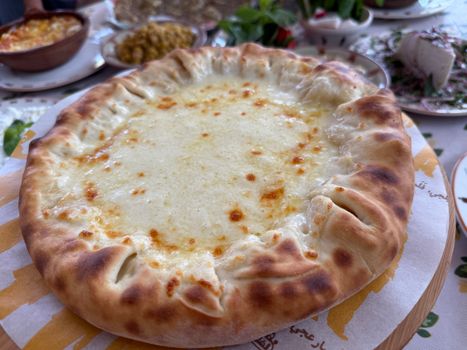
Photo: Anthony Rahayel / Pexels
Georgian
Imeruli Khachapuri
The diets react (see scores below)
Common Ingredients
- wheat flour
- imeruli cheese
- yeast
- milk
- eggs
- butter
- salt
Specific recipes may vary.
Incompatible with 10 of 11 diets
Diet Ratings
Imeruli Khachapuri is a Georgian cheese-filled bread made with wheat flour as its primary structural ingredient. Wheat flour is a high-glycemic grain that delivers a massive carbohydrate load — a single serving of this bread-based dish would likely contain 40-60g+ of net carbs, far exceeding the entire daily keto allowance of 20-50g. While the filling contains keto-friendly ingredients (cheese, eggs, butter), these are encased in a leavened wheat dough that is fundamentally incompatible with ketosis. There is no meaningful portion size at which this dish becomes keto-compatible.
Imeruli Khachapuri is a Georgian cheese-filled bread that contains multiple animal-derived ingredients. Imeruli cheese is a dairy product made from cow's milk, milk is used in the dough, eggs are incorporated into the recipe, and butter is used as well. These four distinct animal-derived ingredients make this dish fundamentally incompatible with a vegan diet. There is no ambiguity here — this dish is defined by its cheese filling and is built around animal products at every level.
Imeruli Khachapuri is a Georgian cheese-filled bread that is fundamentally incompatible with the Paleo diet. The dish is built on wheat flour (a grain, explicitly excluded) and yeast-leavened dough, which alone disqualifies it. Beyond the bread itself, imeruli cheese and milk are dairy products excluded under strict Paleo guidelines, and butter is a dairy derivative also discouraged. Salt is added. Eggs are the only Paleo-compliant ingredient in the entire recipe. There is no meaningful way to frame this dish as Paleo — it is essentially a grain-and-dairy product at its core, violating multiple foundational Paleo exclusions simultaneously.
Imeruli Khachapuri is a Georgian cheese-filled bread that conflicts with Mediterranean diet principles on multiple fronts. The base is refined wheat flour (a refined grain), the primary filling is a generous quantity of high-fat cheese, and the dough is enriched with butter and milk. There is no olive oil, no vegetables, no legumes, and no whole grains. While dairy and eggs are acceptable in moderation in the Mediterranean diet, this dish is essentially a vehicle for refined carbohydrates and saturated fat in one concentrated serving, with no plant-forward redeeming elements. It is not traditional to Mediterranean cuisine and does not align with the diet's core principles.
Imeruli Khachapuri is a Georgian cheese-filled bread that is fundamentally incompatible with the carnivore diet. The dish is primarily composed of wheat flour (a grain and major plant food) and yeast (a fungus), both of which are strictly excluded on carnivore. While it does contain animal-derived ingredients — imeruli cheese, eggs, butter, milk, and salt — these are minor components in a dish whose entire structure is built around a leavened wheat dough. No amount of animal-derived toppings or fillings rescues a bread-based dish. The plant-derived ingredients dominate both by volume and caloric contribution.
Imeruli Khachapuri is a Georgian cheese-filled bread that violates multiple core Whole30 rules simultaneously. Wheat flour is a grain and explicitly excluded. Imeruli cheese and milk are dairy products, both excluded. Butter (regular, not clarified/ghee) is also excluded dairy. Furthermore, even if all ingredients were somehow compliant, this dish is a bread filled with cheese — it falls squarely into the 'no recreating baked goods' rule, which explicitly prohibits bread, wraps, and similar items. There is no compliant version of this dish possible within the Whole30 framework.
Imeruli Khachapuri is a Georgian cheese-filled bread that contains multiple high-FODMAP ingredients. The dominant issue is wheat flour, which is high in fructans and forms the majority of the dough — this alone makes the dish unsuitable during the FODMAP elimination phase. Imeruli cheese is a fresh, brined, soft-style cheese with moderate moisture content; while harder aged cheeses are low-FODMAP due to minimal lactose, fresh brined cheeses like imeruli are more comparable to feta or fresh mozzarella and likely contain moderate to significant lactose, adding a second FODMAP concern. Milk used in the dough also contributes lactose. Eggs and butter are low-FODMAP and not a concern. The combination of a wheat flour crust and a lactose-containing fresh cheese filling makes this dish high-FODMAP at any standard serving size, with no practical portion reduction that would make it safe during elimination.
Imeruli Khachapuri is a Georgian cheese-filled bread that conflicts with multiple core DASH diet principles simultaneously. The dish centers on Imeruli cheese (a full-fat, moderately salty Georgian cheese) encased in a white flour dough made with butter, milk, and eggs. Full-fat dairy is explicitly limited in DASH guidelines, and the combination of cheese plus butter results in significant saturated fat content. The refined white flour dough provides little fiber and ranks poorly compared to DASH-preferred whole grains. Sodium content is high from both the cheese and added salt. The dish offers virtually none of the DASH-emphasized nutrients — potassium, magnesium, calcium from low-fat sources, or dietary fiber — in meaningful amounts relative to its caloric load. As a main dish, portion size further amplifies these concerns. There is no practical low-sodium or low-fat preparation of this dish that preserves its identity.
Imeruli Khachapuri is a Georgian cheese-filled bread that poses fundamental challenges for Zone Diet compliance. The dish is dominated by two Zone-unfavorable components: white wheat flour (high-glycemic refined carbohydrate) and full-fat cheese (high in saturated fat). The macronutrient ratio is essentially opposite to Zone targets — the bread base delivers a heavy, rapid-glycemic carbohydrate load, the cheese provides substantial saturated fat rather than monounsaturated fat, and both butter and whole milk eggs add further saturated fat. The protein from imeruli cheese, while present, is packaged with significant saturated fat rather than being lean. There are no favorable Zone elements such as low-glycemic vegetables, lean protein, or monounsaturated fats. Achieving a 40/30/30 ratio from this dish would require portioning it down to a few bites and adding substantial lean protein and low-GI vegetables on the side, at which point the khachapuri itself is barely present. As a standalone main dish it is essentially impossible to balance within Zone parameters.
Imeruli Khachapuri is a traditional Georgian cheese-filled bread that presents multiple concerns from an anti-inflammatory perspective. The dish is built around refined wheat flour (a refined carbohydrate with a high glycemic index that can drive insulin spikes and promote inflammatory cytokines), butter (a saturated fat source that anti-inflammatory frameworks advise limiting), full-fat cheese (imeruli is a brined, full-fat fresh cheese — full-fat dairy is in the 'limit' category), and eggs (neutral to mildly cautionary). The overall macronutrient profile is high in refined carbs and saturated fat with virtually no fiber, omega-3s, antioxidants, or polyphenols. There are no anti-inflammatory 'bright spots' — no olive oil, no herbs or spices, no vegetables, no whole grains. While individual ingredients like eggs and milk are not strongly pro-inflammatory, the combined effect of a refined-flour, high-saturated-fat, low-fiber meal is clearly unfavorable under anti-inflammatory principles. This is comfort food, not therapeutic food. Occasional consumption by a healthy individual is not catastrophic, but it scores poorly against anti-inflammatory criteria and should be a rare indulgence rather than a regular meal.
Imeruli Khachapuri is a cheese-filled bread that is fundamentally misaligned with GLP-1 dietary priorities. The dish is dominated by refined wheat flour (the bread base) and Imeruli cheese (a full-fat Georgian cheese), with butter and eggs adding additional fat. The caloric profile is heavily weighted toward refined carbohydrates and saturated fat, with relatively low protein density per calorie — cheese provides some protein, but not enough to justify the fat and carbohydrate load. Refined flour offers almost no fiber, making this a poor choice for GLP-1 patients already prone to constipation. The high fat content (saturated, from cheese and butter) is a significant concern because GLP-1 medications slow gastric emptying, meaning fatty foods sit in the stomach longer and dramatically worsen nausea, bloating, and reflux. A typical serving is also a large, heavy portion — the opposite of the small, nutrient-dense meals recommended on GLP-1 therapy. The combination of high saturated fat, refined carbohydrates, low fiber, and low protein density per calorie makes this one of the least compatible dishes for GLP-1 patients.
*See how scores were generated at our methodology page.
Nutritional profile
Six traits that cut across every diet.
Fiber & Plants
How much whole-plant food and fiber it delivers.
Healthy Fats
The quality of its fats (unsaturated, omega-3).
Whole / Unprocessed
How close it is to its natural, unprocessed form.
Gut Gentle
How easy it is on digestion (low FODMAP, few irritants).
Low Glycemic
How little it spikes your blood sugar.
Protein Density
How much protein it packs per calorie.
Controversy Index
Higher controversy = more disagreement between diets.
Diet-Specific Tips
 Anti-Inflammatory — 5/10
View tips
- Refined wheat flour is a high-glycemic refined carbohydrate — pro-inflammatory at regular consumption
- Full-fat imeruli cheese contributes saturated fat, which anti-inflammatory frameworks advise limiting
- Butter adds additional saturated fat load
- No anti-inflammatory ingredients: no omega-3s, no colorful vegetables, no antioxidant-rich herbs or spices, no whole grains, no legumes
- High caloric density with low fiber content — poor glycemic and gut microbiome impact
- Eggs contribute some nutrients (choline, selenium) but do not meaningfully offset the pro-inflammatory profile of the overall dish