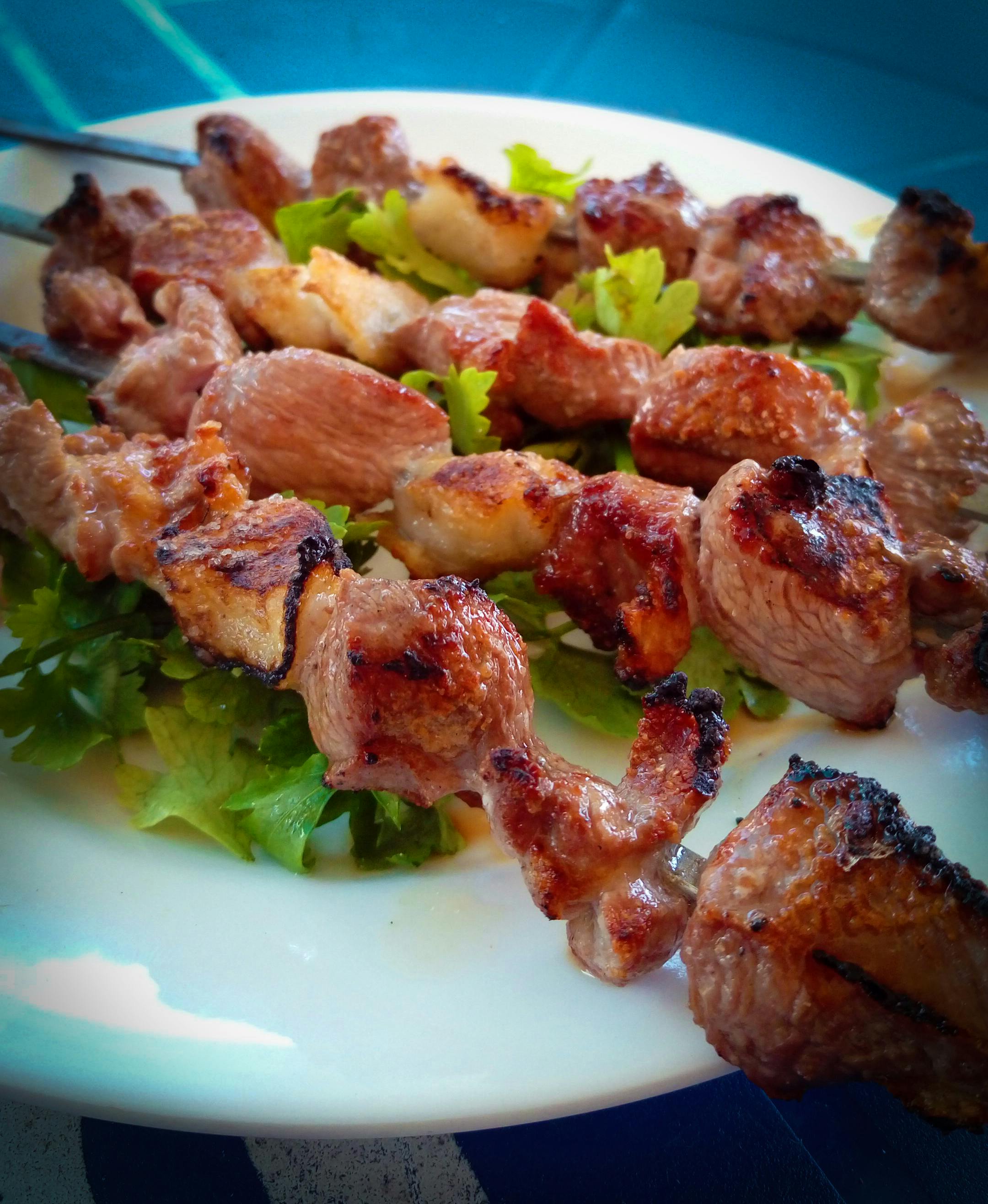
Photo: Omar Mahmood / Pexels
The diets react (see scores below)
Common Ingredients
- pork
- onions
- black pepper
- salt
- pomegranate
- vinegar
Specific recipes may vary.
Incompatible with 5 of 11 diets
Diet Ratings
Mtsvadi is a Georgian pork skewer dish that is fundamentally keto-friendly — pork is an excellent high-fat, moderate-protein source, and the base marinade of vinegar, black pepper, and salt adds negligible carbs. The onions contribute some carbs (~4-5g net per 100g) but in typical marinade quantities are manageable. The problematic ingredient is pomegranate: pomegranate seeds or juice used as a marinade/garnish add meaningful sugar (~14g net carbs per 100g of arils). If pomegranate is used sparingly as a light garnish, the dish likely stays within keto limits. If pomegranate juice is used liberally in the marinade or fresh arils are added generously, net carbs could push the boundaries. The dish earns a caution rating — the pork base is ideal, but portion control over the pomegranate component is essential.
Strict keto practitioners would flag pomegranate entirely, arguing that any fruit-derived ingredient with significant fructose content should be avoided regardless of serving size, as it can disrupt ketosis in metabolically sensitive individuals. They would recommend substituting with lemon juice or apple cider vinegar only.
Mtsvadi is a traditional Georgian pork skewer (shashlik). Pork is a direct animal product — the flesh of a pig — making this dish entirely incompatible with a vegan diet. The remaining ingredients (onions, black pepper, salt, pomegranate, vinegar) are all plant-based, but the primary protein and central component of the dish is meat. There is no vegan version of this specific dish; it is defined by its pork content.
Mtsvadi is a Georgian pork skewer dish that is largely paleo-compatible, but two ingredients place it firmly outside strict paleo guidelines. Salt (added/refined) is excluded from the paleo framework, and vinegar — particularly commercial distilled vinegar — is a processed product not available to Paleolithic humans. The pork itself is a clean, paleo-approved protein, and onions, black pepper, and pomegranate are all whole, unprocessed paleo foods. However, the combination of added salt and vinegar as marinade staples means the dish as traditionally prepared does not meet paleo standards. Without these two ingredients, the dish would score much higher.
Mtsvadi is a Georgian pork skewer (shashlik) where pork is the primary and dominant ingredient. Red meat, particularly pork, is explicitly limited in the Mediterranean diet to only a few times per month. This dish is essentially pure red/processed meat with aromatics, offering no olive oil, no legumes, no whole grains, and no significant plant-forward components. The onions and pomegranate add minor nutritional value, but the core protein source fundamentally contradicts Mediterranean dietary principles. While vinegar and pomegranate are healthy additions, they cannot offset the primary issue of pork as the central ingredient.
Mtsvadi is a Georgian pork skewer dish that contains multiple plant-derived ingredients that disqualify it from the carnivore diet. While pork itself is carnivore-approved, the dish includes onions (plant), black pepper (plant spice), pomegranate (fruit), and vinegar (typically plant-derived, fermented). The pomegranate is a particularly significant violation as a whole fruit, and onions are a vegetable explicitly excluded from all tiers of the carnivore diet. Even the most lenient carnivore practitioners who tolerate trace spices would draw the line at pomegranate and onions as featured ingredients. This dish as traditionally prepared is fundamentally incompatible with carnivore principles.
Mtsvadi is a traditional Georgian pork skewer (shashlik) made with entirely Whole30-compliant ingredients. Pork is an allowed protein, onions and pomegranate are vegetables/fruits, black pepper and salt are permitted seasonings, and vinegar is explicitly allowed on Whole30 (most types, excluding malt vinegar). There are no excluded ingredients — no grains, legumes, dairy, added sugars, or other prohibited items. This is a clean, whole-food preparation that aligns well with the spirit and rules of the Whole30 program.
Mtsvadi (Georgian pork skewers) contains onions as a primary marinade/seasoning ingredient, which are high-FODMAP due to fructans and must be avoided during the elimination phase. Even small amounts of onion are problematic because fructans leach into the meat during marinating. Pork itself is low-FODMAP, black pepper and salt are fine, vinegar (small amounts) is generally low-FODMAP, and pomegranate seeds are low-FODMAP at a standard 45g serving per Monash. However, the onion content is the critical disqualifying factor. In traditional Mtsvadi, onions are used generously in the marinade and often served alongside, making this dish unsuitable during elimination. If onions were omitted or replaced with the green tops of spring onions only, the dish could potentially be approved.
Monash University clearly rates onions as high-FODMAP even in small amounts due to dense fructan content. Some clinical FODMAP practitioners suggest that if onion is used only as a dry marinade and fully wiped off before cooking, the fructan transfer to meat may be minimal — however, this is not supported by Monash guidance and is generally considered too risky during the strict elimination phase.
Mtsvadi is a Georgian pork shashlik (skewered grilled meat), typically made from pork shoulder or other cuts marinated in onions, vinegar, and seasonings. While the dish has some DASH-friendly elements — onions provide potassium and fiber, pomegranate adds antioxidants and potassium, and grilling is a lean cooking method — the primary protein is pork, which DASH categorizes as red meat to be limited. Pork cuts used in mtsvadi (often shoulder or fatty cuts) can be relatively high in saturated fat, conflicting with DASH's emphasis on limiting saturated fat and red meat. Added salt during marinating and cooking further raises sodium concerns. The vinegar-pomegranate marinade is a positive element. If lean pork tenderloin is used and salt is minimized, the dish edges closer to acceptable, but as commonly prepared with fattier cuts and seasoned salt, it warrants caution.
NIH DASH guidelines recommend limiting red meat including pork to small, infrequent portions. However, some updated clinical interpretations note that lean pork cuts (e.g., tenderloin) have a fat profile comparable to chicken breast, and grilled preparations without heavy sodium loading may fit within a broader DASH framework when consumed in controlled portions 1-2 times per week.
Mtsvadi is a Georgian pork shish kebab marinated with onions, black pepper, vinegar, and pomegranate. The dish has genuine Zone-compatible elements alongside some concerns. Pork itself is acceptable in the Zone but falls into a nuanced category — lean cuts (loin, tenderloin) are Zone-friendly, while fattier cuts (shoulder, belly) carry higher saturated fat that conflicts with Zone's anti-inflammatory philosophy. Traditional mtsvadi is often made from pork shoulder or ribs, which are higher in saturated fat. The marinade ingredients — vinegar, onions, pomegranate — are excellent from a Zone perspective: vinegar supports glycemic control, onions are low-glycemic vegetables, and pomegranate is rich in polyphenols that align with Sears' anti-inflammatory emphasis. However, the dish as a standalone meal lacks carbohydrate balance (it's protein- and fat-dominant), meaning it must be paired with significant low-glycemic vegetables or fruits to achieve the 40/30/30 block ratio. The pomegranate component adds some carb blocks but likely insufficient on its own. Portion control of the pork is also critical — a typical serving may exceed the ~25g protein per meal target. Overall, mtsvadi can fit into a Zone meal with the right cut of pork and appropriate side carbs, but as typically prepared it requires meaningful adjustments.
Some Zone practitioners and Sears' later anti-inflammatory writings (e.g., The OmegaRx Zone) take a more lenient view of naturally raised animal fats, noting that the inflammatory concern is more about omega-6-heavy vegetable oils and processed fats than traditional animal fats in moderation. Under this interpretation, mtsvadi from a pasture-raised pork source could score closer to a 6-7, especially given the polyphenol-rich pomegranate and the absence of processed ingredients. Early Zone writings, however, more strictly limited saturated fat, which would push the score lower for a fatty pork cut.
Mtsvadi is a traditional Georgian pork skewer (shashlik), essentially grilled marinated pork. The anti-inflammatory profile is mixed. On the positive side, the dish includes pomegranate (rich in punicalagins and anthocyanins — among the most potent antioxidants known, with documented anti-inflammatory effects on CRP and IL-6), onions (quercetin, prebiotic fiber), black pepper (piperine, which enhances bioavailability of other anti-inflammatory compounds), and vinegar (acetic acid, modest metabolic benefits). The cooking method — open-flame grilling — is traditional and avoids added inflammatory fats. However, the primary protein is pork, which falls into the 'red meat' category that anti-inflammatory guidelines consistently recommend limiting due to saturated fat content, arachidonic acid, and association with elevated inflammatory markers in epidemiological research. Pork is not the worst red meat offender (it has less saturated fat than beef and lamb), but it is not a lean poultry or fatty fish substitute. The dish contains no processed ingredients, refined carbohydrates, seed oils, or added sugars, which is a significant point in its favor. Overall, this is a relatively clean preparation of a limited food, elevated meaningfully by pomegranate — but the red meat base prevents an 'approve' verdict.
Mtsvadi is a traditional Georgian pork skewer (shashlik) — marinated in onions, vinegar, pomegranate, salt, and black pepper, then grilled over open flame. The cooking method (grilling) is one of the better options for GLP-1 patients compared to frying, and the marinade ingredients are largely benign or beneficial. However, the primary protein source is pork, which is the critical limiting factor. Pork used for mtsvadi is typically fatty cuts (neck, shoulder, or belly) with significant saturated fat content, which can worsen GLP-1 side effects including nausea, bloating, and delayed gastric emptying. If made with lean pork tenderloin or loin, the profile improves substantially. The dish does offer real protein content, no refined carbohydrates, and the pomegranate and vinegar marinade adds minimal calories with some antioxidant benefit. Onions provide a small fiber contribution. Overall: acceptable in moderation if made with lean pork cuts and consumed in a small portion, but the typical fatty cut version sits firmly in caution territory.
Some GLP-1-focused dietitians accept grilled pork as a reasonable protein source given the cooking method eliminates added fat, and argue that the cut selection determines the rating more than the protein source itself — meaning lean mtsvadi could approach an approve rating. Others maintain that pork's saturated fat profile and its tendency to slow gastric emptying further (on top of GLP-1's own effect) makes it a poor choice regardless of cut, and recommend substituting with chicken or fish skewers instead.
*See how scores were generated at our methodology page.
Nutritional profile
Six traits that cut across every diet.
Fiber & Plants
How much whole-plant food and fiber it delivers.
Healthy Fats
The quality of its fats (unsaturated, omega-3).
Whole / Unprocessed
How close it is to its natural, unprocessed form.
Gut Gentle
How easy it is on digestion (low FODMAP, few irritants).
Low Glycemic
How little it spikes your blood sugar.
Protein Density
How much protein it packs per calorie.
Controversy Index
Higher controversy = more disagreement between diets.
Diet-Specific Tips
 Keto — 6/10
View tips
- Pork is an ideal keto protein/fat source — naturally high fat, zero carbs
- Pomegranate is the primary concern: ~14g net carbs per 100g arils, fructose-heavy
- Onions add moderate carbs but are typically used in small marinade quantities
- Vinegar, salt, and black pepper are keto-neutral
- Dish is keto-compatible if pomegranate is used minimally as garnish only
- Liberal pomegranate use (juice marinade or heavy garnish) could exceed daily carb targets
 Whole30 — 9/10
View tips
- Pork is a compliant Whole30 protein
- Onions, pomegranate are whole vegetables/fruits — fully allowed
- Vinegar is explicitly permitted (assuming non-malt variety, e.g., wine or plain vinegar)
- Salt and black pepper are compliant seasonings
- No excluded ingredients present
- Simple, unprocessed preparation honors the spirit of Whole30
 DASH — 4/10
View tips
- Pork is a red meat, limited under DASH guidelines
- Fatty pork cuts increase saturated fat content
- Added salt raises sodium load — preparation-dependent
- Pomegranate and onions contribute beneficial potassium and antioxidants
- Grilling is a heart-healthy cooking method with no added fat
- Portion size and cut selection are critical variables
- Vinegar-based marinade is sodium-light and acceptable
 Zone — 5/10
View tips
- Pork cut matters significantly — lean tenderloin/loin is Zone-acceptable, fatty shoulder/ribs are higher in saturated fat and less Zone-compatible
- Pomegranate adds valuable polyphenols and anti-inflammatory compounds, aligning with Sears' later anti-inflammatory Zone framework
- Vinegar in the marinade supports glycemic control, a Zone-positive attribute
- Onions are a favorable low-glycemic Zone carbohydrate
- Dish is carbohydrate-deficient as a standalone meal — must be paired with low-glycemic vegetables to achieve 40/30/30 balance
- Typical serving sizes of pork kebab may exceed the ~25g protein per meal Zone guideline, requiring portion control
- No processed ingredients, seed oils, or high-glycemic additives — clean ingredient profile
 Anti-Inflammatory — 4/10
View tips
- Pork classified as red meat — anti-inflammatory guidelines recommend limiting red meat due to saturated fat and arachidonic acid content
- Pomegranate is a standout anti-inflammatory ingredient with strong research support for reducing CRP and IL-6
- Onions contribute quercetin and prebiotic fiber with anti-inflammatory benefits
- Black pepper provides piperine, which has anti-inflammatory properties and enhances absorption of other phytonutrients
- No processed ingredients, seed oils, refined carbohydrates, or added sugars
- Open-flame grilling avoids inflammatory cooking fats but high-heat charring can generate pro-inflammatory heterocyclic amines (HCAs) and polycyclic aromatic hydrocarbons (PAHs)
- Vinegar adds modest metabolic benefit without inflammatory risk
 GLP-1 Friendly — 4/10
View tips
- Typical fatty pork cuts (neck, shoulder) are high in saturated fat — worsens nausea and bloating on GLP-1s
- Grilling is a GLP-1-friendly cooking method — no added fats
- Lean pork cuts (tenderloin, loin) would significantly improve the rating
- No refined carbohydrates or added sugars
- Pomegranate and vinegar marinade is low-calorie and non-problematic
- Small portion of grilled lean pork can meet 15-20g protein target
- Saturated fat further slows gastric emptying beyond GLP-1 medication effect