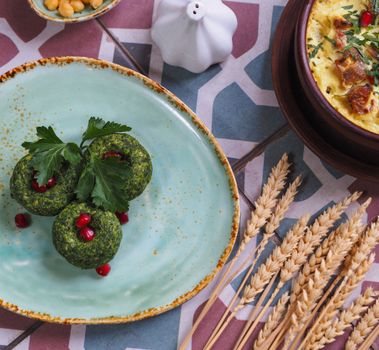
The diets react (see scores below)
Common Ingredients
- spinach
- walnuts
- garlic
- onions
- vinegar
- coriander
- pomegranate seeds
- cilantro
Specific recipes may vary.
Incompatible with 2 of 11 diets
Diet Ratings
Pkhali is a Georgian walnut-herb spread made primarily from spinach and walnuts, which are keto-friendly. Walnuts provide healthy fats and moderate protein, while spinach is a low-carb leafy green. However, pomegranate seeds introduce a notable carb and sugar load — roughly 4-5g net carbs per tablespoon of seeds — which is significant for a condiment. Garlic and onions also add small amounts of net carbs. In a typical serving (2-3 tablespoons as a condiment/appetizer), the dish is borderline: the walnut and spinach base is fine, but the pomegranate seeds push it into caution territory. Portion control is essential — a small taste is manageable, but liberal use could impact daily carb limits.
Some lazy keto practitioners would approve this dish outright, arguing that the pomegranate seeds used are a small garnish and the walnut-spinach base is inherently keto-compatible. Strict keto adherents, however, would flag even trace amounts of pomegranate due to its high sugar content and may recommend omitting the seeds entirely.
Pkhali is a traditional Georgian dish consisting entirely of whole plant foods. All listed ingredients — spinach, walnuts, garlic, onions, vinegar, coriander, pomegranate seeds, and cilantro — are fully plant-based with no animal-derived components. It is also nutritionally excellent: walnuts provide healthy fats and protein, spinach contributes iron and micronutrients, and pomegranate seeds add antioxidants. This is a minimally processed whole-food dish that aligns perfectly with vegan dietary principles at the highest level.
Pkhali is a Georgian walnut-herb paste made from spinach, walnuts, garlic, onions, pomegranate seeds, cilantro, coriander, and vinegar — all of which are whole, unprocessed foods consistent with Paleolithic eating patterns. Spinach, garlic, onions, and pomegranate seeds are paleo-approved vegetables and fruits. Walnuts are a well-accepted paleo nut. Cilantro and coriander are approved herbs and spices. Vinegar (typically wine or apple cider vinegar) is a mild gray area in paleo — most practitioners accept it in small amounts as a condiment ingredient, though strict interpretations may flag it as a fermented/processed product. Overall, the dish is essentially a nutrient-dense vegetable-and-nut preparation with no grains, legumes, dairy, seed oils, or refined sugar, making it broadly paleo-compatible.
Some strict paleo adherents flag vinegar — particularly wine vinegar — as a processed, fermented product not truly ancestral, and would recommend omitting it or substituting lemon juice. Loren Cordain's foundational framework also raises caution around fermented condiments in general.
Pkhali is an exceptional Mediterranean diet-compatible dish. It consists entirely of whole, plant-based ingredients: leafy greens (spinach), nuts (walnuts), aromatics (garlic, onions), herbs (cilantro, coriander), fruit seeds (pomegranate), and vinegar. Walnuts provide healthy unsaturated fats and omega-3s, mirroring the role of olive oil and other nuts in the Mediterranean pattern. Spinach is a nutrient-dense leafy green strongly encouraged by Mediterranean diet principles. There are no processed ingredients, added sugars, refined grains, or animal products. While it originates from Georgian rather than Mediterranean cuisine, its nutritional profile aligns perfectly with Mediterranean diet staples.
Pkhali is a traditional Georgian dish made entirely from plant-based ingredients — spinach, walnuts, garlic, onions, vinegar, coriander, pomegranate seeds, and cilantro. There is not a single animal-derived ingredient in this dish. Every component is explicitly excluded on the carnivore diet: leafy greens (spinach), nuts (walnuts), alliums (garlic, onions), plant-based acids (vinegar), spices (coriander, cilantro), and fruit seeds (pomegranate). This dish is incompatible with carnivore principles at the most fundamental level — it contains no animal products whatsoever.
Pkhali is a traditional Georgian dish made from vegetables, nuts, and aromatics — all of which are fully compliant with Whole30 rules. Spinach is a compliant vegetable, walnuts are a compliant natural fat/nut, garlic and onions are compliant vegetables, vinegar is explicitly allowed (assuming a non-malt variety such as red wine vinegar, which is standard in Georgian cooking), coriander and cilantro are compliant herbs/spices, and pomegranate seeds are a compliant fruit. There are no excluded ingredients in this dish as described.
Pkhali contains multiple high-FODMAP ingredients that make it unsuitable during the elimination phase. Garlic is one of the highest-FODMAP foods tested by Monash University, rich in fructans, and is a primary flavoring component in pkhali. Onions are similarly high in fructans and are used in meaningful quantities in this dish. Walnuts are low-FODMAP at small servings (10 walnut halves per Monash) but pkhali is walnut-heavy by nature, and the combination with other high-FODMAP ingredients is the primary concern. Spinach is low-FODMAP at standard servings. Pomegranate seeds are low-FODMAP at small amounts (45g). Vinegar and cilantro are generally low-FODMAP. However, the combination of raw garlic and onions as structural flavor components — not incidental garnishes — makes this dish definitively high-FODMAP and unsafe during elimination.
Pkhali is a Georgian vegetable and walnut dish featuring spinach, walnuts, garlic, onions, vinegar, coriander, pomegranate seeds, and cilantro — all whole, minimally processed ingredients that align well with DASH principles. Spinach is a DASH-star food, rich in potassium, magnesium, and fiber. Walnuts provide healthy unsaturated fats, magnesium, and protein, and are explicitly encouraged in DASH (as part of the nuts/seeds group, ~4-5 servings/week). Pomegranate seeds contribute fiber, potassium, and antioxidants. Garlic, onions, vinegar, and herbs add flavor without sodium, supporting the DASH goal of reducing salt reliance. The dish contains no added sodium, no saturated fat sources, no refined sugars, and no processed ingredients. The only minor consideration is walnut calorie density, which warrants portion awareness. As a condiment/small dish, portions are naturally controlled. No sodium concerns are present in this preparation.
NIH DASH guidelines strongly endorse all individual ingredients in this dish (leafy greens, unsalted nuts, fruits, vegetables), so there is little clinical debate. Some practitioners might flag walnuts for caloric density in weight-sensitive patients, but within DASH's recommended nut servings, this concern is minimal.
Pkhali is a Georgian appetizer/condiment made primarily from spinach (an excellent Zone-favorable low-glycemic vegetable), walnuts (a good source of fat, though higher in omega-6 than ideal Zone fats like olive oil or macadamia nuts), garlic, onions, vinegar, and herbs — all Zone-friendly. Pomegranate seeds add a small amount of carbohydrates but also deliver polyphenols, which align well with Sears' anti-inflammatory emphasis in his later work. As a condiment, portions are typically small, making macro management straightforward. The dish is vegetable-dominant with fat from walnuts, which provides some monounsaturated fat but also a notable omega-6 load — a mild concern for Zone's anti-inflammatory goals. With no refined carbohydrates, no sugar, and no processed ingredients, it fits comfortably as a Zone-favorable condiment or side component. The main limitation is that walnuts are higher in omega-6 fatty acids compared to the preferred monounsaturated fats (olive oil, almonds, macadamia nuts), and as a standalone condiment with no protein, it would need to be paired with a lean protein source to complete a Zone meal.
Walnuts are the fat source here, and while Sears acknowledges their omega-3 (ALA) content, his anti-inflammatory framework increasingly emphasizes long-chain omega-3s (EPA/DHA) and warns against excess omega-6 from nuts like walnuts. Some strict Zone practitioners would prefer to substitute walnuts with almonds or use olive oil-based preparations. Additionally, pomegranate seeds, while polyphenol-rich, add glycemic load that some conservative Zone followers would account for carefully.
Pkhali is a Georgian walnut-herb paste/ball that reads like a checklist of anti-inflammatory superfoods. Spinach is rich in vitamins K, C, and E alongside magnesium and the carotenoids lutein and zeaxanthin, all associated with reduced inflammatory markers. Walnuts are the standout nut in anti-inflammatory nutrition, providing ALA omega-3 fatty acids, polyphenols, and ellagitannins — Dr. Weil's pyramid explicitly emphasizes walnuts. Garlic contains allicin and organosulfur compounds that suppress NF-κB inflammatory pathways. Cilantro and coriander seed both contribute polyphenols and antioxidants. Pomegranate seeds are exceptionally rich in punicalagins and anthocyanins, among the most potent anti-inflammatory compounds in the fruit world, with research demonstrating reductions in CRP and IL-6. Onions supply quercetin, a well-studied flavonoid with anti-inflammatory and antioxidant properties. Vinegar (likely wine vinegar in Georgian cooking) is benign to mildly beneficial, supporting glycemic control. There are no pro-inflammatory ingredients — no refined carbohydrates, seed oils, added sugar, trans fats, or processed additives. The dish is whole-food, plant-based, herb-forward, and extraordinarily nutrient-dense for its category.
Pkhali is a traditional Georgian vegetable-and-walnut paste, typically served in small portions as a condiment or appetizer. The spinach base provides fiber, micronutrients, and high water content, while garlic, onion, vinegar, cilantro, and coriander are all GLP-1 friendly. Pomegranate seeds add antioxidants and a small fiber boost. However, walnuts — the binding and flavor base — are calorie-dense and moderately high in fat (predominantly unsaturated omega-3 ALA, which is a positive), and the fat load per serving can add up depending on portion size. The dish contains no meaningful protein, making it unsuitable as a standalone item for GLP-1 patients who must prioritize protein at every eating occasion. As a condiment in a small portion alongside a high-protein main, it is acceptable and even beneficial for its fiber and nutrient density. Eaten in larger portions or in place of a protein-forward dish, it works against GLP-1 dietary goals.
Some GLP-1-focused dietitians would rate walnuts more favorably given their omega-3 content and satiety value in small amounts, potentially pushing this to a 6; others would flag the near-zero protein and moderate fat load as disqualifying for a patient population where every eating occasion should deliver meaningful protein, keeping it at a 4-5. Tolerance of garlic and onion also varies, as both can worsen bloating in patients already experiencing GI side effects.
*See how scores were generated at our methodology page.
Nutritional profile
Six traits that cut across every diet.
Fiber & Plants
How much whole-plant food and fiber it delivers.
Healthy Fats
The quality of its fats (unsaturated, omega-3).
Whole / Unprocessed
How close it is to its natural, unprocessed form.
Gut Gentle
How easy it is on digestion (low FODMAP, few irritants).
Low Glycemic
How little it spikes your blood sugar.
Protein Density
How much protein it packs per calorie.
Controversy Index
Higher controversy = more disagreement between diets.
Diet-Specific Tips
 Keto — 5/10
View tips
- Pomegranate seeds add notable sugar and net carbs, problematic even in small garnish amounts
- Walnuts are a keto-approved high-fat nut and form the majority of caloric content
- Spinach is a low-carb leafy green and keto-safe
- Garlic and onions contribute minor but cumulative net carbs
- As a condiment, portion size is typically small, making it manageable with strict portioning
- Pomegranate seeds can be omitted for a fully keto-compatible version
 Vegan — 9/10
View tips
- All ingredients are whole plant foods
- No animal products or animal-derived ingredients present
- Walnuts provide plant-based fat and protein
- Pomegranate seeds and spinach add micronutrient density
- Minimally processed — no refined or synthetic additives
- Traditional recipe contains no dairy, eggs, or meat components
 Paleo — 8/10
View tips
- Spinach: paleo-approved leafy green
- Walnuts: well-accepted paleo nut, rich in omega-3s
- Garlic and onions: paleo-approved alliums
- Pomegranate seeds: paleo-approved fruit
- Cilantro and coriander: approved herbs and spices
- Vinegar: minor gray area — widely accepted in small amounts but flagged by strict interpretations
- No grains, legumes, dairy, seed oils, or refined sugar
 Mediterranean — 9/10
View tips
- Spinach is a nutrient-dense leafy green, a Mediterranean diet staple
- Walnuts provide healthy unsaturated fats and omega-3 fatty acids
- No animal products, refined grains, or added sugars
- Pomegranate seeds add antioxidants and align with fruit-forward Mediterranean eating
- Garlic and onions are foundational Mediterranean aromatics
- Whole, minimally processed ingredients throughout
- Vinegar is a traditional, diet-compatible condiment
 Whole30 — 9/10
View tips
- Spinach: fully compliant vegetable
- Walnuts: compliant natural fat/nut
- Garlic and onions: compliant vegetables
- Vinegar: explicitly allowed on Whole30 (red wine vinegar typical in this dish)
- Coriander and cilantro: compliant spices/herbs
- Pomegranate seeds: compliant whole fruit
- No grains, legumes, dairy, or added sugars present
 DASH — 8/10
View tips
- Spinach is a core DASH vegetable — high in potassium, magnesium, and fiber
- Walnuts are an endorsed DASH nut source providing healthy unsaturated fats
- Pomegranate seeds contribute potassium, fiber, and beneficial polyphenols
- No added sodium — supports DASH sodium reduction goals
- No saturated fat, trans fat, or refined sugar
- Garlic, herbs, and vinegar provide flavor without salt, a DASH dietary strategy
- Portion control natural given condiment serving size
- Walnuts are calorie-dense — moderate portions advised within DASH nut allotment
 Zone — 7/10
View tips
- Spinach is a top-tier Zone-favorable vegetable — very low glycemic, high fiber, nutrient dense
- Walnuts provide fat but carry a higher omega-6 load than preferred Zone fats (olive oil, macadamia, almonds)
- Pomegranate seeds contribute polyphenols valued in Sears' anti-inflammatory framework
- No refined carbohydrates, sugar, or processed ingredients
- Garlic, onions, vinegar, and herbs are all Zone-neutral to favorable
- As a condiment, small portion size makes it easy to incorporate without disrupting block ratios
- Needs to be paired with lean protein to form a complete Zone meal or snack
 Anti-Inflammatory — 9/10
View tips
- Walnuts provide ALA omega-3 fatty acids and ellagitannin polyphenols — explicitly emphasized in Dr. Weil's Anti-Inflammatory Pyramid
- Spinach delivers carotenoids (lutein, zeaxanthin), vitamin K, and magnesium linked to reduced CRP
- Pomegranate seeds are rich in punicalagins and anthocyanins, shown to reduce IL-6 and CRP in clinical research
- Garlic contains allicin and organosulfur compounds that inhibit NF-κB inflammatory signaling
- Cilantro and coriander contribute polyphenols and antioxidants
- Onions supply quercetin, a well-researched anti-inflammatory flavonoid
- No pro-inflammatory ingredients — zero refined sugars, seed oils, trans fats, or additives
- Entirely whole-food and plant-based with no processed components
 GLP-1 Friendly — 5/10
View tips
- No meaningful protein — fails the #1 GLP-1 dietary priority
- Good fiber from spinach, onion, and pomegranate seeds
- Walnuts provide beneficial omega-3 unsaturated fats but add caloric density
- Garlic and onion may worsen bloating or GI discomfort in sensitive GLP-1 patients
- High nutrient density per calorie for a condiment
- Small serving size as a condiment limits fat exposure — portion-dependent rating
- Vinegar, herbs, and spices are GLP-1 friendly
- Should accompany a high-protein main, not replace one