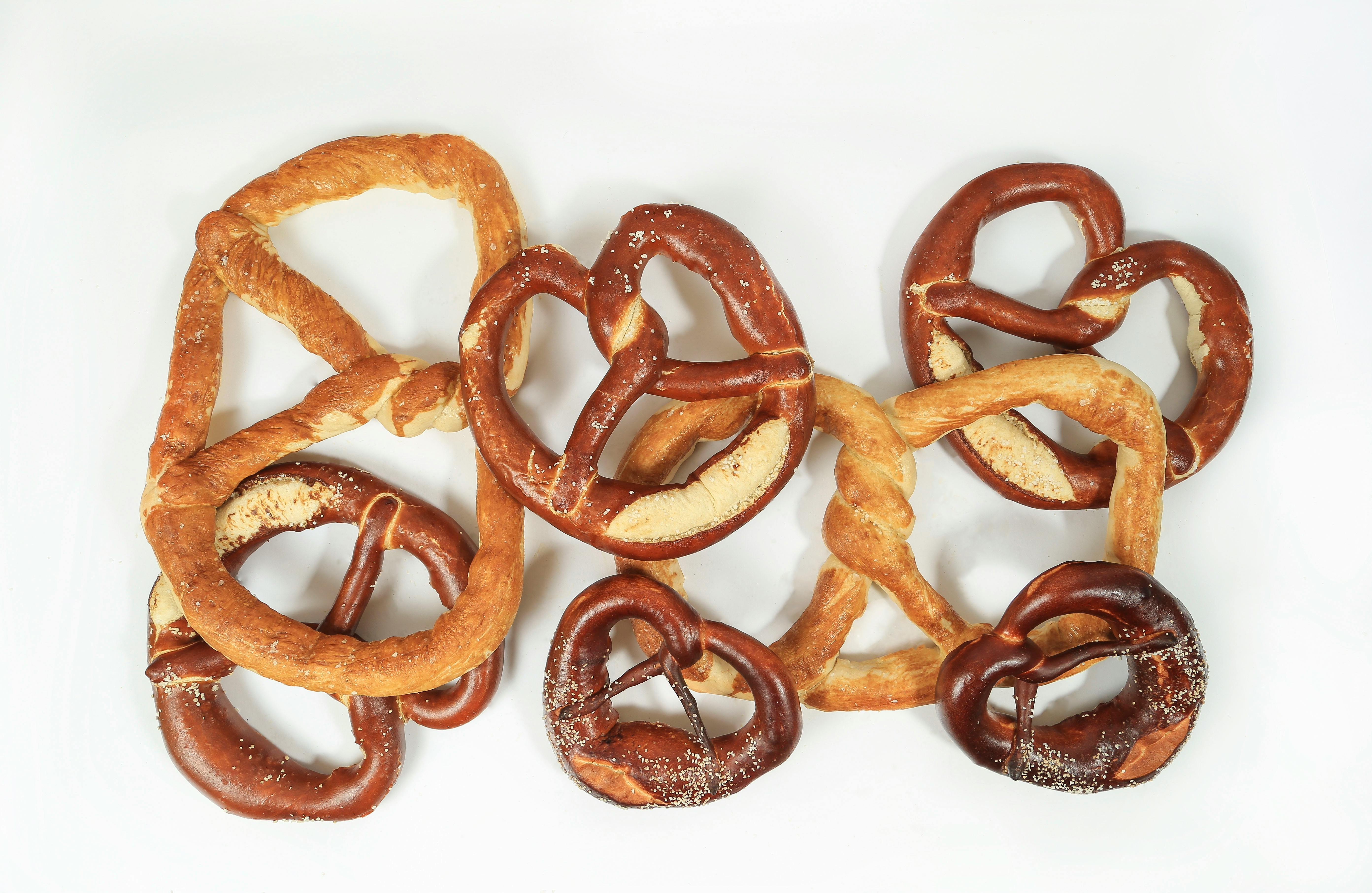
Photo: Stephen Leonardi / Pexels
The diets react (see scores below)
Common Ingredients
- flour
- yeast
- water
- lye
- salt
- butter
Specific recipes may vary.
Incompatible with 8 of 11 diets
Diet Ratings
A German Brezel (pretzel) is made almost entirely from wheat flour, making it a high-carb grain-based food that is fundamentally incompatible with a ketogenic diet. A standard pretzel (approximately 100g) contains roughly 65-70g of net carbs — far exceeding the entire daily carb allowance for ketosis. The small amounts of butter and salt do nothing to offset the carbohydrate load from flour. Yeast and lye are nutritionally negligible. This is a textbook grain-based snack that must be avoided on keto.
This traditional German Brezel recipe includes butter, which is a dairy product derived from cow's milk. Butter is unambiguously non-vegan as it is an animal-derived ingredient. While the base of a Brezel — flour, yeast, water, lye (sodium hydroxide), and salt — is entirely plant-based and vegan-friendly, the inclusion of butter disqualifies this specific recipe. A vegan version of a Brezel is easily achievable by substituting butter with a plant-based fat (e.g., vegan margarine or oil), which would make it fully compliant.
A Brezel (German pretzel) is fundamentally incompatible with the Paleolithic diet. The primary ingredient is wheat flour, a grain that is strictly excluded from paleo eating. Yeast-leavened bread products are a hallmark of post-agricultural, Neolithic food production. Salt is also added, which is discouraged on paleo. Butter is a dairy product, excluded under strict paleo guidelines. The lye (sodium hydroxide) treatment is an industrial processing step entirely foreign to hunter-gatherer food preparation. There is no paleo-compliant ingredient of significance in this dish, making it one of the clearest possible avoid cases.
A German Brezel (pretzel) is made from refined white flour, making it a refined grain product that contradicts Mediterranean diet principles. The Mediterranean diet emphasizes whole grains over refined grains, which offer less fiber and fewer nutrients. Additionally, butter is used as the fat source rather than the Mediterranean-preferred extra virgin olive oil, adding saturated fat. The lye (sodium hydroxide) treatment is a traditional German technique not part of Mediterranean tradition. High sodium content from salt also raises concerns. As a refined-grain snack food from a non-Mediterranean culinary tradition, it sits squarely outside core Mediterranean diet guidelines.
Some Mediterranean diet interpreters allow occasional consumption of refined grain breads and simple baked goods in small portions, noting that traditional Mediterranean cultures did consume white bread products (e.g., white pita in Greece, ciabatta in Italy). In this view, a plain pretzel eaten occasionally as part of an otherwise plant-rich diet would be considered acceptable in moderation rather than categorically avoided.
A Brezel (German pretzel) is entirely plant-based and grain-based, making it completely incompatible with the carnivore diet. The primary ingredient is wheat flour, a grain that is categorically excluded from all tiers of carnivore eating. Yeast is a fungus (not an animal product), and while butter is the only animal-derived ingredient, it is present only as a minor addition and does not redeem the dish. The lye wash and salt are non-plant but also non-animal. There is unanimous consensus across all carnivore authorities that bread-type foods made from grains are strictly forbidden — this is one of the clearest 'avoid' cases possible.
A Brezel (German pretzel) is made with flour (wheat), which is an excluded grain on Whole30. Additionally, it is a baked bread product that falls squarely into the 'no recreating baked goods/bread' rule. Butter is also excluded dairy (only ghee/clarified butter is permitted). Multiple disqualifying factors make this a clear avoid.
A German Brezel (pretzel) is made primarily from wheat flour, which is high in fructans — one of the most significant FODMAPs. Wheat-based products are clearly rated as high-FODMAP by Monash University during the elimination phase. A standard pretzel serving (one pretzel, typically 60–100g) contains a substantial amount of wheat flour, delivering a high fructan load. The other ingredients — yeast, water, lye (sodium hydroxide, used for the characteristic crust), salt, and a small amount of butter — are all low-FODMAP and do not raise concerns. However, wheat flour dominates the recipe and makes this food unsuitable during elimination. Unlike sourdough breads where long fermentation can partially reduce fructan content, a traditional Brezel uses a short yeast fermentation that does not meaningfully reduce fructans.
A traditional German Brezel (pretzel) is problematic for the DASH diet on multiple fronts. The most significant issue is its very high sodium content — a standard soft pretzel contains approximately 800–1,500mg of sodium, largely from both the lye (sodium hydroxide) bath that gives pretzels their characteristic crust and the coarse salt topping. This can represent 35–100% of the DASH daily sodium target in a single snack. The flour used is typically refined white flour, offering minimal fiber, potassium, magnesium, or calcium — nutrients DASH emphasizes. Butter adds saturated fat. The combination of refined carbohydrates, high sodium, and saturated fat directly conflicts with DASH principles. Hard/dry pretzels carry similar or even higher sodium per serving. Unsalted, whole-wheat pretzel versions would score considerably higher (caution range), but the traditional Brezel as commonly consumed is a poor DASH choice.
A Brezel (soft pretzel) is made primarily from refined white flour, making it a high-glycemic, low-fiber carbohydrate with virtually no protein and minimal fat. In Zone terms, it occupies only the carbohydrate block — and as an 'unfavorable' one at that. A typical soft pretzel (around 100g) contains roughly 65-70g of carbohydrates with little fiber, translating to ~7 carb blocks with essentially 0 protein blocks and 0-1 fat blocks. This creates a wildly unbalanced macro ratio, essentially pure refined starch. There is no lean protein to anchor the meal, no monounsaturated fat of significance, and the carb source itself is high-glycemic refined flour. While the Zone Diet is ratio-based and not exclusionary, the Brezel offers almost no pathway to a balanced 40/30/30 ratio on its own. It scores low even for a 'caution' food because pairing it to achieve Zone balance would require very large additions of protein and fat while consuming only a tiny portion of the pretzel itself — at which point the pretzel is no longer a practical snack component. It narrowly avoids a score of 1-2 because small portions could theoretically contribute carb blocks to a mixed Zone meal.
A traditional German Brezel (pretzel) is made from refined wheat flour, yeast, water, lye (sodium hydroxide for the characteristic crust), salt, and a small amount of butter. From an anti-inflammatory perspective, this is a largely neutral-to-mildly-problematic snack. The primary concern is refined white flour, which is a refined carbohydrate with a high glycemic index that can spike blood sugar and contribute to inflammatory signaling when consumed regularly. There are no meaningful anti-inflammatory components — no significant antioxidants, polyphenols, omega-3s, or fiber. The small amount of butter adds minimal saturated fat. The lye treatment is a surface treatment and has no meaningful nutritional impact. Salt content is notable but not an inflammatory driver per se. Occasionally eating a Brezel as part of an otherwise anti-inflammatory diet is unlikely to cause harm, but it offers no anti-inflammatory benefit and its refined carbohydrate base warrants moderation.
A traditional German Brezel (soft pretzel) is a refined-grain snack with minimal protein, low fiber, and moderate fat from butter. It provides mostly simple carbohydrates that offer little nutritional value per calorie — a concern for GLP-1 patients who need every bite to count. The refined flour means rapid blood sugar impact and no meaningful fiber contribution. Butter adds saturated fat without protein benefit. That said, it is not fried, not heavily spiced, and is relatively easy to digest, which prevents it from falling into the avoid category. It could serve as a small occasional carbohydrate vehicle if paired with a high-protein accompaniment (e.g., cottage cheese, quark, or a lean protein dip), but on its own it fails to meet the protein and fiber priorities central to GLP-1 dietary guidance. Portion sensitivity is significant — a full large pretzel (100–130g) is a substantial refined carbohydrate load for a patient with reduced appetite who should be prioritizing protein-dense foods instead.
*See how scores were generated at our methodology page.
Nutritional profile
Six traits that cut across every diet.
Fiber & Plants
How much whole-plant food and fiber it delivers.
Healthy Fats
The quality of its fats (unsaturated, omega-3).
Whole / Unprocessed
How close it is to its natural, unprocessed form.
Gut Gentle
How easy it is on digestion (low FODMAP, few irritants).
Low Glycemic
How little it spikes your blood sugar.
Protein Density
How much protein it packs per calorie.
Controversy Index
Higher controversy = more disagreement between diets.
Diet-Specific Tips
 Zone — 5/10
View tips
- Refined white flour is a high-glycemic 'unfavorable' carbohydrate in Zone terminology
- No meaningful protein content — zero protein blocks
- Minimal fat; butter is present but in small amounts relative to the carb load
- High carbohydrate density with very low fiber, making net carbs nearly equal to total carbs
- Extremely difficult to balance to 40/30/30 without reducing portion to a few bites
- Would require substantial lean protein and fat additions to approach Zone balance
- Processed snack food with no appreciable omega-3s or polyphenols
 Anti-Inflammatory — 4/10
View tips
- Refined wheat flour is a high-glycemic refined carbohydrate — the primary anti-inflammatory concern
- No meaningful anti-inflammatory nutrients: no omega-3s, polyphenols, antioxidants, or significant fiber
- Small amount of butter contributes saturated fat but in negligible quantity per serving
- Lye (sodium hydroxide) is a surface treatment only — no nutritional impact
- High sodium content from salt is worth noting for cardiovascular context but not a direct inflammatory driver
- Acceptable as an occasional treat within an anti-inflammatory dietary pattern
 GLP-1 Friendly — 4/10
View tips
- Near-zero protein — fails the #1 GLP-1 dietary priority
- Refined flour provides minimal fiber — does not support the 25-30g daily fiber target
- Butter contributes saturated fat without nutritional offset
- Low nutrient density per calorie — empty calorie concern for reduced-appetite patients
- Not fried and easy to digest — avoids worsening GLP-1 GI side effects
- Portion-sensitive: a full pretzel is a large refined carbohydrate load for a GLP-1 patient
- Could be acceptable in a small portion if paired with a high-protein accompaniment