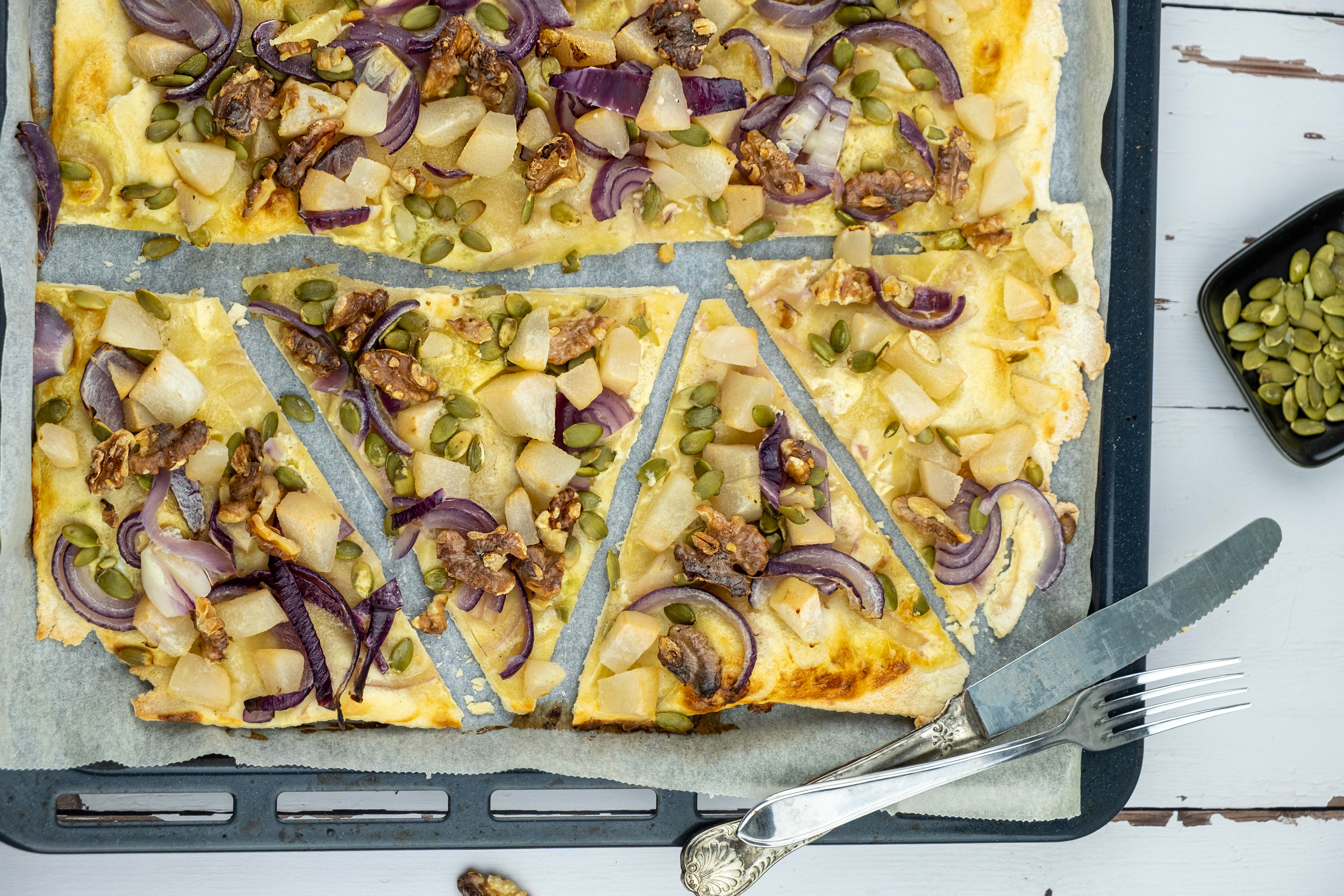
Photo: Elsa silva / Pexels
The diets react (see scores below)
Common Ingredients
- flour
- creme fraiche
- bacon
- onion
- nutmeg
- salt
- oil
Specific recipes may vary.
Incompatible with 10 of 11 diets
Diet Ratings
Flammkuchen is fundamentally a thin-crust flatbread dish built on a wheat flour base, making it incompatible with ketogenic diets. The crust alone provides a substantial load of net carbs (typically 30-50g per serving), far exceeding the daily keto threshold. While the toppings — crème fraîche, bacon, and onion — are largely keto-friendly, the flour-based dough is the dominant component and cannot be portioned away. There is no practical way to consume traditional Flammkuchen and maintain ketosis. The dish would need a full structural replacement (e.g., fathead dough or cauliflower crust) to become keto-compatible.
Flammkuchen contains multiple animal-derived ingredients that are strictly prohibited on a vegan diet. Bacon is pork meat, and crème fraîche is a dairy product (cultured cream). Both are unambiguously non-vegan, making this dish entirely incompatible with a vegan diet regardless of the otherwise plant-based components (flour, onion, nutmeg, salt, oil).
Flammkuchen is an Alsatian-German flatbread dish that is fundamentally incompatible with the paleo diet. The base is wheat flour, a grain explicitly excluded from paleo. Crème fraîche is a dairy product, also excluded. Bacon is a processed meat with added salt and often preservatives, making it non-compliant. Salt itself is excluded as an added ingredient. The dish is essentially a grain-and-dairy-based processed food with multiple core paleo violations stacked together. There is no meaningful way to evaluate this dish as paleo-compatible without replacing virtually every ingredient.
Flammkuchen is a German flatbread dish that conflicts with Mediterranean diet principles on multiple fronts. The primary protein is bacon (processed red meat), which should be consumed only a few times per month at most. Crème fraîche is a high-saturated-fat dairy product far removed from the preferred olive oil fat source. The flour base is refined (white flour), representing a refined grain rather than a whole grain. The dish is non-Mediterranean in origin and character, lacking the plant-forward emphasis, olive oil foundation, and whole-food ingredients central to the dietary pattern. The combination of processed pork, refined flour, and high-fat cream makes this a poor fit.
Flammkuchen is fundamentally incompatible with the carnivore diet. The dish is built on a flour-based flatbread crust, which is a grain product and entirely plant-derived. Onion is a plant food excluded on carnivore. Nutmeg is a plant-derived spice. Plant-based oil is also excluded. While bacon and crème fraîche are animal-derived ingredients, they are minor components of a dish whose structural base is entirely plant-origin. No modification short of a complete reconstruction would make this dish carnivore-compatible — it is not a matter of removing one problematic ingredient but rather that the dish itself is defined by its plant-based dough foundation.
Flammkuchen (Alsatian/German flatbread pizza) is non-compliant on multiple fronts. First, it is built on a flour-based flatbread crust, which contains wheat — an excluded grain. Second, crème fraîche is a dairy product, which is fully excluded on Whole30. Third, bacon as commonly found contains added sugar. Even setting aside the individual ingredients, Flammkuchen is structurally a flatbread/pizza-style dish, which falls squarely into the 'no recreating baked goods/junk food' rule (pizza crust, crackers, flatbreads are explicitly called out). This dish fails on category, spirit, and multiple ingredients simultaneously.
Flammkuchen contains multiple high-FODMAP ingredients that make it unsuitable during the elimination phase. The base is made from wheat flour, which is high in fructans — a major FODMAP trigger. Onion is one of the highest-fructan foods tested by Monash University and is problematic even in small quantities. Crème fraîche contains lactose, adding a disaccharide load. These three ingredients alone (wheat flour, onion, crème fraîche) each independently qualify the dish as high-FODMAP, making the combined effect significant. Bacon and nutmeg in small amounts are generally low-FODMAP, and oil is fine, but they cannot offset the primary offenders.
Flammkuchen (Alsatian tarte flambée) is fundamentally incompatible with DASH diet principles. It combines three major DASH red flags in one dish: bacon (high in sodium and saturated fat), crème fraîche (full-fat dairy, high in saturated fat), and a refined white flour base (not a whole grain). Bacon is explicitly the type of processed red meat DASH guidelines advise avoiding. Crème fraîche directly contradicts the DASH emphasis on fat-free or low-fat dairy. The combination of cured bacon and added salt pushes sodium content well above DASH-friendly thresholds per serving. The refined flour crust provides minimal fiber compared to whole grain alternatives. While onion is a DASH-positive ingredient and oil in small amounts is acceptable, these cannot offset the cumulative impact of the primary ingredients. This dish as traditionally prepared has no realistic modification path short of a near-complete ingredient overhaul.
Flammkuchen (Alsatian flatbread) presents significant Zone Diet challenges. The base is white flour flatbread — a high-glycemic, refined carbohydrate that Zone classifies as 'unfavorable.' The topping is crème fraîche, which is high in saturated fat with minimal protein contribution, and bacon, which is a fatty, processed pork product with a poor protein-to-fat ratio for Zone purposes. Onion is a favorable low-glycemic vegetable and a positive element. The macronutrient profile skews heavily toward refined carbs and saturated fat, with inadequate lean protein — nearly the opposite of the 40/30/30 Zone ratio. While technically one could eat a very small portion and supplement with lean protein and vegetables to approach Zone ratios, this requires extreme portion restriction that defeats the purpose of the dish. The saturated fat load from crème fraîche and bacon is also contrary to Zone's anti-inflammatory, monounsaturated fat preference. This scores low within 'caution' because while it isn't nutritionally empty like pure sugar, it is structurally very difficult to fit into Zone balance without essentially not eating it as a real dish.
Some Zone practitioners might argue a small single-serving portion of Flammkuchen could be worked into a Zone meal as the carbohydrate block alongside lean protein and a salad, accepting the refined flour as an occasional 'unfavorable' carb indulgence. Dr. Sears' later writings acknowledge that rigid exclusion is less important than overall dietary pattern, suggesting moderate enjoyment of traditional dishes is compatible with Zone principles if the rest of the day's meals are well-balanced.
Flammkuchen (Alsatian/German flatbread) presents a strongly pro-inflammatory nutritional profile. The base is refined white flour, which spikes blood sugar and lacks fiber or micronutrients — a staple of the 'avoid' category. Crème fraîche is a full-fat dairy product high in saturated fat, which anti-inflammatory guidelines consistently flag as a contributor to inflammatory pathways (elevated arachidonic acid cascade, potential CRP elevation). Bacon is processed red meat — doubly problematic under anti-inflammatory principles due to both its saturated fat content and its processing (nitrates, additives, high sodium). The dish lacks any meaningful anti-inflammatory components: no omega-3s, no colorful vegetables, no legumes, no anti-inflammatory spices beyond a trace of nutmeg. Onion is the one redemptive ingredient, offering quercetin and mild antioxidant properties, but in quantities too small relative to the inflammatory burden of the other ingredients to meaningfully shift the profile. The oil used is unspecified — if extra virgin olive oil, slightly positive, but most commercial preparations use neutral refined oils. This dish is essentially refined carbs + processed meat + full-fat dairy with minimal fiber or phytonutrients.
Flammkuchen is a poor fit for GLP-1 patients across nearly every priority dimension. The base is refined white flour with minimal fiber or protein contribution. Crème fraîche is very high in saturated fat (roughly 30–45% fat by weight), and bacon adds additional saturated fat and sodium with minimal lean protein payoff. The dish is calorie-dense per serving while being nutritionally sparse — low protein density, negligible fiber, high saturated fat. Slowed gastric emptying on GLP-1 medications means this fat-heavy combination is likely to worsen nausea, bloating, and reflux. There is no meaningful protein source to justify the caloric cost, and no fiber to support digestion or blood sugar stability. Even as an occasional snack, the saturated fat load from crème fraîche and bacon in a small portion is disproportionately high relative to nutritional return.
*See how scores were generated at our methodology page.
Nutritional profile
Six traits that cut across every diet.
Fiber & Plants
How much whole-plant food and fiber it delivers.
Healthy Fats
The quality of its fats (unsaturated, omega-3).
Whole / Unprocessed
How close it is to its natural, unprocessed form.
Gut Gentle
How easy it is on digestion (low FODMAP, few irritants).
Low Glycemic
How little it spikes your blood sugar.
Protein Density
How much protein it packs per calorie.
Controversy Index
Higher controversy = more disagreement between diets.
Diet-Specific Tips
 Zone — 5/10
View tips
- White flour base is a high-glycemic 'unfavorable' carbohydrate in Zone terminology
- Crème fraîche contributes primarily saturated fat, not the preferred monounsaturated fat
- Bacon is a fatty processed meat with poor lean-protein-to-fat ratio for Zone blocks
- Macro profile skews heavily carb and saturated fat, opposite to 40/30/30 Zone target
- Onion is a favorable low-glycemic vegetable — a minor positive element
- Would require extreme portion control to approach Zone ratios, undermining the dish