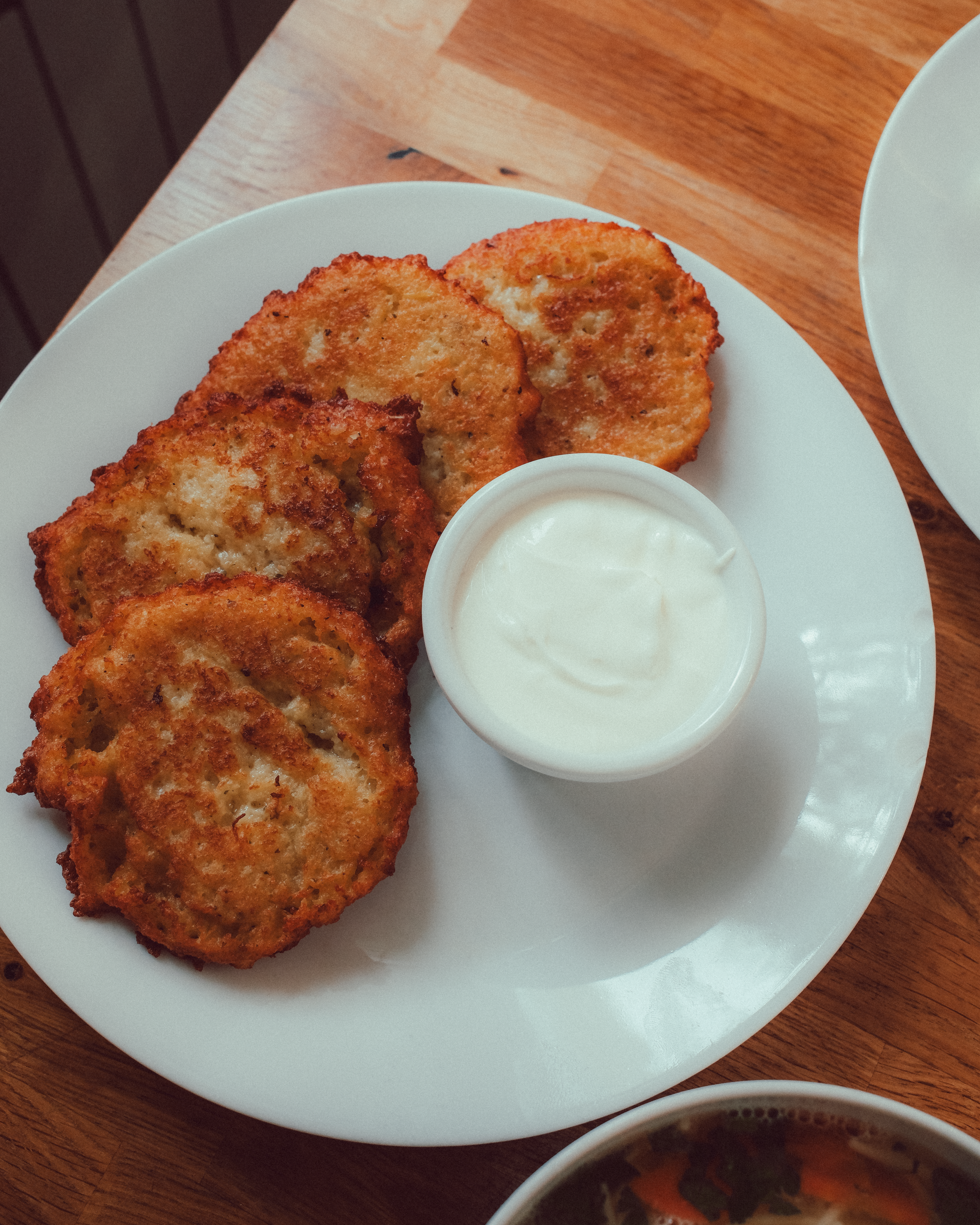
Photo: Anh Nguyen / Pexels
German
Kartoffelpuffer
The diets react (see scores below)
Common Ingredients
- potatoes
- onion
- eggs
- flour
- salt
- oil
- applesauce
Specific recipes may vary.
Incompatible with 8 of 11 diets
Diet Ratings
Kartoffelpuffer (German potato pancakes) are fundamentally incompatible with a ketogenic diet. The primary ingredient is potatoes, which are extremely high in starch and net carbs — a single medium potato contains roughly 30-35g of net carbs, far exceeding most individuals' entire daily keto allowance. Flour adds additional grain-based carbohydrates, and the traditional applesauce accompaniment contributes sugar and fructose. Even a small serving would likely knock a person out of ketosis. There are no redeeming keto-friendly macros to offset the carb load; while eggs and oil are fine, they are minor components overwhelmed by the starch-dominant base.
Kartoffelpuffer (German potato pancakes) contain eggs as a listed ingredient, which are an animal product and therefore not compatible with a vegan diet. All other ingredients — potatoes, onion, flour, salt, oil, and applesauce — are fully plant-based. The dish could be made vegan by substituting the eggs with a plant-based binder such as flax eggs, aquafaba, or a commercial egg replacer, but as traditionally prepared with eggs, it fails vegan criteria.
Kartoffelpuffer (German potato pancakes) contains multiple non-paleo ingredients that make it clearly incompatible with the diet. Flour is a grain derivative and is strictly excluded. Salt is explicitly disallowed as an added ingredient. The oil used in traditional preparation is typically a seed or vegetable oil (canola, sunflower, or vegetable oil), which are all excluded. White potatoes are themselves debated within paleo but are generally discouraged by strict paleo authorities including The Paleo Diet's guide. Even if the potato base were accepted by more permissive paleo frameworks, the flour, added salt, and seed oil make this dish non-compliant across virtually all paleo interpretations. Applesauce is generally paleo-friendly if unsweetened, and eggs and onion are fully approved — but these two ingredients cannot redeem a dish with this many core violations.
Kartoffelpuffer (German potato pancakes) are made from mostly whole, minimally processed ingredients — potatoes, onion, eggs, flour, and applesauce — which aligns reasonably well with Mediterranean principles. Potatoes are a whole vegetable, onions are encouraged, and eggs are acceptable in moderation. However, several factors limit full approval: refined flour is used rather than whole grain; the dish is typically fried in generous amounts of oil, and if that oil is not extra virgin olive oil (likely vegetable or sunflower oil in the German tradition), it conflicts with Mediterranean fat guidelines; and applesauce adds some sugar. The dish is also starch-heavy with little fiber diversity or plant variety. It is not a Mediterranean staple, but with modifications (olive oil for frying, whole wheat flour, unsweetened applesauce) it can fit as an occasional side.
Some Mediterranean diet practitioners would view this more favorably if prepared with extra virgin olive oil, as pan-frying in olive oil is common in Spanish and Italian traditions (e.g., tortilla española uses similar ingredients). In that framing, potatoes, eggs, and olive oil form a culturally adjacent preparation that fits within moderate Mediterranean eating.
Kartoffelpuffer (German potato pancakes) is entirely incompatible with the carnivore diet. The dish is composed almost exclusively of plant-derived foods: potatoes as the primary ingredient, onion, flour, and applesauce. Even the small inclusion of eggs does not redeem this dish — the dominant macrostructure is starch and plant matter. Potatoes are a high-carbohydrate tuber, flour is a grain product, onion is a vegetable, and applesauce is fruit-derived. Plant oils used for frying add another non-carnivore element. There is no animal protein serving as a primary component. This dish would be rejected under every tier of carnivore eating, from the most liberal 'animal-based' approach to the strict Lion Diet.
Kartoffelpuffer (German potato pancakes) are explicitly disallowed on Whole30 for two compounding reasons. First, flour (wheat) is a grain and is excluded from the program. Second, even if the flour were swapped for a compliant alternative, potato pancakes fall squarely into the 'no recreating baked goods/junk food' category — pancakes are explicitly named as a prohibited food form regardless of ingredient compliance. The applesauce served alongside is technically fine (100% fruit, no added sugar assumed), but it cannot redeem the dish as a whole.
Kartoffelpuffer (German potato pancakes) contains two significant high-FODMAP ingredients that make this dish problematic during the elimination phase. Onion is one of the highest-FODMAP foods tested by Monash University, rich in fructans, and is a core ingredient in this dish — there is no safe serving size for onion. Applesauce, typically made from apples with or without added sugar, is high in excess fructose and polyols (sorbitol), making it a high-FODMAP accompaniment at any standard serving. Potatoes themselves are low-FODMAP, eggs are low-FODMAP, and plain wheat flour contributes fructans but only in relatively small amounts per pancake. Salt and frying oil are FODMAP-free. However, the combination of onion (unavoidable in the traditional recipe) and applesauce (the classic accompaniment) makes the standard preparation of this dish clearly high-FODMAP and unsuitable for the elimination phase.
Monash University confirms onion is high-FODMAP at any amount, but some clinical FODMAP practitioners suggest that very small quantities of onion used as flavoring in a large batch (yielding many servings) may dilute FODMAP load enough for tolerant individuals — however, this is not appropriate for strict elimination phase. Additionally, applesauce could theoretically be swapped for a low-FODMAP alternative (e.g., a small portion of sour cream or lactose-free sour cream), which would significantly change the dish's FODMAP profile.
Kartoffelpuffer (German potato pancakes) are made from whole-food ingredients — potatoes, onion, eggs, flour, and applesauce — that are individually DASH-compatible or neutral. However, the dish is pan-fried in oil, which adds significant fat and calories, and salt is added directly to the batter, raising sodium concerns. Potatoes themselves are DASH-friendly (rich in potassium), and applesauce as a topping aligns well with DASH's fruit emphasis. The main issues are the frying method and added salt. If pan-fried in a small amount of vegetable oil (canola or olive), the dish is acceptable in moderation, but typical restaurant or traditional home preparation uses generous oil, making the fat content a concern. The sodium level depends heavily on how much salt is added. Overall, this is a borderline dish — the base ingredients are good, but preparation method pushes it into caution territory.
NIH DASH guidelines would flag the frying method and added sodium as concerns, recommending baked or oven-crisped versions with minimal salt. However, some DASH-oriented clinicians note that when made with modest oil (canola/olive), limited salt, and served with unsweetened applesauce, Kartoffelpuffer fits reasonably within a DASH meal pattern as an occasional side, particularly given the potassium content of potatoes.
Kartoffelpuffer (German potato pancakes) are fundamentally incompatible with Zone Diet principles. The primary ingredient — potatoes — is explicitly listed by Dr. Sears as an 'unfavorable' and high-glycemic carbohydrate to avoid, alongside refined flour which compounds the glycemic load. The dish delivers an extremely high-glycemic carbohydrate spike with virtually no lean protein and whatever fat is used for frying is likely omega-6-rich seed oil (another Zone negative). Applesauce as a topping adds further high-glycemic simple sugars. The macronutrient ratio is wildly skewed: overwhelmingly carbohydrate-dominant with minimal protein and potentially high in the wrong types of fat. Even with careful portioning, a single small serving would consume an outsized carbohydrate block allocation for the meal while providing essentially no protein blocks, making it nearly impossible to construct a Zone-balanced meal around this dish. This is not a ratio-balancing challenge — it is a food built from the exact ingredients Dr. Sears flags as unfavorable (potatoes, flour, applesauce) stacked together.
Kartoffelpuffer (German potato pancakes) present a mixed anti-inflammatory profile. On the positive side, potatoes contain vitamin C, potassium, and resistant starch (especially when cooled), and onions provide quercetin, a notable anti-inflammatory flavonoid. Eggs contribute choline and selenium. Applesauce adds polyphenols and some fiber. However, the dish has several concerns from an anti-inflammatory perspective: (1) White potatoes are a high-glycemic starchy vegetable — when shredded and pan-fried, much of the resistant starch is lost, and the rapid glucose spike can promote inflammatory signaling. (2) The frying method requires a significant amount of oil, and if refined seed oils (sunflower, corn, vegetable) are used — as is traditional in German cooking — this introduces omega-6-heavy fats that anti-inflammatory frameworks recommend limiting. (3) Refined wheat flour, while used in small quantities, adds refined carbohydrates. (4) The dish lacks meaningful anti-inflammatory powerhouses: no omega-3s, no colorful antioxidant-rich vegetables, no herbs/spices with documented anti-inflammatory activity. On balance, this is an occasional-acceptable food rather than one to build a diet around. Using extra virgin olive oil instead of seed oils and pairing with a protein source would improve the profile.
Most anti-inflammatory practitioners would rate this as neutral-to-cautious due to the high-glycemic load and likely use of refined seed oils. However, some integrative nutritionists argue that whole potatoes — even when fried — retain meaningful nutrients and that the glycemic concern is overstated in the context of a varied diet; the AHA and mainstream dietitians do not categorize potatoes as inherently pro-inflammatory foods.
Kartoffelpuffer (German potato pancakes) are a poor fit for GLP-1 patients in their traditional form. They are shallow- or pan-fried in oil, creating a high-fat, greasy dish that directly worsens the most common GLP-1 side effects: nausea, bloating, and reflux. The base is almost entirely refined starch from potatoes and flour, offering very little protein (eggs contribute minimally per serving) and minimal fiber. The accompanying applesauce adds sugar with negligible nutritional benefit. Calorie density is high relative to nutritional return — exactly the empty-calorie profile GLP-1 patients must avoid given their reduced appetite. The frying method and high fat content are disqualifying on their own, independent of the poor protein and fiber profile.
*See how scores were generated at our methodology page.
Nutritional profile
Six traits that cut across every diet.
Fiber & Plants
How much whole-plant food and fiber it delivers.
Healthy Fats
The quality of its fats (unsaturated, omega-3).
Whole / Unprocessed
How close it is to its natural, unprocessed form.
Gut Gentle
How easy it is on digestion (low FODMAP, few irritants).
Low Glycemic
How little it spikes your blood sugar.
Protein Density
How much protein it packs per calorie.
Controversy Index
Higher controversy = more disagreement between diets.
Diet-Specific Tips
 Mediterranean — 5/10
View tips
- Potatoes are a whole food but starch-dense and not a Mediterranean diet staple
- Refined flour reduces whole-grain quality
- Frying oil type is critical — traditional German preparation uses non-olive oils
- Eggs are acceptable in moderation per Mediterranean guidelines
- Applesauce adds minor sugar content
- Dish lacks the vegetable diversity and legume/whole grain emphasis of Mediterranean sides
- Could be adapted to fit better with olive oil and whole wheat flour
 DASH — 5/10
View tips
- Potatoes are DASH-approved and rich in potassium
- Pan-frying adds significant oil/fat — preparation method is the primary concern
- Added salt raises sodium; amount is cook-dependent
- Applesauce topping aligns with DASH fruit servings (choose unsweetened)
- Eggs and flour are acceptable in DASH in moderation
- Baked or oven-crisped version with reduced salt would score higher (7-8)
- No saturated fat, tropical oils, or added sugar in standard recipe
 Anti-Inflammatory — 4/10
View tips
- High-glycemic starchy base (shredded potatoes) with minimal resistant starch after frying
- Frying oil type is critical — seed oils (common in traditional preparation) are high in omega-6; EVOO would be preferable
- Onions contribute quercetin, a beneficial anti-inflammatory flavonoid
- Applesauce adds polyphenols and some soluble fiber
- Refined flour present but in small quantity
- No significant anti-inflammatory nutrients (omega-3s, carotenoids, polyphenols) in meaningful amounts
- Eggs provide modest choline and selenium