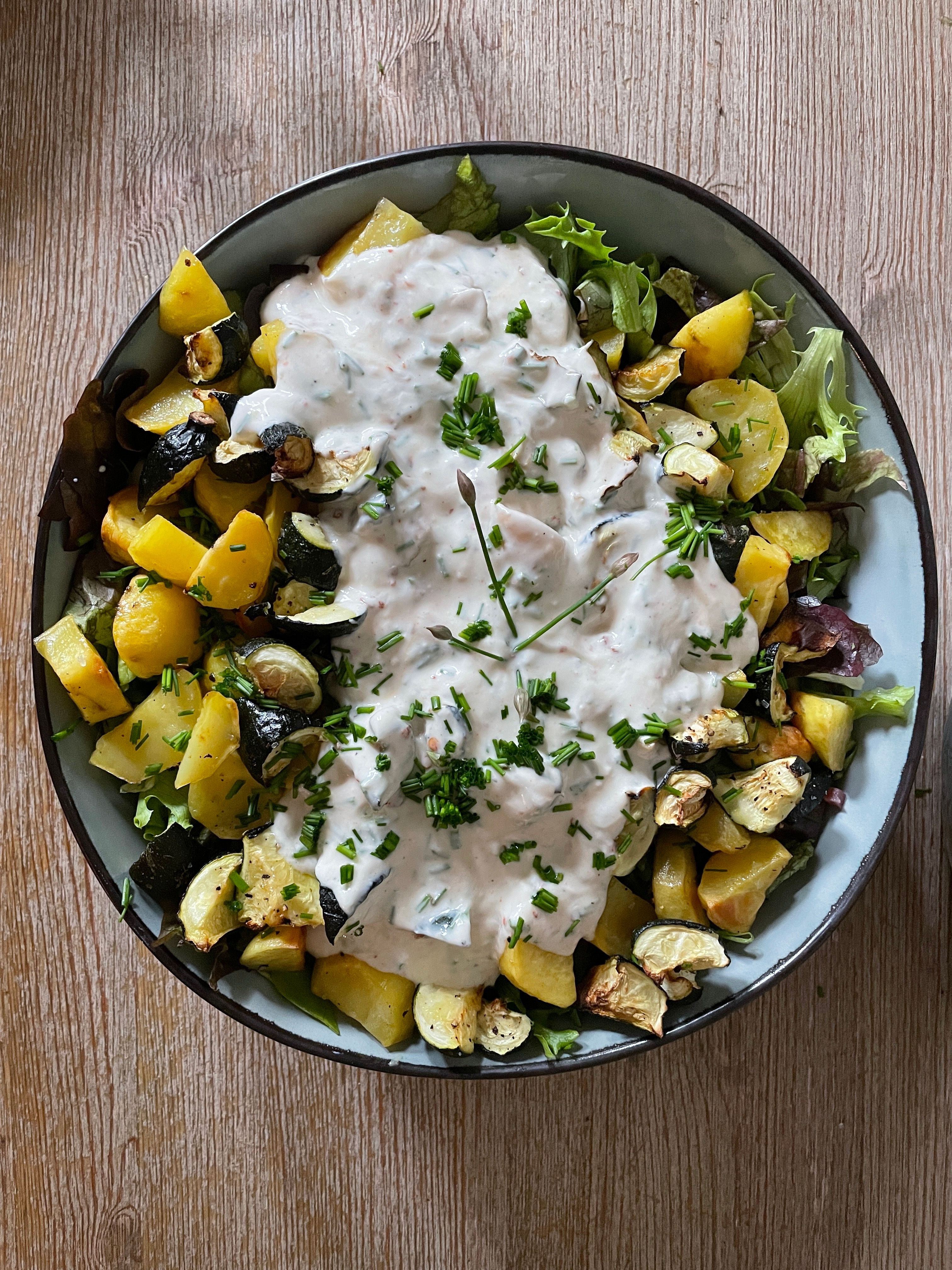
German
Kartoffelsalat
The diets react (see scores below)
Common Ingredients
- potatoes
- onion
- vinegar
- vegetable broth
- mustard
- oil
- chives
Specific recipes may vary.
Incompatible with 4 of 11 diets
Diet Ratings
Kartoffelsalat is fundamentally built on potatoes, which are one of the most keto-incompatible foods available. A single medium potato contains approximately 30-35g of net carbs, and a typical serving of potato salad uses multiple potatoes. This alone can exceed an entire day's keto carb budget. While the other ingredients (vinegar, mustard, oil, onion, chives, broth) are generally low-carb or keto-friendly, they are entirely secondary to the potato base. No amount of portion control makes this dish compatible with ketosis — even a small side portion would contribute 15-20g net carbs from potatoes alone. The starchy, high-glycemic nature of potatoes directly opposes the metabolic state of ketosis.
This version of Kartoffelsalat (German potato salad) is fully plant-based. All listed ingredients — potatoes, onion, vinegar, vegetable broth, mustard, oil, and chives — are whole or minimally processed plant-derived foods. Notably, vegetable broth is specified (not chicken broth, which is common in some traditional recipes), and no mayonnaise or eggs are included (the Bavarian/southern German style sometimes incorporates mayo or bacon, but this recipe represents the Swabian/northern vinegar-dressed style). This is a wholesome, whole-food vegan dish with no animal-derived ingredients.
Kartoffelsalat (German potato salad) has multiple problematic ingredients from a paleo perspective. The most significant issue is the oil — 'oil' in this context almost certainly refers to a seed or vegetable oil (sunflower or canola are standard in German cooking), which is explicitly excluded from paleo. The vegetable broth is likely commercial and contains added salt and often additives, making it a processed food. White potatoes themselves are debated within the paleo community — Cordain's original framework excludes them, though many modern practitioners allow them. Vinegar (apple cider) could be paleo-acceptable, but standard white or wine vinegar is a gray area. Mustard prepared without additives or sugar could be acceptable, but commercial mustard typically contains added salt and other non-paleo ingredients. Onion and chives are fully paleo-approved. The combination of a likely seed oil, processed broth, and white potatoes places this dish firmly in avoid territory under most paleo frameworks.
Mark Sisson and Whole30 now accept white potatoes as paleo-compatible, and if this dish were made with a paleo-approved oil (olive or avocado), homemade additive-free broth, and clean mustard, some modern paleo practitioners would upgrade it to caution. Paul Jaminet's Perfect Health Diet perspective would also be more permissive toward potatoes as a 'safe starch.'
Kartoffelsalat in this German style uses wholesome, minimally processed ingredients: potatoes, onion, vinegar, vegetable broth, mustard, and chives. Potatoes are a whole plant food and a legitimate starch source in Mediterranean-adjacent eating, though not as preferred as whole grains like barley or farro. The dressing is vinegar- and broth-based rather than mayonnaise-based, avoiding heavy saturated fat. The unspecified 'oil' is the main variable — if extra virgin olive oil, this dish aligns well with Mediterranean principles. The overall profile is plant-forward, low in saturated fat, and minimally processed, earning a solid approval with a caveat about oil choice.
Some Mediterranean diet authorities would prefer whole grains over potatoes as the starch base, and the use of a non-specific 'oil' (possibly sunflower or rapeseed, common in German cooking) rather than extra virgin olive oil distances this dish from canonical Mediterranean fat sourcing. Traditionalists would rate it lower if olive oil is not used.
Kartoffelsalat is entirely plant-based with zero animal-derived ingredients. Potatoes are a starchy carbohydrate, onions and chives are vegetables, vinegar and mustard are plant-derived condiments, vegetable broth contains no animal products, and oil is a plant fat. Every single ingredient violates carnivore diet principles. This dish has no redeeming carnivore-compatible components whatsoever.
Kartoffelsalat (German potato salad) is made with potatoes, onion, vinegar, vegetable broth, mustard, oil, and chives — all of which are individually Whole30-compatible. Potatoes are allowed (Whole30 explicitly permits white potatoes), vinegar is allowed (most types), mustard is generally compliant but requires label-checking for added sugars or non-compliant additives, and vegetable broth must be checked for added sugar, MSG (now allowed), or other non-compliant ingredients. The dish itself is a straightforward whole-food salad with no excluded ingredients in principle. The main caution is that store-bought or commercial mustard and vegetable broth often contain added sugar or other additives, so label-reading is essential. Homemade versions with compliant ingredients are fully approved.
Most practitioners consider this a clean, whole-food dish when made with compliant mustard and broth. The only debate is whether certain prepared condiment versions (mustard with sugar, broth with additives) are used — official Whole30 guidelines require label scrutiny on packaged items like mustard and broth, and the community generally flags this as a label-reading caution rather than a philosophical concern.
Kartoffelsalat contains onion, which is high-FODMAP due to fructans and is one of the most problematic ingredients on the low-FODMAP diet. Even small amounts of onion (raw or cooked) are high-FODMAP and must be avoided during the elimination phase. The other ingredients are largely low-FODMAP: potatoes are low-FODMAP at a standard serving (~75g), vinegar is low-FODMAP, mustard is low-FODMAP in small amounts, oil is low-FODMAP, chives are low-FODMAP (unlike onion or garlic chives in large amounts), and plain vegetable broth can be low-FODMAP if it doesn't contain onion or garlic. However, the presence of onion as a core structural ingredient makes this dish unavoidably high-FODMAP in its traditional preparation. There is no realistic way to reduce the onion to a trace safe serving — it is central to the dish's flavor profile.
German Kartoffelsalat (potato salad) made with potatoes, onion, vinegar, vegetable broth, mustard, oil, and chives is a relatively DASH-friendly dish. Potatoes are an excellent source of potassium and fiber — core DASH nutrients. The dressing is vinegar- and broth-based rather than mayonnaise-heavy, avoiding the saturated fat typical of American-style potato salads. Vegetable oil provides heart-healthy unsaturated fats. Onions and chives contribute antioxidants and micronutrients. The main DASH concern is sodium: vegetable broth and mustard can add meaningful sodium (store-bought broth may contribute 400–800mg per cup), so preparation with low-sodium broth keeps this well within DASH limits. Oil quantity should be moderate for caloric reasons. Overall, this is a whole-food, vegetable-forward dish well aligned with DASH principles when prepared with sodium-conscious ingredients.
NIH DASH guidelines don't specifically address potato salad, but potatoes are endorsed as a high-potassium staple. Some DASH-oriented clinicians caution that potatoes have a higher glycemic index compared to other vegetables and may warrant portion control for individuals with insulin resistance — though the 2020–2025 Dietary Guidelines and most DASH practitioners do not restrict potatoes categorically.
Kartoffelsalat is a German potato salad built around potatoes as its primary carbohydrate source. Potatoes are explicitly listed in Zone Diet methodology as an 'unfavorable' high-glycemic carbohydrate that Dr. Sears advises avoiding or strictly limiting. They have a high glycemic index and glycemic load, driving insulin spikes that work against the Zone's core goal of hormonal balance. The dish has no meaningful protein component (listed as 'none'), making it impossible to construct a balanced 40/30/30 meal from this dish alone. The fat component (oil, likely vegetable/canola) raises a secondary concern as vegetable oils are omega-6 heavy, which conflicts with Zone's anti-inflammatory emphasis. On the positive side, onion, chives, vinegar, and mustard are Zone-friendly low-glycemic additions, and the vinegar may slightly blunt the glycemic response of the potatoes. However, the foundation of the dish — potatoes without protein — makes this very difficult to fit into a Zone-balanced meal. It scores low within the 'caution' range because while technically a small portion could theoretically be paired with lean protein and healthier fat, the dish as constructed is fundamentally misaligned with Zone principles. It avoids a score of 1-3 only because it is a real whole food, not processed junk, and small portions are not impossible to work with.
Some Zone practitioners note that Sears' later writings (The OmegaRx Zone, anti-inflammatory protocol work) softened the strict 'avoid potatoes' stance slightly, acknowledging that cold or vinegar-dressed potatoes have a somewhat lower glycemic impact due to resistant starch formation and acid slowing digestion. A small portion of Kartoffelsalat paired with a generous lean protein could theoretically fit into a Zone block structure, which some practitioners would treat as a higher-caution rather than near-avoid food.
This German potato salad (Kartoffelsalat) has a reasonably clean ingredient profile with some anti-inflammatory positives but also some neutral-to-mixed elements. Potatoes are a moderate-glycemic whole food with vitamin C, potassium, and resistant starch (especially when cooled), but lack the dense antioxidant profile of colorful vegetables and are starchy carbohydrates. Onions are a meaningful positive — rich in quercetin, a well-studied anti-inflammatory flavonoid. Mustard contains anti-inflammatory isothiocyanates from mustard seeds. Chives provide flavonoids and sulfur compounds similar to other alliums. Vinegar (especially apple cider or wine vinegar) may aid glycemic response, slightly reducing the inflammatory impact of the starchy base. Vegetable broth is benign. The main concern is 'oil' — unspecified oil could be extra virgin olive oil (an anti-inflammatory standout) or a high-omega-6 refined seed oil like sunflower or canola, which mainstream anti-inflammatory protocols flag as problematic. Assuming a neutral oil (likely sunflower or rapeseed/canola in traditional German preparation), this introduces some omega-6 concern without the benefits of EVOO. There are no red flags like added sugar, trans fats, or processed additives. Overall, this is a simple, whole-food dish that is acceptable in moderation — the potato base keeps it from scoring higher, but the alliums, mustard, and vinegar provide genuine benefit.
Most anti-inflammatory practitioners consider potatoes acceptable whole foods with beneficial resistant starch, but autoimmune protocol (AIP) advocates such as Dr. Tom O'Bryan exclude nightshades — including potatoes — due to solanine and lectin content potentially triggering inflammation in sensitive individuals; mainstream anti-inflammatory guidance (Dr. Weil) does not restrict potatoes. Additionally, if the oil used is a refined seed oil (sunflower, canola), most anti-inflammatory protocols recommend limiting these due to omega-6 load and oxidation potential, though the AHA and mainstream dietetics consider them acceptable.
German Kartoffelsalat (vinegar-based) is a starchy, moderate-fiber side dish with virtually no protein. Potatoes provide some potassium and modest fiber, and the vinegar-mustard-broth dressing keeps fat relatively low compared to mayonnaise-based versions — a meaningful advantage for GLP-1 patients prone to nausea and reflux. However, potatoes are high-glycemic, calorie density is moderate, and with no meaningful protein source this dish does almost nothing to meet the 100-120g daily protein target. On a GLP-1-reduced appetite, eating a serving of Kartoffelsalat crowds out protein-dense foods. It is not inherently harmful, but it is nutritionally thin for the calorie cost and portion space it occupies in a small-appetite patient's day.
Some GLP-1-focused dietitians accept starchy sides like vinegar potato salad in small portions because cooled cooked potatoes form resistant starch, which acts more like fiber and has a lower glycemic impact — making this dish modestly better than freshly cooked potatoes. Others argue that any low-protein starchy filler is counterproductive when appetite is severely reduced and every bite must maximize protein and micronutrient density.
*See how scores were generated at our methodology page.
Nutritional profile
Six traits that cut across every diet.
Fiber & Plants
How much whole-plant food and fiber it delivers.
Healthy Fats
The quality of its fats (unsaturated, omega-3).
Whole / Unprocessed
How close it is to its natural, unprocessed form.
Gut Gentle
How easy it is on digestion (low FODMAP, few irritants).
Low Glycemic
How little it spikes your blood sugar.
Protein Density
How much protein it packs per calorie.
Controversy Index
Higher controversy = more disagreement between diets.
Diet-Specific Tips
 Vegan — 6/10
View tips
- All ingredients are plant-derived
- Vegetable broth used instead of meat-based broth
- Vinegar-dressed style avoids eggs and mayonnaise common in other regional variants
- No bacon or pork, which traditionally appears in some German Kartoffelsalat recipes
- Whole-food ingredients with minimal processing score highly on plant-based criteria
 Mediterranean — 7/10
View tips
- Plant-based, whole-food ingredients throughout
- No meat, dairy, or added sugars
- Vinegar-broth dressing avoids mayonnaise and saturated fat
- Oil type unspecified — extra virgin olive oil would elevate alignment
- Potatoes acceptable but less preferred than whole grains in strict Mediterranean guidelines
- Minimally processed; fresh herbs and vegetables included
 Whole30 — 6/10
View tips
- Potatoes are explicitly allowed on Whole30
- Vinegar is allowed (most types)
- Mustard requires label-check for added sugar or non-compliant additives
- Vegetable broth requires label-check for added sugar or non-compliant ingredients
- All other ingredients (onion, oil, chives) are fully compliant
- No excluded ingredient categories present in the base recipe
 DASH — 7/10
View tips
- Potatoes are high in potassium and fiber — core DASH nutrients
- Vinegar/broth-based dressing avoids saturated fat from mayonnaise
- Sodium risk from vegetable broth and mustard — low-sodium broth strongly recommended
- Vegetable oil provides unsaturated fats consistent with DASH
- No red meat, added sugar, or refined grains
- Chives and onions add micronutrients with negligible sodium
- Portion control advised due to caloric density of oil
 Zone — 5/10
View tips
- Potatoes are explicitly 'unfavorable' high-glycemic carbohydrates in Zone Diet methodology
- No protein component — cannot form a balanced Zone meal without significant additions
- Vegetable oil likely omega-6 heavy, conflicting with Zone's anti-inflammatory focus
- Vinegar dressing may modestly lower glycemic impact compared to hot potato preparations
- Onion, chives, mustard are Zone-friendly ingredients
- Dish as constructed is heavily carbohydrate-skewed with no macro balance
 Anti-Inflammatory — 5/10
View tips
- Potatoes are moderate-glycemic starchy carbohydrates — neutral to mildly mixed on anti-inflammatory scale
- Onions are rich in quercetin, a well-documented anti-inflammatory flavonoid
- Mustard seeds contain anti-inflammatory isothiocyanates
- Chives provide allium-family sulfur compounds and flavonoids
- Vinegar may blunt glycemic response of the starchy base
- Unspecified oil is a key variable — EVOO would boost score; refined seed oil (sunflower, canola) adds omega-6 concern
- No added sugar, no processed ingredients, no trans fats — clean whole-food base
- Potatoes are nightshades, which may be problematic for autoimmune-sensitive individuals
 GLP-1 Friendly — 5/10
View tips
- No meaningful protein — critical gap for GLP-1 patients
- Low fat due to vinegar-broth dressing rather than mayo — reduces nausea risk
- Potatoes are high-glycemic; cooling increases resistant starch content modestly
- Moderate fiber from potatoes and onion, but below high-fiber food threshold
- Occupies limited stomach capacity without contributing to protein goals
- Portion-sensitive: a small side portion is more acceptable than a main serving
- Easy to digest — soft texture suits slowed gastric emptying