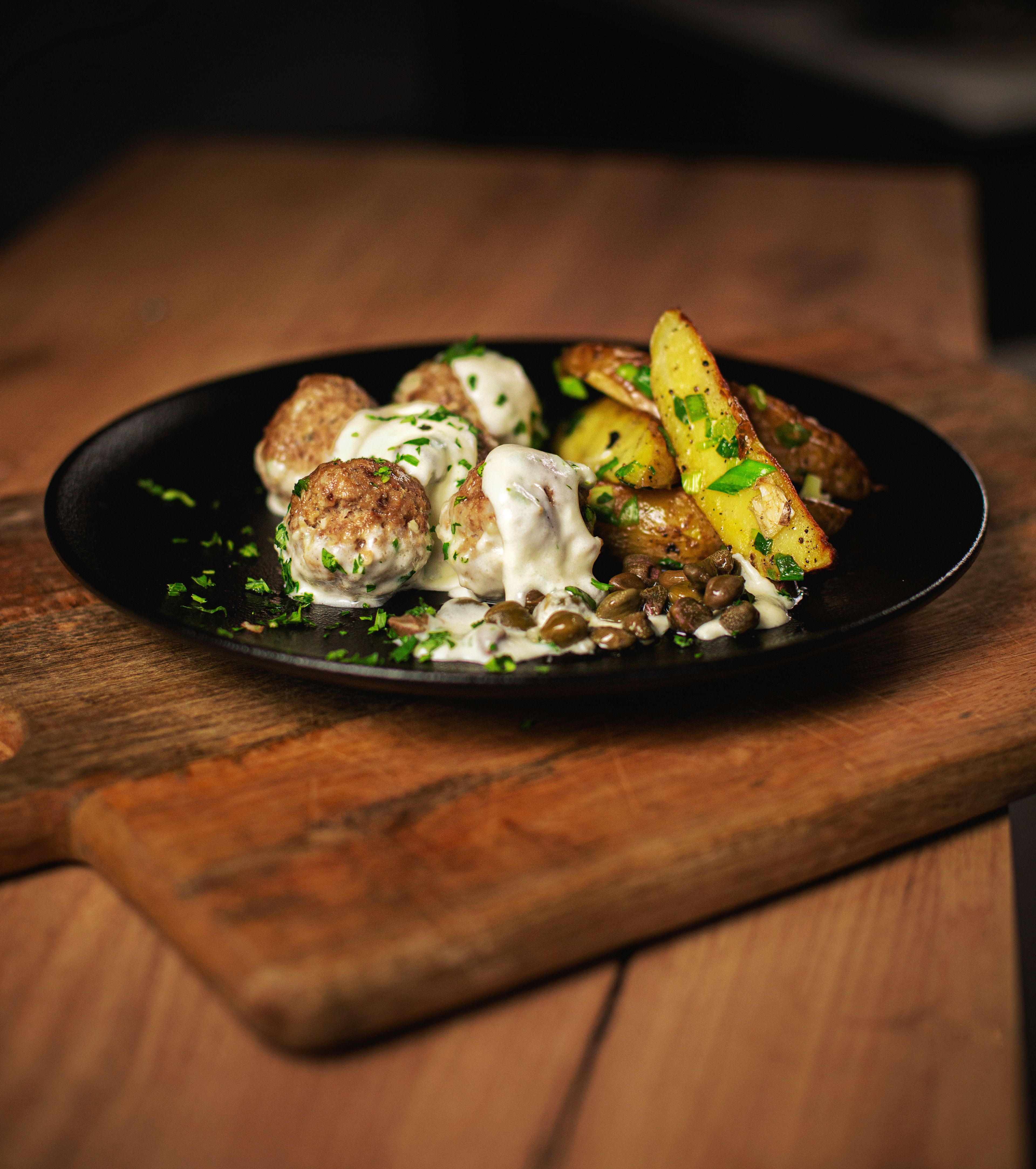
Photo: Yura Forrat / Pexels
German
Konigsberger Klopse
The diets react (see scores below)
Common Ingredients
- ground veal
- onion
- breadcrumbs
- eggs
- capers
- cream
- lemon
- broth
Specific recipes may vary.
Incompatible with 7 of 11 diets
Diet Ratings
Königsberger Klopse are traditional German meatballs prepared with breadcrumbs mixed directly into the meat and served in a cream-lemon-caper sauce thickened with more breadcrumbs or flour. The breadcrumbs are a core structural ingredient in the meatballs, not a garnish — removing them changes the dish fundamentally. Breadcrumbs are a grain-based, high-carb ingredient that immediately disqualifies this dish in its traditional form. A standard serving would carry significant net carbs from the breadcrumbs alone (easily 15-25g per serving), pushing it toward or beyond the daily keto limit in one dish. The cream, veal, eggs, and capers are individually keto-compatible, but the breadcrumbs make the dish as traditionally prepared incompatible with ketosis.
Königsberger Klopse is a traditional German meatball dish that is entirely incompatible with a vegan diet. It contains multiple animal products: ground veal (meat from a calf), eggs (used as a binder in the meatballs), and cream (dairy, used in the caper sauce). The broth is typically meat-based as well. Every core component of this dish violates vegan principles, making it a clear and unambiguous avoid.
Königsberger Klopse is a traditional German meatball dish that contains multiple non-paleo ingredients that disqualify it outright. Breadcrumbs are a grain-based binder, cream is a dairy product, and together these two ingredients are foundational to the dish's texture and sauce. While the ground veal, eggs, onion, capers, lemon, and broth are all paleo-compatible, the breadcrumbs and cream are not peripheral additions — they are structural components of the recipe. Removing them would fundamentally change the dish into something other than Königsberger Klopse. The dish as traditionally prepared cannot be considered paleo.
Königsberger Klopse is a traditional German dish centered on ground veal (red/veal meat), bound with breadcrumbs (refined grain) and eggs, served in a cream-based sauce. From a Mediterranean diet perspective, this dish fails on multiple fronts: veal is a red meat that should be limited to only a few times per month; the cream sauce is high in saturated fat from dairy, not the preferred olive oil fat source; refined breadcrumbs replace whole grains; and there is no significant plant-forward component. The dish lacks olive oil, vegetables, legumes, or other Mediterranean staples as core elements. While capers and lemon add small Mediterranean-friendly touches, they do not redeem the overall profile. This is a Northern European dish fundamentally at odds with Mediterranean dietary principles.
Konigsberger Klopse is fundamentally incompatible with the carnivore diet. While the base protein (ground veal) is a carnivore-approved animal product, the dish contains multiple plant-derived and processed ingredients that are strictly excluded. Breadcrumbs are grain-based and a core binder in the recipe — not a trace ingredient. Onion is a plant vegetable. Capers are a plant-derived condiment. Lemon juice/zest is fruit-derived. These are not optional garnishes but structural components of the dish's identity. The cream and eggs are animal-derived and would otherwise be acceptable to most carnivore practitioners, and the broth is likewise carnivore-friendly, but the plant ingredients dominate and disqualify this dish entirely. This is a traditional German meatball dish whose defining character depends on plant foods, making it clearly incompatible regardless of carnivore tier.
Konigsberger Klopse (German meatballs in caper cream sauce) contains two clearly excluded ingredients: breadcrumbs (a grain product, typically made from wheat bread) and cream (dairy). These are both explicitly prohibited on Whole30. Breadcrumbs are a grain-based binder and cannot be substituted with a compliant alternative without fundamentally changing the recipe. Cream is dairy and also excluded. The remaining ingredients — ground veal, onion, eggs, capers, lemon, and broth — are all Whole30-compatible, but the presence of breadcrumbs and cream makes this dish non-compliant as traditionally prepared.
Königsberger Klopse contains multiple high-FODMAP ingredients that make it unsuitable during the elimination phase. Onion is one of the highest-fructan foods on the Monash scale and is a clear avoid at any meaningful quantity. Breadcrumbs made from wheat are high in fructans as well. The cream sauce, while small amounts of cream (1 tablespoon) can be low-FODMAP, a typical cream-based sauce portion often exceeds the safe threshold and introduces lactose concerns. The broth used is often onion- or garlic-based, adding further fructan load. Ground veal, eggs, capers, and lemon juice are all individually low-FODMAP and would be fine, but the combination of onion and wheat breadcrumbs alone is disqualifying for the elimination phase.
Königsberger Klopse (German meatballs in caper-cream sauce) presents a mixed DASH profile. Ground veal is a relatively lean protein compared to beef, which is a modest positive. However, the cream-based sauce is high in saturated fat, directly conflicting with DASH's emphasis on low-fat dairy and limiting saturated fat. Capers are typically packed in brine and are high in sodium, and the broth adds additional sodium load — together these can significantly push the dish toward DASH's sodium limits. Eggs, onion, lemon, and breadcrumbs are relatively neutral. The dish is not inherently disqualifying given the lean protein base and absence of tropical oils or added sugars, but the cream sauce and high-sodium components (capers, broth) make it a 'caution' food requiring meaningful portion control and ideally modification (e.g., substituting cream with low-fat evaporated milk, using low-sodium broth, and rinsing capers).
NIH DASH guidelines clearly limit saturated fat and high-sodium foods, placing cream sauces and caper-brine firmly in the 'limit' category. However, some updated clinical interpretations note that recent evidence challenges the saturated fat–cardiovascular disease link for dairy-derived fats specifically, and that a single portion of this dish within an otherwise strict DASH day may be acceptable — particularly if low-sodium broth and rinsed capers are used.
Königsberger Klopse is a traditional German dish of veal meatballs in a creamy caper-lemon sauce. From a Zone perspective, the ground veal provides a reasonable lean protein base (veal is relatively low-fat compared to beef), which is favorable. However, several elements complicate Zone compliance: breadcrumbs in the meatballs add high-glycemic refined carbohydrates, the cream-based sauce introduces significant saturated fat, and the dish lacks the low-glycemic vegetable carbohydrates that Zone meals require. The 40/30/30 ratio is difficult to achieve as-is — the dish skews toward fat (cream) and has the wrong type of carbohydrates (breadcrumbs rather than fibrous vegetables). That said, with portion control and pairing with a large serving of non-starchy vegetables (e.g., steamed broccoli, green beans), the meal can be brought into closer Zone balance. The capers and lemon are actually Zone-friendly anti-inflammatory ingredients. The cream sauce is the primary concern, as it contributes saturated fat and tips the fat block ratio away from monounsaturated sources. A Zone practitioner could modify this dish by reducing breadcrumbs, substituting cream with a lighter alternative, and serving over vegetables rather than the traditional potato side.
Some Zone practitioners and later Sears writings (particularly post-2010 anti-inflammatory focus) are somewhat more permissive about saturated fat when it comes packaged with beneficial nutrients and the overall meal context is controlled. The veal is lean, the capers and lemon provide polyphenol value, and a small portion of this dish alongside substantial low-glycemic vegetables could approximate Zone balance reasonably well. Others would note that the breadcrumbs are a minor ingredient by volume and the protein-to-fat ratio in veal keeps the dish closer to Zone targets than richer meat dishes.
Königsberger Klopse is a classic German dish of veal meatballs in a cream-caper-lemon sauce. Its anti-inflammatory profile is mixed. Ground veal is a lean white meat, lighter in saturated fat than beef and relatively low in arachidonic acid, which places it in the 'moderate' category — better than red meat but not as favorable as fish or poultry. Onions provide quercetin, a well-studied anti-inflammatory flavonoid. Capers are notably rich in quercetin and kaempferol, making them a genuine anti-inflammatory highlight in this dish. Lemon contributes vitamin C and antioxidant flavonoids. Broth is neutral to mildly beneficial. On the negative side, the cream sauce adds saturated fat, which anti-inflammatory guidelines consistently recommend limiting. Breadcrumbs represent refined carbohydrates, which can promote low-grade inflammation. Eggs are a contested ingredient (see dissenting view). The overall dish is not aggressively pro-inflammatory, but the cream and refined carbs prevent a positive rating. With modifications — substituting cream with a lower-fat alternative, using whole-grain breadcrumbs, and emphasizing the caper-lemon components — it could lean more favorable.
Some anti-inflammatory practitioners (aligned with Dr. Weil's more permissive framework) would consider this an acceptable occasional dish given veal's lean protein profile and the meaningful quercetin contribution from capers and onions. Others following stricter anti-inflammatory or autoimmune protocols would flag the cream (saturated fat), refined breadcrumbs, and egg arachidonic acid content as reasons to avoid it more consistently.
Königsberger Klopse are German poached meatballs made with ground veal in a cream-caper-lemon sauce. Veal is a leaner red meat than beef, providing meaningful protein (~18-22g per serving depending on portion), which is a positive. Poaching rather than frying is a digestibility advantage — no added frying fats, and the cooking method is gentle on the GI tract. However, the cream-based sauce introduces significant saturated fat per serving, which conflicts with GLP-1 priority #3 (low fat) and can worsen nausea, bloating, and reflux that GLP-1 patients commonly experience. Breadcrumbs add refined carbohydrates with minimal fiber. The dish is low in fiber overall, missing GLP-1 priority #2. Capers, lemon, and broth contribute minimal calories and add flavor without major concerns. The caper/lemon acidity could mildly aggravate reflux in sensitive patients. The dish is not fried, not spicy, and not ultra-processed, which keeps it out of avoid territory. In a modified version with cream reduced or substituted (e.g., with Greek yogurt or light cream), this dish would rate higher. As traditionally prepared, it is acceptable occasionally in small portions but not an ideal GLP-1 staple due to the cream sauce fat load and low fiber content.
Some GLP-1-focused dietitians would be more permissive with this dish because veal is genuinely lean and poaching avoids added fats from cooking — arguing the cream sauce can be portion-controlled to limit fat intake. Others would rate it lower, emphasizing that any significant cream-based sauce is a consistent trigger for nausea and reflux in GLP-1 patients, particularly in the first months of treatment, and that the refined breadcrumb binder adds empty carbohydrates without nutritional payoff.
*See how scores were generated at our methodology page.
Nutritional profile
Six traits that cut across every diet.
Fiber & Plants
How much whole-plant food and fiber it delivers.
Healthy Fats
The quality of its fats (unsaturated, omega-3).
Whole / Unprocessed
How close it is to its natural, unprocessed form.
Gut Gentle
How easy it is on digestion (low FODMAP, few irritants).
Low Glycemic
How little it spikes your blood sugar.
Protein Density
How much protein it packs per calorie.
Controversy Index
Higher controversy = more disagreement between diets.
Diet-Specific Tips
 DASH — 4/10
View tips
- Cream sauce is high in saturated fat, conflicting with DASH low-fat dairy guidance
- Capers in brine are high in sodium — a single tablespoon can contain 200–400mg sodium
- Broth adds additional sodium; standard broth can contribute 500–900mg per cup
- Ground veal is a relatively lean protein, a modest DASH positive
- No tropical oils, added sugars, or heavily processed ingredients
- Dish is modifiable: low-fat dairy substitutes and low-sodium broth can improve DASH compatibility
- Breadcrumbs (refined grain) are a minor negative vs. whole grain alternatives
 Zone — 5/10
View tips
- Ground veal is a relatively lean protein — favorable Zone protein source
- Breadcrumbs are refined high-glycemic carbohydrates — unfavorable Zone carb
- Cream sauce significantly increases saturated fat content — not preferred Zone fat source
- No low-glycemic vegetables present in the dish itself — Zone requires pairing
- Capers and lemon are anti-inflammatory, polyphenol-containing ingredients — favorable
- Dish can be Zone-adapted with portion control and vegetable side dishes
- Overall macro ratio skews high-fat with wrong carbohydrate type as traditionally prepared
 Anti-Inflammatory — 4/10
View tips
- Ground veal is leaner than red beef and sits in the 'moderate' category for anti-inflammatory diets
- Cream sauce adds saturated fat, consistently flagged as pro-inflammatory in anti-inflammatory guidelines
- Capers are rich in quercetin and kaempferol — a genuine anti-inflammatory benefit
- Onions contribute quercetin, a well-studied anti-inflammatory flavonoid
- Breadcrumbs (refined carbohydrates) are a mild pro-inflammatory element
- Lemon provides vitamin C and antioxidant flavonoids
- Eggs are a contested ingredient — some sources flag arachidonic acid, others emphasize choline and selenium
- Overall profile is mixed: some anti-inflammatory ingredients offset by cream and refined carbs
 GLP-1 Friendly — 5/10
View tips
- Veal is a lean protein source — moderate protein density, better than fatty ground beef
- Poached preparation avoids frying — a meaningful digestibility advantage for GLP-1 patients
- Cream-based sauce adds significant saturated fat per serving — risk factor for GLP-1 GI side effects (nausea, bloating, reflux)
- Breadcrumbs are refined carbohydrates with negligible fiber — missed opportunity for nutrient density
- Very low fiber overall — does not support GLP-1 priority #2
- Caper and lemon acidity may mildly aggravate acid reflux in sensitive patients
- No carbonation, no alcohol, not fried, not spicy — avoids major GLP-1 red flags
- Portion-sensitive: a small serving limits fat exposure from the sauce