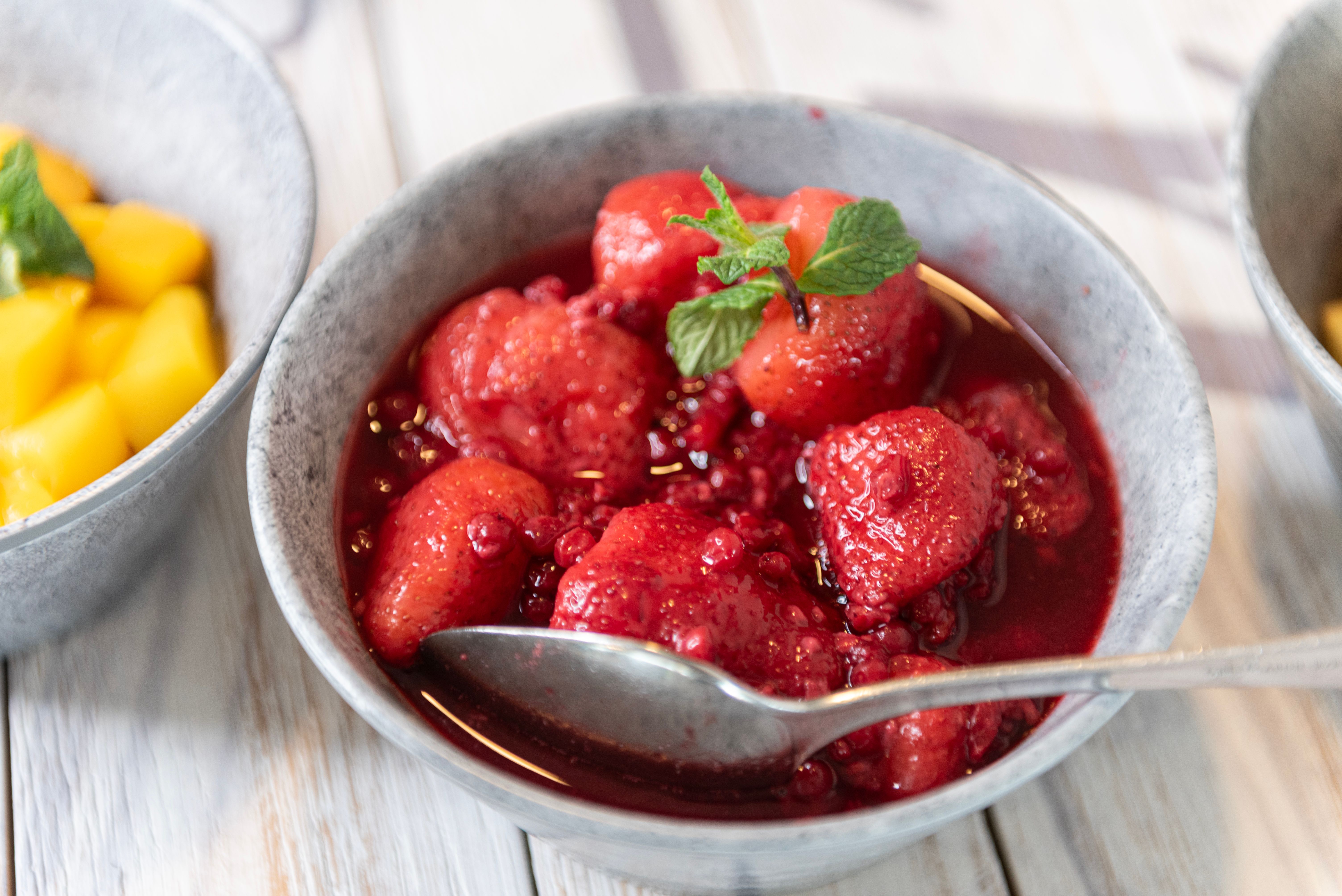
Photo: Miquel Rosselló Calafell / Pexels
The diets react (see scores below)
Common Ingredients
- raspberries
- strawberries
- red currants
- cherries
- sugar
- cornstarch
- cream
Specific recipes may vary.
Incompatible with 5 of 11 diets
Diet Ratings
Rote Grütze is a German berry compote that is fundamentally incompatible with a ketogenic diet. The dish combines multiple high-sugar fruits (cherries and strawberries are moderate-carb, red currants are higher, and raspberries are the only relatively keto-friendly option) with added sugar and cornstarch as a thickener. The added sugar alone disqualifies it, and cornstarch is a high-glycemic starch that will spike blood glucose and knock anyone out of ketosis rapidly. While cream is keto-friendly, it cannot offset the carbohydrate load from the fruit, sugar, and starch combination. A typical serving would easily contain 40-60g of net carbs, far exceeding the entire daily keto allowance in one snack.
Rote Grütze is a traditional German red berry compote made with raspberries, strawberries, red currants, and cherries thickened with cornstarch — all of which are fully plant-based. However, this recipe explicitly includes cream, which is a dairy product derived from cow's milk and is therefore not vegan. The dish as listed cannot be approved for a vegan diet. A vegan version is easily achievable by substituting the cream with a plant-based alternative such as coconut cream, oat cream, or soy-based whipped cream.
Rote Grütze contains three major non-paleo ingredients that disqualify it from approval. Refined sugar is explicitly excluded from the paleo diet. Cornstarch is derived from corn, a grain, and is therefore not paleo-compliant. Cream is a dairy product, also excluded. While the fruit base — raspberries, strawberries, red currants, and cherries — is entirely paleo-approved and nutritious, the dish as traditionally prepared cannot be considered paleo. There is no meaningful paleo version of this dish without substituting at least the sugar, cornstarch, and cream.
Rote Grütze is a German berry dessert made primarily from raspberries, strawberries, red currants, and cherries — all excellent, Mediterranean-diet-friendly fruits rich in antioxidants and fiber. However, the dish includes added sugar and cornstarch (a refined starch used as a thickener), which push it away from ideal Mediterranean principles. The cream topping adds saturated fat and is not a Mediterranean staple fat. The fruit base is strongly approved, but the added sugar and cream moderate the overall assessment. Enjoyed occasionally in small portions, this dish is acceptable, but it is not a Mediterranean dietary staple.
Some Mediterranean diet interpreters would view this more favorably, arguing that a modest fruit-forward dessert with small amounts of added sugar is well within the traditional Mediterranean pattern of ending meals with seasonal fruit — the cream could be replaced or minimized, and the cornstarch is a minor ingredient. Conversely, stricter modern clinical guidelines (e.g., those emphasizing minimal added sugars) would score this lower.
Rote Grütze is a German berry dessert made almost entirely of plant-derived ingredients: raspberries, strawberries, red currants, cherries, sugar, and cornstarch. All of these are strictly excluded on the carnivore diet. The only animal-derived ingredient is the cream served alongside, which is a minor component. With no meaningful animal protein source and the dish being fundamentally a fruit compote thickened with a grain-derived starch and sweetened with sugar, this is incompatible with carnivore principles at every level.
Rote Grütze contains three excluded ingredients: (1) sugar, which is an added sugar explicitly banned on Whole30; (2) cornstarch, which is explicitly excluded by the Whole30 program; and (3) cream, which is a dairy product and therefore excluded. The fruit base (raspberries, strawberries, red currants, cherries) would be perfectly compliant on its own, but the combination of added sugar, cornstarch, and cream makes this dish firmly off-limits.
Rote Grütze is a traditional German berry compote thickened with cornstarch and served with cream. Most of its ingredients are individually manageable on a low-FODMAP diet at controlled portions, but the combination creates stacking risk. Raspberries and strawberries are low-FODMAP at standard servings (around 60g and 140g respectively per Monash). Red currants are low-FODMAP at around 1 tablespoon (Monash data is limited). Cherries are the primary concern — they are high in polyols (sorbitol) and are high-FODMAP at servings as small as 3 cherries (around 45g); a typical Rote Grütze serving will contain a significant cherry component. Cornstarch and sugar are low-FODMAP. Cream is low-FODMAP at around 2 tablespoons (it is very low in lactose), but larger pours become problematic. The dish as a whole rates as 'caution' because cherries drive the polyol risk, and the cumulative FODMAP load from multiple fruits in a typical serving size is likely to exceed safe thresholds even if each fruit individually might be within limits.
Monash University classifies cherries as high-FODMAP at any realistic serving due to sorbitol content; a version of this dish made without cherries (using only raspberries and strawberries with minimal red currants) could be considered low-FODMAP at a controlled ~100–120g portion. Clinical FODMAP practitioners would generally advise avoiding standard Rote Grütze during elimination due to the cherry component and cumulative fruit FODMAP stacking.
Rote Grütze is primarily a berry-based dessert or snack, which aligns well with DASH principles — raspberries, strawberries, red currants, and cherries are all DASH-approved fruits rich in potassium, fiber, and antioxidants, and the dish is very low in sodium. However, two ingredients pull it back from a full 'approve' rating: added sugar (typically 3-6 tablespoons per serving), which DASH limits to ≤5 servings of sweets per week, and heavy cream served alongside, which is full-fat dairy high in saturated fat — a category DASH explicitly limits. If served with low-fat yogurt or a small amount of cream, the dish would score higher. The fruit base itself would score 8-9, but the added sugar and full-fat cream together warrant a 'caution' verdict.
NIH DASH guidelines explicitly restrict added sugars and full-fat dairy, placing this dish in 'caution' territory. However, some updated clinical interpretations note that emerging research has softened concerns around full-fat dairy's cardiovascular impact, and that moderate added sugar in an otherwise nutrient-dense, fruit-forward dish may be acceptable within overall DASH calorie and sugar budgets — particularly if cream is used as a small garnish rather than a substantial topping.
Rote Grütze is a traditional German berry compote made from raspberries, strawberries, red currants, and cherries — all of which are Zone-favorable fruits in moderate portions, being relatively low-glycemic and rich in polyphenols and antioxidants. However, the dish has several Zone problems: (1) Added sugar significantly raises the glycemic load, pushing what would otherwise be a reasonable fruit snack into 'unfavorable' territory. (2) The cornstarch thickener is a high-glycemic refined carbohydrate that adds additional unfavorable carb blocks. (3) Heavy cream adds saturated fat rather than the preferred monounsaturated fat. (4) As a snack, Rote Grütze is almost entirely carbohydrate and fat with no protein component, making it impossible to achieve the 40/30/30 Zone ratio on its own. It would need to be paired with a lean protein source to balance the meal. The berry base is genuinely Zone-friendly, but the sugar, cornstarch, and cream additions make this a challenging fit without significant modification.
A Zone-sympathetic practitioner might argue that a small portion of Rote Grütze — particularly if made with reduced sugar or a sugar substitute, and paired with a Greek yogurt or cottage cheese for protein — could fit within a Zone snack framework. The berries themselves are explicitly listed as favorable carb sources in Sears' books, and the polyphenol content aligns well with his anti-inflammatory emphasis. The dish is fundamentally fruit-based, and the problematic elements (sugar, cornstarch) are adjustable in home preparation.
Rote Grütze is a traditional German berry compote made primarily from highly anti-inflammatory fruits — raspberries, strawberries, red currants, and cherries — all of which are rich in antioxidants, polyphenols, anthocyanins, and vitamin C that actively reduce inflammatory markers like CRP and IL-6. These berries are among the most emphasized foods in anti-inflammatory nutrition. However, the dish is offset by two problematic components: added sugar (which is pro-inflammatory at meaningful quantities) and cream (full-fat dairy, which is in the 'limit' category due to saturated fat content). Cornstarch is a refined carbohydrate with minimal nutritional value but is used in small quantities as a thickener, making it a minor concern. The net profile depends heavily on preparation — a small dollop of cream and modest sugar keeps this a caution-range dish that leans positive; a heavily sweetened version with generous cream shifts it more pro-inflammatory. The outstanding berry base saves it from an 'avoid' rating, but the cream and sugar prevent approval.
Some anti-inflammatory nutritionists, including those following Dr. Weil's framework, might approve a lightly sweetened version of this dish given the exceptional antioxidant density of the berry base and the modest role of cream as a condiment. Conversely, stricter anti-inflammatory and autoimmune protocols (AIP, Wahls Protocol) would flag added sugar and full-fat dairy more firmly, potentially rating this closer to 'avoid' unless sugar is eliminated and cream replaced with a non-dairy alternative.
Rote Grütze is a traditional German berry compote made from raspberries, strawberries, red currants, and cherries, thickened with cornstarch and typically served with cream. The berry base provides genuine nutritional value — natural fiber, antioxidants, vitamins C and K, and meaningful water content that supports hydration, which is a priority for GLP-1 patients. However, the dish has several meaningful drawbacks for this population. It contains added sugar, which contributes empty calories and blood sugar spikes with minimal protein offset. Cornstarch is a refined, low-fiber thickener that adds digestible carbohydrates without nutritional value. The cream topping adds saturated fat, which can worsen GLP-1 side effects including nausea, bloating, and reflux. Critically, this dish contains no meaningful protein, making it a poor standalone snack for GLP-1 patients who need 15–30g of protein per eating occasion to protect muscle mass. As an occasional small-portion treat paired with a high-protein food (e.g., Greek yogurt or cottage cheese instead of cream), the berry component has merit. Served as presented — with cream and sugar — it scores as a caution rather than an approve.
Some GLP-1-focused dietitians view naturally fruit-forward dishes positively for their fiber content, hydration support, and palatability during periods of nausea when appetite is severely suppressed — arguing that getting any nutrient-dense calories in matters more than macronutrient balance at that stage. Others hold firm that every eating occasion must anchor on protein given the muscle-loss risk, and would rate any no-protein snack as categorically poor regardless of its fruit content.
*See how scores were generated at our methodology page.
Nutritional profile
Six traits that cut across every diet.
Fiber & Plants
How much whole-plant food and fiber it delivers.
Healthy Fats
The quality of its fats (unsaturated, omega-3).
Whole / Unprocessed
How close it is to its natural, unprocessed form.
Gut Gentle
How easy it is on digestion (low FODMAP, few irritants).
Low Glycemic
How little it spikes your blood sugar.
Protein Density
How much protein it packs per calorie.
Controversy Index
Higher controversy = more disagreement between diets.
Diet-Specific Tips
 Mediterranean — 5/10
View tips
- Strong fruit base (raspberries, strawberries, red currants, cherries) is highly Mediterranean-compatible
- Added sugar contradicts Mediterranean principle of minimal added sugars
- Cornstarch is a refined starch, not aligned with whole-grain preferences
- Cream adds saturated fat; not a primary Mediterranean fat source
- No olive oil or plant-based fat present
- Portion size and frequency of consumption are critical moderating factors
 Low-FODMAP — 5/10
View tips
- Cherries are high-FODMAP due to sorbitol (polyols) even at small servings (~3 cherries/45g)
- FODMAP stacking risk from combining multiple fruits in one serving
- Raspberries and strawberries are low-FODMAP at controlled portions but contribute to cumulative load
- Red currants have limited Monash testing data
- Cornstarch is low-FODMAP and a safe thickener
- Cream is low-FODMAP at small servings (~2 tbsp) but may be used more generously
- Standard dessert portion sizes make it difficult to keep total FODMAP load low
 DASH — 5/10
View tips
- High-quality DASH-approved fruit base (raspberries, strawberries, red currants, cherries) rich in potassium, fiber, and antioxidants
- Added sugar increases simple carbohydrate and calorie load beyond DASH sweets allowance
- Heavy cream is full-fat dairy high in saturated fat, explicitly limited by DASH guidelines
- Negligible sodium — a strong positive for DASH compliance
- Substituting low-fat yogurt or skyr for cream would significantly improve DASH compatibility
- Cornstarch is a neutral thickener with minimal nutritional impact
 Zone — 4/10
View tips
- Berries (raspberries, strawberries, red currants, cherries) are Zone-favorable low-glycemic carbs rich in polyphenols
- Added sugar significantly raises glycemic load — a core Zone concern
- Cornstarch is a high-glycemic refined starch that adds unfavorable carb blocks
- Heavy cream contributes saturated fat rather than preferred monounsaturated fat
- No protein component — cannot achieve 40/30/30 ratio as a standalone snack
- Must be paired with lean protein to function as a Zone snack
- Small portions of the berry base would be acceptable; the added ingredients are the problem
 Anti-Inflammatory — 5/10
View tips
- Raspberries, strawberries, red currants, and cherries are rich in anthocyanins and polyphenols with strong anti-inflammatory evidence
- Added sugar is pro-inflammatory and should be limited — quantity in preparation is critical
- Cream (full-fat dairy) is in the 'limit' category due to saturated fat content
- Cornstarch is a refined carbohydrate with negligible nutritional benefit
- Net profile is mixed: excellent fruit base undermined by sugar and cream
- Dish can be modified toward anti-inflammatory by reducing sugar and substituting cream with coconut cream or omitting it
 GLP-1 Friendly — 4/10
View tips
- No protein — fails the 15–30g per meal/snack protein target
- Added sugar raises blood glucose without nutritional return
- Cornstarch thickener is a refined carbohydrate with no fiber benefit
- Cream adds saturated fat, which can worsen nausea and reflux on GLP-1s
- Berry base is genuinely positive — fiber, antioxidants, water content, micronutrients
- Small portion of berries alone could be acceptable; full dish as served is nutritionally imbalanced for GLP-1 patients
- Easily improved by substituting cream with Greek yogurt to add protein and reduce saturated fat