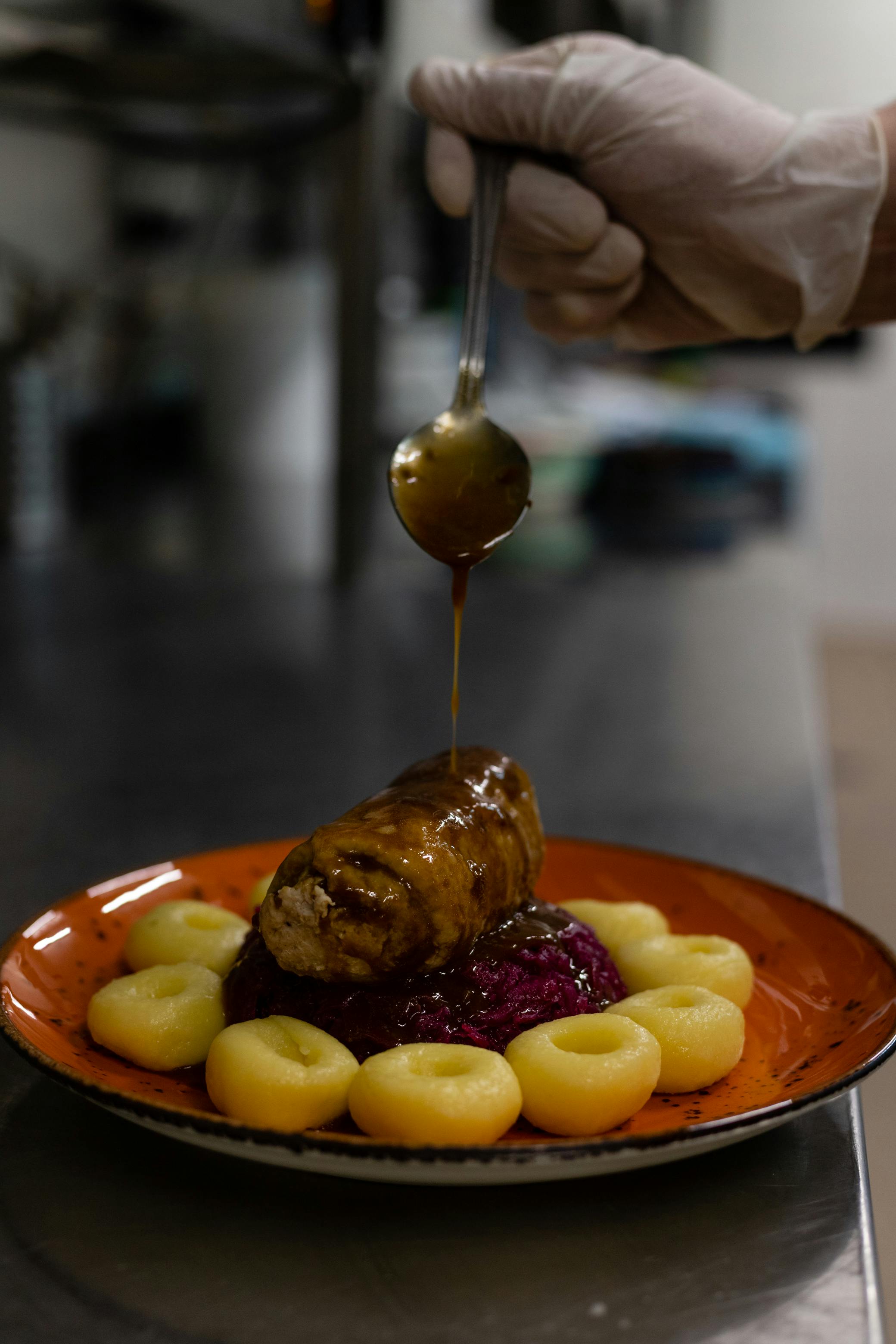
Photo: Mateusz Feliksik / Pexels
The diets react (see scores below)
Common Ingredients
- beef
- bacon
- onion
- pickles
- mustard
- beef broth
- red wine
Specific recipes may vary.
Incompatible with 6 of 11 diets
Diet Ratings
Rouladen is fundamentally a keto-friendly dish. Thin beef slices wrapped around bacon, onion, pickles, and mustard, braised in beef broth and red wine, are predominantly protein and fat with minimal carbs. The net carbs are low: onion and pickles contribute small amounts, mustard is negligible, and red wine used in braising concentrates as alcohol burns off leaving trace carbs. The gravy/sauce made from beef broth and red wine reduction is the main carb concern, but in typical serving portions it remains well within keto limits. Beef and bacon provide excellent fat and protein profiles ideal for keto.
Some stricter keto practitioners flag red wine as a concern — even in cooking, residual sugars and carbs remain, and certain keto protocols discourage any alcohol-derived ingredients. Additionally, traditional Rouladen recipes sometimes include a small amount of flour or cornstarch to thicken the gravy, which would push this dish toward caution if that variation is used.
Rouladen is a classic German dish built entirely around animal products. The primary protein is beef (thinly sliced beef rolls), which is wrapped around bacon — both directly animal-derived. Beef broth is made from animal bones and meat. These three ingredients alone make this dish completely incompatible with a vegan diet. There is no plant-based ambiguity here; every core component of the dish is an animal product.
Rouladen contains several non-paleo ingredients that disqualify it from approval. Bacon is a processed meat containing added salt, nitrates, and preservatives, making it a clear paleo violation. Pickles typically contain added salt and vinegar with preservatives. Mustard in its commercial form usually contains added salt and sometimes sugar or vinegar-based additives. Beef broth from commercial sources commonly contains added salt and flavor enhancers. Red wine, while debated, adds further concern. The beef itself is paleo-approved, and onion is fine, but the combination of processed bacon, commercially prepared condiments, and broth with additives means this traditional German dish as commonly prepared cannot be considered paleo-compliant.
Rouladen is a traditional German dish centered on rolled beef filled with bacon — combining two red/processed meats that directly contradict Mediterranean diet principles. Red meat is limited to a few times per month, and processed meats like bacon are strongly discouraged or excluded entirely. The dish is high in saturated fat from both the beef and bacon, with no plant-based protein emphasis. While onions, pickles, mustard, and red wine are benign or even positive components, they are minor elements that do not offset the core protein composition. The use of beef broth is neutral, and red wine in cooking is acceptable, but these positives are marginal against the dominant red and processed meat profile. This dish is fundamentally incompatible with Mediterranean diet principles as a regular meal.
Rouladen is a traditional German beef roll that, while centered on beef and bacon (both carnivore-approved), contains multiple plant-based ingredients that disqualify it from the carnivore diet. Onions, pickles (cucumber with vinegar and spices), and mustard are all plant-derived. Red wine is a plant-derived fermented beverage with sugar and plant compounds. Mustard contains seeds and often vinegar. These ingredients are not incidental trace additives — they are core structural components of the dish, used as the filling and braising liquid. Even practitioners who are lenient about spices would draw the line at whole onions, pickles, and wine as primary ingredients. The beef broth and bacon are the only carnivore-compatible elements. This dish cannot be modified slightly to become carnivore-compliant; it would require a fundamental reinvention.
Rouladen is a German dish of thin beef slices rolled around bacon, onion, pickles, and mustard, then braised in beef broth. Most of the core ingredients are Whole30-compliant: beef, onion, and beef broth are straightforwardly allowed. Red wine used in cooking (as a braising liquid) is technically permitted under Whole30 rules — alcohol used in cooking is not excluded. However, several ingredients require careful label-reading: (1) Bacon commonly contains added sugar and/or nitrates — a compliant, sugar-free version must be sourced. (2) Pickles often contain added sugar or sulfites — a compliant version (just cucumbers, vinegar, salt, spices) must be verified. (3) Mustard is usually compliant but some brands include sugar, wine, or non-compliant additives — label check required. (4) Beef broth may contain sugar, MSG (now allowed per 2024 rules), or other additives — a compliant version is needed. With careful sourcing of compliant versions of each processed ingredient, this dish can be made Whole30-compliant, but it requires diligence.
Some Whole30 practitioners may flag the reliance on multiple processed/cured ingredients (bacon, pickles, mustard, broth) as contrary to the program's whole-food philosophy, even if compliant versions are used. Melissa Urban's guidance encourages minimizing dependence on processed foods, and a dish requiring four separate label-verified packaged items may undermine the spirit of the reset.
Rouladen contains multiple high-FODMAP ingredients that make it unsuitable during the elimination phase. Onion is one of the highest-FODMAP foods known, rich in fructans, and is a core ingredient in the filling — there is no safe serving size. The beef broth used in braising almost certainly contains onion and/or garlic (standard in commercial and homemade broths), adding further fructan load. Red wine contains polyols (sorbitol) and fructose at amounts that can be problematic, especially when used in quantity for braising. Pickles and mustard are generally low-FODMAP in small amounts, and bacon and beef are naturally FODMAP-free proteins. However, the onion alone disqualifies this dish during strict elimination, and the broth compounds the problem significantly.
Rouladen is fundamentally incompatible with DASH diet principles across multiple dimensions. The dish combines several high-sodium, high-saturated-fat ingredients that DASH explicitly limits. Beef (especially the thin slices of round used in Rouladen) is red meat, which DASH limits significantly. Bacon is a processed red meat high in both sodium and saturated fat — one of the clearest 'avoid' foods on DASH. Pickles are extremely high in sodium, often contributing 300–900mg per serving. Mustard adds additional sodium. Beef broth (standard commercial versions) is notoriously high in sodium, often 800–1,000mg per cup. The combination of bacon + pickles + beef broth + mustard creates a sodium load that can easily exceed the entire daily DASH sodium budget (1,500–2,300mg) in a single serving. Additionally, the saturated fat from both the beef and bacon conflicts with DASH's emphasis on limiting total and saturated fat. While onion and red wine offer minor cardiovascular benefits (polyphenols, potassium), these do not meaningfully offset the dish's overall DASH incompatibility. This dish would require fundamental reformulation — eliminating bacon, using low-sodium broth, and swapping pickles for fresh vegetables — to approach DASH acceptability.
Rouladen is a German dish of thinly pounded beef rolled with bacon, onions, pickles, and mustard, braised in beef broth and red wine. From a Zone perspective, the dish has both strengths and challenges. The lean beef provides quality protein, and onions, pickles, and mustard are low-glycemic, Zone-favorable ingredients. The broth and red wine braising liquid add polyphenols (wine) with minimal glycemic impact in the quantities used for cooking. However, the bacon introduces saturated fat, which the Zone diet — especially in Dr. Sears' earlier writings — actively discourages in favor of monounsaturated fats. The overall fat profile leans toward saturated rather than the preferred monounsaturated sources. Additionally, Rouladen is traditionally served with sides like potato dumplings (Kartoffelklöße) or bread dumplings, which are high-glycemic carbs that would significantly worsen Zone compatibility. Evaluated as a protein component alone, it scores reasonably well — the beef is lean, the aromatics are favorable, and portion control is manageable. The bacon and saturated fat content prevent a higher score. A Zone-adapted version would use turkey bacon or omit bacon, pair with steamed vegetables instead of dumplings, and add a drizzle of olive oil to hit monounsaturated fat targets.
Dr. Sears' later anti-inflammatory writings (e.g., 'The Zone Diet' updated editions and his omega-3/polyphenol focus) acknowledge that modest saturated fat from whole food sources like bacon in small quantities is acceptable if the overall meal ratio is maintained. Some Zone practitioners argue that the pickle and mustard components, along with the polyphenol-rich red wine braising, make Rouladen a defensible Zone meal component when paired with non-starchy vegetable sides. The beef itself, if from a lean cut, aligns well with Zone protein blocks.
Rouladen is a traditional German braised beef dish with several problematic ingredients from an anti-inflammatory perspective, though also some mitigating factors. The primary protein is beef — a red meat that anti-inflammatory guidelines recommend limiting due to saturated fat content and arachidonic acid, which can promote inflammatory signaling. Bacon adds further saturated fat and is a processed meat with added sodium and nitrates, both associated with increased inflammatory markers. However, the dish is not entirely negative: onions are rich in quercetin, a potent anti-inflammatory flavonoid; mustard contains anti-inflammatory compounds including turmeric (in yellow mustard) and glucosinolates; pickles (fermented cucumbers) may offer modest gut-health benefits; and red wine in the braise contributes resveratrol and polyphenols. Beef broth, especially if homemade, is largely neutral. The cooking method (slow braising) is generally better than high-heat grilling, which can produce advanced glycation end-products (AGEs). Overall, the dish is not acutely pro-inflammatory like a fast food item or trans-fat-laden food, but its core of red meat plus processed bacon places it in 'limit' territory per anti-inflammatory frameworks. It earns a caution rating — acceptable occasionally for those following an anti-inflammatory diet, but not a staple.
Some anti-inflammatory practitioners, particularly those following Dr. Weil's more moderate framework, would note that occasional red meat consumption as part of an otherwise plant-rich diet is acceptable, and the polyphenol contributions from red wine, onion, and mustard partially offset concerns. Conversely, stricter anti-inflammatory and autoimmune-focused protocols (e.g., AIP, or functional medicine approaches emphasizing CRP reduction) would flag both red meat and processed bacon as foods to avoid more consistently, pushing this dish closer to a score of 3.
Rouladen is a German braised beef roll that offers meaningful protein from the beef itself, but is substantially compromised by several GLP-1 unfriendly elements. Bacon adds saturated fat and sodium; the red wine in the braising liquid introduces alcohol (even cooked, it raises concerns about empty calories, though most alcohol cooks off); and the fatty cut of beef typically used (top round or flank) plus bacon together create a high saturated fat load per serving. On the positive side, braising makes the meat tender and relatively easy to digest, the dish is served in small portions by nature, pickles and onion add modest fiber and digestive benefit, and the protein yield per serving is reasonable (25-35g depending on portion). The broth base is preferable to a cream or butter sauce. However, this dish does not prioritize lean protein, contains processed meat (bacon), includes alcohol in preparation, and has moderate-to-high saturated fat — enough to potentially worsen GLP-1 side effects like nausea, reflux, and bloating. It sits in caution territory: acceptable occasionally in a small portion, but not a recommended staple for GLP-1 patients.
Some GLP-1-focused RDs would argue that if bacon is minimized to a thin slice (as is traditional) and portion size is kept small, the saturated fat load is manageable and the high protein density of braised beef justifies inclusion as an occasional meal. Others maintain that any processed meat combined with red wine and high saturated fat warrants avoidance, particularly for patients on higher doses experiencing stronger GI sensitivity.
*See how scores were generated at our methodology page.
Nutritional profile
Six traits that cut across every diet.
Fiber & Plants
How much whole-plant food and fiber it delivers.
Healthy Fats
The quality of its fats (unsaturated, omega-3).
Whole / Unprocessed
How close it is to its natural, unprocessed form.
Gut Gentle
How easy it is on digestion (low FODMAP, few irritants).
Low Glycemic
How little it spikes your blood sugar.
Protein Density
How much protein it packs per calorie.
Controversy Index
Higher controversy = more disagreement between diets.
Diet-Specific Tips
 Keto — 8/10
View tips
- High-quality beef is the primary ingredient — excellent protein and fat source
- Bacon adds beneficial saturated fat with near-zero carbs
- Onion and pickles contribute minimal net carbs in small quantities used
- Mustard is keto-friendly in typical amounts
- Red wine in braising reduces significantly but leaves some residual carbs — monitor sauce quantity
- No grains or starches in the base recipe — avoid thickened gravy versions
- Overall net carbs per serving estimated at 4-8g depending on sauce amount
 Whole30 — 5/10
View tips
- Beef is fully Whole30-compliant as a protein source
- Red wine used in braising is permitted — alcohol in cooking is not excluded
- Bacon commonly contains added sugar — a compliant, sugar-free version is required
- Pickles may contain added sugar — must verify label shows only compliant ingredients
- Mustard is usually compliant but some brands add sugar or non-compliant additives
- Beef broth must be checked for added sugar or non-compliant additives
- Onion is fully compliant
 Zone — 5/10
View tips
- Lean beef is a Zone-favorable protein source, approximately aligned with 1-2 protein blocks per serving
- Bacon adds saturated fat, conflicting with Zone's preference for monounsaturated fat sources
- Onions, pickles, and mustard are low-glycemic, Zone-favorable carbohydrate contributors
- Red wine and beef broth braising adds polyphenols with negligible glycemic impact at cooking quantities
- Traditional accompaniments (potato/bread dumplings) are high-glycemic and would significantly disrupt Zone ratios
- Fat profile is predominantly saturated rather than the preferred monounsaturated fat
- Dish is manageable in Zone with side substitution (steamed vegetables) and bacon reduction or elimination
 Anti-Inflammatory — 4/10
View tips
- Red meat (beef) is a 'limit' food in anti-inflammatory guidelines due to saturated fat and arachidonic acid
- Bacon is a processed meat with added sodium and nitrates — pro-inflammatory
- Onion provides quercetin, a well-researched anti-inflammatory flavonoid
- Red wine in braising adds resveratrol and polyphenols (beneficial, though alcohol is moderated)
- Mustard and pickles are largely neutral to mildly beneficial
- Slow braising reduces AGE formation compared to high-heat cooking methods
- No trans fats, refined sugars, or seed oils present
- Not a regular anti-inflammatory staple, but acceptable occasionally in a broader anti-inflammatory dietary pattern
 GLP-1 Friendly — 4/10
View tips
- Moderate-to-high saturated fat from beef cut plus bacon
- Bacon is a processed meat — generally limited for GLP-1 patients
- Red wine in braising liquid introduces alcohol, even partially cooked off
- Good protein yield per serving (est. 25-35g) supports muscle preservation
- Braised preparation improves digestibility compared to fried or grilled
- No fiber-rich ingredients beyond onion and pickle — low fiber dish
- Broth-based sauce preferred over cream or butter alternatives
- Small traditional portion size is a relative advantage
- High sodium content from bacon, mustard, pickles, and broth