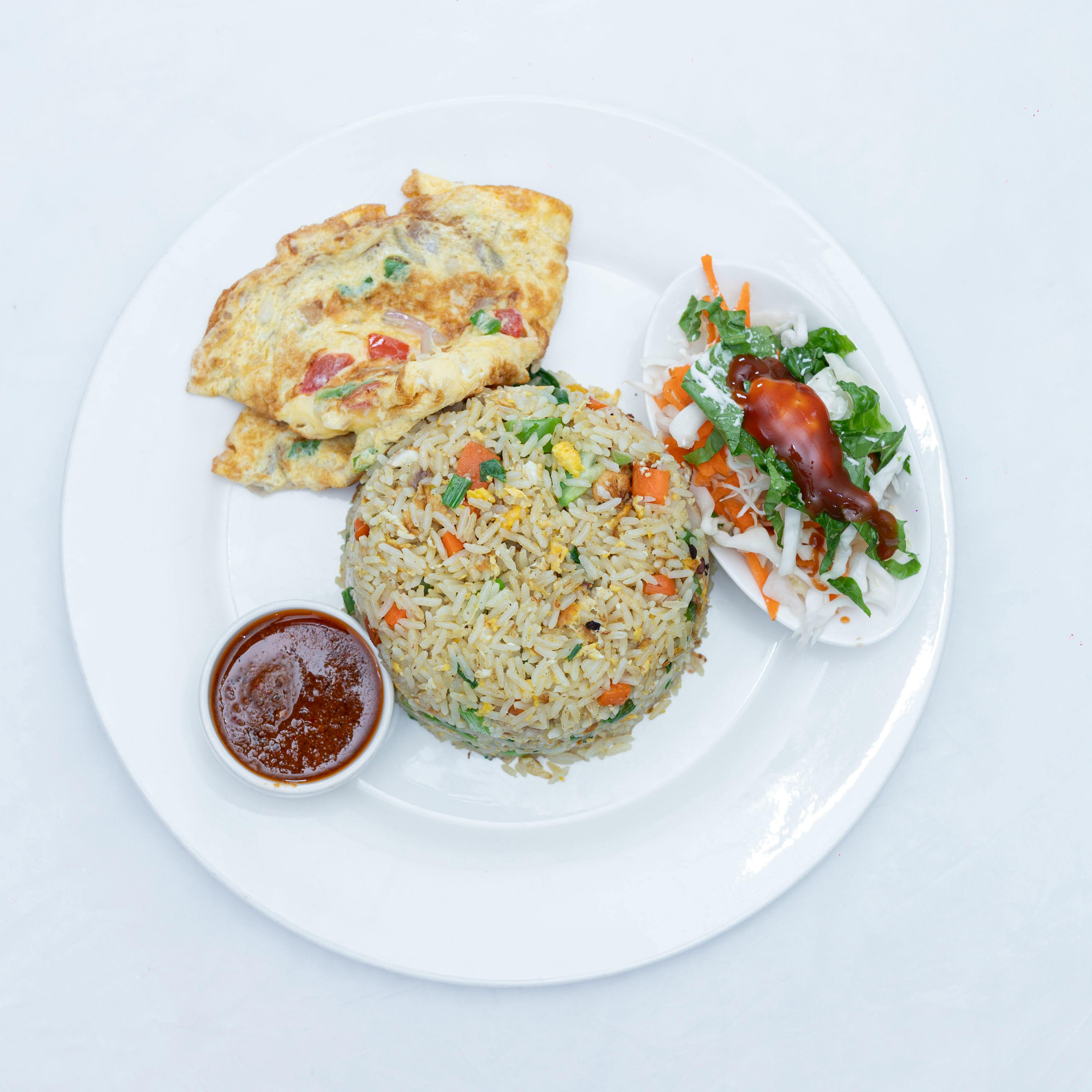
The diets react (see scores below)
Common Ingredients
- rice
- vegetable oil
- onion
- ginger
- garlic
- cloves
- bay leaves
- salt
Specific recipes may vary.
Incompatible with 5 of 11 diets
Diet Ratings
Angwa Mo is a Ghanaian spiced rice dish where rice is the primary and dominant ingredient. Rice is one of the highest net-carb foods available — a single cup of cooked rice contains approximately 45g of net carbs, which alone can exceed or consume the entire daily keto carb allowance. There is no meaningful way to consume a standard serving of this dish and remain in ketosis. The vegetable oil adds fat, and the aromatics (onion, ginger, garlic, cloves, bay leaves) contribute negligible carbs in spice quantities, but none of this offsets the fundamental incompatibility of rice as the base. This dish is structurally built around a grain and cannot be modified into a keto-compatible form without replacing the core ingredient entirely.
Angwa Mo is a Ghanaian spiced rice dish cooked in oil with aromatics. Every ingredient listed — rice, vegetable oil, onion, ginger, garlic, cloves, bay leaves, and salt — is entirely plant-based with no animal products or animal-derived ingredients present. The dish is built around whole or minimally processed plant foods (rice and spices), with vegetable oil being the only processed component, which is standard in cooking. There is nothing ambiguous or contested about any of these ingredients from a vegan standpoint.
Angwa Mo is a Ghanaian spiced rice dish that is fundamentally incompatible with the paleo diet. Rice is a grain and is explicitly excluded from paleo eating. Vegetable oil (likely a seed oil such as sunflower or soybean) is also a prohibited ingredient, as paleo favors animal fats, olive oil, coconut oil, or avocado oil. Added salt is likewise discouraged under strict paleo guidelines. While the aromatic ingredients — onion, ginger, garlic, cloves, and bay leaves — are all paleo-approved herbs and vegetables, the foundational ingredients of this dish (rice and vegetable oil) place it firmly in the 'avoid' category. There is no meaningful way to adapt this dish while keeping it recognizable, as rice is its primary and defining component.
Angwa Mo is a Ghanaian spiced rice dish made with white rice cooked in vegetable oil with aromatic spices. The spice profile (onion, garlic, ginger, cloves, bay leaves) is strongly aligned with Mediterranean flavors and principles. However, two factors temper the rating: (1) white rice rather than a whole grain is the base, which modern Mediterranean diet guidelines discourage in favor of whole grains like brown rice, farro, or bulgur; and (2) the fat source is generic vegetable oil rather than extra virgin olive oil, which is the cornerstone fat of the Mediterranean diet. The dish is otherwise whole-food, plant-forward, minimally processed, and free of added sugars or red meat, making it acceptable in moderation especially if the oil is swapped for olive oil.
Some traditional Mediterranean cuisines, particularly in Spain, Greece, and the Middle East, do incorporate white rice regularly (e.g., Greek pilafi, Spanish arroz), and moderate consumption is considered compatible by some Mediterranean diet practitioners. From this perspective, the dish's aromatic, whole-food character could earn a higher approval rating.
Angwa Mo is a Ghanaian spiced rice dish made entirely from plant-based ingredients. Every single component — rice (grain), vegetable oil (plant oil), onion, ginger, garlic, cloves, bay leaves — is explicitly excluded on the carnivore diet. There are no animal products whatsoever in this dish. This is a straightforward avoid with maximum confidence, as grains and plant oils are among the most universally rejected foods across all carnivore diet tiers.
Angwa Mo is a Ghanaian spiced rice dish. Rice is explicitly excluded on the Whole30 program as a grain. Regardless of the other ingredients (vegetable oil, onion, ginger, garlic, cloves, bay leaves, and salt — all of which are compliant), the rice as the primary base ingredient makes this dish incompatible with Whole30.
Angwa Mo (Ghanaian spiced rice) contains multiple high-FODMAP ingredients that make it unsuitable during the elimination phase. Garlic and onion are both high in fructans and are among the most problematic FODMAP foods — they are high-FODMAP at any typical cooking quantity and cannot be made safe by reducing portion size of the dish. Cloves also contain moderate-to-high FODMAPs (polyols/other). While rice and vegetable oil are low-FODMAP, and ginger and bay leaves are generally safe at culinary amounts, the foundational aromatics of this dish — garlic and onion — are disqualifying for the elimination phase. Even if the onion and garlic were removed from the final dish after cooking, FODMAPs (being water-soluble) leach into the cooking liquid/rice, making the entire dish high-FODMAP.
Angwa Mo is a Ghanaian spiced rice dish cooked in vegetable oil with aromatic spices (onion, ginger, garlic, cloves, bay leaves). The core ingredients are broadly compatible with DASH principles: white rice is a neutral grain (though not a whole grain), vegetable oil is acceptable in moderation, and the spices are DASH-friendly aromatics that can reduce reliance on salt for flavor. The main concerns are: (1) the use of white rice rather than brown rice — DASH emphasizes whole grains, making brown rice a preferable choice; (2) the amount of vegetable oil used in preparation can be significant in traditional recipes, adding calories and fat; and (3) the added salt level is unclear — if used liberally, sodium could become a concern. On the positive side, the dish is free from red meat, saturated fat sources, added sugar, and processed ingredients. With modest oil, limited salt, and ideally a substitution of brown rice, this dish would align well with DASH. As commonly prepared with white rice and moderate oil, it earns a cautious approval.
NIH DASH guidelines emphasize whole grains over refined grains, which would technically place white rice in a 'use sparingly' category. However, updated clinical interpretations note that white rice in moderate portions within an otherwise nutrient-rich dietary pattern has minimal cardiovascular impact, and the spice-forward, low-saturated-fat profile of this dish is consistent with DASH spirit even if not its letter.
Angwa Mo is a Ghanaian spiced rice dish cooked in oil, making rice the dominant macronutrient. White rice is a high-glycemic carbohydrate that Dr. Sears explicitly classifies as an 'unfavorable' carb in Zone methodology — it spikes insulin rapidly and provides little fiber to slow absorption. The dish is essentially pure high-GI carbohydrate with added fat (vegetable oil, likely omega-6-heavy), and critically, no protein whatsoever. This makes it nearly impossible to construct a Zone-balanced meal from Angwa Mo alone. The 40/30/30 macro ratio cannot be achieved without adding substantial lean protein and swapping or drastically reducing the rice portion. The aromatic spices (ginger, garlic, cloves, onion) are Zone-friendly and anti-inflammatory, which is a small positive. However, the core macro profile — high-glycemic carbs, omega-6 fat, zero protein — is fundamentally misaligned with Zone principles. A small portion could be used as a carb block component in a larger Zone-constructed meal, but even then, white rice ranks poorly versus preferred low-GI carbs. It scores a 3 rather than 1-2 because it is real food (not processed junk or pure sugar) and the spice profile has merit.
Angwa Mo is a Ghanaian spiced rice dish cooked with aromatic ingredients. Its profile is mixed from an anti-inflammatory standpoint. On the positive side, the dish features several potent anti-inflammatory spices: ginger and garlic are well-supported for reducing inflammatory markers (CRP, IL-6), cloves are among the highest antioxidant-scoring spices, and bay leaves contain compounds like linalool and eugenol with anti-inflammatory properties. Onion provides quercetin, a beneficial flavonoid. These aromatics are genuinely meaningful contributors. However, the base is white rice — a refined grain with a high glycemic index that can promote inflammatory responses, particularly when consumed in the large quantities typical of a main dish. The anti-inflammatory framework favors whole grains (brown rice, quinoa, farro) over white rice. The 'vegetable oil' is ambiguous and potentially problematic: if it is a high-omega-6 refined oil such as corn, sunflower, or cottonseed oil — common in Ghanaian cooking — it conflicts with anti-inflammatory principles. If it is extra virgin olive oil or avocado oil, the picture improves. The dish has no protein or significant fiber source, limiting its overall nutritional density. Overall, the spice blend is a genuine bright spot, but the white rice base and uncertain oil type keep this in 'caution' territory.
The choice of cooking oil significantly shifts this dish's profile. Many mainstream anti-inflammatory researchers (including positions aligned with the AHA and Mediterranean diet research) consider moderate use of vegetable oils acceptable and focus more on overall dietary pattern than individual oils. Under this view, the aromatic spice base could push this dish toward approval. Conversely, stricter anti-inflammatory protocols would flag white rice more severely for its glycemic impact, potentially scoring this lower.
Angwa Mo is a Ghanaian spiced rice dish cooked in vegetable oil with aromatics (onion, ginger, garlic, cloves, bay leaves). It provides refined carbohydrates from white rice with no meaningful protein source, making it a poor fit as a standalone main dish for GLP-1 patients who must prioritize 15–30g of protein per meal. The vegetable oil adds fat without nutritional benefit at scale, and white rice is a refined grain with low fiber and high glycemic impact, which can destabilize blood sugar and offer little satiety per calorie. The aromatics (ginger, garlic, cloves) are digestively neutral to mildly beneficial and do not worsen GLP-1 side effects. The dish is not fried, not spicy, and is easy to digest, which prevents a lower score. It earns a caution rating rather than avoid because it is not inherently harmful — it is simply nutritionally incomplete and calorie-inefficient for the reduced appetite context of GLP-1 therapy. It could be salvaged by pairing with a high-protein side (grilled chicken, fish, legumes) and controlling oil quantity, but as described it does not meet GLP-1 dietary priorities.
*See how scores were generated at our methodology page.
Nutritional profile
Six traits that cut across every diet.
Fiber & Plants
How much whole-plant food and fiber it delivers.
Healthy Fats
The quality of its fats (unsaturated, omega-3).
Whole / Unprocessed
How close it is to its natural, unprocessed form.
Gut Gentle
How easy it is on digestion (low FODMAP, few irritants).
Low Glycemic
How little it spikes your blood sugar.
Protein Density
How much protein it packs per calorie.
Controversy Index
Higher controversy = more disagreement between diets.
Diet-Specific Tips
 Vegan — 9/10
View tips
- Rice is a whole-grain staple — fully vegan
- Vegetable oil is plant-derived — fully vegan
- Onion, ginger, garlic are whole plant aromatics
- Cloves and bay leaves are plant-based spices
- Salt is a mineral, not an animal product
- No meat, dairy, eggs, or any animal-derived additives present
- Dish is largely whole-food in character, scoring near the top of the approve range
 Mediterranean — 5/10
View tips
- White rice is a refined grain, less preferred than whole grains in modern Mediterranean guidelines
- Generic vegetable oil used instead of extra virgin olive oil, the canonical Mediterranean fat
- Aromatic spice blend (garlic, ginger, onion, cloves, bay leaves) is highly compatible with Mediterranean flavor principles
- No red meat, processed ingredients, or added sugars
- Entirely plant-based dish with no animal products
- Lacks legumes, vegetables, or other nutrient-dense Mediterranean staples that would boost the rating
 DASH — 5/10
View tips
- White rice used instead of DASH-preferred whole grain (brown rice)
- Vegetable oil is DASH-acceptable but quantity matters — traditional preparation may use significant amounts
- No red meat, saturated fat, added sugar, or processed ingredients — a positive profile
- Spices (ginger, garlic, cloves, bay leaves, onion) are DASH-friendly and reduce need for salt
- Added salt is a sodium concern depending on quantity used
- No lean protein source, reducing overall nutritional completeness for a main dish
- Switching to brown rice and limiting oil/salt would improve DASH compatibility significantly
 Zone — 5/10
View tips
- White rice is classified as an 'unfavorable' high-glycemic carbohydrate in Zone methodology — raises insulin significantly
- No protein present — impossible to achieve 30% protein ratio without external additions
- Vegetable oil is likely omega-6-heavy (e.g., soybean or palm oil common in Ghana), which conflicts with Zone's anti-inflammatory fat emphasis
- Aromatic spices (ginger, garlic, cloves) are Zone-positive — anti-inflammatory and polyphenol-rich
- As a standalone main dish, the macro ratio is deeply unbalanced (nearly all carbs and fat, zero protein)
- Could serve as a small carb block component in a broader Zone meal, but low-GI alternatives would be strongly preferred
 Anti-Inflammatory — 5/10
View tips
- White rice (refined grain, high glycemic index) — pro-inflammatory potential, especially in large portions
- Ginger and garlic — well-evidenced anti-inflammatory effects, reduce CRP and IL-6
- Cloves — exceptionally high ORAC/antioxidant value, eugenol is anti-inflammatory
- Bay leaves — contain linalool and eugenol with anti-inflammatory properties
- Onion — quercetin and flavonoid content support anti-inflammatory profile
- Vegetable oil — type unspecified; high-omega-6 refined oils (corn, sunflower) are discouraged; olive or avocado oil would be preferable
- No protein, legumes, or fiber-rich components to balance the dish
 GLP-1 Friendly — 4/10
View tips
- No protein source — fails the #1 GLP-1 dietary priority entirely as a standalone main
- White rice is a refined grain: low fiber, moderate glycemic index, poor nutrient density per calorie
- Vegetable oil adds fat calories with limited nutritional return at typical cooking quantities
- Aromatics (ginger, garlic, cloves) are GI-neutral to mildly beneficial and do not worsen side effects
- Not fried, not spicy, easy to digest — avoids the worst GLP-1 triggers
- Portion-sensitive: a small serving as a side paired with lean protein and vegetables would be more appropriate than as a standalone main