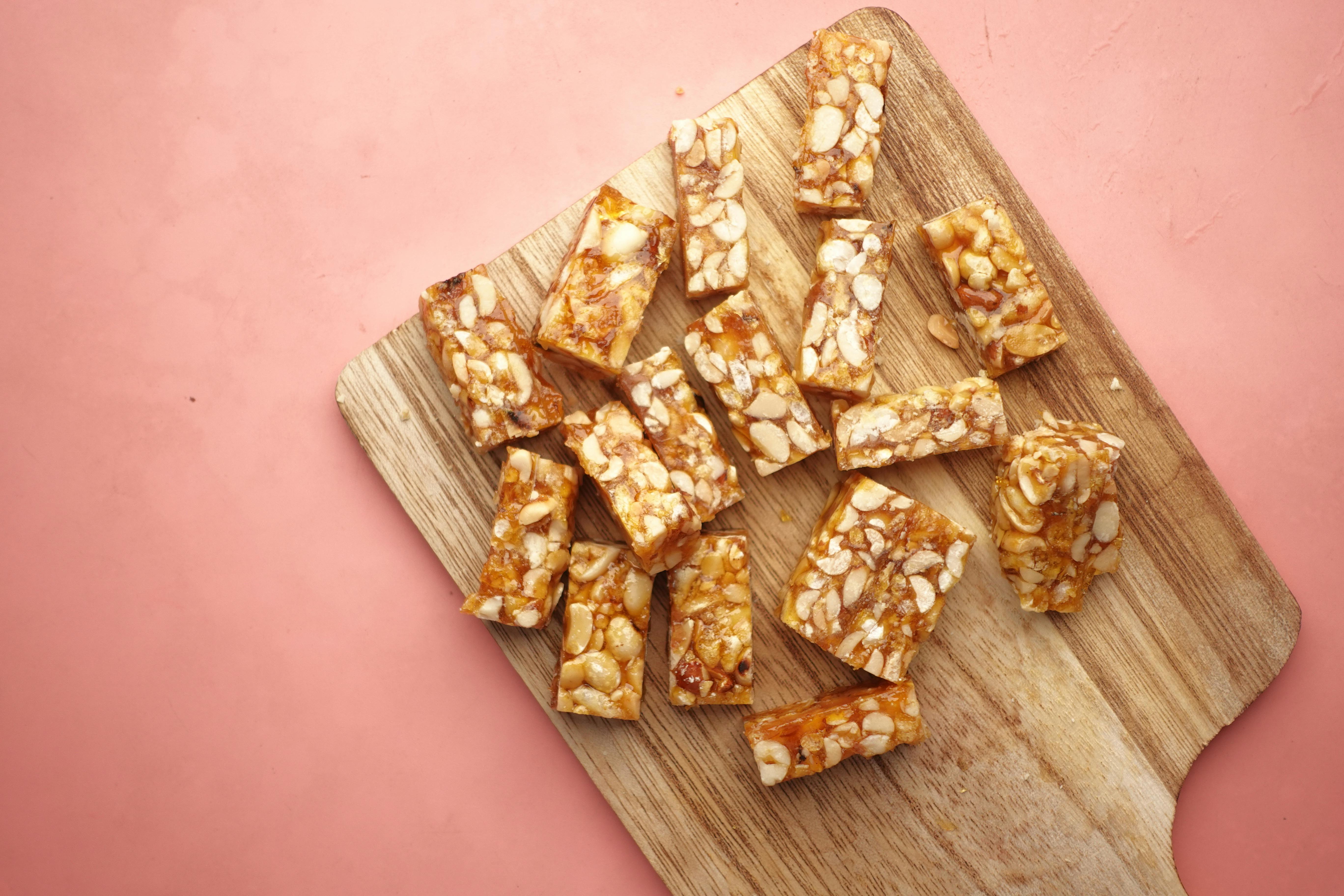
Photo: Towfiqu barbhuiya / Pexels
Ghanaian
Nkatie Cake
The diets react (see scores below)
Common Ingredients
- roasted peanuts
- sugar
- water
- salt
- ginger
Specific recipes may vary.
Incompatible with 7 of 11 diets
Diet Ratings
Nkatie Cake is a Ghanaian peanut brittle made by binding roasted peanuts with a sugar syrup (sugar and water cooked to a hard candy stage). While peanuts themselves are borderline keto-acceptable, the primary binding agent is pure sugar, making this candy fundamentally incompatible with ketosis. A standard serving would deliver a very high dose of net carbs almost entirely from added sugar, easily exceeding an entire day's keto carb allowance. There is no practical way to consume this in a portion that maintains ketosis.
Nkatie Cake is a traditional Ghanaian peanut brittle-style snack made entirely from plant-based ingredients. Roasted peanuts provide protein and healthy fats, while sugar, water, salt, and ginger complete the recipe. There are no animal products or animal-derived ingredients present. The minimal processing and use of whole-food peanuts as the primary ingredient make this a strong vegan-compliant snack, scoring near the top of the approval range.
Nkatie Cake is a Ghanaian peanut brittle made from roasted peanuts, sugar, water, salt, and ginger. It fails on multiple paleo criteria simultaneously: peanuts are legumes (not nuts), not permitted on a paleo diet; refined sugar is explicitly excluded; and added salt is also discouraged. The only paleo-compliant ingredient in the entire dish is ginger. With three core non-paleo ingredients, this snack is firmly in the avoid category.
Nkatie Cake is a Ghanaian peanut brittle made primarily of roasted peanuts bound together with a sugar syrup. While peanuts (legumes) are genuinely Mediterranean-friendly and even encouraged as a plant-based protein and fat source, the dominant role of added sugar as a structural ingredient — not merely a flavoring — pushes this firmly into 'avoid' territory. The dish is essentially a confection: a high-sugar, calorie-dense candy where the sugar content likely rivals or exceeds the peanut content by caloric impact on blood glucose. Mediterranean diet principles explicitly minimize added sugars and sweets, reserving them for rare, occasional treats. The ginger and salt are negligible factors. This is not a staple snack compatible with the diet's emphasis on whole, minimally processed plant foods.
Some Mediterranean diet practitioners argue that small portions of nut-based sweets — analogous to traditional Mediterranean confections like Greek pasteli (sesame-honey brittle) or Middle Eastern nut candies — can be acceptable as very occasional treats within a broadly plant-forward diet. Under this lenient interpretation, the peanut base provides some nutritional redemption, and the dish could be tolerated in strict moderation rather than categorically avoided.
Nkatie Cake is a Ghanaian peanut brittle made entirely from plant-based ingredients: roasted peanuts (a legume), sugar, water, salt, and ginger. Every single ingredient except salt is either plant-derived or a processed sugar, making this completely incompatible with the carnivore diet. Peanuts are legumes — explicitly excluded. Sugar is a processed plant product — explicitly excluded. Ginger is a plant spice — excluded. There is no animal product of any kind in this dish.
Nkatie Cake contains two excluded ingredients: peanuts (a legume, explicitly banned on Whole30) and sugar (added sugar, explicitly banned on Whole30). This Ghanaian peanut brittle-style snack is fundamentally incompatible with the program regardless of preparation method or portion size.
Nkatie Cake is a Ghanaian peanut brittle made from roasted peanuts, sugar, water, salt, and ginger. Most ingredients are low-FODMAP: sugar (sucrose) is low-FODMAP, water and salt are FODMAP-free, and fresh ginger is low-FODMAP at typical culinary amounts (up to 1 teaspoon). The critical factor is peanuts: Monash University has tested peanuts and rates them as low-FODMAP at 32g (about 2 tablespoons) per serving. However, peanuts contain GOS (galacto-oligosaccharides) and fructans, and servings exceeding 32g push them into moderate-to-high FODMAP territory. Nkatie Cake is typically eaten in portions that may approach or exceed this threshold, especially as a snack. At a small, controlled portion (roughly 28-32g of peanut content), this snack could be considered low-FODMAP, but standard snack portions often exceed this. The remaining ingredients pose no FODMAP concern.
Monash University rates peanuts as low-FODMAP at 32g, but many clinical FODMAP practitioners advise caution with peanut-based snacks during elimination because portion control is difficult and GOS content rises quickly above the threshold. The enjoyable, moreish nature of brittle-style snacks makes staying within the safe serving size particularly challenging in practice.
Nkatie Cake is a Ghanaian peanut brittle made from roasted peanuts bound with a sugar-water syrup, with salt and ginger. The peanuts themselves are a DASH-friendly ingredient — nuts are explicitly encouraged in the DASH plan (4-5 servings/week) as a source of healthy unsaturated fats, magnesium, and protein. However, the high added sugar content (a sugar-syrup candy base) places this firmly in the 'sweets' category that DASH limits to 5 or fewer servings per week, ideally fewer. The salt adds sodium, though likely a modest amount. Ginger is neutral and beneficial. As a candy/confection, the primary concern is the significant added sugar load, which DASH explicitly limits. In small, occasional portions it is not categorically off-limits due to the nutritional value of peanuts, but the candy format makes it a treat rather than a core DASH food.
NIH DASH guidelines categorize sweets and added sugars as foods to limit, which would push this toward 'avoid' for strict adherents. However, updated clinical interpretations note that peanuts provide meaningful magnesium, potassium, and unsaturated fats — some DASH-oriented dietitians would allow small portions of nut-based confections as a way to include nuts, particularly when sodium is kept low, rather than applying a blanket avoid for all sweets.
Nkatie Cake is a Ghanaian peanut brittle made by binding roasted peanuts with a sugar syrup (sugar + water + salt + ginger). While peanuts themselves contain protein and monounsaturated fat that could theoretically fit Zone blocks, the dominant macronutrient context here is a high-glycemic sugar matrix that forms the structural base of the snack. Sugar is the primary binder, making this essentially a candy. From a Zone perspective, this is a pure sugar delivery vehicle with peanuts embedded in it — the carbohydrate portion is entirely high-glycemic refined sugar with zero fiber, offering no ability to moderate the glycemic response. There is no lean protein component, the fat is primarily from peanuts (which are higher in omega-6 polyunsaturated fat compared to preferred monounsaturated sources like almonds or macadamia nuts), and the carbohydrate block is extremely unfavorable. Balancing this into a Zone meal would require essentially not eating it in any meaningful quantity, as even a small piece delivers a disproportionate sugar load. The ginger and salt are negligible macro contributors. This is one of the clearest Zone 'avoid' cases — a confection where refined sugar is structurally inseparable from the food itself.
Nkatie Cake is a Ghanaian peanut brittle made from roasted peanuts, sugar, water, salt, and ginger. The profile is genuinely mixed. Peanuts contain monounsaturated fats, resveratrol, and polyphenols with some anti-inflammatory properties, plus fiber, magnesium, and vitamin E — all modest positives. Ginger is a well-established anti-inflammatory spice (gingerols). However, peanuts are also relatively high in omega-6 fatty acids (arachidonic acid precursor) and are a legume that some anti-inflammatory protocols flag for lectin content. More critically, the dominant ingredient by caloric impact after peanuts is added sugar — sugar is used in sufficient quantity to form a brittle (caramel), which is a meaningful pro-inflammatory concern. Added sugar promotes glycation, elevates CRP, and triggers insulin responses linked to inflammatory cascades. The salt is negligible as a concern. The ginger is a genuine positive but likely present in small amounts. On balance: anti-inflammatory benefits from peanuts and ginger are real but partially offset by the significant added sugar load inherent to a brittle/candy format. This is a snack to enjoy occasionally, not regularly.
Some anti-inflammatory practitioners (particularly those following AIP or stricter protocols) would rate this lower, flagging peanuts as pro-inflammatory due to high omega-6 content, lectin load, and aflatoxin contamination risk — peanuts are excluded entirely from Paleo and AIP frameworks. Conversely, mainstream nutrition research (including studies cited by Dr. Weil) treats peanuts similarly to tree nuts and considers them broadly acceptable in anti-inflammatory eating, making the sugar content the primary concern rather than the peanuts themselves.
Nkatie Cake is a Ghanaian peanut brittle — roasted peanuts bound together with a sugar syrup. While peanuts do provide some protein and unsaturated fat, the dominant nutritional profile here is high sugar and high fat in a small, calorie-dense package. The primary binder is a sugar-heavy caramel, making this a high-glycemic, empty-calorie snack with no fiber, no meaningful micronutrient contribution, and no practical protein delivery per serving. For GLP-1 patients, this fails on nearly every priority: it is sugar-forward (spiking blood glucose and stimulating hunger signaling), calorie-dense per gram (bad for patients already eating small volumes), high in total fat (worsening nausea and GI discomfort due to slowed gastric emptying), and nutritionally hollow relative to its caloric cost. The ginger and salt are negligible positives. This is precisely the category of snack — small, sweet, fatty, low-nutrient-density — that GLP-1 dietary guidance most consistently flags as counterproductive.
*See how scores were generated at our methodology page.
Nutritional profile
Six traits that cut across every diet.
Fiber & Plants
How much whole-plant food and fiber it delivers.
Healthy Fats
The quality of its fats (unsaturated, omega-3).
Whole / Unprocessed
How close it is to its natural, unprocessed form.
Gut Gentle
How easy it is on digestion (low FODMAP, few irritants).
Low Glycemic
How little it spikes your blood sugar.
Protein Density
How much protein it packs per calorie.
Controversy Index
Higher controversy = more disagreement between diets.
Diet-Specific Tips
 Vegan — 9/10
View tips
- All ingredients are plant-derived with no animal products
- Roasted peanuts are a whole-food legume, nutritionally valuable in a vegan diet
- Sugar is used but in typical brittle quantities; no bone char concern flagged unless specified as refined cane sugar from non-vegan sources (brand-dependent, not ingredient-level)
- Ginger adds flavor and is fully plant-based
- No honey, dairy, eggs, or other animal-derived binders used
- Minimal processing relative to packaged vegan snack foods
 Low-FODMAP — 5/10
View tips
- Peanuts are low-FODMAP at 32g but high-FODMAP at larger servings due to GOS and fructans
- Sugar (sucrose) is FODMAP-free and poses no concern
- Ginger is low-FODMAP at culinary quantities
- Salt and water contain no FODMAPs
- Portion size is the primary determinant of FODMAP safety for this dish
- Risk of exceeding safe peanut threshold in a typical snack serving
 DASH — 4/10
View tips
- High added sugar content — peanut brittle/candy format conflicts with DASH's limit on sweets
- Roasted peanuts are a DASH-approved nut source rich in magnesium, potassium, and unsaturated fats
- Salt adds sodium, though quantity in a small serving is likely modest
- No saturated fat concern — peanuts are predominantly mono- and polyunsaturated
- Ginger is DASH-neutral and anti-inflammatory
- Portion control is critical — a small occasional serving is more acceptable than regular consumption
 Anti-Inflammatory — 4/10
View tips
- Significant added sugar (caramel/brittle format) — pro-inflammatory, raises CRP and promotes glycation
- Peanuts provide monounsaturated fats, polyphenols, fiber, and vitamin E — modest anti-inflammatory benefit
- Peanuts are relatively high in omega-6 fatty acids — potential pro-inflammatory concern at high intake
- Ginger is a validated anti-inflammatory spice (gingerols) — positive but likely in small quantity here
- No trans fats, artificial additives, or processed oils — cleaner than most commercial candy
- Peanuts excluded from AIP/Paleo anti-inflammatory protocols due to lectin and omega-6 concerns