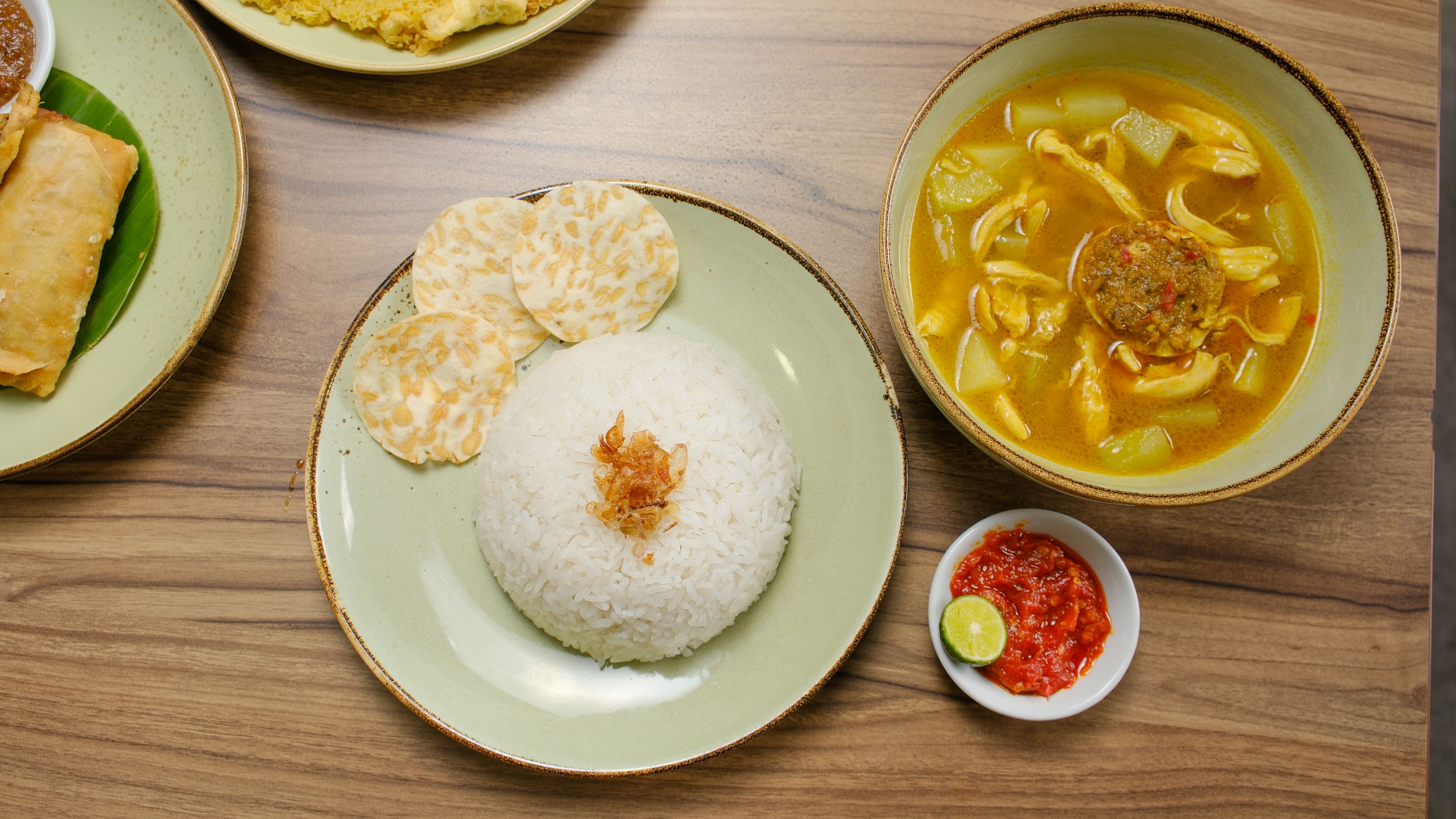
Photo: Fadli Octora Channel / Pexels
The diets react (see scores below)
Common Ingredients
- short-grain rice
- water
- salt
- groundnut soup
- chicken
Specific recipes may vary.
Incompatible with 6 of 11 diets
Diet Ratings
Omo Tuo is a Ghanaian rice ball dish made from short-grain rice that is boiled and pounded into a sticky, dense starchy ball. Rice is one of the highest net-carb foods available — a single serving of Omo Tuo can easily contain 60–80g+ of net carbohydrates, far exceeding the entire daily keto limit of 20–50g. While the accompanying groundnut soup with chicken contributes healthy fats and protein, the rice base itself is fundamentally incompatible with ketosis. No portion reduction can make rice balls keto-friendly, as even a small serving would breach the daily carb threshold. Grains are explicitly excluded from the ketogenic diet.
Omo Tuo contains chicken, which is an animal product and categorically excluded from a vegan diet. The dish is a Ghanaian rice ball typically served with groundnut (peanut) soup, but the inclusion of chicken in the soup makes this entirely incompatible with veganism. While the rice ball itself (short-grain rice, water, salt) is plant-based, and groundnut soup can be made vegan, the chicken listed as an ingredient is a direct disqualifier.
Omo Tuo is a Ghanaian rice ball dish made primarily from short-grain rice, which is a grain and strictly excluded from the paleo diet. Additionally, it is served with groundnut soup, which contains groundnuts (peanuts) — a legume that is also explicitly forbidden on paleo. Salt is added, which is also discouraged. The only paleo-compatible component is the chicken. With two core non-paleo ingredients (rice and groundnuts/peanuts) forming the foundation of the dish, this meal is fundamentally incompatible with paleo principles.
Omo Tuo is a Ghanaian rice ball dish made from short-grain white rice cooked to a sticky consistency, typically served with groundnut (peanut) soup and chicken. From a Mediterranean diet perspective, several factors pull in different directions. The short-grain white rice is a refined grain, which Mediterranean guidelines discourage in favor of whole grains — though white rice does appear in some traditional Mediterranean cuisines (e.g., Greek, Spanish) in moderation. The groundnut soup provides beneficial plant-based fats, legume-adjacent nutrition from peanuts, and likely vegetables, which aligns reasonably well with Mediterranean principles. Chicken is an acceptable moderate protein in the Mediterranean framework. However, groundnut soup is often rich in peanut paste/oil and may be calorie-dense; peanut oil is not the preferred Mediterranean fat (olive oil is canonical). The dish lacks olive oil, whole grains, or typical Mediterranean staples, and is not part of any Mediterranean culinary tradition. Overall, it is not strongly contradictory but sits outside the core Mediterranean pattern, warranting a caution rating.
Some modern Mediterranean diet interpretations are flexible about white rice in moderate portions, particularly when served alongside vegetable-rich soups — a Greek or Spanish practitioner might consider this dish acceptable if the soup contains abundant vegetables and the portion of rice is controlled. The peanuts in groundnut soup, as a legume-family food, also provide a plant-forward element that some nutritionists would view favorably.
Omo Tuo is a Ghanaian rice ball dish that is fundamentally incompatible with the carnivore diet. The primary base is short-grain rice, a grain that is strictly excluded on carnivore. The dish is traditionally served with groundnut (peanut) soup, which is legume/plant-based and also entirely off-limits. While chicken is present as a protein component, it cannot redeem a dish whose core ingredients are plant-derived grains and legumes. The entire dish structure violates carnivore principles at its foundation.
Omo Tuo is a Ghanaian rice ball dish made from short-grain rice cooked and pounded into a sticky ball, served with groundnut soup and chicken. Rice is an excluded grain on the Whole30 program, making this dish non-compliant regardless of the other ingredients. Additionally, groundnut soup is made from groundnuts (peanuts), which are legumes — another excluded category on Whole30. Both of the dish's core components (rice and peanuts) are explicitly excluded, making this a clear avoid.
Omo Tuo consists of pounded short-grain rice balls served with groundnut (peanut) soup and chicken. The rice itself is low-FODMAP and safe. Plain chicken is also low-FODMAP. However, groundnut soup is the critical problem: traditional Ghanaian groundnut soup is made with a base that almost universally includes onions and garlic (both high-FODMAP fructans), tomatoes (low-FODMAP in moderate amounts), and often additional aromatics like shallots or chili. While peanuts themselves are low-FODMAP at a 28g serving, the onion and garlic in the soup base make the dish high-FODMAP as typically prepared. The dish cannot be meaningfully ordered or consumed without the groundnut soup, which is inseparable from the dish's identity. Without a significant modification to the soup (omitting onion and garlic entirely, using garlic-infused oil instead), this dish is unsuitable during the elimination phase.
If the groundnut soup is prepared at home with garlic-infused oil instead of garlic cloves, and onion is replaced with the green tops of scallions, the dish could theoretically become low-FODMAP — Monash University confirms these substitutions work. However, clinical FODMAP practitioners would caution that as traditionally prepared and served, groundnut soup contains high-FODMAP ingredients that cannot be assumed absent, making this dish unreliable during strict elimination.
Omo Tuo is a Ghanaian dish of soft, sticky rice balls (made from short-grain rice cooked until very mushy) typically served with groundnut (peanut) soup and chicken. From a DASH perspective, several factors require caution. The short-grain white rice base lacks the fiber of whole grains DASH emphasizes, though rice itself is not prohibited. The groundnut soup is the primary concern: it is made with peanuts/groundnut paste, palm nut or tomato base, and often significant salt, which can push sodium content high. Groundnuts (peanuts) do offer DASH-friendly nutrients like magnesium, potassium, and unsaturated fats, but traditional groundnut soup preparation frequently uses palm oil (a tropical oil DASH limits due to saturated fat) and generous salt. The chicken component is lean protein, which is DASH-approved. Overall, the dish has DASH-compatible elements (legume-based protein, lean poultry) but is undermined by likely high sodium from soup seasoning, potential palm oil use raising saturated fat, and refined white rice rather than whole grain. With sodium and saturated fat as the main limiting factors, this dish lands in the caution zone — acceptable occasionally in smaller portions with low-sodium preparation modifications.
NIH DASH guidelines emphasize limiting sodium, saturated fat, and tropical oils, which traditional groundnut soup may exceed. However, updated clinical interpretations note that peanuts are a DASH-endorsed food, chicken is lean protein, and a home-prepared, low-sodium, palm-oil-reduced version of this dish could align reasonably well with DASH principles — context and preparation matter significantly here.
Omo Tuo is a Ghanaian dish consisting of soft, pounded short-grain rice balls served with groundnut (peanut) soup and chicken. From a Zone Diet perspective, this dish has several competing factors. The short-grain rice is a high-glycemic carbohydrate — it is the primary ingredient, is highly processed in texture (pounded to a sticky, gelatinous consistency), and ranks poorly in Zone terminology as an 'unfavorable' carb. However, the dish is served as a complete meal with groundnut soup and chicken, which provides lean protein (favorable) and fat from groundnuts (peanuts are largely monounsaturated, which Zone approves of). The macro ratio challenge is significant: the rice base dominates the carbohydrate load with a high glycemic impact, making it difficult to achieve the 40/30/30 ratio without dramatically reducing the rice portion. The chicken in the soup contributes lean protein favorably. Groundnut (peanut) fat is largely monounsaturated and omega-6, which Zone accepts cautiously — groundnuts are less ideal than almonds or macadamia nuts but are not condemned. As a complete dish, Omo Tuo could theoretically be Zone-portioned (small rice ball, generous chicken, moderate groundnut soup), but in its traditional serving size and ratio, the glycemic carb load from the rice balls dominates and disrupts Zone balance. A small portion with emphasis on the soup and chicken could be incorporated with care.
Some Zone practitioners may argue that peanuts and groundnut soup provide a meaningful monounsaturated fat contribution and that the chicken protein anchors the meal adequately. If the rice portion is kept very small (1 block of carbs) and the soup is rich in chicken and groundnuts, the overall meal could approach Zone ratios. Dr. Sears' later writings also emphasize anti-inflammatory polyphenols and omega-3s, and while this dish lacks those, it is not a nutritionally empty food. Zone-adapted versions with reduced rice and increased vegetable content in the soup could move this toward a moderate approval.
Omo Tuo is a Ghanaian dish of soft, pounded short-grain rice balls typically served with groundnut (peanut) soup and chicken. From an anti-inflammatory perspective, this dish presents a mixed profile. The groundnut soup is the most nutritionally complex component: groundnuts (peanuts) contain resveratrol, niacin, and some anti-inflammatory polyphenols, and the soup often includes onions, tomatoes, garlic, and ginger — all beneficial anti-inflammatory spices and aromatics. Chicken (lean poultry) is acceptable in moderation per anti-inflammatory guidelines. However, the base starch — short-grain white rice — is a refined carbohydrate with a high glycemic index that can spike blood sugar and promote low-grade inflammation when consumed regularly. It lacks the fiber, bran, and germ that make whole grains beneficial. Groundnut soup is also typically made with peanut butter or whole peanuts, which are relatively high in omega-6 fatty acids (linoleic acid); while not as concerning as seed oils, high omega-6 intake without adequate omega-3 balance is a mild inflammatory concern. The dish is not processed, contains no trans fats, added sugars, or artificial additives, and the soup's vegetable and spice base provides genuine anti-inflammatory benefit. Overall, this is a culturally whole, minimally processed meal with meaningful anti-inflammatory elements offset by a refined-carbohydrate base and moderate omega-6 load — placing it solidly in 'caution' territory.
Some anti-inflammatory practitioners, including followers of Dr. Weil's broadly permissive framework, might view this dish more favorably given its whole-food ingredients, lack of processing, and the anti-inflammatory potential of the soup's aromatics (garlic, ginger, onion, tomato). Others following stricter glycemic or omega-6-focused anti-inflammatory protocols would flag the white rice base and peanut oil content more strongly, rating it closer to the lower end of caution or even avoid for those with insulin resistance or autoimmune conditions.
Omo Tuo is a Ghanaian dish of soft, sticky pounded short-grain rice balls served with groundnut (peanut) soup and chicken. As a complete dish, it has meaningful redeeming qualities but several GLP-1 concerns. The chicken component provides genuine protein (15-25g depending on portion and cut), which is a positive. However, the rice balls themselves are a refined, high-glycemic starch with virtually no fiber and no protein — exactly the kind of empty-calorie base that is problematic when appetite is reduced. The groundnut soup is the most significant concern: groundnut (peanut) soup is typically high in fat from peanuts and palm oil (a saturated fat common in West African cooking), which can worsen GLP-1 side effects including nausea, bloating, and reflux due to slowed gastric emptying. The soft, mushy texture of the rice balls is actually beneficial — easy to digest and small-portion friendly. The dish's nutrient density per calorie is moderate at best, heavily dependent on the soup-to-rice ratio and how much chicken is included. As typically prepared and served, the high-fat soup base is the primary limiting factor. A modified version with more chicken, less soup, and a reduced rice portion would score higher.
Some GLP-1-focused dietitians would note that the chicken in groundnut soup can contribute meaningfully to protein targets, and that the soft texture of omo tuo makes it one of the more tolerable starchy staples for patients with GI side effects. Others, however, flag that the fat load from peanuts and palm oil in a traditional groundnut soup preparation is significant enough to warrant avoidance on high-nausea days or for patients early in their GLP-1 titration.
*See how scores were generated at our methodology page.
Nutritional profile
Six traits that cut across every diet.
Fiber & Plants
How much whole-plant food and fiber it delivers.
Healthy Fats
The quality of its fats (unsaturated, omega-3).
Whole / Unprocessed
How close it is to its natural, unprocessed form.
Gut Gentle
How easy it is on digestion (low FODMAP, few irritants).
Low Glycemic
How little it spikes your blood sugar.
Protein Density
How much protein it packs per calorie.
Controversy Index
Higher controversy = more disagreement between diets.
Diet-Specific Tips
 Mediterranean — 4/10
View tips
- Short-grain white rice is a refined grain, not preferred over whole grains in Mediterranean guidelines
- Groundnut (peanut) soup adds plant-based fats and likely vegetables, partially aligning with Mediterranean principles
- Chicken is an acceptable moderate-consumption protein in the Mediterranean diet
- Peanut oil/paste rather than extra virgin olive oil as the primary fat source deviates from Mediterranean norms
- Dish is not part of any Mediterranean culinary tradition
- No whole grains, legumes, or olive oil — core Mediterranean staples — are present
 DASH — 4/10
View tips
- Short-grain white rice lacks fiber compared to DASH-preferred whole grains
- Groundnut soup traditionally high in sodium from seasoning and salt
- Palm oil commonly used in groundnut soup raises saturated fat concern — a DASH-limited tropical oil
- Groundnuts/peanuts provide DASH-friendly magnesium, potassium, and healthy unsaturated fats
- Chicken is lean protein, DASH-approved
- Low-sodium, palm-oil-free preparation would improve DASH compatibility substantially
- Portion size of groundnut soup critically affects overall sodium and fat load
 Zone — 4/10
View tips
- Short-grain rice is a high-glycemic 'unfavorable' carbohydrate in Zone terminology
- Pounded/gelatinous rice texture increases glycemic impact further
- Chicken provides lean, favorable Zone protein
- Groundnut (peanut) fat is primarily monounsaturated — cautiously acceptable in Zone
- Traditional serving sizes are rice-heavy, making 40/30/30 ratio difficult to achieve
- Groundnut soup may contain added oils (often palm oil in traditional recipes) — palm oil is high in saturated fat, which Zone limits
- Dish can be Zone-adapted with significantly reduced rice portion and emphasis on soup protein and fat components
 Anti-Inflammatory — 5/10
View tips
- Short-grain white rice is a refined, high-glycemic carbohydrate with little fiber — a notable anti-inflammatory concern
- Groundnut (peanut) soup provides resveratrol and polyphenols but is relatively high in omega-6 fatty acids
- Soup base likely includes garlic, ginger, onion, and tomatoes — all anti-inflammatory aromatics
- Lean chicken is acceptable in moderation per anti-inflammatory guidelines
- Dish is minimally processed with no trans fats, artificial additives, or added sugars
- No omega-3-rich ingredients to balance the omega-6 load from peanuts
 GLP-1 Friendly — 4/10
View tips
- Chicken provides meaningful protein (15-25g), supporting GLP-1 priority #1
- Short-grain rice base is low fiber, high glycemic — poor nutrient density per calorie
- Groundnut soup is high in fat (peanuts + palm oil/saturated fat) — may worsen nausea and reflux
- Soft, mushy rice texture is easy to digest — beneficial for GLP-1 GI tolerance
- Palm oil base raises saturated fat concerns beyond just peanut fat
- Dish is portion-sensitive — smaller rice portion with more chicken improves the profile significantly
- No vegetables or fiber-rich ingredients in the core dish as listed