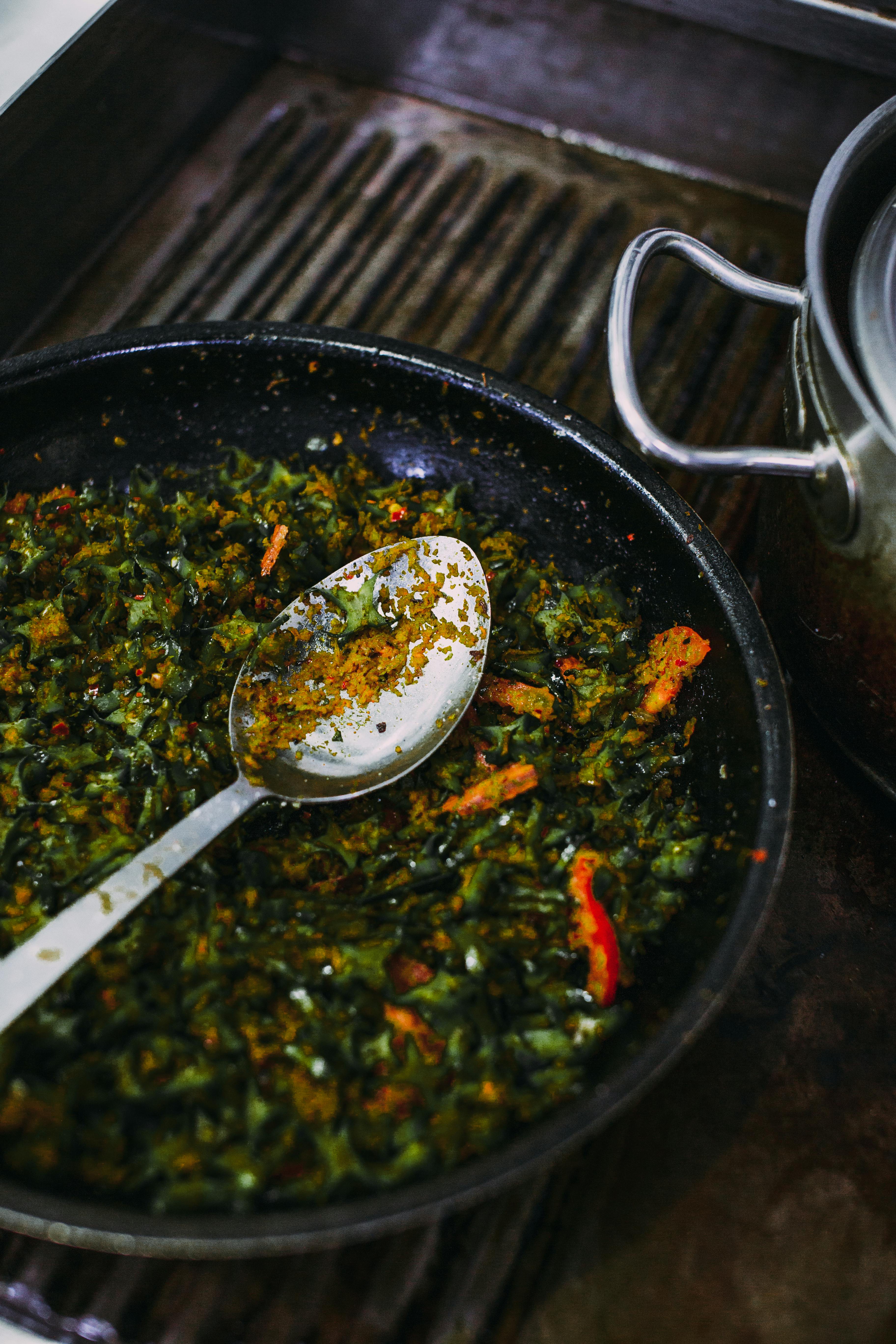
Photo: Rachel Claire / Pexels
Ghanaian
Palava Sauce
The diets react (see scores below)
Common Ingredients
- cocoyam leaves
- egusi
- palm oil
- smoked fish
- onion
- tomatoes
- scotch bonnet peppers
- crayfish
Specific recipes may vary.
Incompatible with 5 of 11 diets
Diet Ratings
Palava Sauce has a genuinely mixed keto profile. The base is strongly keto-friendly: palm oil is an excellent high-fat ketogenic ingredient, egusi (ground melon seeds) is high in fat and protein with modest net carbs (~3-4g per 30g serving), smoked fish and crayfish add quality protein, and scotch bonnet/onion/tomatoes contribute flavor with moderate carbs manageable in small quantities. The main concern is cocoyam leaves (kontomire/taro leaves), which are the leafy green base — these are lower in carbs than the root and are fiber-rich, but can add up. Tomatoes and onions in typical sauce quantities (~1 medium tomato, half onion) contribute roughly 5-8g net carbs combined. The full dish across a standard serving likely lands in the 8-15g net carb range, which fits within keto limits but requires portion awareness. The dish is not eaten alone — it is traditionally served over fufu or rice, which are strict keto exclusions. As a standalone sauce in a keto-adapted meal context, it is cautiously acceptable.
Strict keto practitioners may flag the tomato and onion base as unnecessarily carb-costly and argue that cocoyam leaves, while lower-carb than the root, are not well-documented enough nutritionally for confident tracking. Some clinical keto protocols would recommend limiting this dish entirely due to cumulative carb uncertainty across multiple sauce ingredients.
Palava Sauce as described contains multiple animal-derived ingredients that disqualify it from a vegan diet. Smoked fish is a direct animal product, crayfish (dried/ground shellfish) is an animal product widely used as a flavoring in West African cuisine, and egusi (melon seeds) itself is plant-based but is typically cooked alongside these animal ingredients here. The cocoyam leaves, palm oil, onion, tomatoes, and scotch bonnet peppers are all fully plant-based, but the presence of smoked fish and crayfish makes this dish clearly non-vegan. A vegan adaptation would require omitting smoked fish and crayfish and substituting with plant-based umami sources such as smoked paprika, nori, or liquid smoke.
Palava Sauce contains egusi (ground melon seeds from the Cucurbitaceae family), which is the primary problematic ingredient. Egusi seeds are classified as legume-adjacent or seed-based and are broadly excluded from paleo due to their anti-nutrient profile and processing requirements, though some debate exists. The remaining ingredients are largely paleo-compliant: cocoyam leaves (leafy greens), palm oil (a whole-food saturated fat acceptable in paleo), smoked fish (though smoking may involve added salt or processing agents, raising a minor flag), onion, tomatoes, scotch bonnet peppers, and crayfish are all whole foods available to hunter-gatherers. However, egusi is a staple seed/legume-type ingredient that anchors this dish and cannot be omitted — its exclusion changes the dish entirely. The dish is therefore rated avoid primarily on the basis of egusi.
Some paleo practitioners, particularly those following a more ancestral or 'primal' framework like Paul Jaminet's Perfect Health Diet, argue that whole seeds and seed-adjacent foods consumed in traditional cultures can be acceptable if properly prepared. Egusi's classification is murkier than true legumes, and a small number of paleo voices may permit it in moderation given its whole-food origin.
Palava Sauce is a nutrient-dense West African dish with several Mediterranean-compatible elements: leafy greens (cocoyam leaves), vegetables (tomatoes, onions, peppers), legume seeds (egusi/melon seeds), and smoked fish — all align well with Mediterranean principles. However, the primary fat source is palm oil rather than extra virgin olive oil, which is a significant departure. Palm oil is high in saturated fat and is not part of the Mediterranean dietary tradition. Egusi (ground melon seeds) is a plant-based protein and fat source with some parallels to nuts/seeds in the Mediterranean diet. Smoked fish adds a positive seafood component. The dish is whole-food, minimally processed, and plant-forward overall, but the palm oil moderates the score considerably.
Some modern Mediterranean diet researchers argue that the framework should be evaluated by its nutritional pattern rather than strict ingredient geography — by that logic, this dish's emphasis on leafy greens, legume seeds, seafood, and vegetables could place it closer to 'approve' territory if palm oil is viewed as a culturally equivalent plant fat. Conversely, strict clinical interpretations (e.g., PREDIMED protocol) would flag palm oil's saturated fat content as incompatible regardless of its plant origin.
Palava Sauce is overwhelmingly plant-based and is entirely incompatible with the carnivore diet. The dish is built around cocoyam leaves (a leafy vegetable), egusi (melon seeds — a legume/seed), tomatoes, onion, and scotch bonnet peppers — all strictly excluded plant foods. While it does contain smoked fish and crayfish (both animal-derived and carnivore-approved ingredients), these are minor components in a dish whose foundation is entirely plant matter. Palm oil, though sometimes tolerated by some practitioners, is a plant-derived oil explicitly excluded on strict carnivore. There is no version of this dish that could be made carnivore-compliant without fundamentally reconstructing it into an entirely different recipe.
Most ingredients in Palava Sauce are straightforwardly Whole30-compliant: cocoyam leaves (a leafy vegetable), palm oil (a natural fat), onion, tomatoes, and scotch bonnet peppers are all approved. Crayfish (dried/ground shrimp) is a compliant seafood seasoning. However, egusi (melon seeds) introduces ambiguity — while seeds are generally allowed on Whole30, egusi occupies a gray area as it is sometimes classified botanically closer to a legume-adjacent plant, though it is technically a cucurbit seed (from a gourd family plant), not a true legume. Egusi seeds are more accurately comparable to pumpkin seeds, which are Whole30-compliant. The smoked fish is the larger practical concern: commercially prepared smoked fish frequently contains added sugars, sulfites, or other non-compliant additives depending on the preparation. A home-smoked or label-verified additive-free smoked fish would be compliant. Given careful sourcing, this dish is likely compliant, but label vigilance on the smoked fish is essential.
Some Whole30 practitioners may flag egusi seeds as borderline due to unfamiliarity, though official Whole30 guidelines do not exclude seeds from gourd-family plants. The smoked fish is the more legitimate concern — Melissa Urban's guidelines require that all proteins be free of added sugars and non-compliant additives, making label verification critical for commercially smoked fish.
Palava Sauce contains multiple high-FODMAP ingredients that make it unsuitable during the elimination phase. Onion is a major fructan source and one of the highest-FODMAP foods on the Monash list — it is problematic even in small amounts and is essentially unavoidable here as a base ingredient. Egusi (melon seeds/ground melon) has limited Monash testing but is a legume-adjacent seed that may contain GOS and fructans at typical serving sizes. Crayfish (dried/powdered shrimp) is not well-tested by Monash, adding further uncertainty. Cocoyam leaves are also largely untested for FODMAP content. Palm oil is low-FODMAP, tomatoes are low-FODMAP at standard serves, and smoked fish (plain) is generally low-FODMAP. Scotch bonnet peppers are likely low-FODMAP at small amounts, similar to other chillies. However, the onion alone is sufficient to classify this dish as high-FODMAP, and the untested ingredients (egusi, cocoyam leaves, crayfish) add additional risk. This dish cannot be recommended during the elimination phase.
Monash University has not specifically tested cocoyam leaves, egusi, or crayfish, so their exact FODMAP load is uncertain — some clinical FODMAP practitioners may allow small portions of unfamiliar ingredients while monitoring symptoms, but the onion content remains a clear disqualifier for strict elimination phase compliance. The absence of Monash data on several key ingredients means this rating carries meaningful uncertainty around total FODMAP load beyond the onion issue.
Palava Sauce has a mixed DASH profile. On the positive side, it features cocoyam leaves (a nutrient-dense leafy green rich in calcium, potassium, and fiber — strongly aligned with DASH), tomatoes, onions, and scotch bonnet peppers (all DASH-friendly vegetables), and egusi (melon seeds providing plant protein and magnesium). However, the dish is significantly compromised by two key ingredients: palm oil and smoked fish. Palm oil is a tropical oil high in saturated fat (about 50%), which DASH explicitly limits, and it is a primary cooking fat in this dish rather than a minor ingredient. Smoked fish, while a lean protein source in principle, is typically very high in sodium due to the curing/smoking process — a major concern for DASH, especially the low-sodium variant (<1,500mg/day). Crayfish (dried/fermented) also adds substantial sodium. The combination of high saturated fat from palm oil and high sodium from smoked fish and crayfish creates two simultaneous DASH violations, pulling the dish into caution territory despite its otherwise vegetable-rich base.
Some updated DASH-aligned clinicians note that palm oil's saturated fat composition differs from animal fats (it contains tocotrienols with potential cardioprotective effects), and a small amount used in cooking may be acceptable within an otherwise high-vegetable dish. Additionally, if smoked fish is used in small amounts as a flavoring agent rather than a primary protein, sodium contribution may be moderate and manageable within daily DASH sodium limits.
Palava Sauce is a nutritionally complex West African dish with several Zone-favorable elements but one significant concern. Cocoyam leaves are excellent low-glycemic, polyphenol-rich leafy greens that Zone would strongly approve of. Smoked fish provides lean protein with omega-3 fatty acids — favorable. Egusi (melon seeds) contributes protein and fat, though the fat profile leans toward omega-6 polyunsaturated rather than the preferred monounsaturated. Tomatoes, onions, and scotch bonnet peppers are low-glycemic Zone-favorable vegetables. The primary concern is palm oil, which is high in saturated fat (palmitic acid) and omega-6 content. Early Zone Diet writings by Dr. Sears strongly discouraged saturated fat and seed oils in favor of monounsaturated fats like olive oil. However, Sears' later anti-inflammatory work acknowledged nuance around natural saturated fat sources. The dish also lacks a clear dominant lean protein source (listed as 'none'), meaning it would need to be paired carefully to hit a 40/30/30 ratio. As a side dish, it can complement a Zone meal if the rest of the plate includes a lean protein block, but the palm oil and omega-6-heavy egusi make it imperfect from a strict Zone anti-inflammatory perspective.
Some Zone practitioners following Sears' later writings (e.g., 'The OmegaRx Zone') may be more permissive with palm oil given its natural, unprocessed origin and the presence of tocotrienols (a form of vitamin E). Additionally, smoked fish and egusi together do provide meaningful protein, potentially making this dish more macro-balanced than it initially appears. If palm oil is used minimally (1 tsp per serving), the fat burden becomes manageable and the dish's high vegetable content and polyphenol richness from leafy greens and peppers align well with Sears' anti-inflammatory goals.
Palava Sauce is a nutrient-dense West African dish with a genuinely mixed anti-inflammatory profile. On the positive side, cocoyam leaves (kontomire) are rich in antioxidants, vitamins A, C, and K, and chlorophyll — strongly anti-inflammatory leafy greens. Egusi (melon seeds) provide plant protein, zinc, magnesium, and some beneficial fatty acids. Tomatoes supply lycopene and vitamin C. Scotch bonnet peppers are extremely high in capsaicin, a well-documented anti-inflammatory compound, plus carotenoids. Onions contribute quercetin. Smoked fish introduces omega-3 fatty acids and protein, supporting an anti-inflammatory profile. The significant concern is palm oil, which is high in saturated fat (palmitic acid) and is linked to pro-inflammatory pathways — it is generally in the 'limit' category of anti-inflammatory frameworks due to its saturated fat content, though red palm oil also contains beta-carotene and tocotrienols that provide some antioxidant benefit. Crayfish (dried shrimp) adds sodium but also astaxanthin. Overall, the dish is a whole-food, vegetable-forward preparation with meaningful anti-inflammatory contributors, partially offset by palm oil. The preparation method (smoked fish) and sodium load are additional moderate concerns.
Most anti-inflammatory nutrition frameworks consider palm oil unfavorably due to high saturated fat content and pro-inflammatory potential (consistent with Dr. Weil's guidance to limit saturated fat). However, proponents of traditional African diets note that unrefined red palm oil contains significant tocotrienols and beta-carotene with demonstrated antioxidant activity, and some researchers argue it behaves differently from other saturated fats in metabolic studies. The dish's overall whole-food, plant-rich character could shift its rating to 'approve' if palm oil quantity is modest.
Palava Sauce presents several significant concerns for GLP-1 patients. Palm oil is the primary fat source and is high in saturated fat, used in substantial quantities in traditional preparation — this directly worsens nausea, bloating, and reflux, which are already common GLP-1 side effects. Scotch bonnet peppers are among the hottest peppers used in cooking and can aggravate reflux and gastric discomfort, particularly given that GLP-1 medications slow gastric emptying and food sits in the stomach longer. While smoked fish and egusi (melon seeds) contribute some protein, smoked fish portions in this dish are typically modest and egusi is also high in fat, limiting their net benefit. Cocoyam leaves do provide fiber and micronutrients, which is a positive, and tomatoes and onions add beneficial nutrients. However, the combination of high saturated fat from palm oil, intense spice from scotch bonnet, and the heavy, dense texture of egusi makes this dish poorly suited for GLP-1 patients, especially those managing GI side effects. As a side dish with no designated primary protein, it also fails to support the critical protein priority. Smoked fish also raises sodium concerns relevant to overall dietary quality.
Some GLP-1-aware dietitians may note that small portions of this dish alongside a lean protein main could be tolerated by patients with established GI stability, given the genuine nutritional value of cocoyam leaves and egusi. However, the palm oil volume and scotch bonnet heat level are difficult to meaningfully reduce without fundamentally changing the dish, making individual tolerance the primary variable rather than a modified preparation.
*See how scores were generated at our methodology page.
Nutritional profile
Six traits that cut across every diet.
Fiber & Plants
How much whole-plant food and fiber it delivers.
Healthy Fats
The quality of its fats (unsaturated, omega-3).
Whole / Unprocessed
How close it is to its natural, unprocessed form.
Gut Gentle
How easy it is on digestion (low FODMAP, few irritants).
Low Glycemic
How little it spikes your blood sugar.
Protein Density
How much protein it packs per calorie.
Controversy Index
Higher controversy = more disagreement between diets.
Diet-Specific Tips
 Keto — 5/10
View tips
- Palm oil is an ideal keto fat source — strongly positive
- Egusi is high in fat and protein with manageable net carbs per serving
- Smoked fish and crayfish provide quality protein with near-zero carbs
- Cocoyam leaves are the leafy greens base — lower carb than the root but quantity matters
- Tomatoes and onions add 5-8g net carbs combined in typical sauce portions
- Traditional pairing with fufu or rice is strictly incompatible with keto — must substitute
- Overall net carbs per serving estimated 8-15g, workable within daily keto limits with portion control
 Mediterranean — 5/10
View tips
- Palm oil is high in saturated fat and not a Mediterranean staple fat — contrasts with EVOO as the canonical fat source
- Cocoyam leaves are nutrient-rich leafy greens, strongly Mediterranean-compatible
- Egusi (melon seeds) functions similarly to nuts/seeds — a positive plant-based fat and protein source
- Smoked fish aligns with Mediterranean seafood recommendations
- Tomatoes, onions, and scotch bonnet peppers are whole vegetables — Mediterranean-compatible
- No refined grains, added sugars, or red meat — avoids major Mediterranean diet pitfalls
- Dish is whole-food and minimally processed overall
 Whole30 — 5/10
View tips
- Cocoyam leaves are compliant leafy greens
- Palm oil is a compliant natural fat
- Egusi (melon/gourd seeds) are technically compliant seeds, not legumes
- Smoked fish may contain added sugar or non-compliant additives — label verification required
- Crayfish (dried shrimp) is a compliant seafood seasoning
- Onion, tomatoes, and scotch bonnet peppers are all fully compliant
 DASH — 4/10
View tips
- Palm oil is a tropical oil high in saturated fat (~50%), explicitly limited by DASH guidelines
- Smoked fish is high in sodium, conflicting with DASH sodium targets (<2,300mg or <1,500mg/day)
- Crayfish (dried/fermented) adds additional significant sodium load
- Cocoyam leaves are an excellent DASH food — rich in potassium, calcium, magnesium, and fiber
- Egusi provides plant-based protein, healthy fats, and magnesium — DASH-compatible
- Tomatoes, onions, and peppers are strong DASH-aligned vegetables
- Dish can be improved for DASH by substituting palm oil with olive/canola oil and using fresh or low-sodium fish
 Zone — 5/10
View tips
- Palm oil is high in saturated fat, which conflicts with Zone's preference for monounsaturated fats like olive oil
- Cocoyam leaves are excellent Zone-favorable low-glycemic leafy greens rich in polyphenols
- Smoked fish is a lean omega-3 protein source, Zone-approved
- Egusi contributes protein and fat but is omega-6-heavy, which Sears discourages for anti-inflammatory balance
- No dominant protein source listed — dish needs pairing with lean protein to achieve 40/30/30 ratio
- Tomatoes, onions, and scotch bonnet peppers are all Zone-favorable low-glycemic vegetables
- As a side dish, portion control of palm oil is critical to Zone compatibility
- Crayfish adds additional umami protein micronutrients but in small quantity
 Anti-Inflammatory — 5/10
View tips
- Cocoyam leaves are rich in antioxidants, vitamins A, C, K, and chlorophyll — strongly anti-inflammatory
- Scotch bonnet peppers provide high-dose capsaicin and carotenoids with documented anti-inflammatory effects
- Palm oil is high in saturated fat (palmitic acid), placing it in the 'limit' category of anti-inflammatory diets
- Unrefined red palm oil contains tocotrienols and beta-carotene that partially offset its saturated fat concerns
- Smoked fish contributes omega-3 fatty acids supporting anti-inflammatory balance
- Tomatoes and onions add lycopene and quercetin — well-studied anti-inflammatory polyphenols
- Egusi provides plant protein, zinc, and magnesium with neutral-to-positive inflammatory profile
- Smoked preparation and dried crayfish add significant sodium, a consideration for inflammatory conditions