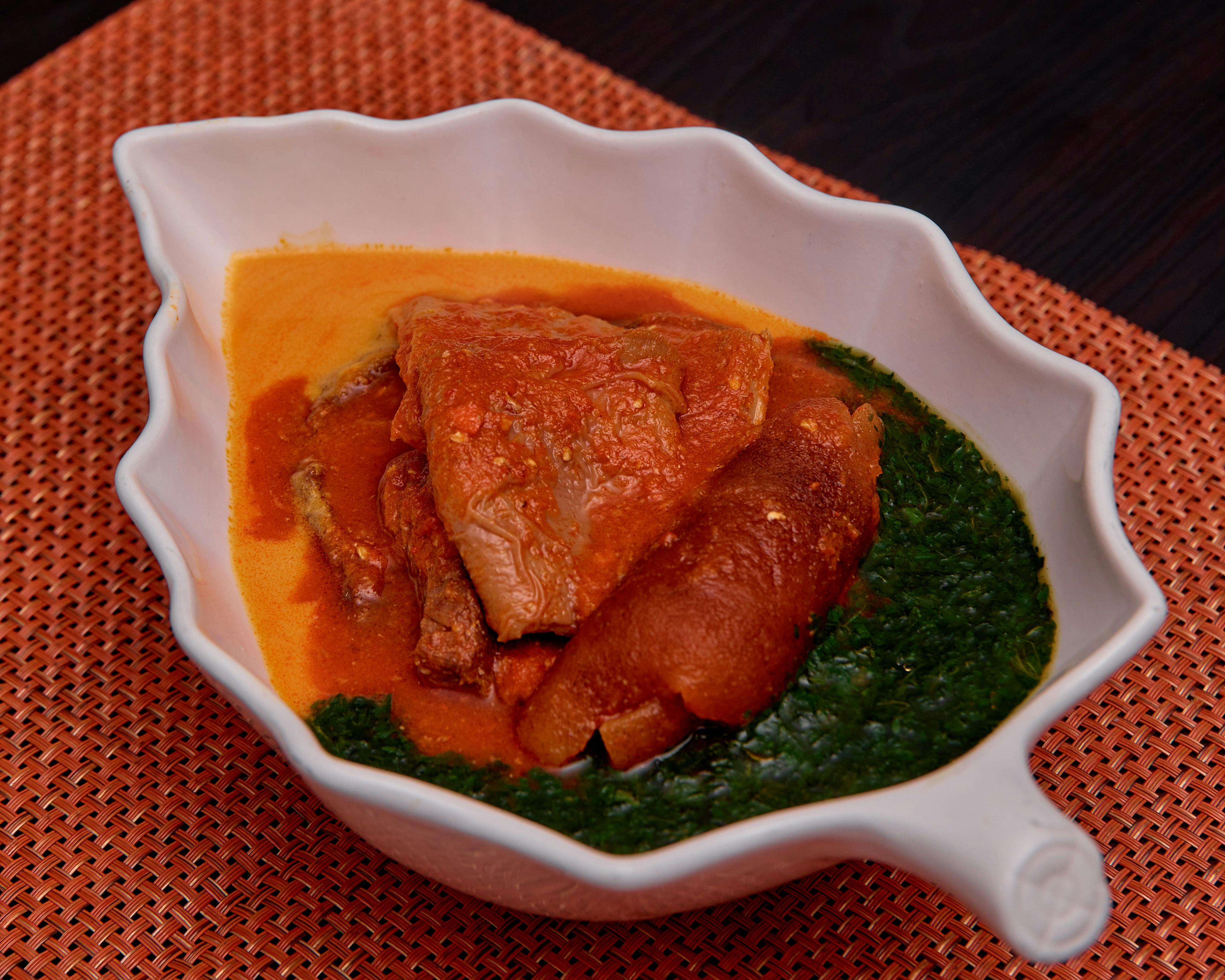
Photo: Tochukwu Ekeh / Pexels
Ghanaian
Tuo Zaafi
The diets react (see scores below)
Common Ingredients
- millet flour
- corn flour
- ayoyo leaves
- potash
- dawadawa
- onion
- scotch bonnet peppers
- water
Specific recipes may vary.
Incompatible with 5 of 11 diets
Diet Ratings
Tuo Zaafi is a traditional Ghanaian porridge/dumpling made primarily from millet flour and corn flour, both of which are high-carbohydrate grains that are fundamentally incompatible with a ketogenic diet. Millet flour contains approximately 70-75g of net carbs per 100g, and corn flour is similarly dense at around 70g+ net carbs per 100g. A single standard serving of Tuo Zaafi would likely contain well over 50-80g of net carbs, which would single-handedly exceed the entire daily keto carb budget. The accompanying ayoyo leaf soup with dawadawa and vegetables is relatively keto-friendly, but the staple base of the dish is a non-negotiable carbohydrate bomb. There is no meaningful portion size of this dish that would allow someone to remain in ketosis.
Tuo Zaafi as listed is entirely plant-based. The starchy dumpling base is made from millet and corn flour cooked with water, while the soup (ayoyo/jute leaf soup) is seasoned with potash (a mineral alkali used to tenderize greens), dawadawa (fermented locust bean, a traditional plant-based flavor enhancer), onion, and scotch bonnet peppers. Every ingredient is derived from plants or minerals. Traditional versions can sometimes include fish or meat in the soup, but as specified here with no animal proteins, this dish is fully vegan-compliant and built around whole-food plant ingredients.
Tuo Zaafi is a traditional Ghanaian porridge/dumpling dish whose base is millet flour and corn flour — both are grains explicitly excluded from the paleo diet. Grains are among the most clearly non-paleo foods due to their anti-nutrients (phytates, lectins) and the fact that they only became staple foods with the advent of agriculture. Potash (potassium carbonate used as a food additive/alkalizing agent) is a processed mineral additive also inconsistent with paleo principles. Dawadawa (fermented locust bean) is a legume-based fermented condiment, placing it in the excluded legume category. The remaining ingredients — ayoyo leaves (jute mallow), onion, scotch bonnet peppers, and water — are paleo-compatible, but they cannot redeem a dish built on a foundation of grains and legume-derived seasoning. With three core non-paleo components (two grains, one legume product, and a processed additive), this dish is firmly in 'avoid' territory.
Tuo Zaafi is a West African dish built almost entirely from whole, plant-based ingredients that align well with Mediterranean diet principles. Millet and corn flour are whole grains providing complex carbohydrates and fiber. Ayoyo leaves (jute/molokhia) are a nutrient-dense leafy green, analogous to vegetables widely used in Mediterranean cooking (molokhia is in fact eaten across North Africa and the Levant). Onion and scotch bonnet peppers are vegetables. Dawadawa (fermented locust beans) is a legume-derived condiment rich in protein and flavor. Potash (kaun/trona) is a mineral salt used as a cooking aid; while not a Mediterranean staple, it is not nutritionally harmful in small quantities. There is no red meat, added sugar, or highly processed ingredient. The dish is plant-forward, whole-grain-based, and protein-rich from legume ferment, making it compatible with Mediterranean eating patterns despite not originating in the Mediterranean region.
Some Mediterranean diet purists may note that refined corn flour (if not whole grain masa) represents a partially refined grain, and that potash is a non-traditional additive not found in canonical Mediterranean ingredients. Modern clinical Mediterranean diet guidelines (e.g., PREDIMED framework) would prefer 100% whole grain formulations and might score this slightly lower on that basis.
Tuo Zaafi is a traditional Ghanaian dish made entirely from plant-based ingredients. It consists of a starchy porridge base made from millet flour and corn flour, served with a leafy green soup made from ayoyo leaves, seasoned with potash (a plant-derived alkaline salt), dawadawa (fermented locust beans — a legume-based condiment), onion, and scotch bonnet peppers. Every single ingredient is plant-derived — there are no animal products whatsoever. This dish is completely incompatible with the carnivore diet, which requires exclusive consumption of animal products. The grains (millet, corn), legume-based fermented condiment (dawadawa), leafy greens (ayoyo), and plant spices/aromatics all violate core carnivore principles.
Tuo Zaafi is a traditional Ghanaian porridge/dumpling dish made primarily from millet flour and corn flour. Both millet and corn are grains explicitly excluded on the Whole30 program. Corn flour is a grain-based ingredient, and millet is also a grain — both are on the banned list. The soup component (ayoyo leaf soup with dawadawa, onion, scotch bonnet peppers) would otherwise be largely compliant: ayoyo leaves are a vegetable, scotch bonnet peppers are fine, onion is fine, and dawadawa (fermented locust beans) is a legume-derived seasoning which raises its own concern. However, the grain issue alone is disqualifying. Potash (potassium carbonate, used as a tenderizer) is a mineral salt and not inherently excluded, but it cannot rescue a dish built on excluded grains.
Tuo Zaafi is a Ghanaian porridge-like dish made from millet flour and corn flour, served with a leafy green soup (ayoyo/jute leaves) containing onion, dawadawa (fermented locust beans), potash, and scotch bonnet peppers. The most significant FODMAP concern is onion, which is high in fructans and a clear 'avoid' during elimination at any standard serving. Dawadawa (fermented locust beans/African locust bean) is a legume-based fermented condiment — legumes contain GOS, and while fermentation may reduce FODMAP content somewhat (similar to tempeh), dawadawa has not been tested by Monash University, and its GOS content at typical culinary amounts is uncertain but potentially significant. Millet flour is generally considered low-FODMAP at moderate servings, and corn flour (maize) is low-FODMAP. Ayoyo (jute/corchorus leaves) have not been tested by Monash but are unlikely to be high-FODMAP as leafy greens. Scotch bonnet peppers (chili) are low-FODMAP. Potash (potassium carbonate) is a mineral salt and not a FODMAP concern. However, onion alone — a core structural ingredient of the ayoyo soup — makes this dish high-FODMAP during the elimination phase, and the untested dawadawa adds further risk.
Monash University has not tested several key ingredients in this dish (dawadawa, ayoyo leaves), making a definitive assessment difficult. Some clinical FODMAP practitioners may suggest that small amounts of onion cooked in oil and then removed could reduce fructan load, but onion appears to be integrated into the soup in a way that would not allow this mitigation.
Tuo Zaafi is a traditional Ghanaian dish combining millet and corn flour dumplings with a leafy green soup (ayoyo/jute leaves). The core components align reasonably well with DASH principles: millet and corn flour provide whole grains and fiber, ayoyo leaves are highly nutritious and rich in calcium, magnesium, potassium, and fiber — all key DASH nutrients. Scotch bonnet peppers and onion are DASH-friendly vegetables. However, two ingredients raise concern: potash (kaun/trona), an alkaline salt used as a food additive in West African cooking, contributes sodium and is a processed mineral compound not addressed in NIH DASH guidelines; and dawadawa (fermented locust beans), while a good plant-based protein source, is fermented and can be moderately high in sodium depending on preparation. The dish lacks animal saturated fat or added sugars, which is a strong positive. The main DASH concern is the cumulative sodium contribution from potash and dawadawa, which warrants moderation rather than avoidance. Prepared with minimal potash and low-sodium dawadawa, this dish could score higher.
NIH DASH guidelines do not specifically address traditional West African fermented condiments like dawadawa or alkaline additives like potash, creating ambiguity. Some DASH-oriented clinicians familiar with global diets may view dawadawa favorably as a probiotic-rich, plant-based protein source with beneficial fermentation byproducts, while others would flag both potash and dawadawa as sodium sources requiring careful quantification before approval.
Tuo Zaafi is a traditional Ghanaian dish consisting of a starchy millet/corn flour porridge (similar to fufu or ugali) served with a leafy green soup made from ayoyo leaves (jute leaves), dawadawa (fermented locust beans), onion, and scotch bonnet peppers. From a Zone perspective, this dish has significant macro imbalance issues. The base is predominantly high-glycemic refined grain starch (millet and corn flour cooked into a thick paste), which would constitute a very high carbohydrate load relative to protein and fat. The soup component is actually quite favorable — ayoyo leaves are nutrient-dense leafy greens rich in polyphenols and fiber, dawadawa provides some protein and fermented probiotic benefit, and onions/scotch bonnets contribute anti-inflammatory compounds. However, the dish as presented has no primary protein source, meaning the 30% protein target is essentially unmet. The fat content is also negligible. To Zone-balance this meal, a lean protein (fish, chicken) would need to be added, the starch portion significantly reduced to perhaps a few tablespoons, and a monounsaturated fat source incorporated. The leafy green soup is a Zone asset, but the starchy porridge base dominates and skews the ratio heavily toward carbohydrates. It scores a 4 rather than lower because the soup component is genuinely Zone-friendly and the dish can be modified.
Some Zone practitioners and later Sears anti-inflammatory writings give more credit to traditional whole-food grain preparations, particularly fermented or minimally processed ones. Millet has a moderate glycemic index compared to refined white flour products, and the fiber content in the full meal (from ayoyo leaves) moderates glycemic response somewhat. In this context, a small portion of the starchy base paired with a generous serving of the leafy soup and an added protein could be viewed more leniently, perhaps scoring a 5-6 in a real-world Zone application rather than being treated as a near-avoid starch.
Tuo Zaafi is a traditional Ghanaian dish with a solid anti-inflammatory profile overall. Millet flour is a whole grain with fiber, magnesium, and antioxidants — well-regarded in anti-inflammatory frameworks. Corn flour is less nutritionally dense than millet but still a whole grain source with acceptable fiber. Ayoyo leaves (jute leaves/Corchorus olitorius) are the nutritional standout here: rich in beta-carotene, iron, calcium, vitamin C, and polyphenols, and have demonstrated anti-inflammatory properties in preliminary research — functioning similarly to other dark leafy greens emphasized in the anti-inflammatory pyramid. Scotch bonnet peppers contribute capsaicin, a well-documented anti-inflammatory compound, along with vitamin C. Onion provides quercetin, a potent anti-inflammatory flavonoid. Dawadawa (fermented locust beans) is a fermented food with probiotic potential and is associated with reduced inflammation in African traditional diets. Potash (kaun/kanwa — potassium carbonate used as a food tenderizer) is the most complex ingredient from an anti-inflammatory standpoint: it is used in small culinary amounts, and while not inherently inflammatory, excessive intake may be a concern; at typical culinary quantities it is unlikely to meaningfully affect inflammatory status. The dish is plant-based, whole-food-centered, oil-free, and free of added sugars, refined carbohydrates, or processed additives. Its main limitation is the absence of a protein source with omega-3s and the modest caloric and protein density, but it is not assessed for completeness — only inflammatory profile.
Mainstream anti-inflammatory nutrition would rate this dish favorably given its whole grains, dark leafy greens, and anti-inflammatory spices. However, some practitioners following stricter anti-inflammatory or autoimmune protocols (such as AIP) may flag corn as a potentially irritating grain due to its lectin content and lower nutrient density compared to millet, and potash as a non-food-grade additive that could irritate sensitive guts at culinary doses — though evidence for this at normal serving levels is limited.
Tuo Zaafi is a traditional Ghanaian dish consisting of a thick millet/corn flour porridge (the 'tuo') served with a leafy green soup made from ayoyo leaves (jute/corchorus leaves), seasoned with potash, dawadawa (fermented locust beans), onion, and scotch bonnet pepper. From a GLP-1 perspective, the dish has meaningful strengths and notable weaknesses. On the positive side, ayoyo leaves are nutrient-dense and provide fiber, vitamins (A, C, K), and minerals; millet offers moderate fiber and micronutrients compared to refined grains; dawadawa contributes some plant-based protein and fermented probiotic-like properties that may support gut health; and the dish is low in fat and easy to digest in modest portions. However, the dish is critically low in protein — no primary protein source is listed, and the combination of millet flour, corn flour, and leafy soup provides only minimal protein per serving (likely under 8-10g total), falling far short of the 15-30g per meal target that is the #1 GLP-1 dietary priority. The starchy porridge base is also high in refined carbohydrates relative to its protein content, making it calorie-inefficient for GLP-1 patients who need maximum nutrient density per bite. Scotch bonnet peppers are among the hottest commonly used peppers and may worsen GLP-1-related nausea, reflux, or GI discomfort in sensitive patients. Potash (potassium carbonate) is a traditional alkaline additive with no significant nutritional concern in the small amounts used culinarily. The dish is not inherently 'bad' — it is whole-food-based, low-fat, and fiber-containing — but as a standalone main dish without a protein source, it misses the most critical GLP-1 dietary requirement. It would rate higher if paired with grilled fish, eggs, or legumes to meet protein targets.
Some GLP-1-focused dietitians working with West African patient populations may give this dish more credit as a culturally appropriate, low-fat, whole-grain base that can be adapted by adding protein (e.g., grilled tilapia or beans), arguing that rigid protein scoring penalizes traditional dishes unfairly when the broader meal context matters. Others would maintain that rating dishes as submitted — without assumed additions — is essential for honest guidance, and that a protein-free starchy main is categorically insufficient regardless of cultural context.
*See how scores were generated at our methodology page.
Nutritional profile
Six traits that cut across every diet.
Fiber & Plants
How much whole-plant food and fiber it delivers.
Healthy Fats
The quality of its fats (unsaturated, omega-3).
Whole / Unprocessed
How close it is to its natural, unprocessed form.
Gut Gentle
How easy it is on digestion (low FODMAP, few irritants).
Low Glycemic
How little it spikes your blood sugar.
Protein Density
How much protein it packs per calorie.
Controversy Index
Higher controversy = more disagreement between diets.
Diet-Specific Tips
 Vegan — 9/10
View tips
- Millet and corn flour are whole-grain, plant-based staples
- Ayoyo (jute) leaves are nutrient-dense leafy greens — fully plant-based
- Dawadawa (fermented locust bean) is a traditional plant-based umami ingredient, not animal-derived
- Potash is a mineral alkaline agent, not an animal product
- No meat, fish, dairy, eggs, or other animal-derived ingredients listed
- Traditional Tuo Zaafi often includes fish or meat stock — this version explicitly excludes both
- High nutritional value: whole grains, leafy greens, and legume-fermented seasoning
 Mediterranean — 8/10
View tips
- Whole grain millet flour as primary carbohydrate base
- Ayoyo (jute) leaves are a nutrient-dense leafy green with North African/Levantine Mediterranean parallels
- Dawadawa (fermented locust beans) adds plant-based protein and umami
- No red meat, saturated fat, added sugar, or highly processed ingredients
- Potash is an uncommon additive not part of Mediterranean tradition but used in small amounts
- Corn flour may be partially refined depending on preparation, slight concern for whole-grain alignment
 DASH — 6/10
View tips
- Millet and corn flour provide whole grains, fiber, and magnesium — core DASH nutrients
- Ayoyo (jute) leaves are exceptionally rich in calcium, magnesium, potassium, and fiber, strongly supporting DASH goals
- Potash (alkaline salt additive) contributes sodium and is not addressed by NIH DASH guidelines
- Dawadawa (fermented locust beans) adds plant-based protein but may contribute moderate sodium depending on preparation
- No animal saturated fat, no added sugars, no tropical oils — favorable for DASH
- Scotch bonnet peppers and onion are DASH-compatible vegetables
- Sodium load can be reduced by minimizing potash quantity and using freshly prepared dawadawa
 Zone — 4/10
View tips
- High starch load from millet and corn flour paste — dominant carbohydrate source with moderate-to-high glycemic impact
- No primary protein source listed — 30% protein Zone target unmet without additions like fish or chicken
- Negligible fat content — 30% fat Zone target also unmet
- Ayoyo (jute) leaves are excellent Zone-favorable leafy greens — rich in fiber, polyphenols, and micronutrients
- Dawadawa (fermented locust beans) contributes modest protein and probiotic benefit, Zone-positive element
- Scotch bonnet peppers and onions are anti-inflammatory, Zone-favorable flavor contributors
- Dish would require significant portioning adjustment and protein/fat additions to fit Zone blocks
- Traditional whole-food preparation with no processed additives is a positive factor compared to refined Western starch products
 Anti-Inflammatory — 7/10
View tips
- Ayoyo (jute) leaves are rich in beta-carotene, polyphenols, and vitamin C — strong anti-inflammatory dark leafy greens
- Millet flour is a whole grain with fiber, magnesium, and antioxidant compounds
- Scotch bonnet peppers contribute capsaicin and vitamin C — both anti-inflammatory
- Onion provides quercetin, a well-researched anti-inflammatory flavonoid
- Dawadawa (fermented locust beans) adds fermented food benefits with potential probiotic and anti-inflammatory effects
- No added sugar, refined oils, trans fats, or processed additives
- Potash (culinary potassium carbonate) is a minor concern at high amounts but likely neutral at typical culinary use
- Corn flour is the least anti-inflammatory ingredient — lower fiber and nutrient density than millet; may be a concern for lectin-sensitive individuals
 GLP-1 Friendly — 4/10
View tips
- Critically low protein — no primary protein source, likely under 10g per serving, far below the 15-30g per meal GLP-1 target
- Ayoyo (jute) leaves provide meaningful fiber, vitamins A/C/K, and minerals — a genuine nutritional strength
- Millet flour offers more fiber and micronutrients than refined white flour but is still predominantly starchy carbohydrate
- Scotch bonnet peppers are very high on the Scoville scale and may worsen GLP-1-related nausea, reflux, or GI discomfort
- Dawadawa (fermented locust beans) adds modest plant protein and fermented food benefits, but not enough to close the protein gap
- Low fat content is a positive — dish unlikely to worsen nausea or bloating via fat-related mechanisms
- Whole-food, minimally processed ingredients support nutrient density despite low caloric efficiency
- Dish would move to 'approve' territory if served with a substantial protein addition such as grilled fish, eggs, or legumes