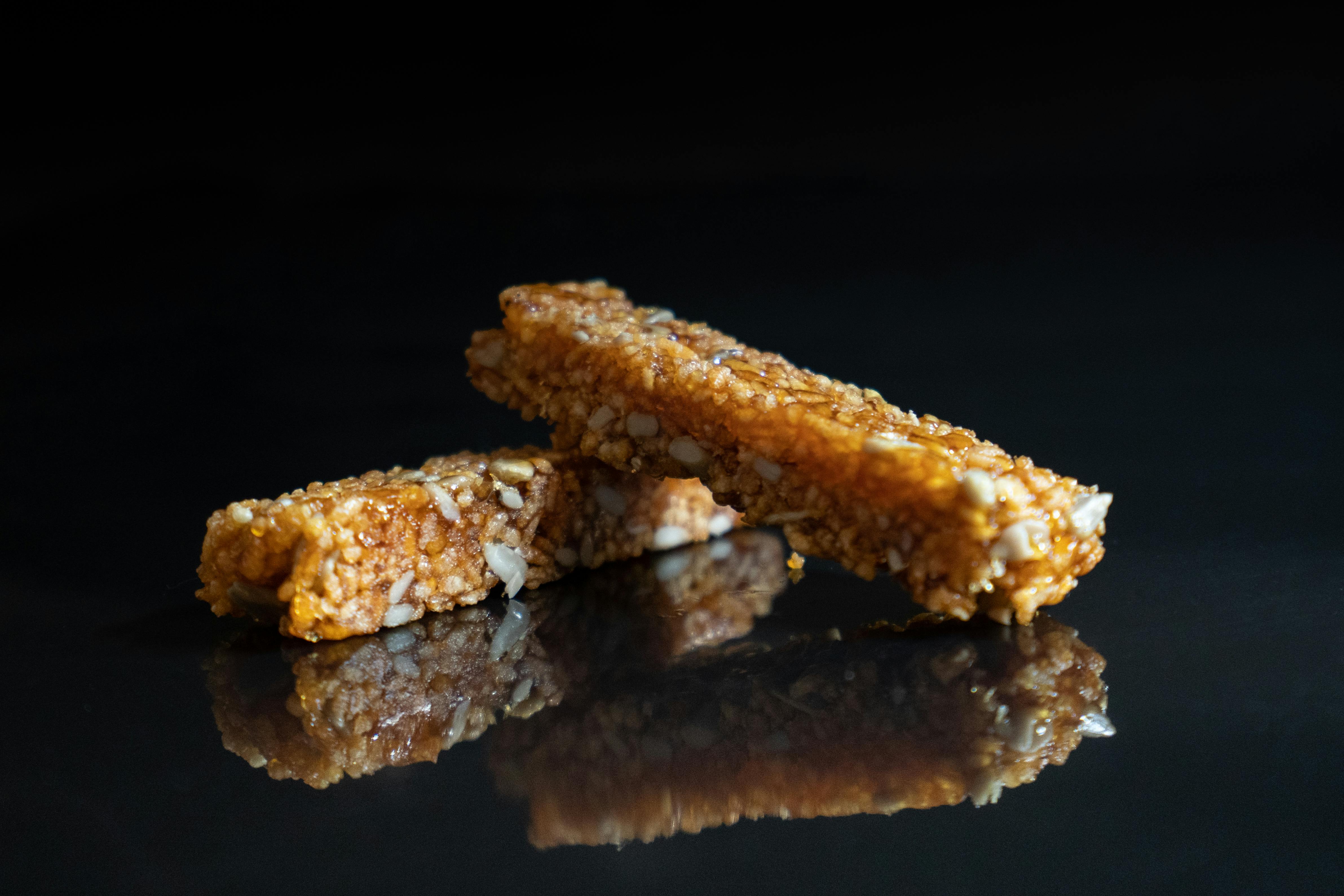
Photo: Cats Coming / Pexels
The diets react (see scores below)
Common Ingredients
- walnuts
- honey
- sesame seeds
- butter
Specific recipes may vary.
Incompatible with 7 of 11 diets
Diet Ratings
Gozinaki is a Georgian confection made by cooking walnuts and sesame seeds in honey until caramelized, then setting with butter. While walnuts, sesame seeds, and butter are keto-friendly ingredients, honey is the primary binding agent and sweetener, making it fundamentally incompatible with ketogenic eating. Honey is essentially pure sugar (fructose and glucose), with roughly 17g of net carbs per tablespoon. A typical serving of gozinaki contains a substantial quantity of honey, easily pushing net carbs far beyond the 20-50g daily limit in a single piece. There is no meaningful way to consume a standard portion of this dish without severely disrupting ketosis. The dish cannot be modified without ceasing to be gozinaki.
Gozinaki contains two clear animal-derived ingredients: honey and butter. Butter is unambiguously non-vegan (dairy fat), making this dish firmly in 'avoid' territory regardless of any debate about honey. The walnuts and sesame seeds are fully plant-based, but they cannot offset the dairy and animal-product content. The dish could theoretically be made vegan by substituting maple syrup or agave for honey and a plant-based butter alternative, but the traditional recipe as listed is not vegan-compliant.
A small minority of plant-based eaters who follow a 'bee-friendly' philosophy might consider honey acceptable on grounds that bee welfare is not meaningfully harmed by ethical beekeeping — but this position does not resolve the butter issue, which remains animal-derived dairy by any vegan standard. The honey debate is therefore moot here.
Gozinaki is a Georgian walnut-and-honey candy. Two of its four ingredients are straightforwardly paleo-approved: walnuts are a whole nut with no issues, and sesame seeds are technically seeds available to hunter-gatherers (though they are also a seed oil source when pressed, whole sesame seeds are generally accepted). Honey is the main complication: it is a natural, ancestral sweetener and is allowed in the paleo framework, but its concentrated sugar content places it in the 'caution' category rather than a full approve. Butter is the most debated ingredient — it is a dairy derivative excluded under strict Cordain-school paleo, though many modern paleo practitioners accept it, particularly when grass-fed. The dish is minimally processed (essentially just cooked nuts and seeds bound with honey and butter), which aligns with the paleo philosophy better than most confections, but the combination of a dairy fat and a concentrated natural sweetener used as a candy/dessert keeps this in caution territory overall.
Strict Cordain-school paleo (as outlined in Loren Cordain's original 'The Paleo Diet') would push this closer to avoid due to butter being a dairy product and honey being used in a concentrated, candy-like quantity. Conversely, practitioners following Mark Sisson's 'Primal Blueprint' would likely rate this more favorably, accepting both grass-fed butter and moderate honey as part of an 80/20 primal approach.
Gozinaki is a Georgian walnut-and-honey candy. Walnuts and sesame seeds are excellent Mediterranean diet staples—rich in healthy fats, fiber, and micronutrients. Honey is a traditional natural sweetener used in moderation across Mediterranean cultures, far preferable to refined sugar. However, honey here is used in a significant quantity as a binding syrup (concentrated added sugar), and butter—while not strictly anti-Mediterranean—replaces the preferred fat source (olive oil). The dish is also a confection/sweet snack, meaning the sugar load is higher than typical Mediterranean snacking patterns would encourage. It is not a processed food in the industrial sense, and its core ingredients (nuts, seeds, natural honey) are wholesome, but the candy format and butter inclusion push it toward 'acceptable in moderation' rather than a staple.
Some Mediterranean diet authorities would view this more favorably, noting that nuts and honey are ancient, traditional foods throughout the eastern Mediterranean and Caucasus region, and that small portions of such whole-ingredient sweets are far preferable to modern processed confections; the butter content is modest and traditional in Georgian culinary practice.
Gozinaki is a Georgian walnut and honey candy that is almost entirely plant-based. Walnuts and sesame seeds are nuts/seeds — explicitly excluded from the carnivore diet. The only animal-derived ingredient is butter, which is a minor component and itself debated in strict carnivore circles. Even if honey were considered borderline acceptable in some 'animal-based' frameworks (Saladino's approach), the walnuts and sesame seeds are unambiguously excluded plant foods. This dish has no meaningful animal protein and is fundamentally a confection built on plant ingredients.
Gozinaki is a Georgian walnut-and-honey candy traditionally made by cooking walnuts and sesame seeds in caramelized honey, then pressing into slabs. The core problem is regular butter: Whole30 excludes all dairy except ghee and clarified butter. Additionally, Gozinaki is fundamentally a candy/confection — even if butter were swapped for ghee, this dish is essentially a compliant-ingredient recreation of a junk food (candy), which violates Whole30's Rule 4 prohibition on recreating sweets and dessert-style treats. Walnuts, honey in small cooking quantities, and sesame seeds are individually compliant, but the combination assembled into a candy format crosses the program's spirit boundary.
Gozinaki is a Georgian candy made by cooking walnuts in honey, often with sesame seeds and butter. The main FODMAP concern is honey, which is high in excess fructose and is classified as high-FODMAP by Monash University. However, in a typical serving of gozinaki, the honey is distributed across many pieces, and the quantity per individual piece may be small enough to stay within the low-FODMAP threshold (Monash lists 1 teaspoon/7g of honey as the upper limit for low-FODMAP). Walnuts are low-FODMAP at 10 walnut halves (30g). Sesame seeds are low-FODMAP at 1 tablespoon (11g). Butter is low-FODMAP. The dish is therefore borderline: a small piece or two may be tolerable, but a standard snack portion likely contains enough honey to push into high-FODMAP territory due to excess fructose. Portion control is critical and realistic snacking behavior makes accidental overconsumption of honey likely.
Monash University rates honey as high-FODMAP even at moderate servings (>1 tsp), making any honey-based confection risky during strict elimination. Clinical FODMAP practitioners typically advise avoiding honey entirely during the elimination phase regardless of portion size, as it is a primary source of excess fructose. Some practitioners may permit a single very small piece if honey content is judged minimal, but this requires careful estimation.
Gozinaki is a Georgian walnut-and-honey candy made by cooking walnuts (and sometimes sesame seeds) in honey, typically with butter. The ingredients present a mixed DASH profile. Walnuts and sesame seeds are explicitly endorsed by DASH guidelines as heart-healthy nuts and seeds rich in unsaturated fats, magnesium, and fiber. Honey is a natural sweetener, but DASH limits sweets and added sugars — it should be consumed sparingly. Butter contributes saturated fat, which DASH limits, though the quantity per serving is likely modest. The primary concern is the significant added sugar load from honey, which, even as a natural sugar, pushes this into 'sweets' territory that DASH restricts. The dish is low in sodium and contains no processed ingredients, which is positive. Overall, it's acceptable occasionally and in small portions but is not a DASH-emphasized food due to its high sugar content and some saturated fat from butter.
NIH DASH guidelines categorize sweets (including honey-based confections) as foods to limit to ≤5 servings per week of small portions, placing Gozinaki firmly in the 'occasional treat' category. However, some updated clinical interpretations note that the walnut and sesame base provides meaningful cardiovascular benefit (omega-3s, magnesium, fiber), and that a small portion of this minimally processed, whole-ingredient confection compares favorably to typical processed sweets — some DASH-oriented dietitians would allow it more liberally than packaged candy.
Gozinaki is a Georgian confection made by cooking walnuts in honey (sometimes with sesame seeds and butter), then cooling into a brittle-like candy. From a Zone Diet perspective, this is essentially a high-sugar candy. Honey is extremely high-glycemic and drives a rapid insulin spike — precisely the hormonal response Dr. Sears designed the Zone to prevent. The dish has no meaningful protein component, making it impossible to balance into a 40/30/30 block structure. While walnuts provide some monounsaturated and polyunsaturated fat (a Zone-friendly element), the dominant macronutrient profile is high-glycemic carbohydrate from honey with fat and virtually no protein. There is no practical portion size that would allow Gozinaki to serve as a Zone-compliant snack block, since even a tiny serving provides a large carbohydrate hit relative to near-zero protein. Sesame seeds contribute some protein and fat but in quantities too small to meaningfully offset the honey load. Butter adds saturated fat without helping the ratio. This is categorically a 'avoid' food in Zone terminology — not because walnuts are bad, but because the honey-dominant sweet confection format makes Zone balance impossible.
Gozinaki is a traditional Georgian confection made by caramelizing honey with walnuts and sesame seeds, often with a small amount of butter. The ingredient profile is genuinely mixed from an anti-inflammatory standpoint. Walnuts are one of the most emphasized foods in anti-inflammatory frameworks — rich in ALA omega-3s, polyphenols, and ellagitannins that reduce CRP and IL-6. Honey, especially raw or minimally processed varieties, contains antioxidants, flavonoids, and antimicrobial compounds, and is generally preferred over refined sugar in anti-inflammatory diets, though it remains a concentrated source of sugar and should be consumed moderately. Sesame seeds contribute lignans (sesamin, sesamolin), which have demonstrated anti-inflammatory activity in research, along with calcium and zinc. The small amount of butter is the only clearly pro-inflammatory element — saturated fat places it in the 'limit' category — but in a traditional recipe the quantity is typically modest relative to the other ingredients. The dish is cooked, which reduces some antioxidant activity in the honey, and it is still a sugar-dense confection consumed as a sweet snack. Overall, this is a better-than-average treat with real anti-inflammatory components, but the concentrated sugar load and butter temper the otherwise favorable profile.
Some anti-inflammatory practitioners would rate this more favorably, emphasizing that walnuts and sesame seeds are nutritionally dense anti-inflammatory foods and that honey is a far superior sweetener to refined sugar or HFCS — Dr. Weil's framework allows moderate use of honey as a preferred sweetener. Conversely, stricter interpretations (particularly those focused on blood sugar stability, such as functional medicine protocols) would flag any high-sugar confection as pro-inflammatory regardless of the quality of other ingredients, given that sugar spikes can transiently elevate inflammatory markers.
Gozinaki is a Georgian walnut-and-honey candy made by cooking walnuts (and often sesame seeds) in honey with butter until hardened into a brittle-like confection. For GLP-1 patients, this dish is problematic on nearly every axis: it is calorie-dense with no meaningful protein contribution, very high in fat (walnuts and butter together), and high in sugar from honey. The sugar load can spike blood glucose and worsen nausea. The high fat content — including saturated fat from butter — directly worsens GLP-1 side effects such as nausea, bloating, and delayed gastric emptying. It is a classic empty-calorie snack from a GLP-1 perspective: the walnuts do supply unsaturated fats and trace fiber, but in this preparation the dominant nutritional story is fat plus sugar with negligible protein. Small-portion consumption might limit harm, but even a small piece delivers concentrated calories with no satiety drivers GLP-1 patients need. It does not meet any of the top priorities — protein, fiber, or low fat per serving.
*See how scores were generated at our methodology page.
Nutritional profile
Six traits that cut across every diet.
Fiber & Plants
How much whole-plant food and fiber it delivers.
Healthy Fats
The quality of its fats (unsaturated, omega-3).
Whole / Unprocessed
How close it is to its natural, unprocessed form.
Gut Gentle
How easy it is on digestion (low FODMAP, few irritants).
Low Glycemic
How little it spikes your blood sugar.
Protein Density
How much protein it packs per calorie.
Controversy Index
Higher controversy = more disagreement between diets.
Diet-Specific Tips
 Paleo — 5/10
View tips
- Walnuts are fully paleo-approved whole nuts
- Sesame seeds are paleo-acceptable whole seeds
- Honey is a natural ancestral sweetener but falls in the caution zone due to high sugar concentration
- Butter is a dairy derivative — excluded by strict Cordain paleo, debated by most modern paleo frameworks
- Dish is minimally processed with no grains, legumes, refined sugar, or seed oils
- Used as a sweet candy/snack, meaning honey is consumed in a concentrated dessert context rather than moderation
 Mediterranean — 5/10
View tips
- Walnuts are a core Mediterranean nut—strongly approved
- Sesame seeds are a traditional Mediterranean ingredient (tahini culture)
- Honey is a natural sweetener preferred over refined sugar, but used here in high quantity as a candy base
- Butter is not the preferred Mediterranean fat (olive oil is canonical), adding saturated fat
- No refined grains, artificial ingredients, or industrial processing
- High sugar load from honey syrup contradicts moderate added-sugar guidance
- Portion size critical—small occasional treat vs. regular snack
 DASH — 5/10
View tips
- Walnuts and sesame seeds are DASH-approved nuts/seeds rich in unsaturated fats, magnesium, and fiber
- Honey is a high-sugar sweetener; DASH limits sweets and added sugars
- Butter adds saturated fat, which DASH restricts, though likely in small amounts per serving
- No sodium concerns — naturally very low in sodium
- Whole, minimally processed ingredients — no artificial additives or trans fats
- High caloric density from nuts and honey requires portion control
- Suitable as an occasional small treat within DASH sweets allowance (≤5 small servings/week)
 Anti-Inflammatory — 5/10
View tips
- Walnuts are a top anti-inflammatory food — high in ALA omega-3s and polyphenols
- Sesame seeds contribute anti-inflammatory lignans (sesamin, sesamolin)
- Honey preferred over refined sugar in anti-inflammatory diets but still a concentrated sugar source
- Cooking honey reduces some antioxidant and enzyme activity
- Butter (saturated fat) is in the 'limit' category but present in small quantity
- High overall sugar density makes this a treat to consume in moderation