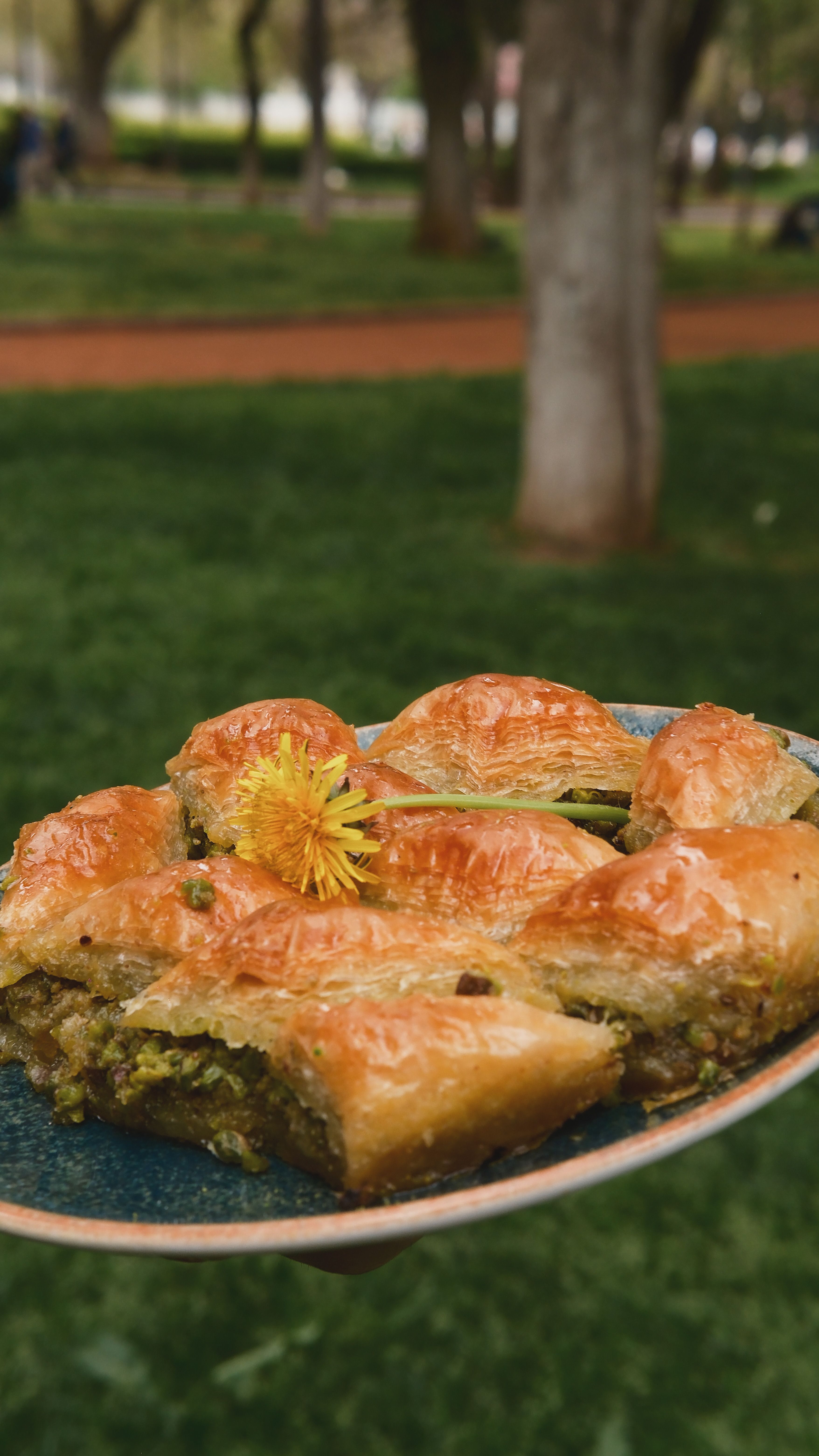
Photo: Beyza Emişen / Pexels
The diets react (see scores below)
Common Ingredients
- phyllo dough
- walnuts
- almonds
- butter
- honey
- sugar
- cinnamon
- cloves
Specific recipes may vary.
Incompatible with 11 of 11 diets
Diet Ratings
Baklava is fundamentally incompatible with a ketogenic diet. It contains three major keto-disqualifying ingredients: phyllo dough (refined wheat flour, a grain-based carbohydrate), honey (pure sugar/fructose), and added sugar — all of which spike blood glucose and instantly break ketosis. A single standard piece of baklava contains approximately 25-35g of net carbs, which alone can exceed or meet an entire day's keto carb allowance. While walnuts, almonds, butter, cinnamon, and cloves are individually keto-friendly, they are completely overwhelmed by the carbohydrate load from the dough and sweeteners. There is no realistic portion size that makes baklava keto-compatible.
Traditional baklava contains two non-vegan ingredients: butter (a dairy product) and honey (excluded by the Vegan Society and most mainstream vegan organizations as an animal-derived product). Both are central to the recipe — butter is used to layer the phyllo dough, and honey is the primary sweetener in the syrup. The remaining ingredients (phyllo dough, walnuts, almonds, sugar, cinnamon, cloves) are all plant-based. A vegan version of baklava is achievable by substituting vegan margarine or coconut oil for butter and agave syrup or maple syrup for honey, but the traditional recipe as listed here is not vegan-compliant. The score is 2 rather than 1 because the dish is predominantly plant-based and easy to veganize, with only two (substitutable) animal-derived ingredients.
A minority of plant-based eaters who do not exclude honey on ethical grounds (arguing bee pollination is not equivalent to animal exploitation) would still reject this baklava due to the butter, but some very lenient 'plant-based' practitioners who permit both honey and clarified butter derivatives might consider it borderline — though this position is not supported by any major vegan organization.
Baklava is fundamentally incompatible with the Paleo diet. Its primary structural ingredient is phyllo dough, a highly processed wheat-based grain product, which is one of the clearest 'avoid' items in Paleo. Beyond the phyllo, it contains butter (dairy) and refined sugar — both explicitly excluded. While walnuts, almonds, honey, cinnamon, and cloves are individually Paleo-compatible ingredients, they are entirely overwhelmed by the non-compliant base components. This dish is a processed, grain-and-dairy-laden dessert with no meaningful path to Paleo approval.
Baklava is a traditional Greek (and broader Mediterranean/Middle Eastern) dessert, but it fundamentally contradicts core Mediterranean diet principles. It is made primarily of refined phyllo dough (refined grain), large amounts of added sugar and honey, and butter (saturated fat) rather than olive oil. While it contains nuts (walnuts, almonds), which are Mediterranean staples, the overall composition is high in added sugars, refined carbohydrates, and saturated fat. It is a highly caloric, processed sweet that Mediterranean diet guidelines explicitly minimize. It should be treated as an occasional indulgence at most, not a regular snack.
Some Mediterranean diet authorities acknowledge that traditional sweets like baklava, consumed in small portions and infrequently as part of a celebratory or cultural context, are not categorically forbidden — the diet is a lifestyle pattern, not a strict prohibition. Traditional Greek and Levantine practice includes such pastries as rare festive treats, and the presence of nuts provides some nutritional offset.
Baklava is almost entirely plant-derived and heavily processed, making it completely incompatible with the carnivore diet. It contains phyllo dough (grain-based), walnuts and almonds (nuts), sugar (refined carbohydrate), cinnamon and cloves (plant spices), and honey. The only animal-derived ingredient is butter, which is a minor component. This dish is essentially a concentrated source of carbohydrates, plant fats, and sugar — the antithesis of carnivore eating. There is no meaningful animal protein present. Every core carnivore authority would unanimously reject this food.
Baklava contains multiple excluded ingredients that make it clearly non-compliant with Whole30. Phyllo dough is made from wheat (a grain), butter is excluded dairy, and sugar is an excluded added sweetener. Even if some ingredients like walnuts, almonds, honey, cinnamon, and cloves are individually compliant, the combination of phyllo dough, butter, and sugar makes this dish unambiguously off-limits. Furthermore, baklava is a classic pastry/baked good, which falls squarely into the category of foods Whole30 prohibits even when made with compliant ingredients — the program explicitly excludes recreating baked goods and sweets.
Baklava contains multiple high-FODMAP ingredients that make it problematic during the elimination phase. The most significant issues are: (1) Phyllo dough is wheat-based, making it high in fructans — a primary FODMAP concern. (2) Honey is high in excess fructose and is explicitly listed as high-FODMAP by Monash University; it is a key sweetener in baklava used in generous quantities. (3) Walnuts are low-FODMAP at 10 walnut halves (~30g), but almonds become high-FODMAP above 10 almonds (~12g) due to GOS and excess fructose — baklava typically contains a generous nut filling making portion control very difficult. (4) Cloves have limited Monash data but are used in small quantities as a spice, posing minimal risk. The combination of wheat-based phyllo and honey alone is sufficient to classify baklava as high-FODMAP at any standard serving size. Even a single piece of baklava contains multiple layers of fructan-rich pastry soaked in honey syrup, making safe consumption during the elimination phase essentially impossible without a complete reformulation.
Monash University rates honey as high-FODMAP even at 1 teaspoon (7g) due to excess fructose, but some clinical FODMAP practitioners allow very small amounts of honey occasionally; however, baklava is so heavily saturated with honey syrup that even this lenient view does not rescue the dish. The wheat-based phyllo alone would disqualify it for most elimination-phase protocols regardless of honey quantity.
Baklava is fundamentally incompatible with the DASH diet. It is a calorie-dense dessert loaded with added sugars (honey and granulated sugar combined), saturated fat from butter, and refined carbohydrates from phyllo dough. DASH explicitly limits sweets and added sugars to 5 or fewer servings per week, and a single piece of baklava can contain 20–30g of added sugar and 8–12g of fat, much of it saturated. While walnuts and almonds are DASH-approved nuts, their benefit is entirely overshadowed by the butter, honey, and sugar in this preparation. The phyllo dough is a refined grain, not a whole grain as DASH recommends. There is essentially no redeeming nutritional density (fiber, potassium, calcium, magnesium) relative to the sugar and saturated fat load.
Baklava is one of the clearest 'avoid' cases in Zone Diet methodology. It is essentially a concentrated delivery system for high-glycemic carbohydrates and saturated fat with virtually no protein and no meaningful low-GI vegetable content. The primary carbohydrate sources — refined phyllo dough, honey, and sugar — are all high-glycemic and nutritionally empty by Zone standards. Honey and sugar are among the most unfavorable carbs in Sears' framework, causing rapid insulin spikes that directly contradict the Zone's core goal of hormonal balance. The fat profile is also problematic: butter is saturated fat, which the Zone limits, and while walnuts and almonds do contribute monounsaturated and omega-3 fats, they are completely overwhelmed by the butter and sugar matrix. There is no protein component whatsoever, making it impossible to achieve a 40/30/30 block ratio even with creative portioning. Unlike many foods that can be 'balanced' within a Zone meal, baklava's macro profile (overwhelmingly carb and fat, zero protein, all high-GI carbs) makes it functionally incompatible with Zone block construction. It cannot serve as any Zone block type — not a carb block (too high-GI and calorie-dense), not a fat block (wrong fat profile), and certainly not a protein block. As a standalone snack, it offers no Zone-compatible nutritional role.
Baklava is a high-sugar, high-saturated-fat dessert that presents a strongly pro-inflammatory profile. The dominant ingredients by caloric weight are butter, honey, and sugar — a combination that delivers significant saturated fat and rapidly digested sugars, both well-established drivers of inflammatory markers like CRP and IL-6. Refined phyllo dough is a high-glycemic refined carbohydrate with negligible fiber. While walnuts are an anti-inflammatory star ingredient (ALA omega-3s, polyphenols) and almonds offer vitamin E and fiber, they are present in relatively modest quantities compared to the saturated fat and sugar load, and their benefits are effectively overwhelmed by the inflammatory context. Cinnamon and cloves are genuine anti-inflammatory spices, but again appear in trace culinary amounts that cannot offset the dish's overall profile. Butter is specifically flagged as a 'limit' item under anti-inflammatory guidelines due to saturated fat content. The combination of refined carbohydrates, added sugars, and saturated fat in a single concentrated dessert makes baklava a clear 'avoid' in anti-inflammatory nutrition — essentially a hyperpalatable vehicle for three of the framework's most cautioned ingredients at once. Occasional consumption as a treat is a personal choice, but from a strict anti-inflammatory assessment, this dish offers minimal benefit and significant inflammatory burden.
Baklava is a poor fit for GLP-1 patients on virtually every relevant dimension. It is extremely high in sugar (honey plus refined sugar as primary ingredients), high in saturated fat (butter-soaked phyllo), and calorie-dense with almost no protein or fiber relative to its caloric load. The combination of high fat and high sugar is particularly problematic for GLP-1 patients, as slowed gastric emptying means fatty, sugary foods sit in the stomach longer, significantly worsening nausea, bloating, and reflux. Refined phyllo dough adds empty carbohydrates with negligible fiber. While walnuts and almonds do contribute small amounts of healthy fats and protein, their contribution is overwhelmed by the butter, honey, and sugar in a standard serving. Nutrient density per calorie is extremely poor — exactly what GLP-1 patients can least afford given their reduced appetite and caloric intake. This is a treat food that offers almost nothing clinically useful in this context.
*See how scores were generated at our methodology page.
Nutritional profile
Six traits that cut across every diet.
Fiber & Plants
How much whole-plant food and fiber it delivers.
Healthy Fats
The quality of its fats (unsaturated, omega-3).
Whole / Unprocessed
How close it is to its natural, unprocessed form.
Gut Gentle
How easy it is on digestion (low FODMAP, few irritants).
Low Glycemic
How little it spikes your blood sugar.
Protein Density
How much protein it packs per calorie.
Controversy Index
Higher controversy = more disagreement between diets.