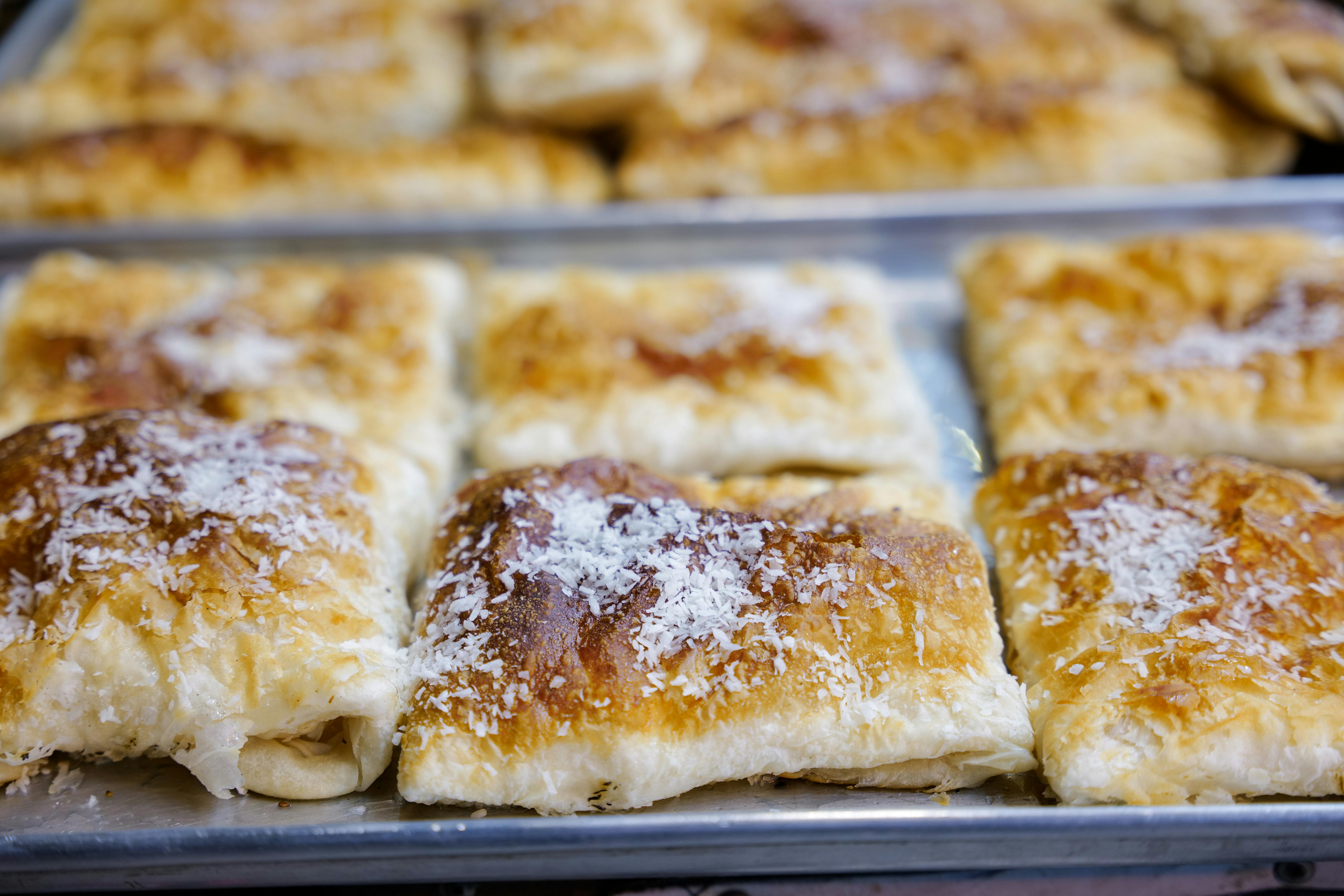
Photo: Anthony Rahayel / Pexels
The diets react (see scores below)
Common Ingredients
- phyllo dough
- semolina
- milk
- eggs
- sugar
- butter
- vanilla
- cinnamon
Specific recipes may vary.
Incompatible with 10 of 11 diets
Diet Ratings
Bougatsa is fundamentally incompatible with a ketogenic diet. It combines multiple high-carbohydrate ingredients that individually would disqualify it: phyllo dough is made from refined wheat flour (extremely high in net carbs), semolina is a high-glycemic grain product, milk adds lactose carbs, and sugar is a direct keto disqualifier. A single serving would deliver well over 50g of net carbs — likely exceeding the entire daily keto carb allowance in one dish. The butter and eggs are keto-friendly, but they are overwhelmed by the carb-heavy components. There is no meaningful substitution or portion reduction that would make this dish keto-compatible while preserving its character.
Bougatsa is a traditional Greek pastry filled with a semolina custard. It contains multiple animal-derived ingredients that are clearly excluded from a vegan diet: milk and eggs form the basis of the custard filling, and butter is used in the phyllo dough and throughout the pastry. These are unambiguous animal products with no debate within the vegan community. There is no plant-based version of this dish implied by the standard recipe — it is fundamentally built on dairy and eggs.
Bougatsa is fundamentally incompatible with the Paleo diet. It contains multiple non-Paleo ingredients with no ambiguity: phyllo dough is a refined wheat product (grain), semolina is a wheat derivative (grain), milk is dairy, sugar is a refined sweetener, and butter is dairy. Every core structural ingredient violates Paleo principles. The only Paleo-compliant ingredients in the dish are eggs, vanilla, and cinnamon — which are entirely secondary. This dish is essentially a grain-and-dairy pastry with refined sugar, hitting virtually every major Paleo exclusion category simultaneously.
Bougatsa is a traditional Greek pastry made with refined phyllo dough, semolina custard, added sugar, butter, and whole milk. While it is a culturally authentic Greek dish, it conflicts significantly with Mediterranean diet principles: it relies on refined grains (phyllo, semolina), added sugars, and butter as the primary fat rather than olive oil. It is essentially a dessert-style pastry consumed at breakfast, providing minimal fiber, no vegetables or legumes, and a high proportion of saturated fat and simple carbohydrates. These characteristics place it firmly in the 'avoid' category for regular consumption.
Some Mediterranean diet interpretations acknowledge that traditional whole-food pastries like bougatsa — made with eggs, milk, and semolina — are culturally embedded in Greek breakfast tradition and contain less processing than industrial baked goods. Occasional, mindful enjoyment of such traditional foods is seen by some practitioners as compatible with the diet's spirit of cultural inclusivity and enjoyment of food.
Bougatsa is a Greek pastry that is fundamentally incompatible with the carnivore diet. The dish is built around phyllo dough and semolina, both of which are grain-based plant foods that are strictly excluded from any tier of carnivore eating. Sugar and vanilla are additional disqualifiers. While eggs, butter, and milk are animal-derived ingredients present in the recipe, they are minor components in a dish that is overwhelmingly plant- and grain-based. No modification short of a complete recipe overhaul could make this carnivore-compliant.
Bougatsa contains multiple excluded ingredients that make it entirely incompatible with Whole30. Phyllo dough is a grain-based product (wheat flour), semolina is a wheat derivative, sugar is an excluded added sweetener, milk is dairy, and butter (regular, not ghee) is also excluded dairy. This dish violates the program on nearly every ingredient level. Even setting aside the spirit-of-the-program concerns, the hard exclusions alone disqualify it completely.
Bougatsa contains multiple high-FODMAP ingredients that make it unsuitable during the elimination phase. Phyllo dough is made from wheat flour, which is high in fructans — a major FODMAP trigger. Semolina is also derived from durum wheat and is likewise high in fructans. Milk contributes significant lactose, another key FODMAP. These three ingredients alone would disqualify this dish at any standard serving size. Butter is low-FODMAP (fat-soluble, minimal lactose), eggs are low-FODMAP, and vanilla, cinnamon, and sugar are all low-FODMAP at typical culinary quantities. However, the combination of wheat-based phyllo, wheat-based semolina, and lactose-rich milk creates a triple FODMAP burden (fructans + fructans + lactose) that cannot be mitigated by portion control in any realistic serving of bougatsa.
Bougatsa is a Greek pastry made with phyllo dough, semolina custard, eggs, sugar, and butter — a combination that conflicts with core DASH principles on multiple fronts. The dish is high in saturated fat from generous butter (used both in the custard and to layer phyllo sheets), high in added sugar, and made with refined grains (white phyllo, semolina). It lacks the potassium, magnesium, fiber, and other micronutrients DASH emphasizes. There is no lean protein, no vegetables or fruit, and no whole grains. As a sweet pastry, it falls squarely into the 'sweets' category that DASH advises limiting to 5 or fewer servings per week, and a full serving of bougatsa would likely use up much of that weekly allowance in one sitting. While milk and eggs provide some nutritional value, the overall nutritional profile is dominated by saturated fat and added sugar, making this a poor fit for the DASH dietary pattern.
Bougatsa is a Greek pastry made primarily of phyllo dough, semolina custard, milk, sugar, and butter — a combination that creates a macro profile nearly opposite to Zone ideals. The dominant macronutrients are high-glycemic carbohydrates (refined phyllo dough, semolina, and added sugar) and saturated fat (butter), with negligible lean protein. Semolina is a refined grain with a high glycemic index, and added sugar further spikes the glycemic load. Butter provides saturated fat rather than the preferred monounsaturated fats (olive oil, avocado, almonds). While eggs contribute some protein, the quantity is minimal relative to the carbohydrate and fat load, making it virtually impossible to achieve a 40/30/30 block ratio from this dish. Even in small portions, the carb-to-protein ratio is severely skewed — you would need to add substantial lean protein and drastically reduce the portion size to approach any Zone balance, at which point the dish contributes little nutritional value. This is essentially a dessert served at breakfast, placing it firmly in the 'avoid' category alongside other pastries, cakes, and sugary baked goods that Sears explicitly flags as disrupting eicosanoid balance.
Bougatsa is a traditional Greek pastry made with phyllo dough filled with a semolina custard. While it contains some mildly beneficial ingredients — cinnamon has well-documented anti-inflammatory properties, eggs provide choline and selenium, and milk offers some nutrients — the overall profile is problematic from an anti-inflammatory standpoint. The dish is high in refined carbohydrates (phyllo dough is made from refined white flour; semolina, while slightly better than white flour, is still a refined grain product), added sugar, and butter (a significant source of saturated fat). Butter in particular is flagged as a food to limit in anti-inflammatory frameworks. The combination of refined starch, sugar, and saturated fat is a classic pro-inflammatory triad that can spike blood glucose, promote glycation end-products, and elevate inflammatory markers like CRP. This is a treat-category food — enjoyable occasionally but not consistent with regular anti-inflammatory eating. The cinnamon is the only meaningfully anti-inflammatory ingredient, and its quantity as a garnish is too small to offset the inflammatory burden of the rest of the dish. Scored at 3 rather than 1-2 because it lacks trans fats, artificial additives, or high-fructose corn syrup, and contains whole-food ingredients in their unprocessed forms.
Bougatsa is a traditional Greek pastry made of buttered phyllo dough filled with a semolina custard sweetened with sugar. For GLP-1 patients, it fails on nearly every key criterion. Protein content is minimal — the eggs and milk in the custard contribute some, but a typical serving delivers only 5-8g of protein, far below the 15-30g per meal target. Fat content is high due to the generous butter used to layer phyllo sheets, meaning saturated fat per serving is significant and likely to worsen nausea, bloating, and reflux — the most common GLP-1 side effects. The dish is high in refined carbohydrates and sugar (semolina is a refined grain, sugar is added directly), offering little fiber and causing rapid blood glucose spikes. Calorie density per gram of nutritional value is poor — this is essentially an empty-calorie pastry. It is also portion-challenging: a single piece is calorically dense, leaving little room for nutrient-dense foods in an already-reduced appetite window. Digestibility is a concern as well — the butter-heavy pastry layers slow digestion further on top of already-slowed gastric emptying. There are no meaningful redeeming nutritional features for a GLP-1 patient context.
*See how scores were generated at our methodology page.
Nutritional profile
Six traits that cut across every diet.
Fiber & Plants
How much whole-plant food and fiber it delivers.
Healthy Fats
The quality of its fats (unsaturated, omega-3).
Whole / Unprocessed
How close it is to its natural, unprocessed form.
Gut Gentle
How easy it is on digestion (low FODMAP, few irritants).
Low Glycemic
How little it spikes your blood sugar.
Protein Density
How much protein it packs per calorie.
Controversy Index
Higher controversy = more disagreement between diets.
Diet-Specific Tips
 Anti-Inflammatory — 5/10
View tips
- High in refined carbohydrates (phyllo dough + semolina) — pro-inflammatory
- Added sugar elevates glycemic load and promotes inflammatory response
- Butter is a saturated fat source flagged as 'limit' in anti-inflammatory frameworks
- No omega-3 fatty acids, polyphenols, or significant antioxidant content
- Cinnamon offers minor anti-inflammatory benefit but insufficient to offset the dish
- No trans fats or artificial additives — distinguishes this from the lowest-tier foods
- Eggs provide some choline and selenium but are a minor component of the overall profile