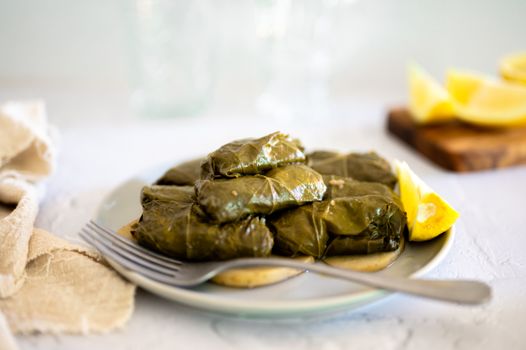
The diets react (see scores below)
Common Ingredients
- grape leaves
- rice
- onion
- dill
- mint
- parsley
- lemon juice
- olive oil
Specific recipes may vary.
Incompatible with 5 of 11 diets
Diet Ratings
Dolmades are fundamentally incompatible with a ketogenic diet due to their primary filling ingredient: white rice. Rice is a high-glycemic grain with approximately 28g of net carbs per 100g cooked, and a typical serving of dolmades (4-6 pieces) can easily contain 30-45g of net carbs from rice alone, blowing the entire daily keto carb budget. While grape leaves themselves are very low-carb and the olive oil, herbs, and lemon juice are keto-friendly, the rice is the core structural ingredient and cannot be considered incidental. There is no version of traditional dolmades that fits keto without fundamentally replacing the rice filling.
This version of dolmades is entirely plant-based. Grape leaves, rice, onion, fresh herbs (dill, mint, parsley), lemon juice, and olive oil are all whole plant foods with no animal-derived ingredients. Traditional Greek dolmades can contain lamb or beef and are sometimes served with an egg-lemon (avgolemono) sauce, but this ingredient list avoids both of those non-vegan elements entirely. The dish is close to whole-food plant-based, with olive oil being the only processed ingredient — a common, minimally processed fat widely accepted by vegans. This is a nutritious, flavorful vegan-friendly side dish.
Dolmades are disqualified primarily by rice, a grain explicitly excluded from the paleo diet. While most other ingredients — grape leaves, onion, dill, mint, parsley, lemon juice, and olive oil — are fully paleo-compliant, the rice filling is a core, non-optional component of the dish. Grains are excluded from paleo due to their anti-nutrient content (phytates, lectins) and absence from the Paleolithic diet. No amount of paleo-friendly wrapping changes the fact that the defining filling ingredient violates the core rules.
Dolmades are a classic Greek Mediterranean dish featuring grape leaves wrapped around a rice and herb filling, dressed with olive oil and lemon juice. The ingredients are overwhelmingly plant-based and whole: grape leaves provide fiber and micronutrients, fresh herbs (dill, mint, parsley) are hallmarks of Mediterranean cooking, lemon juice adds brightness without added sugar, and extra virgin olive oil is the primary fat — all core Mediterranean diet principles. The only moderate concern is the use of white rice rather than a whole grain, which slightly reduces the whole-grain credentials of an otherwise exemplary dish.
Some modern Mediterranean diet clinical guidelines (e.g., those emphasizing glycemic control) would prefer brown rice or another whole grain over white rice as the filling. However, traditional Greek practice has always used short-grain white rice in dolmades, and most Mediterranean diet authorities accept white rice in moderate portions within the broader dietary pattern.
Dolmades are entirely plant-based with zero animal-derived ingredients. Every single component — grape leaves, rice, onion, dill, mint, parsley, lemon juice, and olive oil — is explicitly excluded on the carnivore diet. Rice is a grain, onion and herbs are plant foods, lemon juice is fruit-derived, and olive oil is a plant oil. There is nothing in this dish that is compatible with carnivore eating at any tier, including the most lenient 'animal-based' approaches.
Dolmades contain rice, which is a grain explicitly excluded from the Whole30 program. Rice is listed among the prohibited grains (wheat, oats, rice, corn, quinoa, etc.) that must be eliminated for the full 30 days. All other ingredients in this dish — grape leaves, onion, dill, mint, parsley, lemon juice, and olive oil — are fully Whole30-compliant, but the inclusion of rice makes the dish non-compliant regardless of the quality or quantity of that ingredient.
Dolmades contain onion as a primary ingredient, which is high in fructans and is one of the most problematic FODMAP foods. Even small amounts of onion are high-FODMAP during the elimination phase, and in dolmades, onion is typically mixed directly into the rice filling in meaningful quantities. While most other ingredients are low-FODMAP — rice (low-FODMAP), grape leaves (low-FODMAP), dill, mint, parsley (low-FODMAP in standard culinary amounts), lemon juice (low-FODMAP), and olive oil (low-FODMAP) — the onion alone disqualifies this dish during the elimination phase. There is no realistic way to consume a standard serving of traditional dolmades without ingesting a significant FODMAP load from the onion.
Dolmades as described here (grape leaves, rice, onion, dill, mint, parsley, lemon juice, olive oil) are made from wholesome, largely DASH-friendly ingredients. Olive oil is a recommended unsaturated fat, herbs and lemon juice add flavor without sodium, and the vegetables and rice contribute fiber and micronutrients. However, the key concern is sodium: commercially prepared or restaurant-served grape leaves and dolmades are often quite high in sodium due to brined/preserved grape leaves (which can contribute 300–500mg sodium per serving). The white rice is also a refined grain rather than the whole grain DASH prefers. Additionally, olive oil adds calories and fat that require portion control. When made at home with fresh or well-rinsed low-sodium grape leaves and brown rice, this dish would score much higher (7–8) and lean toward approval. As commonly consumed (using jarred preserved grape leaves), moderate caution is warranted.
NIH DASH guidelines do not specifically address dolmades, but the dish's core ingredients (vegetables, herbs, olive oil, legume-adjacent plant foods) align well with DASH principles. Some DASH-oriented clinicians would approve this dish if prepared with rinsed preserved grape leaves or fresh leaves, noting that the Mediterranean dietary pattern it represents has strong cardiovascular evidence — and that preparation method matters more than categorical avoidance.
Dolmades are a classic Greek dish, but from a Zone Diet perspective they present a significant macro imbalance. The primary filling is white rice, which is a high-glycemic, 'unfavorable' carbohydrate in Zone terminology — it raises blood sugar quickly and offers little fiber to slow absorption. Grape leaves themselves are negligible in macros. The olive oil is a Zone-ideal monounsaturated fat, a genuine positive. The fresh herbs (dill, mint, parsley), onion, and lemon juice are all Zone-favorable low-glycemic additions. However, the dish is essentially carbohydrate-dominant with no meaningful protein source listed, making it impossible to build a balanced 40/30/30 Zone block from this dish alone. As a side dish, it can be paired with a lean protein source (grilled fish, chicken) to help restore balance, but the rice base remains an 'unfavorable' carb requiring careful portioning. A small serving (1-2 dolmades) could fit within a Zone meal's carb block allocation if the rest of the meal is structured accordingly, but the white rice content limits its Zone compatibility. This is a caution food — usable in controlled quantities as part of a larger Zone-balanced plate, but not a food Sears would categorize as favorable.
Dolmades made with this ingredient list are a strong anti-inflammatory dish by most measures. Grape leaves themselves are rich in polyphenols, flavonoids, and antioxidants, and have shown anti-inflammatory activity in research. Olive oil provides oleocanthal and monounsaturated fats, both well-established anti-inflammatory agents. The fresh herbs — dill, mint, and parsley — are concentrated sources of flavonoids, carotenoids, and volatile phytonutrients with documented antioxidant properties. Onion contributes quercetin, a potent anti-inflammatory flavonoid. Lemon juice adds vitamin C and supports the bioavailability of polyphenols. Rice is the one neutral element — it is a refined carbohydrate with a moderate glycemic index, providing minimal anti-inflammatory benefit, but it does not significantly undermine the dish at typical serving sizes. If brown or wild rice were substituted it would be a marginal improvement, but white rice in a dish dominated by grape leaves, olive oil, and herbs is not a meaningful concern. Overall this is a plant-forward, olive-oil-dressed, herb-rich Mediterranean side dish that aligns closely with the core principles of the anti-inflammatory dietary pattern.
Dolmades (stuffed grape leaves) are a portion-friendly, herb-rich side dish, but their nutritional profile is misaligned with core GLP-1 priorities. The primary macronutrient is refined white rice, which is low in fiber and protein and delivers mostly simple carbohydrates — a poor use of limited appetite on a GLP-1 medication. There is no meaningful protein source listed. Olive oil adds unsaturated fat, which is the preferred fat type, but still contributes calories without protein. On the positive side, grape leaves themselves offer some fiber, the herbs (dill, mint, parsley) are nutrient-dense per calorie, lemon juice is fine, and the small rolled format is naturally portion-controlled. The dish is easy to digest, not fried, not spicy, and not high in saturated fat — so it is unlikely to worsen GLP-1 side effects. The concern is primarily one of missed nutritional opportunity: in a reduced-appetite state, dolmades deliver carbohydrates and fat with minimal protein or fiber payoff. As a small accompaniment alongside a high-protein main (e.g., grilled fish or chicken), 2–3 pieces is acceptable. As a standalone side replacing a more nutrient-dense option, it falls short.
Some GLP-1-focused dietitians are more permissive with traditional Mediterranean dishes like dolmades because the olive oil and herb profile align with anti-inflammatory eating patterns they consider supportive of metabolic health; however, others flag the white rice filling as nutritionally wasteful given the caloric constraints GLP-1 patients operate under, and would recommend a cauliflower rice or lentil-based variation instead.
*See how scores were generated at our methodology page.
Nutritional profile
Six traits that cut across every diet.
Fiber & Plants
How much whole-plant food and fiber it delivers.
Healthy Fats
The quality of its fats (unsaturated, omega-3).
Whole / Unprocessed
How close it is to its natural, unprocessed form.
Gut Gentle
How easy it is on digestion (low FODMAP, few irritants).
Low Glycemic
How little it spikes your blood sugar.
Protein Density
How much protein it packs per calorie.
Controversy Index
Higher controversy = more disagreement between diets.
Diet-Specific Tips
 Vegan — 6/10
View tips
- All ingredients are exclusively plant-based
- No meat, dairy, or eggs present — unlike many traditional Greek dolmades recipes
- No avgolemono (egg-lemon) sauce, which would render it non-vegan
- Olive oil is minimally processed and universally accepted in vegan diets
- Grape leaves are a whole-food plant ingredient
- Fresh herbs and lemon juice add nutritional value with no ethical concerns
 Mediterranean — 8/10
View tips
- Grape leaves are a traditional, nutrient-dense Mediterranean ingredient
- Extra virgin olive oil as primary fat — fully aligned with Mediterranean principles
- Rich in fresh herbs (dill, mint, parsley) typical of Greek cuisine
- Lemon juice provides acidity with no added sugar
- White rice rather than whole grain is a minor detraction
- No animal protein, processed ingredients, or added sugars
- Dish is a recognized staple of traditional Greek Mediterranean cooking
 DASH — 6/10
View tips
- Preserved/jarred grape leaves are typically high in sodium due to brining — a significant DASH concern
- Olive oil is a DASH-approved unsaturated fat, used in moderation here
- White rice is a refined grain; DASH recommends whole grains — substituting brown rice improves alignment
- Herbs (dill, mint, parsley), lemon juice, and onion are all DASH-positive ingredients
- No saturated fat, no added sugar, no red meat or full-fat dairy
- Rinsing preserved grape leaves or using fresh leaves can substantially reduce sodium content
- Portion control important due to caloric density from olive oil and rice
 Zone — 4/10
View tips
- White rice is a high-glycemic 'unfavorable' carbohydrate in Zone methodology — raises insulin quickly
- No protein source present — dish is almost entirely carbohydrate and fat
- Olive oil is Zone-ideal monounsaturated fat — a positive element
- Fresh herbs, lemon juice, and onion are Zone-favorable low-glycemic additions
- Grape leaves contribute minimal macros but are nutritionally neutral to positive
- Must be paired with lean protein to approach any Zone balance
- Small portion (1-2 pieces) could serve as a carb block in a broader Zone meal
 Anti-Inflammatory — 8/10
View tips
- Grape leaves are rich in polyphenols and flavonoids with documented anti-inflammatory properties
- Extra virgin olive oil provides oleocanthal and monounsaturated fats — a cornerstone anti-inflammatory fat
- Dill, mint, and parsley are concentrated sources of anti-inflammatory phytonutrients and antioxidants
- Onion contributes quercetin, a well-researched anti-inflammatory flavonoid
- Lemon juice adds vitamin C and enhances polyphenol bioavailability
- White rice is nutritionally neutral — moderate glycemic index, no significant inflammatory load at typical portion sizes
- No processed ingredients, seed oils, refined sugars, or additives present
- Strong alignment with Mediterranean and Dr. Weil anti-inflammatory dietary patterns
 GLP-1 Friendly — 4/10
View tips
- Very low protein — no meaningful protein source in the listed ingredients
- White rice filling is low-fiber and carbohydrate-dense, a poor use of limited caloric budget
- Olive oil provides unsaturated fat — preferred fat type, but adds calories without protein
- Grape leaves contribute modest fiber and micronutrients
- Herbs (dill, mint, parsley) are nutrient-dense and anti-inflammatory
- Small rolled format supports portion control naturally
- Easy to digest — not fried, not greasy, not spicy, unlikely to worsen GLP-1 GI side effects
- Best consumed as a small accompaniment to a high-protein main dish, not as a standalone side