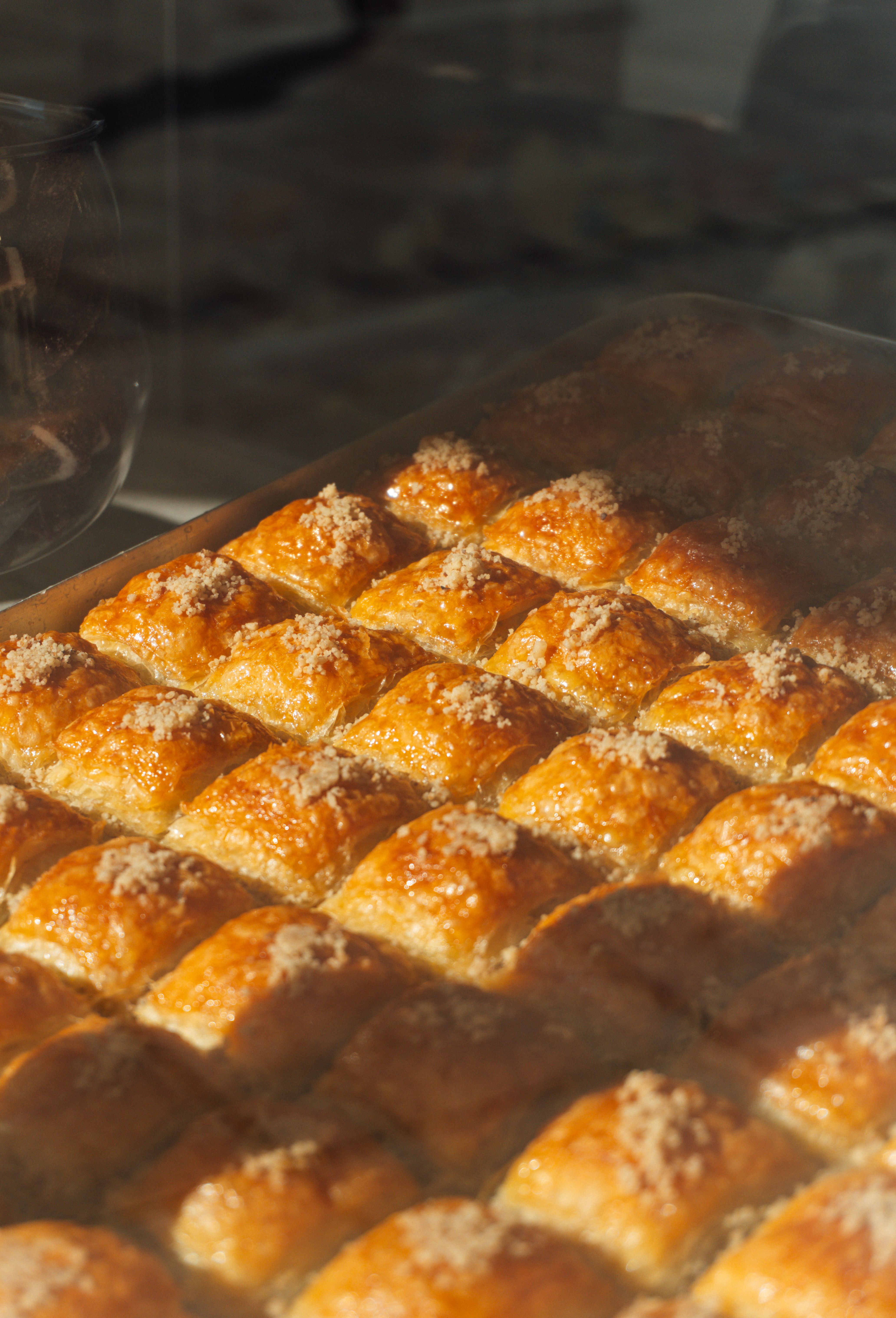
Photo: Raymond Petrik / Pexels
Greek
Galaktoboureko
The diets react (see scores below)
Common Ingredients
- phyllo dough
- semolina
- milk
- eggs
- sugar
- butter
- lemon
- vanilla
Specific recipes may vary.
Incompatible with 11 of 11 diets
Diet Ratings
Galaktoboureko is a Greek custard pastry that is fundamentally incompatible with a ketogenic diet. It contains phyllo dough (made from refined wheat flour), semolina (a high-carb grain), milk, and significant added sugar, along with a sugar syrup typically poured over the finished dish. A single serving likely contains 50-80g of net carbs, far exceeding the entire daily keto carb budget. There is no realistic portion size that makes this keto-friendly, and its core ingredients — grains and sugar — are explicitly excluded from ketogenic eating.
Galaktoboureko is a traditional Greek custard pastry that contains multiple animal-derived ingredients. Milk and eggs form the base of the semolina custard filling, and butter is used throughout the phyllo layers. These are unambiguously animal products with no debate within the vegan community. There is no plant-based version of this dish by default; while vegan adaptations could theoretically be made using plant milks, flax eggs, and vegan butter, the traditional recipe as described is entirely incompatible with a vegan diet.
Galaktoboureko is a Greek custard pastry that contains multiple core non-paleo ingredients. Phyllo dough is made from wheat flour, a grain explicitly excluded from the paleo diet. Semolina is a wheat-derived product, making it doubly grain-based. Milk is a dairy product excluded under paleo rules. Sugar is refined and excluded. Butter, while debated in some paleo circles, is dairy-derived and generally discouraged. The only paleo-compliant ingredients in this dish are eggs, lemon, and vanilla. With at least four clearly prohibited ingredient categories (grains, dairy, refined sugar), this dish is firmly in the avoid category with no meaningful paleo adaptation possible without completely reconstructing it.
Galaktoboureko is a traditional Greek custard pastry that, while culturally authentic, significantly contradicts core Mediterranean diet principles. It is built around refined phyllo dough, added sugar, and butter as the primary fat — all of which the Mediterranean diet discourages. The semolina custard filling adds refined grain content, and sugar is a central ingredient. Butter replaces olive oil entirely. As a dessert-category snack with high refined carbohydrate, saturated fat, and added sugar content, it fits the 'avoid' profile for regular consumption.
Some Mediterranean diet scholars note that traditional Greek sweets like galaktoboureko are consumed sparingly and socially — at celebrations or as occasional treats — and that rigid exclusion ignores the cultural and psychological dimensions of Mediterranean eating patterns. The Oldways Preservation Trust and some Greek dietary traditions frame such pastries as acceptable on rare festive occasions rather than categorically forbidden.
Galaktoboureko is a Greek custard pastry that is fundamentally incompatible with the carnivore diet. The dish is built around phyllo dough (wheat flour — a grain) and semolina (another grain derivative), both of which are strictly plant-based and excluded on any tier of carnivore eating. Additional violations include sugar (processed plant-derived sweetener), lemon (fruit), and vanilla (plant extract). While the dish does contain some animal-derived ingredients — eggs, milk, and butter — these are minor components within an overwhelmingly plant-based, grain-heavy, sugar-laden dessert. No amount of carnivore-friendly tweaking could salvage this dish; it would require a complete reformulation. There is universal consensus across all carnivore authorities that grain-based pastries with sugar are strictly off-limits.
Galaktoboureko is a Greek custard pastry that contains multiple excluded ingredients. Phyllo dough is made from wheat flour, which is a grain and therefore excluded. Semolina is a wheat-derived grain product, also excluded. Milk is dairy, which is excluded (only ghee/clarified butter is the dairy exception). Sugar is an added sweetener, which is excluded. Butter is excluded dairy (only ghee/clarified butter is allowed). This dish fails on at least five separate Whole30 exclusion categories simultaneously, making it firmly in the 'avoid' category.
Galaktoboureko contains multiple high-FODMAP ingredients that make it unsuitable during the elimination phase. Phyllo dough is wheat-based, making it high in fructans — a primary FODMAP trigger. Semolina is also derived from durum wheat and similarly high in fructans. Milk is high in lactose, a disaccharide FODMAP, and a standard custard filling uses a substantial quantity of it. These three ingredients alone — each individually rated as high-FODMAP by Monash University — stack together in a single serving of this dessert, making avoidance necessary during elimination. Eggs, butter, sugar, lemon juice, and vanilla are low-FODMAP and do not contribute to the problem.
Galaktoboureko is a Greek custard pastry made with phyllo dough, semolina custard, eggs, whole milk, sugar, and substantial butter. It is a dessert/sweet snack that conflicts with multiple core DASH diet principles: it is high in added sugar (typically soaked in sugar syrup), high in saturated fat from generous amounts of butter used both in the custard and to layer the phyllo, and made with refined grains (phyllo dough, semolina). It provides none of the key DASH-beneficial nutrients in meaningful amounts — no significant potassium, magnesium, or fiber. The calorie density is high relative to nutritional value. DASH guidelines explicitly limit sweets, added sugars, saturated fats, and refined grains while emphasizing whole grains and nutrient-dense foods. This dish is fundamentally incompatible with DASH eating patterns as a regular food item.
Galaktoboureko is a Greek custard pastry made with phyllo dough, semolina custard, and sugar syrup — a combination that is fundamentally incompatible with Zone Diet principles. The dish is overwhelmingly carbohydrate-dominant with high-glycemic ingredients: refined phyllo dough, semolina (a moderate-to-high glycemic grain), and significant added sugar. There is virtually no lean protein to build a Zone block around, as the eggs present are a minor custard binder relative to the carb load. The fat content comes primarily from butter (saturated), not the preferred monounsaturated fats. The macronutrient ratio is nowhere near 40/30/30 — it skews heavily toward carbohydrates and saturated fat with negligible protein. Even with careful portioning, a meaningful serving would blow through multiple carbohydrate blocks while contributing almost no protein blocks, making Zone balancing at a meal level essentially impossible without dramatically deconstructing the dish. This is a dessert/pastry that functions as concentrated sugar and refined starch delivery — exactly what Dr. Sears identifies as driving unfavorable eicosanoid production and insulin spikes.
Galaktoboureko is a traditional Greek custard pastry that combines several ingredients that are problematic from an anti-inflammatory standpoint. Butter (saturated fat) is used generously to layer the phyllo and in the syrup, contributing significantly to saturated fat load. The dish is high in added sugar, both within the semolina custard filling and in the heavy sugar syrup typically soaked into the pastry — added sugar is one of the most consistently pro-inflammatory dietary components, linked to elevated CRP and IL-6. Phyllo dough is made from refined white flour, a refined carbohydrate that spikes blood glucose and contributes to inflammatory signaling. Full-fat milk and eggs provide some neutral-to-moderate nutritional value, and lemon and vanilla offer minor antioxidant benefits, but these are negligible in context. The overall profile — high refined carbs, high added sugar, high saturated fat, minimal fiber, no omega-3s, no meaningful antioxidant or polyphenol contribution — places this firmly in the 'avoid' category. This is an occasional treat food, not compatible with regular anti-inflammatory eating patterns.
Galaktoboureko is a Greek custard pastry made with buttered phyllo dough, semolina custard, and sugar syrup — a high-sugar, high-saturated-fat dessert with minimal protein and negligible fiber. It is fundamentally incompatible with GLP-1 dietary priorities. The butter-laden phyllo layers deliver substantial saturated fat, which worsens GLP-1 side effects including nausea, bloating, and reflux. The sugar content (custard plus syrup soak) represents empty calories at a time when every calorie must count nutritionally. Semolina provides minimal fiber compared to whole grains. Eggs and milk contribute modest protein, but not nearly enough to redeem the dish — the protein-to-calorie ratio is poor. The rich, heavy nature of this dessert is also poorly suited to slowed gastric emptying, increasing the risk of prolonged nausea and discomfort. There is no realistic portion size that makes this an appropriate choice for a GLP-1 patient.
*See how scores were generated at our methodology page.
Nutritional profile
Six traits that cut across every diet.
Fiber & Plants
How much whole-plant food and fiber it delivers.
Healthy Fats
The quality of its fats (unsaturated, omega-3).
Whole / Unprocessed
How close it is to its natural, unprocessed form.
Gut Gentle
How easy it is on digestion (low FODMAP, few irritants).
Low Glycemic
How little it spikes your blood sugar.
Protein Density
How much protein it packs per calorie.
Controversy Index
Higher controversy = more disagreement between diets.