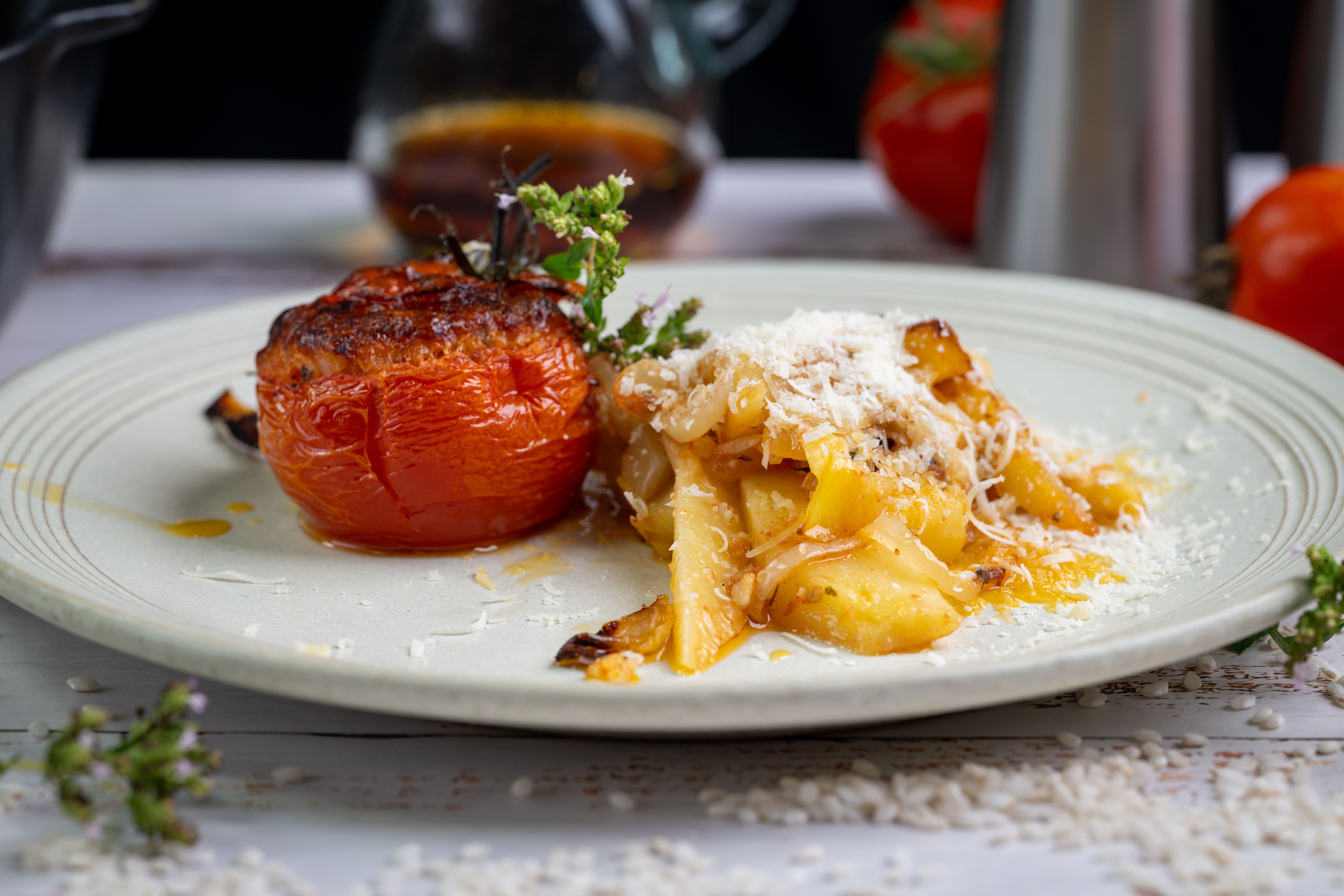
Photo: Jana Ohajdova / Pexels
The diets react (see scores below)
Common Ingredients
- tomatoes
- bell peppers
- rice
- onion
- parsley
- mint
- potatoes
- olive oil
Specific recipes may vary.
Incompatible with 5 of 11 diets
Diet Ratings
Gemista is fundamentally incompatible with a ketogenic diet. The dish is built around rice as a primary filling ingredient, which is a high-carb grain that alone can exceed the entire daily keto carb limit in a single serving. Potatoes are starchy vegetables with very high net carbs, also strictly excluded from keto. The vessel vegetables (tomatoes and bell peppers) add additional net carbs on top. Combined, a standard serving of Gemista could easily deliver 60-100g+ of net carbs, far exceeding the 20-50g daily keto threshold. While olive oil is keto-friendly, it cannot offset the overwhelming carbohydrate load from rice and potatoes. There is no meaningful portion size at which this dish becomes keto-compatible without fundamentally altering its core ingredients.
Gemista is a traditional Greek dish of vegetables (tomatoes and bell peppers) stuffed with a rice and herb mixture, baked alongside potatoes. All listed ingredients — tomatoes, bell peppers, rice, onion, parsley, mint, potatoes, and olive oil — are entirely plant-based whole foods. There are no animal products or animal-derived ingredients present. The dish is naturally vegan without any substitutions required, and consists predominantly of whole, minimally processed ingredients, which earns it a high score within the approve range.
Gemista is a Greek stuffed vegetable dish that is fundamentally non-paleo due to rice, which is a grain and explicitly excluded from the paleo diet. Rice is the central filling ingredient and cannot be omitted without completely changing the dish. The remaining ingredients are mostly paleo-friendly — tomatoes, bell peppers, onion, parsley, mint, and olive oil are all approved. Potatoes are debated but largely accepted in modern paleo. However, rice is a clear, non-negotiable exclusion across all major paleo frameworks, making this dish a firm avoid in its traditional form.
Gemista is a classic Greek dish of vegetables (tomatoes and bell peppers) stuffed with rice, herbs, and onion, roasted with olive oil and potatoes. It is overwhelmingly plant-based, uses extra virgin olive oil as the primary fat, and features whole vegetables and fresh herbs — all core Mediterranean diet staples. The only minor consideration is the use of white rice rather than a whole grain, which is common in traditional Greek preparation but slightly less favored by modern Mediterranean diet guidelines that emphasize whole grains.
Traditional Greek Gemista has always used white rice as the stuffing grain, and some Mediterranean diet researchers argue that rice consumed within a vegetable-rich, olive oil-dressed dish has a moderated glycemic impact. However, modern clinical Mediterranean diet guidelines (such as those from the Harvard T.H. Chan School of Public Health) recommend substituting whole grains like brown rice or farro where possible.
Gemista is a traditional Greek dish consisting entirely of plant-based ingredients. Stuffed tomatoes and bell peppers filled with rice, onion, parsley, mint, and potatoes, all cooked in olive oil — every single ingredient is excluded on the carnivore diet. There is no animal product whatsoever in this dish. Rice and potatoes are high-carbohydrate plant foods, tomatoes and bell peppers are vegetables/fruits, olive oil is a plant-derived oil, and parsley and mint are plant-based herbs. This dish is fundamentally incompatible with carnivore principles at every level.
Gemista is a Greek dish of stuffed tomatoes and bell peppers filled with rice, which is explicitly excluded on the Whole30 program. Rice is a grain and is on the list of prohibited foods for the 30-day elimination period. All other ingredients — tomatoes, bell peppers, onion, parsley, mint, potatoes, and olive oil — are fully compliant, but the rice filling is a disqualifying ingredient with no ambiguity. The dish cannot be made compliant in its traditional form without fundamentally changing the recipe (e.g., substituting cauliflower rice, which would be a different dish).
Gemista is a Greek stuffed vegetable dish that contains two significant high-FODMAP ingredients that make it problematic during the elimination phase. Onion is one of the highest-FODMAP foods tested by Monash University, containing very high levels of fructans at any serving size — there is no safe portion of onion during elimination. The dish also uses tomatoes as the stuffed vessel (meaning a large quantity per serving, beyond the low-FODMAP threshold of ~65g/half a medium tomato) and potatoes cooked alongside, which are themselves low-FODMAP, but the onion alone disqualifies the dish. Bell peppers are low-FODMAP in moderate servings (~52g), rice is low-FODMAP, parsley and mint are low-FODMAP herbs, and olive oil is fine. However, onion cannot be reduced to a trace amount in this dish — it is a core flavoring ingredient. For a low-FODMAP adaptation, onion would need to be completely omitted and replaced with the green tops of spring onions (scallions) or garlic-infused oil for flavor. Tomato quantity would also need to be managed. As traditionally prepared, this dish should be avoided during the elimination phase.
Gemista (Greek stuffed tomatoes and bell peppers with rice) aligns well with DASH diet principles. The dish is built around vegetables (tomatoes, bell peppers, onion) and herbs (parsley, mint), uses olive oil as the fat source — consistent with DASH's emphasis on vegetable oils — and includes rice as a grain and potatoes as an additional vegetable. It is naturally low in sodium when prepared at home without added salt, contains no saturated fat or red meat, and provides meaningful amounts of potassium, fiber, vitamin C, and antioxidants from the vegetables. The olive oil quantity is a mild consideration since DASH recommends modest fat intake, and white rice (the typical choice) is less ideal than brown rice. Potatoes are a moderate-glycemic starch but are DASH-compatible in reasonable portions. Overall, this is a plant-forward, whole-food dish that fits well within the DASH eating pattern.
NIH DASH guidelines do not specifically address Mediterranean dishes like Gemista, so the rating extrapolates from food group principles. Some DASH-oriented clinicians note that white rice raises glycemic load and that olive oil, while heart-healthy, adds calories and fat that should be portioned carefully; an updated clinical interpretation would score this even higher if brown rice is substituted and olive oil is kept to 1-2 tablespoons.
Gemista is a traditional Greek stuffed vegetable dish with several Zone-friendly elements but notable concerns. On the positive side, tomatoes and bell peppers are excellent low-glycemic, polyphenol-rich Zone-favorable carbohydrates, and olive oil is an ideal monounsaturated fat source. However, the dish has two significant Zone problems: (1) it contains no meaningful protein source, making the 30% protein macro target essentially unachievable without adding a separate protein component — this is a structural issue, not just a portioning one; (2) both rice and potatoes are high-glycemic 'unfavorable' carbohydrates in Zone terminology, and Gemista typically contains both in substantial amounts, creating a carbohydrate load that is difficult to balance. The rice-stuffed interior combined with the surrounding potato wedges (often baked alongside) creates a glycemic spike profile directly contrary to Zone principles. The dish could be partially salvaged by drastically reducing or eliminating the rice and potatoes, adding a lean protein, but at that point the recipe has been fundamentally altered. As traditionally prepared, this dish is carbohydrate-heavy with the wrong type of carbs and lacks protein entirely.
Gemista is a classic Greek stuffed vegetable dish built almost entirely on anti-inflammatory foundations. Tomatoes and bell peppers are rich in lycopene, vitamin C, and carotenoids — antioxidants well-documented to reduce inflammatory markers. Cooking tomatoes in olive oil notably increases lycopene bioavailability. Extra virgin olive oil provides oleocanthal, a natural COX inhibitor with ibuprofen-like anti-inflammatory action, and is a cornerstone of the anti-inflammatory diet. Onion contributes quercetin, a potent anti-inflammatory flavonoid. Parsley and mint bring polyphenols and chlorophyll. Potatoes are the one mildly complex ingredient — they are a whole food with some resistant starch and potassium, but they are a high-glycemic starch that can nudge the dish toward a neutral inflammatory profile when consumed in large portions. Rice (presumably white rice in the traditional version) is a refined carbohydrate, though not as inflammatory as processed grains. Together, potatoes and white rice represent the only mild detractors in an otherwise exemplary anti-inflammatory dish. The overall profile — colorful vegetables, EVOO, herbs, no processed ingredients, no animal fat, no sugar or additives — is strongly aligned with Dr. Weil's Anti-Inflammatory Food Pyramid and Mediterranean diet principles.
Autoimmune Protocol (AIP) and some anti-inflammatory practitioners (e.g., Dr. Tom O'Bryan) would flag tomatoes, bell peppers, and potatoes as nightshades, cautioning that solanine and lectins may trigger inflammation in sensitive individuals with autoimmune conditions. Mainstream anti-inflammatory authorities including Dr. Weil and most Mediterranean diet researchers include these vegetables and consider them strongly beneficial due to their antioxidant content.
Gemista (Greek stuffed tomatoes and peppers with rice) is a vegetable-forward dish with good fiber from the tomatoes, bell peppers, and herbs, and moderate digestibility. However, it falls short on protein — the primary filling is white rice with no significant protein source listed, making it difficult to hit the 15-30g per meal target on GLP-1 medications without meaningful additions. White rice is a refined carbohydrate with low fiber density and a high glycemic index, which is not ideal for blood sugar stability. Olive oil adds healthy unsaturated fat but contributes calories without protein. Potatoes add further starchy carbohydrate load. The vegetables (tomatoes, bell peppers, onion, parsley, mint) contribute hydration, fiber, and micronutrients, and the dish is generally easy to digest and not greasy or fried. The overall profile is nutrient-moderate but protein-deficient as written — a significant drawback for GLP-1 patients where every meal must prioritize protein. It can be acceptable as a side dish or if substantially modified (e.g., adding ground turkey, lentils, or feta to the filling), but as a standalone main it does not meet protein priorities.
Some GLP-1-focused dietitians may rate traditional Mediterranean dishes like gemista more favorably given their whole-food ingredient profile, high vegetable content, and use of olive oil — arguing that the Mediterranean dietary pattern broadly supports metabolic health and that rigid per-meal protein targets are less critical at lower calorie intakes. Others maintain that without a protein anchor in every meal, muscle loss risk during rapid GLP-1-induced weight loss is meaningfully increased, making the dish unsuitable as a primary main.
*See how scores were generated at our methodology page.
Nutritional profile
Six traits that cut across every diet.
Fiber & Plants
How much whole-plant food and fiber it delivers.
Healthy Fats
The quality of its fats (unsaturated, omega-3).
Whole / Unprocessed
How close it is to its natural, unprocessed form.
Gut Gentle
How easy it is on digestion (low FODMAP, few irritants).
Low Glycemic
How little it spikes your blood sugar.
Protein Density
How much protein it packs per calorie.
Controversy Index
Higher controversy = more disagreement between diets.
Diet-Specific Tips
 Vegan — 6/10
View tips
- All ingredients are whole plant foods
- No animal products or animal-derived ingredients
- Traditional preparation is naturally vegan — no adaptation needed
- Olive oil is plant-derived and uncontroversial in vegan assessment
- Rice, herbs, and vegetables form a nutritionally sound combination
- No processed or ethically contested ingredients present
 Mediterranean — 8/10
View tips
- Abundant vegetables as the main component (tomatoes, bell peppers)
- Extra virgin olive oil as the primary fat — a Mediterranean cornerstone
- Fresh herbs (parsley, mint) and aromatics align perfectly with the diet
- White rice rather than a whole grain is a minor deviation from modern guidelines
- No animal protein or processed ingredients — fully plant-based
- Traditional Greek dish with deep roots in Mediterranean culinary heritage
 DASH — 8/10
View tips
- Vegetables (tomatoes, bell peppers, onion) form the base — core DASH foods rich in potassium and fiber
- Olive oil is the recommended fat source in DASH (vegetable oil)
- Naturally low in sodium when home-prepared without added salt
- No saturated fat, no red meat, no processed ingredients
- White rice is acceptable but less ideal than whole-grain (brown) rice
- Potatoes are DASH-compatible but should be portion-controlled
- Herbs (parsley, mint) add flavor without sodium, supporting reduced-salt cooking
- Dish lacks lean protein — could be complemented with legumes or fish for a more complete DASH meal
 Zone — 4/10
View tips
- No protein source — fails the 30% protein requirement entirely; requires a separate lean protein to balance
- Rice is a high-glycemic 'unfavorable' carbohydrate in Zone methodology
- Potatoes are explicitly listed as an unfavorable, high-glycemic carb to avoid in Dr. Sears' Zone framework
- Tomatoes and bell peppers are Zone-favorable low-glycemic vegetables with polyphenol benefits
- Olive oil is an ideal Zone monounsaturated fat source
- Onion, parsley, and mint contribute minimal macros and are Zone-neutral to positive
- As traditionally served, the carbohydrate ratio is too high and glycemic index too elevated for Zone compliance
 Anti-Inflammatory — 7/10
View tips
- Tomatoes and bell peppers: rich in lycopene, carotenoids, and vitamin C — strong anti-inflammatory antioxidants
- Extra virgin olive oil: oleocanthal with documented anti-inflammatory (COX-inhibiting) action; central to Mediterranean and anti-inflammatory diets
- Onion: quercetin content is a well-researched anti-inflammatory flavonoid
- Parsley and mint: polyphenol-rich herbs with anti-inflammatory properties
- White rice: refined carbohydrate with moderate glycemic impact; a mild detractor
- Potatoes: whole food but high-glycemic starch; nightshade consideration for autoimmune-sensitive individuals
- No processed ingredients, trans fats, added sugars, or pro-inflammatory seed oils
- Cooking tomatoes in EVOO enhances lycopene bioavailability
 GLP-1 Friendly — 5/10
View tips
- Very low protein — no significant protein source in the dish as described, fails the 15-30g per meal target
- White rice is a refined carbohydrate with high glycemic index and low fiber density
- Good vegetable variety (tomatoes, bell peppers, onion, herbs) provides fiber, hydration, and micronutrients
- Olive oil contributes healthy unsaturated fat but adds calorie density without protein
- Potatoes add additional starchy carbohydrate load, increasing glycemic impact
- Dish is easy to digest and not greasy or fried — no GI side effect concerns
- Works better as a side dish or with protein additions (ground turkey, lentils, feta) than as a standalone GLP-1 main