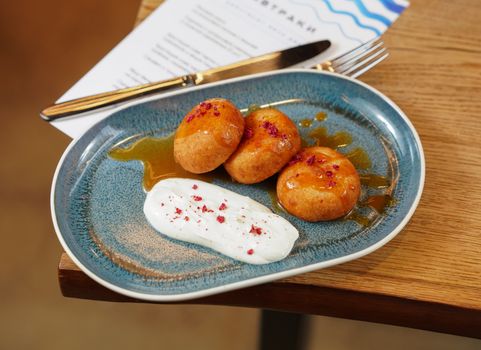
The diets react (see scores below)
Common Ingredients
- flour
- yeast
- water
- honey
- cinnamon
- walnuts
- sugar
- oil
Specific recipes may vary.
Incompatible with 10 of 11 diets
Diet Ratings
Loukoumades are Greek honey doughnuts that are fundamentally incompatible with a ketogenic diet. The base is wheat flour (high-carb grain), leavened with yeast and deep-fried, then topped with honey and sugar — two direct sources of rapidly absorbed sugars. A single serving of 4-5 loukoumades can easily contain 40-60g of net carbs, which would exceed or nearly exhaust the entire daily keto carb allowance in one snack. The flour alone disqualifies this dish, and the added honey and sugar compound the problem severely. While walnuts and cinnamon are keto-friendly ingredients, they are present in trivial amounts relative to the carb load of the other components and cannot redeem the dish.
Loukoumades are Greek honey puffs made from flour, yeast, water, and oil — all plant-based ingredients — but the traditional recipe calls for honey as the primary topping/sweetener. Honey is excluded by the Vegan Society and most major vegan organizations on the grounds that bees are animal workers whose products should not be exploited. The remaining ingredients (flour, yeast, water, cinnamon, walnuts, sugar, oil) are fully vegan-compliant. The dish can be made vegan by substituting maple syrup or agave nectar for honey, but as traditionally prepared it is not vegan under mainstream vegan ethics. The caution rating rather than avoid reflects that the animal-derived ingredient is a topping (easily substituted) rather than a structural component, and that a meaningful minority of plant-based eaters do not exclude honey.
A minority of plant-based eaters argue that honey from small-scale or treatment-free beekeeping does not constitute animal exploitation and is therefore acceptable; under this view, loukoumades made with quality honey would be fully plant-based. Strict ethical vegans aligned with the Vegan Society, however, hold that any commercial use of bee labor is incompatible with veganism regardless of scale.
Loukoumades are Greek honey doughnuts made by deep-frying a wheat flour and yeast dough, then topping with honey, cinnamon, walnuts, and sugar. The dish contains multiple hard paleo violations: flour (wheat grain) is explicitly excluded from any paleo framework, refined sugar is a clear avoid, and the frying oil is almost certainly a seed or vegetable oil — all non-negotiable disqualifiers. While honey, cinnamon, and walnuts are individually paleo-compatible, they cannot redeem a dish whose base is fundamentally grain-derived and processed. This is a fried grain product with added refined sugar — there is no paleo interpretation that would accept it.
Loukoumades are deep-fried dough balls made from refined white flour and added sugar, then drizzled with honey and topped with walnuts and cinnamon. While walnuts, honey, and cinnamon are individually Mediterranean-friendly ingredients, the dish's core is a deep-fried refined grain product with added sugar — a combination that directly contradicts Mediterranean diet principles emphasizing whole grains, minimal added sugars, and avoiding deep-fried foods. The refined flour provides little nutritional value, deep-frying in oil (likely not extra virgin olive oil) adds significant unhealthy fat, and the sugar plus honey creates a high glycemic load treat. This is firmly in the 'avoid' category for regular consumption.
As a traditional Greek street food with centuries of cultural history, some Mediterranean diet practitioners acknowledge loukoumades as an occasional festive treat rather than a dietary staple — the honey and walnuts do provide some nutritional benefit, and traditional Greek dietary patterns always included such celebratory sweets in small amounts during festivals and special occasions.
Loukoumades are Greek honey-dough fritters that are entirely plant-based and contain no animal products whatsoever. Every single ingredient — flour, yeast, water, honey, cinnamon, walnuts, sugar, and oil — is either plant-derived or a non-animal additive. Flour and yeast are grain/fungal products, walnuts are a plant nut, cinnamon is a plant spice, sugar is a plant-derived sweetener, and the frying oil is a plant oil. Even the honey, which some carnivore practitioners debate, is irrelevant here given the overwhelming plant-based ingredient list. This dish is completely incompatible with any tier of the carnivore diet.
Loukoumades are Greek honey puffs — deep-fried dough balls that are excluded on Whole30 for multiple reasons. First, flour is a grain product (wheat), which is explicitly excluded. Second, sugar is an added sweetener, also explicitly excluded. Third, even setting aside individual ingredients, loukoumades are a fried dough/pastry that falls squarely into the 'no recreating baked goods/junk food' rule — they are essentially donuts and are categorically prohibited regardless of ingredient substitutions.
Loukoumades contain multiple high-FODMAP ingredients that make this dish problematic during the elimination phase. The primary issue is wheat flour, which is high in fructans — a major FODMAP category. Even a small serving of 2-3 loukoumades would deliver a significant fructan load. Honey is another high-FODMAP ingredient (excess fructose), and walnuts become high-FODMAP above 10 nuts per serving (moderate at smaller amounts). Sugar (sucrose) and oil are low-FODMAP, and cinnamon and yeast are generally low-FODMAP at culinary amounts. The combination of wheat flour AND honey makes this dish very difficult to make low-FODMAP without fundamental recipe changes — substituting gluten-free flour AND replacing honey with maple syrup would be necessary. A standard serving of 3-5 loukoumades would present both a substantial fructan hit from the wheat dough and excess fructose from the honey drizzle, making avoidance the appropriate recommendation during elimination.
Some FODMAP practitioners note that deep-frying dough may slightly alter the fructan content compared to baked goods, though no Monash University data specifically supports this for fried dough products. The honey drizzle amount varies significantly — a very light drizzle might stay below the fructose threshold, but this is difficult to control in practice and most practitioners would still advise avoidance during elimination.
Loukoumades are deep-fried dough balls — a classic fried sweet that DASH guidelines explicitly discourage. The dish is high in refined carbohydrates (white flour, added sugar, honey), deep-fried in oil (adding significant total fat and potentially trans fats depending on oil used), and provides little nutritional value in terms of potassium, calcium, magnesium, or fiber. DASH guidelines specifically limit sweets, added sugars, and fried foods. While walnuts and cinnamon offer minor DASH-friendly elements, and honey is a natural sweetener, the overall profile — refined flour, frying oil, and added sugars — makes this a poor fit for the DASH eating plan. This is analogous to donuts or fried dough, which DASH categorically limits.
Loukoumades are deep-fried dough balls — essentially Greek donut holes — topped with honey, sugar, and cinnamon, with walnuts as the only redeeming nutritional element. The macro profile is deeply incompatible with Zone principles: the base is refined white flour (high-glycemic carbohydrate with minimal fiber), fried in oil (likely omega-6-heavy seed oil, not monounsaturated), sweetened with both honey and sugar (pure glycemic load with no protein or fat buffering). There is no meaningful protein source whatsoever, making it impossible to construct anything approaching a 40/30/30 ratio. The carbohydrate-to-protein ratio is wildly skewed — this is essentially pure carbohydrate and fat with negligible protein. Even with small portions, the refined flour and sugar combination would spike insulin rapidly. Walnuts provide some omega-3s and monounsaturated fat, and cinnamon has mild anti-inflammatory properties acknowledged by Sears, but these are minor positives buried under a fundamentally Zone-incompatible food structure. This is one of the rare cases where the food is genuinely difficult to fit into any Zone-balanced context without transforming it into something unrecognizable.
Loukoumades are deep-fried dough balls — essentially a refined wheat flour dough (white flour, yeast, water, sugar) fried in oil and topped with honey. While the dish contains some genuinely anti-inflammatory ingredients — cinnamon (a potent anti-inflammatory spice), walnuts (excellent source of omega-3 ALA and polyphenols), and honey (antioxidant properties in raw form) — these benefits are overwhelmed by the core preparation method and base ingredients. The dough is made from refined white flour with added sugar, providing a high glycemic load that drives insulin spikes and promotes inflammatory markers like CRP and IL-6. Deep-frying in unspecified oil (almost certainly a refined seed or vegetable oil — sunflower, cottonseed, or similar) introduces excessive omega-6 fatty acids and oxidized lipids from high-heat frying, both of which are strongly pro-inflammatory. The frying process also generates advanced glycation end products (AGEs) and potentially harmful aldehydes. This combination — refined carbs + added sugar + deep-fried in seed oil — represents the core pattern that anti-inflammatory nutrition consistently identifies as most harmful. The cinnamon and walnuts as toppings cannot meaningfully offset the inflammatory foundation of the dish. Loukoumades are a treat food with a profile nearly identical to donuts, which every major anti-inflammatory framework would categorize as an avoid.
Loukoumades are deep-fried dough balls drizzled with honey and sugar, topped with walnuts and cinnamon. They are fundamentally incompatible with GLP-1 dietary guidelines across nearly every criterion: they are deep-fried (high fat, difficult to digest, known to worsen nausea, bloating, and reflux in GLP-1 patients), made from refined flour (minimal fiber, low nutrient density), loaded with added sugars via honey and sugar topping (empty calories, blood sugar spike), and contain virtually no protein. The walnuts provide a small amount of healthy fat and trace protein, but in the quantities used as a garnish they do not meaningfully offset the dish's profile. Gastric emptying is already slowed by GLP-1 medications, and a high-fat, fried, sugary food sits in the stomach longer, compounding GI side effects. Every calorie in this dish is nutritionally low-value relative to what GLP-1 patients need. There is no practical portion size that makes loukoumades a reasonable choice on a GLP-1-aligned diet.
*See how scores were generated at our methodology page.
Nutritional profile
Six traits that cut across every diet.
Fiber & Plants
How much whole-plant food and fiber it delivers.
Healthy Fats
The quality of its fats (unsaturated, omega-3).
Whole / Unprocessed
How close it is to its natural, unprocessed form.
Gut Gentle
How easy it is on digestion (low FODMAP, few irritants).
Low Glycemic
How little it spikes your blood sugar.
Protein Density
How much protein it packs per calorie.
Controversy Index
Higher controversy = more disagreement between diets.
Diet-Specific Tips
 Vegan — 4/10
View tips
- Honey is the key non-vegan ingredient under mainstream vegan standards
- Honey is excluded by the Vegan Society and PETA as an animal-derived product
- All other ingredients — flour, yeast, water, cinnamon, walnuts, sugar, oil — are fully plant-based
- Honey functions as a topping and can be replaced with maple syrup or agave to make a vegan version
- Fried dough base is otherwise whole-food-adjacent but still a processed snack food