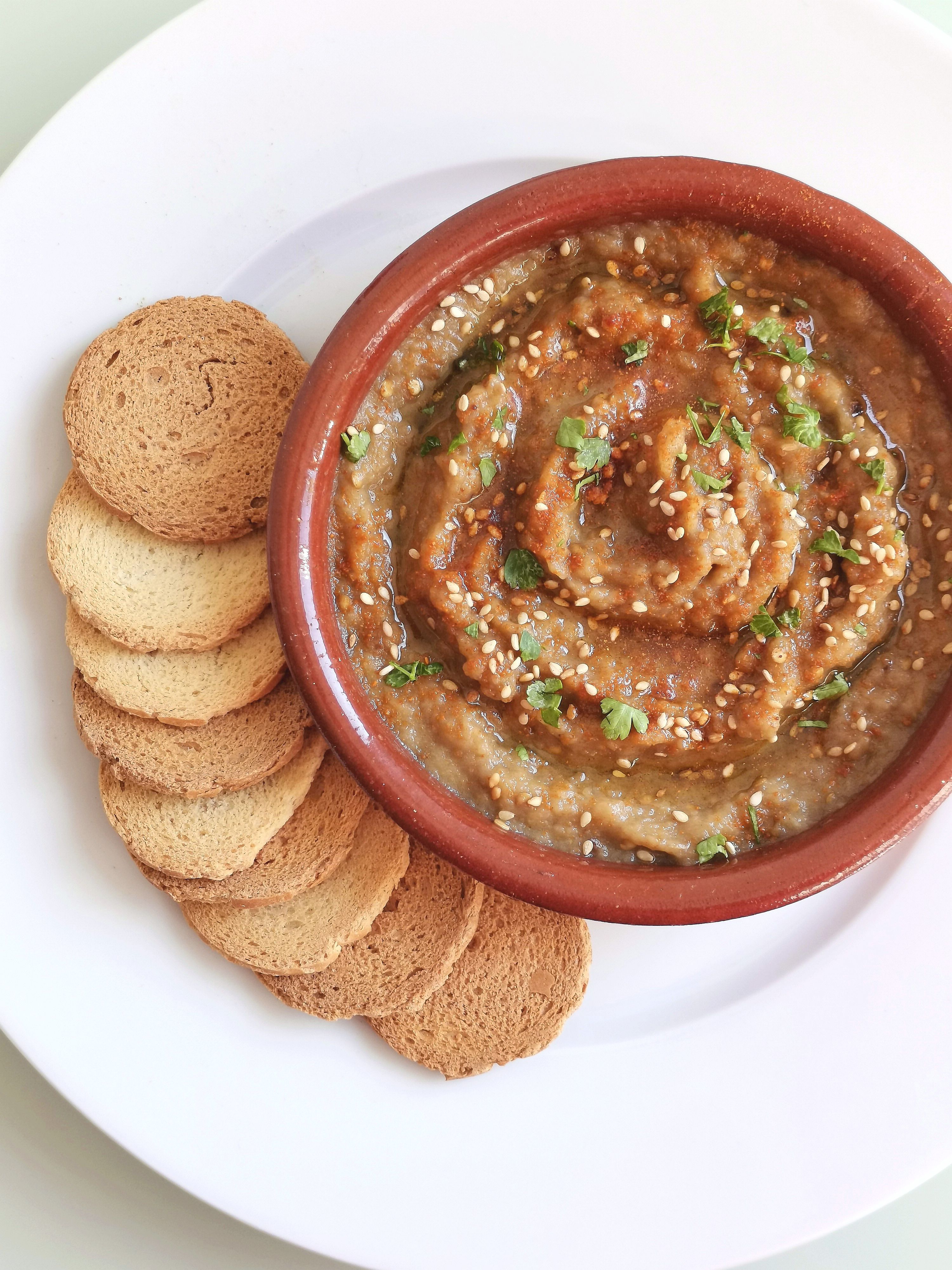
Photo: SartenPorElMango / Pexels
Greek
Melitzanosalata
The diets react (see scores below)
Common Ingredients
- eggplant
- garlic
- lemon juice
- olive oil
- parsley
- red onion
- red wine vinegar
Specific recipes may vary.
Incompatible with 2 of 11 diets
Diet Ratings
Melitzanosalata is a Greek roasted eggplant dip made primarily from low-carb, keto-friendly ingredients: eggplant, olive oil, garlic, lemon juice, parsley, red onion, and red wine vinegar. Eggplant itself has approximately 3g net carbs per 100g, and the olive oil base is ideal for keto. However, as a condiment or dip, portions matter — a generous serving (150-200g) could contribute 5-8g net carbs, and the red onion and lemon juice add small but meaningful carb amounts. The dish contains no grains, added sugars, or high-carb ingredients, making it generally compatible, but portion control is necessary to avoid carb accumulation, especially when consumed alongside other keto foods with any carb content.
Stricter keto practitioners may flag red onion and lemon juice as unnecessarily carb-dense, preferring to substitute with green onions and limit acidic additions, keeping this as an occasional rather than regular condiment.
Melitzanosalata is a traditional Greek roasted eggplant dip made entirely from whole plant foods. Every ingredient — eggplant, garlic, lemon juice, olive oil, parsley, red onion, and red wine vinegar — is unambiguously plant-derived. There are no animal products, animal-derived additives, or contested ingredients in this preparation. It is minimally processed and centered on a whole vegetable base, which aligns strongly with both strict vegan and whole-food plant-based standards. The score is slightly below 10 only because olive oil is a processed fat rather than a whole food, but it is entirely plant-based.
Melitzanosalata is a traditional Greek roasted eggplant dip made entirely from whole, unprocessed ingredients that align well with paleo principles. Eggplant is a non-starchy vegetable available in the wild; garlic, parsley, and red onion are whole plant foods; lemon juice and red wine vinegar are natural acidic condiments without additives; and olive oil is a preferred paleo fat. All ingredients are recognizable, minimally processed, and free from grains, legumes, dairy, refined sugars, or seed oils. Red wine vinegar is the only ingredient that draws occasional scrutiny in strict paleo circles due to its fermented, processed nature, but it is broadly accepted by the mainstream paleo community in small culinary quantities.
Melitzanosalata is a quintessential Greek eggplant dip that exemplifies Mediterranean diet principles. Every ingredient is a Mediterranean staple: roasted eggplant (a core vegetable in Levantine and Greek cuisine), extra virgin olive oil (the primary fat), garlic, lemon juice, red wine vinegar, parsley, and red onion. There are no processed ingredients, added sugars, refined grains, or animal products. As a plant-forward condiment rich in fiber, antioxidants, and healthy monounsaturated fats, it is not only compatible with but emblematic of traditional Greek Mediterranean eating.
Melitzanosalata is a Greek roasted eggplant dip made entirely from plant-based ingredients. Every single component — eggplant, garlic, lemon juice, olive oil, parsley, red onion, and red wine vinegar — is plant-derived and explicitly excluded from the carnivore diet. There are no animal products whatsoever in this dish. This is a clear, unambiguous violation of carnivore principles across all tiers, from the most permissive animal-based approach to the strictest Lion Diet.
Melitzanosalata is a traditional Greek roasted eggplant dip/salad. Every ingredient in this dish is fully Whole30 compliant: eggplant is a vegetable, garlic and parsley are herbs/aromatics, lemon juice is a natural acid, olive oil is an approved natural fat, red onion is a vegetable, and red wine vinegar is explicitly allowed by the Whole30 program. There are no excluded ingredients whatsoever — no grains, legumes, dairy, added sugars, or other disallowed substances. This is a whole, minimally processed condiment made entirely from compliant foods.
Melitzanosalata contains two significant high-FODMAP ingredients that make it unsuitable during the elimination phase: garlic and red onion. Both are among the highest-fructan foods on the Monash scale and are problematic at even small amounts. Garlic is one of the worst offenders on the low-FODMAP diet — a single clove contains enough fructans to trigger symptoms. Red onion is similarly high in fructans and is a classic trigger food. Eggplant is low-FODMAP at a standard serving (up to 182g per Monash), and the remaining ingredients — lemon juice, olive oil, parsley, and red wine vinegar — are all low-FODMAP. However, the garlic and red onion are core structural ingredients in traditional melitzanosalata, not incidental additions, meaning the dish cannot reasonably be considered safe during elimination. A FODMAP-modified version using garlic-infused oil and omitting red onion (substituting with the green tops of spring onions) could make this dish compliant.
Melitzanosalata is a Greek roasted eggplant dip made entirely from DASH-friendly whole-food ingredients. Eggplant is a low-calorie vegetable rich in fiber and potassium. Olive oil is a heart-healthy unsaturated fat explicitly supported by DASH. Garlic, parsley, red onion, lemon juice, and red wine vinegar add flavor without sodium, supporting the DASH goal of reducing salt through aromatic alternatives. The dish contains no added sodium, no saturated fat, no added sugar, and no processed ingredients. The main consideration is olive oil quantity — as a condiment, portion size matters since olive oil is calorie-dense, but a typical 2-tablespoon serving keeps fat intake reasonable. Overall, this dish aligns strongly with DASH principles as a vegetable-forward, low-sodium, unsaturated-fat condiment.
NIH DASH guidelines emphasize limiting total fat intake and controlling portion sizes for oils; some conservative DASH clinicians may flag olive oil-heavy dips if consumed in large quantities beyond the recommended 2-3 teaspoons/day of added fats. However, updated clinical interpretations increasingly support liberal use of extra-virgin olive oil given its strong cardiovascular evidence base, and many DASH-aligned practitioners would not restrict this dish.
Melitzanosalata is a Greek eggplant dip/spread made primarily from roasted eggplant, olive oil, garlic, lemon juice, red onion, parsley, and red wine vinegar. From a Zone perspective, this is an excellent condiment. Eggplant is a favorable, low-glycemic vegetable with minimal net carbs and good fiber content — exactly the type of vegetable Sears promotes. Olive oil is the gold standard Zone fat source, being rich in monounsaturated fatty acids. Garlic, parsley, red onion, lemon juice, and red wine vinegar are all Zone-favorable ingredients that add polyphenols and anti-inflammatory compounds without meaningfully disrupting macronutrient ratios. As a condiment used alongside lean protein, this dish contributes healthy fat blocks (from olive oil) and favorable carb fractions (from eggplant and aromatics) with negligible saturated fat and no refined carbohydrates. The anti-inflammatory profile is excellent — polyphenols from eggplant skin and parsley, omega-9 from olive oil, and vinegar which may help moderate glycemic response. The primary consideration is portion control of olive oil to stay within fat block targets, but this is straightforward to manage.
Melitzanosalata is a Greek roasted eggplant dip with a strongly anti-inflammatory ingredient profile. Eggplant (aubergine) is rich in nasunin, a potent anthocyanin antioxidant found in the skin, along with chlorogenic acid — both associated with reduced oxidative stress and inflammatory markers. Garlic contains allicin and other sulfur compounds with well-documented anti-inflammatory and immunomodulatory effects. Extra virgin olive oil is a cornerstone of anti-inflammatory eating, providing oleocanthal (a natural COX inhibitor), oleic acid, and polyphenols. Lemon juice and red wine vinegar add vitamin C and acetic acid respectively, both with mild anti-inflammatory properties. Parsley is rich in apigenin and luteolin, flavonoids with anti-inflammatory activity. Red onion contributes quercetin, one of the most studied anti-inflammatory flavonoids. There are no processed ingredients, refined carbohydrates, seed oils, or added sugars. The dish is essentially a Mediterranean whole-food preparation that aligns closely with Dr. Weil's Anti-Inflammatory Food Pyramid principles. The only caveat worth noting is that eggplant is a nightshade, which introduces mild controversy for autoimmune-sensitive individuals.
Mainstream anti-inflammatory nutrition (Dr. Weil, Mediterranean diet research) considers eggplant beneficial due to its high antioxidant content. However, the Autoimmune Protocol (AIP) and researchers like Dr. Tom O'Bryan exclude nightshades including eggplant, arguing that solanine alkaloids and lectins may trigger or worsen inflammation in individuals with autoimmune conditions or leaky gut — making this dish less suitable for that subpopulation.
Melitzanosalata is a roasted eggplant dip made with mostly vegetables, olive oil, lemon juice, and aromatics. It has no meaningful protein, which is a significant drawback for GLP-1 patients who must prioritize protein at every meal and snack. The eggplant base provides some fiber and is easy to digest. The olive oil contributes unsaturated fat, which is the preferred fat type for GLP-1 patients, but the amount used in traditional recipes can add up calorically for a food with no protein payoff. On the positive side, the ingredients are whole and minimally processed, nutrient-dense relative to similar condiments, and the garlic, lemon, and vinegar components are well-tolerated. The portion size matters significantly here — a small amount as a condiment or spread alongside a high-protein food is acceptable and even beneficial for variety and vegetable intake, but it should not displace protein-rich foods in a meal. As a dip paired with vegetables or whole grain crackers, it scores reasonably; as a standalone snack it is nutritionally insufficient for GLP-1 patients.
Some GLP-1-focused dietitians would view this more favorably as a vegetable-forward, minimally processed condiment that supports dietary variety and digestibility, particularly for patients struggling with nausea who need gentle, flavorful foods. Others would caution that the olive oil volume in traditional preparations adds empty calories relative to protein content, making it a poor use of limited appetite capacity.
*See how scores were generated at our methodology page.
Nutritional profile
Six traits that cut across every diet.
Fiber & Plants
How much whole-plant food and fiber it delivers.
Healthy Fats
The quality of its fats (unsaturated, omega-3).
Whole / Unprocessed
How close it is to its natural, unprocessed form.
Gut Gentle
How easy it is on digestion (low FODMAP, few irritants).
Low Glycemic
How little it spikes your blood sugar.
Protein Density
How much protein it packs per calorie.
Controversy Index
Higher controversy = more disagreement between diets.
Diet-Specific Tips
 Keto — 6/10
View tips
- Eggplant is low net carb (~3g per 100g) and keto-compatible
- Olive oil base is ideal for keto fat macros
- Red onion and lemon juice add minor carb load requiring portion awareness
- No added sugars, grains, or high-carb ingredients
- As a condiment, standard servings are manageable within daily carb limits
- Cumulative carbs from generous portions or repeated servings could be a concern
 Vegan — 9/10
View tips
- All ingredients are 100% plant-derived
- Whole-food base (eggplant) with minimal processing
- No dairy, eggs, or animal-derived additives present
- Olive oil is plant-based but a refined fat — not a concern for veganism, only for whole-food plant-based purists
- Traditional recipe contains no hidden animal ingredients such as yogurt or feta (unlike some Greek dip variations)
- Red wine vinegar is vegan-compliant
 Paleo — 8/10
View tips
- Eggplant is a whole vegetable fully compatible with paleo
- Olive oil is an approved paleo fat
- Garlic, parsley, and red onion are unprocessed whole foods
- Lemon juice provides natural acidity with no additives
- Red wine vinegar is widely accepted in paleo in culinary amounts
- No grains, legumes, dairy, refined sugar, or seed oils present
- Dish is minimally processed and ingredient-forward
 Mediterranean — 9/10
View tips
- All ingredients are whole, unprocessed plant foods
- Extra virgin olive oil as the primary fat source aligns perfectly with Mediterranean principles
- Eggplant is a staple vegetable in Greek and broader Mediterranean cuisine
- No added sugars, refined grains, or animal products
- Garlic, lemon juice, and red wine vinegar are traditional Mediterranean flavor enhancers
- Traditionally served with whole grain pita or vegetables, further enhancing its dietary profile
 Whole30 — 9/10
View tips
- Eggplant: compliant vegetable
- Garlic, parsley, red onion: compliant aromatics/vegetables
- Lemon juice: compliant natural acid
- Olive oil: compliant natural fat
- Red wine vinegar: explicitly approved by Whole30 program
- No excluded ingredients present
- Whole, unprocessed condiment — not a recreation of a junk food or baked good
 DASH — 8/10
View tips
- Eggplant is a DASH-approved vegetable rich in fiber and potassium
- No added sodium — uses lemon juice and vinegar as flavor enhancers, a DASH strategy
- Olive oil provides heart-healthy monounsaturated fats consistent with DASH
- No saturated fat, trans fat, added sugar, or processed ingredients
- Portion control advised — olive oil is calorie-dense; use as a condiment in moderation
- All ingredients are whole foods explicitly or implicitly supported by DASH guidelines
 Zone — 8/10
View tips
- Eggplant is a low-glycemic, high-fiber Zone-favorable vegetable
- Olive oil provides ideal monounsaturated fat — the preferred Zone fat source
- Rich in polyphenols from eggplant, parsley, garlic, and red onion — aligns with Sears' anti-inflammatory emphasis
- No refined carbohydrates, added sugars, or high-glycemic ingredients
- No protein source, so must be paired with lean protein to complete a Zone meal
- Portion of olive oil should be monitored to hit fat block targets without overshooting
- Red wine vinegar may modestly improve glycemic response — a Zone-compatible bonus
 Anti-Inflammatory — 8/10
View tips
- Eggplant provides nasunin and chlorogenic acid — potent antioxidants
- Extra virgin olive oil delivers oleocanthal and polyphenols — anti-inflammatory cornerstone
- Garlic contains allicin with well-documented anti-inflammatory effects
- Red onion is a rich source of quercetin, a key anti-inflammatory flavonoid
- Parsley contributes apigenin and luteolin
- No seed oils, refined carbs, added sugars, or processed ingredients
- Eggplant is a nightshade — may be a concern for autoimmune-sensitive individuals (AIP protocol)
 GLP-1 Friendly — 5/10
View tips
- No meaningful protein content — significant drawback for GLP-1 protein targets
- Eggplant provides moderate fiber and is easy to digest
- Olive oil contributes unsaturated fat — preferred fat type but calorie-dense with no protein offset
- Whole, minimally processed ingredients support nutrient density
- Garlic and vinegar are generally well-tolerated and may support digestion
- Portion-sensitive: works as a condiment alongside protein, not as a standalone snack
- Low sugar, not fried, not carbonated — avoids major GLP-1 side effect triggers