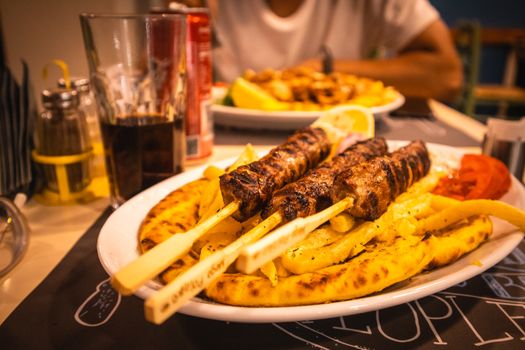
Photo: Pham Ngoc Anh / Pexels
The diets react (see scores below)
Common Ingredients
- pork
- olive oil
- lemon juice
- garlic
- oregano
- pita
- tzatziki
- onion
Specific recipes may vary.
Incompatible with 6 of 11 diets
Diet Ratings
Traditional souvlaki as served includes pita bread, which is a grain-based, high-carb component that alone can contribute 30-40g of net carbs per serving, immediately threatening or exceeding the daily keto limit. The pork itself — marinated in olive oil, lemon juice, garlic, and oregano — is excellent for keto: high protein, good fat, negligible carbs. Tzatziki (yogurt, cucumber, garlic, dill) is borderline acceptable in small portions. Onion adds a few grams of net carbs. However, as a complete dish in its standard form, the pita makes it incompatible with ketosis. Without the pita, the dish would be an 'approve.'
Some lazy keto and flexible keto practitioners argue that souvlaki can be ordered or prepared without pita and evaluated on its meat and sauce components alone, in which case it would be fully keto-compliant. They rate the dish on its adaptability rather than its traditional form.
Souvlaki is fundamentally incompatible with a vegan diet. It contains pork as its primary protein, which is animal flesh, and tzatziki — a Greek yogurt-based sauce — which is a dairy product. Both are direct animal products excluded under all vegan frameworks. The remaining ingredients (olive oil, lemon juice, garlic, oregano, pita, onion) are plant-based, but they are insufficient to redeem the dish given the core animal components.
Souvlaki as traditionally served contains two clear non-paleo components: pita bread (a wheat-based grain product) and tzatziki (a dairy-based yogurt sauce). Both are firmly excluded under paleo rules. The pork skewer itself — marinated in olive oil, lemon juice, garlic, and oregano — is entirely paleo-compliant, as are the onion and herbs. However, the dish in its standard form is defined by its accompaniments, and pita and tzatziki are central to the souvlaki experience rather than optional additions. Grains and dairy are among the clearest 'avoid' categories in paleo with near-universal consensus.
Souvlaki is a traditional Greek dish with a mixed Mediterranean diet profile. The marinade of olive oil, lemon juice, garlic, and oregano is exemplary Mediterranean cooking. However, pork is red meat, which the Mediterranean diet limits to a few times per month or once weekly. The pita bread is typically refined white flour, which conflicts with the preference for whole grains. Tzatziki (yogurt-based) and onion are fine in moderation. As an occasional traditional dish, souvlaki is acceptable but not a daily staple due to the pork and refined pita.
Traditional Greek and broader Mediterranean culinary practice has included pork souvlaki as a cultural staple for centuries, and some Mediterranean diet researchers argue that lean pork in modest portions, prepared with olive oil and herbs, fits within the spirit of the diet when consumed occasionally. The PREDIMED-style dietary patterns acknowledge that traditional foods consumed in moderation within an otherwise plant-rich diet are compatible.
Souvlaki as traditionally prepared is almost entirely incompatible with the carnivore diet. While the pork itself is a perfectly acceptable carnivore protein, virtually every other ingredient violates carnivore principles. Pita bread is a grain-based food and a hard exclude. Tzatziki contains cucumber, garlic, and often lemon — all plant-derived. The marinade includes olive oil (plant oil), lemon juice (fruit), garlic (vegetable/allium), and oregano (herb/spice). Onion is a plant food. The dish as a whole is a plant-heavy preparation wrapped in bread — the pork is incidental to a fundamentally plant-forward dish structure. A carnivore practitioner could salvage only the pork by eating it plain, but the dish itself as defined cannot be approved or even cautioned.
Souvlaki as traditionally served contains two clearly excluded ingredients: pita bread (a grain-based flatbread) and tzatziki (which contains yogurt, a dairy product). The marinated pork itself — pork, olive oil, lemon juice, garlic, and oregano — is fully Whole30 compliant. However, the dish as listed includes pita, which is a wheat-based grain product explicitly excluded from Whole30, and tzatziki made with yogurt, which is dairy and also excluded. Additionally, pita falls squarely into the 'no recreating baked goods/wraps' rule, as it functions as a wrap or bread. The compliant components (pork skewer with marinade and onion) could be enjoyed on their own, but the dish as described cannot be considered Whole30 compatible.
Souvlaki as traditionally prepared contains multiple high-FODMAP ingredients that make it unsuitable during the elimination phase. Garlic is one of the highest-FODMAP foods known (fructans), and is typically used directly in the marinade where FODMAPs leach into the meat. Pita bread is wheat-based and high in fructans. Onion is another major fructan source and is commonly served raw or grilled alongside the meat. Tzatziki, while yogurt-based, introduces lactose concerns. Even if the pork itself is FODMAP-free, the combination of garlic in marinade, wheat pita, raw or cooked onion, and lactose-containing tzatziki creates a dish that is high-FODMAP across multiple FODMAP categories simultaneously. Olive oil, lemon juice, and oregano are safe, but they cannot offset the significant FODMAP load from the other ingredients.
Souvlaki made with pork, olive oil, lemon juice, garlic, oregano, onion, pita, and tzatziki is a mixed dish from a DASH perspective. On the positive side, it uses heart-healthy olive oil, lemon juice, garlic, and oregano — all DASH-friendly. Onion adds potassium and fiber. Tzatziki (yogurt-based) contributes calcium and probiotics. However, pork is a red meat, which DASH limits; lean cuts like pork tenderloin or loin are acceptable in moderation, but fattier cuts common in souvlaki (e.g., pork shoulder) carry more saturated fat. Pita bread is often made from refined white flour, not a whole grain preferred by DASH. Tzatziki and the overall preparation can add moderate sodium. The dish is not inherently high in sodium the way processed foods are, but restaurant or street-food versions may be saltier. As a snack, the portion size could be appropriate, but as a meal-sized serving it may push sodium and saturated fat limits. Overall, this dish is acceptable in moderation — especially if lean pork cuts and whole-wheat pita are used — but it is not a core DASH food.
NIH DASH guidelines classify pork as a red meat to be limited and favor poultry and fish as primary proteins; however, updated clinical interpretations increasingly distinguish between lean pork cuts (tenderloin) and fatty cuts, with some DASH-oriented dietitians allowing lean pork in moderate portions. The tzatziki component, made from low-fat yogurt, actually aligns with DASH dairy recommendations in some updated protocols, softening the overall concern.
Souvlaki has several Zone-friendly elements but requires modification to fit Zone ratios properly. The pork itself can be a lean protein source (tenderloin or loin cuts approach Zone-favorable lean protein), olive oil is an ideal monounsaturated fat, lemon juice and garlic are essentially free foods in Zone, oregano is a polyphenol-rich herb Sears would appreciate, onion adds low-glycemic carb value, and tzatziki (yogurt, cucumber, garlic) contributes modest protein and favorable carbs. The main Zone challenge is the pita bread — a refined, higher-glycemic carbohydrate that Sears classifies as 'unfavorable.' A standard pita adds significant high-GI carbs that spike insulin and disrupt the 40/30/30 ratio. The pork cut matters too: fatty cuts (shoulder, belly) add saturated fat that pushes Zone compliance down, while lean cuts (tenderloin) are much more favorable. As a snack category, the full pita portion is particularly problematic — a snack Zone block is much smaller than a meal, so even half a pita may dominate the carb allocation. To bring this into Zone compliance: use a half or quarter pita (or skip it entirely), choose lean pork, keep the olive oil to 1 fat block (~1.5g), and load up on raw onion and vegetable sides to balance carbs with low-GI options.
Some Zone practitioners treat souvlaki as a reasonable Zone meal (not snack) when portioned carefully — lean pork provides solid protein blocks, tzatziki adds protein from yogurt, and a half pita can be counted as the carb block alongside vegetable-based carbs. Sears' later writings also show more flexibility around whole-food carb sources like pita when consumed in small quantities alongside adequate protein and monounsaturated fat. In a meal context (3 blocks), souvlaki with half a pita, lean pork, and tzatziki can approximate Zone ratios without strict avoidance.
Souvlaki presents a mixed anti-inflammatory profile. On the positive side, several ingredients are strongly anti-inflammatory: extra virgin olive oil provides oleocanthal and monounsaturated fats; garlic and oregano are rich in polyphenols and have demonstrated anti-inflammatory activity; lemon juice adds antioxidant vitamin C; onion contributes quercetin; and tzatziki (yogurt, cucumber, garlic, dill) is generally neutral to mildly beneficial. The preparation style — grilled meat with a marinade of olive oil, lemon, and herbs — is a favorable cooking method that minimizes harmful compounds compared to frying. The limiting factor is pork as the primary protein. Pork is red meat and falls into the 'limit' category due to its saturated fat content and potential to elevate arachidonic acid levels, which can promote inflammatory pathways. The pita bread adds refined carbohydrates, which are also on the 'limit' list. Overall, this is a Mediterranean dish whose anti-inflammatory herbs, olive oil, and preparation method partially offset the pork and refined pita. It is acceptable in moderation — especially if lean cuts are used — but not an anti-inflammatory standout.
Some anti-inflammatory practitioners, particularly those following Dr. Weil's Mediterranean-inspired pyramid, would view traditional souvlaki more favorably given its deep roots in Mediterranean cuisine, generous use of olive oil and herbs, and its relatively unprocessed nature compared to Western fast food. Conversely, stricter anti-inflammatory and AIP-leaning protocols would flag pork as a significant pro-inflammatory red meat and the refined wheat pita as a refined carbohydrate to avoid, potentially pushing this dish toward a lower score.
Souvlaki is a mixed profile for GLP-1 patients. The grilled pork provides a meaningful protein source, and the preparation method (grilled, not fried) is a positive. Olive oil, lemon juice, garlic, and oregano are all GLP-1-friendly ingredients. Tzatziki adds a small amount of additional protein from yogurt and is low in fat. However, pork is a moderate-fat protein — less ideal than chicken breast or fish but acceptable depending on the cut (pork loin vs. fattier cuts). The pita bread introduces refined carbohydrates with low fiber and low protein density, adding caloric volume without strong nutritional return. The combination of pita plus olive oil plus pork fat may push total fat per serving higher than ideal, increasing risk of nausea, bloating, or reflux. As a snack category item, the portion is likely smaller, which helps — but a full souvlaki with pita is more of a light meal. Patients could improve the profile by skipping or halving the pita, choosing pork loin, and leaning into the tzatziki for added protein.
Some GLP-1-focused dietitians would rate this higher, viewing grilled pork souvlaki as a practical, real-world protein source that is far superior to fried or ultra-processed alternatives, with the pita providing manageable carbohydrate volume for patients who tolerate it. Others would flag the pork fat content and refined pita more aggressively, recommending a full swap to chicken or a lettuce wrap format to reduce GI side effect risk.
*See how scores were generated at our methodology page.
Nutritional profile
Six traits that cut across every diet.
Fiber & Plants
How much whole-plant food and fiber it delivers.
Healthy Fats
The quality of its fats (unsaturated, omega-3).
Whole / Unprocessed
How close it is to its natural, unprocessed form.
Gut Gentle
How easy it is on digestion (low FODMAP, few irritants).
Low Glycemic
How little it spikes your blood sugar.
Protein Density
How much protein it packs per calorie.
Controversy Index
Higher controversy = more disagreement between diets.
Diet-Specific Tips
 Mediterranean — 5/10
View tips
- Pork is red meat — Mediterranean diet limits red meat to a few times per month
- Olive oil marinade with lemon, garlic, and oregano is strongly Mediterranean
- Pita bread is typically refined white flour, not a whole grain
- Tzatziki adds moderate dairy, which is acceptable
- Souvlaki is a culturally authentic Greek dish with deep traditional roots
- Portion size and frequency of consumption are key to compatibility
 DASH — 5/10
View tips
- Pork is a red meat limited by DASH; lean cuts (loin/tenderloin) are more acceptable than fatty cuts (shoulder)
- Olive oil, lemon juice, garlic, and oregano are all DASH-compatible ingredients
- Pita bread is typically made from refined white flour — whole-wheat pita preferred
- Tzatziki provides calcium from yogurt but may add sodium depending on preparation
- Moderate sodium overall if home-prepared, but restaurant versions can be high in salt
- Portion size matters — as a snack portion this is more manageable; full meal servings may exceed limits
- Heart-healthy Mediterranean preparation method aligns partially with DASH principles
 Zone — 5/10
View tips
- Pita bread is a high-glycemic 'unfavorable' carbohydrate in Zone terminology — the primary drawback
- Pork leanness is critical: tenderloin is Zone-acceptable, shoulder/belly is high in saturated fat
- Olive oil marinade is ideal monounsaturated fat — a Zone strength
- Tzatziki contributes modest protein and low-GI carbs from cucumber — Zone-positive
- Lemon juice, garlic, oregano, and onion are anti-inflammatory polyphenol sources Sears endorses
- As a snack, full pita portion far exceeds a 1-block carb allocation
- Dish is salvageable with pita reduction or elimination and lean pork selection
 Anti-Inflammatory — 5/10
View tips
- Pork is a red/processed meat in the anti-inflammatory 'limit' category due to saturated fat and arachidonic acid content
- Extra virgin olive oil is a cornerstone anti-inflammatory fat with oleocanthal activity
- Garlic and oregano are potent anti-inflammatory herbs rich in polyphenols
- Lemon juice contributes antioxidant vitamin C and alkalizing properties
- Onion provides quercetin, an anti-inflammatory flavonoid
- Pita bread is a refined carbohydrate — 'limit' category
- Tzatziki is neutral to mildly beneficial (probiotics from yogurt, anti-inflammatory garlic and cucumber)
- Grilling is a preferable cooking method compared to frying
- Dish is a traditional Mediterranean preparation, consistent with the broader dietary pattern anti-inflammatory research supports
 GLP-1 Friendly — 5/10
View tips
- Grilled preparation is GLP-1-friendly — not fried or greasy
- Pork provides moderate protein but carries more saturated fat than chicken breast or fish
- Pita bread is a refined grain with low fiber, reducing nutrient density per calorie
- Olive oil is an unsaturated fat and acceptable in moderate amounts
- Tzatziki (yogurt-based) adds small protein boost and is easy to digest
- Combined fat load (pork + olive oil + pita) may worsen nausea or bloating
- Portion size matters significantly — snack-sized serving is more manageable than a full plate
- Lemon, garlic, and oregano are non-irritating and nutritionally neutral to positive