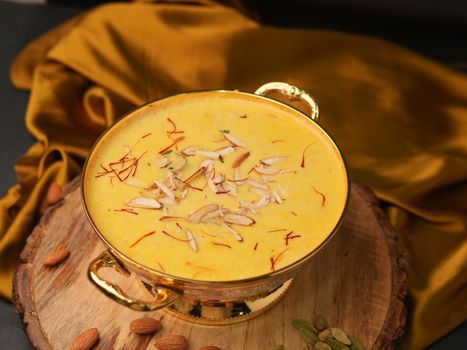
Photo: Anil Sharma / Pexels
The diets react (see scores below)
Common Ingredients
- milk
- sugar
- cardamom
- saffron
- almonds
- pistachios
- nutmeg
Specific recipes may vary.
Incompatible with 7 of 11 diets
Diet Ratings
Basundi is a traditional Indian sweet dish made by reducing whole milk and adding significant amounts of sugar, making it fundamentally incompatible with ketogenic dietary requirements. A standard serving contains a large quantity of added sugar (a primary ingredient) plus the natural lactose from heavily reduced milk, resulting in very high net carbohydrates that would almost certainly spike blood sugar and break ketosis. While almonds and pistachios are keto-friendly, and spices like cardamom, saffron, and nutmeg are negligible in carbs, the sugar and concentrated milk base dominate the macronutrient profile. This dish is a dessert-style snack with no meaningful pathway to keto compatibility without completely reformulating it.
Basundi is a traditional Indian milk-based dessert made by reducing whole milk to a thick, creamy consistency. Milk is a direct animal product (dairy), making this dish incompatible with a vegan diet. All other ingredients — sugar, cardamom, saffron, almonds, pistachios, and nutmeg — are fully plant-based, but the foundational ingredient is dairy. A vegan version could theoretically be made using plant-based milk (e.g., cashew or almond milk), but the traditional dish as described is not vegan.
Basundi is an Indian milk-based dessert that fundamentally conflicts with core paleo principles. Milk is a dairy product, explicitly excluded from the paleo diet as it was not consumed by Paleolithic hunter-gatherers in its processed form. Sugar is a refined sweetener, also strictly forbidden. These two ingredients form the base of the dish and are both clear paleo violations. While cardamom, saffron, nutmeg, almonds, and pistachios are individually paleo-approved ingredients, the dominant components — dairy and refined sugar — make this dish firmly off-limits. No amount of paleo-friendly spices or nuts can redeem a dish whose foundation is built on excluded foods.
Basundi is a rich Indian milk dessert made by slowly reducing whole milk with added sugar, nuts, and spices. From a Mediterranean diet perspective, dairy (milk) is acceptable in moderate amounts, and nuts (almonds, pistachios) and spices (cardamom, saffron, nutmeg) are positively regarded. However, the added sugar is a concern — the Mediterranean diet calls for minimal added sugars — and the dish is high in saturated fat from reduced whole milk. The nuts are a redeeming quality, providing healthy fats and protein. Overall, this dish sits in the 'caution' zone: the dairy base and nut content are acceptable, but the concentrated sugar and high-fat profile from milk reduction push it away from core Mediterranean principles. Occasional consumption as a treat is reasonable, but it should not be a regular feature.
Some Mediterranean diet practitioners emphasize the importance of whole, minimally processed dairy and nuts as nutrient-dense foods, and might view a small portion of basundi as a culturally equivalent analog to Greek rice pudding (rizogalo) or other traditional dairy-based desserts enjoyed occasionally in the diet. The spices used are also recognized for their anti-inflammatory properties in integrative nutrition contexts.
Basundi is an Indian sweet dairy dessert that is fundamentally incompatible with the carnivore diet. While it does contain milk (an animal product), it is loaded with multiple non-carnivore ingredients: sugar (processed sweetener), cardamom (plant spice), saffron (plant spice), almonds (nuts/plant), pistachios (nuts/plant), and nutmeg (plant spice). The majority of this dish's ingredients are explicitly plant-derived or processed, making it a clear 'avoid' even for the most lenient carnivore practitioners. Even setting aside the dairy debate, the sugar, nuts, and spices alone disqualify this dish entirely.
Basundi contains two excluded ingredients: milk (dairy) and sugar (added sugar). Both are explicitly prohibited on the Whole30 program. Milk is a dairy product with no exception granted (only ghee and clarified butter are allowed dairy), and added sugar in any form is excluded. The remaining ingredients — cardamom, saffron, almonds, pistachios, and nutmeg — are all Whole30-compliant, but the presence of dairy and added sugar makes this dish clearly off-limits.
Basundi is a traditional Indian milk-based dessert made by reducing full-fat milk to a thick, creamy consistency with sugar and spices. The primary FODMAP concern is lactose: full-fat cow's milk is high in lactose (Monash rates regular milk as high-FODMAP at standard serving sizes of 100ml or more), and Basundi is consumed in significant quantities — typically 150–250ml per serving. As milk is reduced, lactose becomes more concentrated per volume, making the lactose load per serving even higher than regular milk. Sugar (sucrose) is low-FODMAP. Cardamom is low-FODMAP at culinary doses. Saffron is low-FODMAP. Almonds are low-FODMAP at 10 nuts (approx. 12g) but become high-FODMAP at larger quantities; in Basundi they are typically used as garnish in moderate amounts. Pistachios are high-FODMAP even at small serves (Monash rates 1 tablespoon/15g as high-FODMAP due to fructans and GOS). Nutmeg is low-FODMAP at culinary doses. The combination of high-lactose concentrated milk as the dominant ingredient plus pistachios makes Basundi clearly high-FODMAP and unsuitable during the elimination phase.
Basundi is an Indian milk-based dessert made by simmering whole milk until reduced, sweetened with sugar, and flavored with cardamom, saffron, nutmeg, and garnished with nuts. While it contains DASH-friendly elements — nuts (almonds, pistachios) provide healthy fats, magnesium, and potassium; spices are neutral; milk contributes calcium and protein — the dish has significant concerns for DASH adherence. Basundi is traditionally made with whole (full-fat) milk, which DASH guidelines explicitly limit in favor of fat-free or low-fat dairy due to saturated fat content. The generous amount of added sugar used to sweeten basundi is also a DASH concern, as the diet limits sweets and added sugars. As a reduced-milk dessert, a serving is calorie-dense and high in both saturated fat and sugar. It is not a 'core' DASH food but could be consumed occasionally and in small portions. If made with low-fat or skim milk and reduced sugar, the DASH compatibility improves considerably.
NIH DASH guidelines specify low-fat or fat-free dairy and limit added sugars, clearly placing traditional full-fat, sugar-heavy basundi outside core DASH recommendations. However, updated clinical interpretations note that emerging evidence on full-fat dairy and cardiovascular outcomes is less clear-cut than once thought, and some DASH practitioners may allow small portions of traditional dairy-based desserts in an otherwise compliant diet, particularly when nuts provide beneficial nutrients.
Basundi is a rich Indian milk-based dessert made by reducing whole milk and adding significant sugar, making it high in both simple carbohydrates and saturated fat. The macro profile is heavily skewed: carbohydrates come primarily from added sugar (high-glycemic, unfavorable in Zone), fat comes from whole milk's saturated fat content, and protein from milk is present but relatively low compared to the caloric load. The sugar content is the primary concern — it drives a high glycemic load that disrupts the Zone's 40/30/30 ratio and triggers insulin spikes that Sears specifically targets as problematic. The almonds and pistachios add some monounsaturated fat and modest protein, which are Zone-favorable, and the spices (cardamom, saffron, nutmeg) are anti-inflammatory polyphenol sources Sears would appreciate. However, the dish as traditionally prepared provides little lean protein, excess saturated fat, and a substantial sugar load, making it very difficult to incorporate into a Zone-balanced snack without radical reformulation. It scores a 3 rather than 1-2 because the nuts and dairy protein provide some structural Zone value, and small portions are technically possible.
Some Zone practitioners following Sears' later anti-inflammatory writings (e.g., 'The Zone Diet' updates) might note that full-fat dairy has been partially rehabilitated — the saturated fat in whole milk is less concerning than trans fats or omega-6 oils. A very small serving of basundi (as a condiment-sized portion) could technically be incorporated into a Zone meal if the rest of the meal is structured with lean protein and low-GI carbs to compensate. The nuts also add some favorable fat and protein blocks. However, the added sugar remains genuinely problematic under all iterations of Zone methodology.
Basundi is a traditional Indian milk-based dessert made by slowly reducing whole milk with sugar, aromatic spices, and nuts. The profile is genuinely mixed from an anti-inflammatory standpoint. On the positive side, cardamom, saffron, and nutmeg all carry meaningful anti-inflammatory and antioxidant properties. Almonds and pistachios are well-regarded anti-inflammatory foods — rich in healthy fats, polyphenols, vitamin E, and fiber. Saffron in particular has documented anti-inflammatory activity (crocin, safranal). On the negative side, whole milk contributes saturated fat, which the anti-inflammatory framework recommends limiting (low-fat dairy is preferred). Added sugar is a significant concern — Basundi is typically quite sweet, and added sugar is a driver of inflammatory markers like CRP and IL-6. The dish is also calorie-dense and consumed as a dessert/sweet snack. The result is a food that contains genuinely beneficial anti-inflammatory ingredients (spices, nuts) but is undermined by full-fat dairy and added sugar in meaningful quantities. Occasional consumption is reasonable; regular consumption is not advisable on an anti-inflammatory diet.
Some anti-inflammatory practitioners, particularly those drawing on Ayurvedic-aligned frameworks, view whole milk prepared with warming spices (cardamom, saffron, nutmeg) as inherently beneficial and digestive-supportive — a position that would rate Basundi more favorably. Conversely, stricter anti-inflammatory protocols emphasizing dairy elimination and zero added sugar would rate this more harshly than a 4, potentially placing it in 'avoid' territory.
Basundi is a rich, reduced whole-milk Indian dessert sweetened with sugar and garnished with nuts. Despite being categorized as a snack, it is nutritionally problematic for GLP-1 patients on nearly every key criterion. It is high in sugar (primary sweetener), high in saturated fat from whole milk reduced to a concentrated form, very low in fiber, and offers minimal protein relative to its calorie load. The milk reduction process concentrates both the fat and sugar content significantly beyond a standard glass of milk. Almonds and pistachios contribute small amounts of protein and unsaturated fat, but in garnish-level quantities they do not meaningfully offset the dish's drawbacks. The high sugar content risks blood sugar spikes, the high fat content can worsen GLP-1 side effects including nausea, bloating, and reflux, and the calorie density per small serving is high with poor nutrient return. Spices like cardamom, saffron, and nutmeg are fine, but they do not alter the nutritional profile. As a sweet, fatty, low-protein, low-fiber, high-sugar dish, Basundi conflicts with GLP-1 dietary priorities across the board.
Some GLP-1-aware dietitians may note that whole milk does provide calcium and a modest amount of protein, and that a very small portion consumed occasionally may be acceptable for patients who are meeting their protein and fiber targets elsewhere. However, most clinicians working with GLP-1 patients would flag the concentrated sugar and saturated fat as significant concerns that outweigh these marginal benefits.
*See how scores were generated at our methodology page.
Nutritional profile
Six traits that cut across every diet.
Fiber & Plants
How much whole-plant food and fiber it delivers.
Healthy Fats
The quality of its fats (unsaturated, omega-3).
Whole / Unprocessed
How close it is to its natural, unprocessed form.
Gut Gentle
How easy it is on digestion (low FODMAP, few irritants).
Low Glycemic
How little it spikes your blood sugar.
Protein Density
How much protein it packs per calorie.
Controversy Index
Higher controversy = more disagreement between diets.
Diet-Specific Tips
 Mediterranean — 4/10
View tips
- Added sugar contradicts Mediterranean diet's low-sugar principle
- Whole milk dairy is acceptable in moderation per Mediterranean guidelines
- Almonds and pistachios are Mediterranean-approved nuts, adding positive value
- Anti-inflammatory spices (saffron, cardamom, nutmeg) are diet-compatible
- High caloric density from milk reduction and sugar is a concern
- Not a traditional Mediterranean dish, but analogous to occasional dairy-based desserts in the region
 DASH — 4/10
View tips
- Made with whole full-fat milk — DASH emphasizes fat-free or low-fat dairy
- High added sugar content — DASH limits sweets and sugary foods
- Almonds and pistachios are DASH-approved nuts providing healthy fats and minerals
- No sodium concerns — very low sodium dish
- Calorie-dense due to milk reduction and sugar
- Small portion size could make occasional consumption acceptable
- Low-fat milk and reduced sugar substitutions would significantly improve DASH compatibility
 Zone — 5/10
View tips
- High added sugar content — primary unfavorable carbohydrate source that spikes insulin, directly contrary to Zone principles
- No lean protein source listed; milk provides some protein but insufficient for Zone protein block requirements
- Whole milk contributes saturated fat rather than preferred monounsaturated fat
- Almonds and pistachios are Zone-favorable — monounsaturated fat sources with some protein value
- Spices (cardamom, saffron, nutmeg) are polyphenol-rich and anti-inflammatory, consistent with Sears' later emphasis
- Macro ratio is heavily imbalanced: high carb (mostly sugar), moderate fat (mostly saturated), low protein
- As a snack category, Zone requires a balanced mini-block structure — this dish cannot provide that without significant reformulation
 Anti-Inflammatory — 4/10
View tips
- Full-fat whole milk contributes saturated fat — anti-inflammatory guidelines favor low-fat dairy
- Added sugar is a primary pro-inflammatory concern and likely significant in quantity
- Cardamom, saffron, and nutmeg provide meaningful anti-inflammatory and antioxidant compounds
- Almonds and pistachios are anti-inflammatory foods rich in healthy fats, vitamin E, and polyphenols
- Saffron contains crocin and safranal with documented anti-inflammatory properties
- Overall profile is mixed: beneficial spices and nuts offset by sugar and full-fat dairy
- Appropriate only in moderation; not suitable for regular consumption on an anti-inflammatory diet