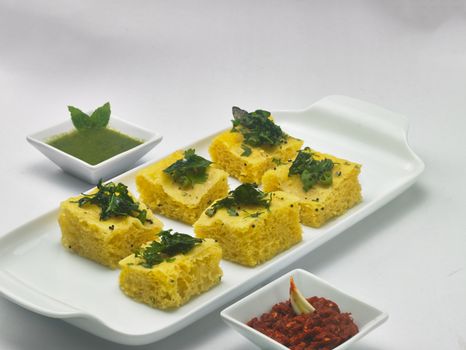
Photo: Milton Das / Pexels
The diets react (see scores below)
Common Ingredients
- gram flour
- yogurt
- ginger
- green chili
- mustard seeds
- turmeric
- curry leaves
- sugar
- lemon
Specific recipes may vary.
Incompatible with 6 of 11 diets
Diet Ratings
Dhokla is fundamentally incompatible with a ketogenic diet. The primary ingredient, gram flour (besan/chickpea flour), is extremely high in carbohydrates — a standard serving of dhokla (100g) can contain 25-35g of net carbs, easily exceeding or consuming the entire daily keto carb budget. The dish also contains added sugar and is made from fermented lentil-based batter, both of which are disqualifying on keto. While fermentation slightly reduces carb content, it does not reduce it enough to make dhokla viable. The yogurt and spices are keto-friendly, but they are minor components that do not offset the carbohydrate load from the gram flour base.
Dhokla as listed contains yogurt, which is a dairy product derived from cow's milk. This makes it non-vegan despite the majority of its ingredients being plant-based. The base of gram flour (chickpea flour), ginger, green chili, mustard seeds, turmeric, curry leaves, sugar, and lemon are all fully plant-based, but yogurt is an animal-derived ingredient that disqualifies the dish under vegan standards. A vegan version of dhokla is easily achievable by substituting yogurt with plant-based yogurt (coconut, soy, or almond) or a combination of lemon juice and water to achieve the necessary fermentation and acidity.
Dhokla is fundamentally incompatible with the paleo diet. Its two primary ingredients are gram flour (besan), made from chickpeas — a legume strictly excluded from paleo — and yogurt, a dairy product equally excluded. These are not minor or trace ingredients; they are the structural base of the dish. Beyond those core violations, sugar is a refined/added sweetener also excluded under paleo rules. Mustard seeds, ginger, green chili, turmeric, curry leaves, and lemon are all paleo-compliant, but they cannot redeem a dish whose foundation is built on multiple paleo-prohibited foods. There is no paleo-accepted substitution that would preserve the character of Dhokla.
Dhokla is a fermented, steamed snack made primarily from gram flour (chickpea/legume-based), which aligns well with the Mediterranean diet's strong emphasis on legumes as a dietary staple. The fermentation process adds probiotic benefits similar to fermented foods valued in Mediterranean traditions. Yogurt provides modest dairy, acceptable in moderation. Spices like turmeric, ginger, green chili, mustard seeds, and curry leaves are anti-inflammatory and nutrient-dense. The small amount of sugar is minimal and not a primary concern. The dish is steamed (low added fat), plant-forward, and minimally processed. It is not traditionally Mediterranean, but its nutritional profile maps closely to Mediterranean principles.
Some Mediterranean diet purists might rate this with caution since gram flour, while legume-based, is not a whole legume and the refined flour form offers less fiber than whole chickpeas or lentils; modern clinical guidelines (e.g., Oldways Mediterranean Diet pyramid) emphasize whole legumes over processed legume flours.
Dhokla is an entirely plant-based Indian snack with zero animal-derived ingredients. It is made from fermented gram flour (chickpea/legume-based), yogurt being the only remotely animal-adjacent ingredient, and is seasoned with plant-based spices, chili, ginger, curry leaves, lemon, and sugar. Even the yogurt is overshadowed by the dominant legume base. Legumes, grains, vegetables, spices, sugar, and plant oils are all explicitly excluded on the carnivore diet. This dish is incompatible at every level with carnivore principles.
Dhokla contains multiple excluded ingredients. Gram flour (besan) is made from chickpeas, which are legumes — a clearly excluded category on Whole30. Yogurt is dairy, also excluded. Sugar is an added sweetener, also excluded. Any one of these three ingredients alone would disqualify the dish, and all three are present simultaneously. There is no compliant workaround that would make a recognizable dhokla, as the legume flour and dairy are core to the dish's identity.
Dhokla is primarily made from gram flour (besan), which is chickpea/Bengal gram flour — a high-FODMAP ingredient due to its significant GOS (galacto-oligosaccharides) content. Even a standard serving of dhokla (2-3 pieces, ~100g) would involve a substantial amount of gram flour, making it high-FODMAP. Additionally, yogurt contributes lactose, adding another FODMAP load. The fermentation process used in traditional dhokla recipes may reduce some FODMAP content (similar to sourdough fermentation reducing fructans), but Monash has not specifically tested fermented gram flour/dhokla to confirm meaningful GOS reduction. The remaining ingredients — ginger, green chili, mustard seeds, turmeric, curry leaves, sugar, and lemon — are generally low-FODMAP at typical culinary quantities and are not a concern. However, the gram flour base and yogurt together make this dish very difficult to consume safely during the elimination phase.
Some FODMAP practitioners note that fermentation (as used in traditional dhokla preparation) can reduce oligosaccharide content meaningfully, as seen with sourdough bread. However, Monash University has not published specific testing on dhokla or fermented gram flour to confirm GOS reduction to a safe level, so elimination-phase caution requires treating this as high-FODMAP. Lactose-free yogurt could be substituted to remove the lactose concern, but the gram flour issue remains the primary barrier.
Dhokla is a steamed Indian snack made primarily from fermented gram flour (chickpea flour) and yogurt, which aligns well with DASH principles. Gram flour is rich in plant-based protein, fiber, potassium, and magnesium — all nutrients emphasized in DASH. The yogurt component contributes calcium and, if low-fat, fits neatly into the DASH dairy category. The dish is steamed rather than fried, keeping fat content low. Spices like turmeric, ginger, mustard seeds, and curry leaves add flavor without sodium, which supports DASH's sodium-reduction goal. The small amount of sugar is not a significant concern in typical serving sizes. However, the fermentation process and added salt (common in preparation, though not listed explicitly) can raise sodium moderately. The yogurt used is typically low-fat in traditional recipes. Overall, dhokla is a nutrient-dense, low-fat, plant-protein-rich snack that fits DASH well, though sodium from preparation salt and the modest sugar addition warrant mild caution.
NIH DASH guidelines don't specifically address fermented legume-based snacks like dhokla, so this rating extrapolates from its food category components. Some DASH-oriented clinicians may flag the small added sugar and variable sodium from preparation salt, while others emphasize that its high fiber, plant protein, and low saturated fat profile make it an excellent DASH-compatible snack with minimal modification needed.
Dhokla is a fermented steamed snack made primarily from gram flour (besan), which provides a reasonable protein and carbohydrate base. The fermentation process slightly lowers the glycemic impact compared to unfermented chickpea flour preparations. However, gram flour is a moderate-to-high glycemic carbohydrate source, and Dhokla is carbohydrate-dominant with limited protein relative to Zone block requirements. The yogurt adds a small amount of lean protein and probiotic benefit, which aligns with Zone's anti-inflammatory focus. The tempering ingredients — mustard seeds, turmeric, curry leaves, ginger, and green chili — are all excellent from a Zone and anti-inflammatory perspective, with turmeric being a notable polyphenol source. The sugar content is a concern, as it adds empty high-glycemic carbs, though the quantity in a typical Dhokla recipe is small. The dish lacks fat almost entirely, making it difficult to achieve the Zone's 30% fat target without adding a monounsaturated fat source. The protein content from gram flour and yogurt is real but insufficient for a complete Zone block meal without supplementation. As a snack rather than a full meal, Dhokla can fit into a Zone plan if paired with a lean protein addition and a healthy fat source like a small portion of avocado or almonds, with sugar minimized.
Some Zone practitioners may rate Dhokla more favorably given that chickpea/gram flour is listed as a favorable Zone carbohydrate source by Dr. Sears due to its legume-based protein and fiber content. The fermentation also improves the glycemic profile. Others may rate it lower due to the sugar addition and the near-zero fat content making Zone balance harder to achieve without significant meal engineering.
Dhokla is a fermented, steamed snack made primarily from gram flour (besan/chickpea flour), which is a legume-based, high-protein, high-fiber ingredient — well-aligned with the anti-inflammatory emphasis on beans and legumes. Fermentation via yogurt introduces beneficial probiotics and enhances bioavailability of nutrients, further supporting gut health and reducing inflammatory markers. The spice profile is a standout: turmeric (curcumin), ginger, green chili, mustard seeds, and curry leaves are each recognized anti-inflammatory agents in both traditional and evidence-based nutrition. Lemon juice adds vitamin C and polyphenols. The tempering (tadka) with mustard seeds and curry leaves in a small amount of oil is traditional and minimal. The main concerns are the added sugar (typically modest in amount but a mildly pro-inflammatory ingredient) and the refined gram flour, which, while legume-derived, loses some fiber compared to whole lentils. Yogurt is a low-fat dairy product, rated as acceptable in moderation under anti-inflammatory principles. Overall, the dish is predominantly plant-based, fermented, spiced with potent anti-inflammatory herbs, and steamed rather than fried — making it a solid anti-inflammatory choice.
Some anti-inflammatory and autoimmune-focused practitioners (e.g., those following the Autoimmune Protocol/AIP) would flag gram flour for its lectin content and the potential for legume-based foods to irritate sensitive guts. Additionally, if the tempering oil used is a refined seed oil (e.g., sunflower or corn oil), that would add omega-6 concern, though traditional recipes often use small amounts of neutral oils or ghee, the latter being a moderate-use saturated fat under Weil's framework.
Dhokla is a steamed, fermented snack made from gram flour (besan) and yogurt, giving it a modest protein and fiber profile relative to its calorie count. A standard serving (2-3 pieces, ~100g) provides roughly 5-7g protein and 2-3g fiber — meaningful but not high enough to make it a primary protein vehicle for GLP-1 patients. Its strengths are real: it is low in fat, easy to digest, light in texture, and steamed rather than fried, making it gentle on a slowed GI tract. Fermentation from yogurt adds probiotic benefit, which may support gut health during GLP-1-related GI adjustment. The small amount of sugar and lemon juice in the batter is not a significant concern at typical serving sizes. The green chili and ginger in the tempering are mild concerns — ginger is generally well-tolerated and may actually ease nausea, but green chili could trigger reflux or GI irritation in sensitive patients. Mustard seeds and curry leaves in the tempering add negligible fat. The main limitation is that dhokla functions better as a complementary snack than a protein-forward meal component — it should be paired with a higher-protein accompaniment (e.g., yogurt dip, cottage cheese) to meet GLP-1 protein targets. Portion friendliness is a strength: small servings are satisfying and the food is not calorie-dense.
Some GLP-1-focused dietitians view fermented, legume-based snacks like dhokla favorably as a gentle, nutrient-dense option that supports GI tolerance and hydration, particularly on high-side-effect days. Others caution that the protein-per-calorie ratio is insufficient for patients who need to maximize protein within a dramatically reduced calorie budget, and recommend reserving snack slots for higher-protein options like Greek yogurt or cottage cheese instead.
*See how scores were generated at our methodology page.
Nutritional profile
Six traits that cut across every diet.
Fiber & Plants
How much whole-plant food and fiber it delivers.
Healthy Fats
The quality of its fats (unsaturated, omega-3).
Whole / Unprocessed
How close it is to its natural, unprocessed form.
Gut Gentle
How easy it is on digestion (low FODMAP, few irritants).
Low Glycemic
How little it spikes your blood sugar.
Protein Density
How much protein it packs per calorie.
Controversy Index
Higher controversy = more disagreement between diets.
Diet-Specific Tips
 Mediterranean — 8/10
View tips
- Gram flour is legume-based, strongly aligned with Mediterranean emphasis on legumes
- Fermented preparation adds probiotic value
- Steamed cooking method with minimal added fat
- Small amount of sugar is a minor concern
- Yogurt is an acceptable moderate dairy component
- Anti-inflammatory spice profile (turmeric, ginger)
- Not traditional Mediterranean cuisine, but nutritionally compatible
 DASH — 7/10
View tips
- Gram flour is high in plant protein, fiber, potassium, and magnesium — core DASH nutrients
- Steamed preparation keeps fat content very low with no saturated fat concern
- Yogurt contributes calcium, supporting DASH dairy recommendations
- Spices replace sodium as flavor agents, supporting DASH sodium-reduction goals
- Small amount of added sugar is minimal concern at typical serving sizes
- Preparation often includes added salt not listed in ingredients, which can raise sodium moderately
- Fermented base may offer probiotic benefit, consistent with evolving DASH-aligned dietary science
 Zone — 5/10
View tips
- Gram flour (besan) provides moderate protein and carbohydrates but is carbohydrate-dominant for Zone block balancing
- Fermentation slightly reduces glycemic impact compared to unfermented preparations
- Small amount of sugar adds unfavorable high-glycemic carbs, though quantity is typically minor
- Yogurt contributes lean protein and probiotic/anti-inflammatory benefit
- Turmeric and ginger are polyphenol-rich, supporting Zone's anti-inflammatory focus
- Near-zero fat content requires pairing with a monounsaturated fat source to achieve 40/30/30 ratio
- Insufficient protein density for a standalone Zone snack — needs supplementation
- Works best as a partial Zone snack component rather than a complete meal block
 Anti-Inflammatory — 7/10
View tips
- Gram flour (besan) is legume-based — high fiber, plant protein, aligned with anti-inflammatory legume emphasis
- Fermentation with yogurt supports gut microbiome health and may reduce inflammatory markers
- Turmeric contains curcumin, one of the most well-studied anti-inflammatory compounds
- Ginger, green chili, mustard seeds, and curry leaves all contribute anti-inflammatory phytonutrients
- Steamed preparation avoids frying and excessive added fats
- Small amount of added sugar is a mild pro-inflammatory concern
- Refined gram flour is less anti-inflammatory than whole chickpeas/lentils
- Yogurt (low-fat dairy) is acceptable in moderation per anti-inflammatory guidelines
 GLP-1 Friendly — 6/10
View tips
- Steamed and low-fat — good GI tolerability for GLP-1 patients
- Modest protein (~5-7g per 100g serving) — insufficient as a standalone protein source
- Gram flour and yogurt provide some fiber and probiotic benefit
- Green chili may trigger reflux or nausea in sensitive GLP-1 patients
- Ginger in recipe may actually help with GLP-1-related nausea
- Small sugar content is not a significant concern at typical serving sizes
- Best used as a complementary snack paired with a high-protein food
- Portion-friendly and low calorie density — fits small meal pattern well