Photo: Gaurav Kumar / Pexels
The diets react (see scores below)
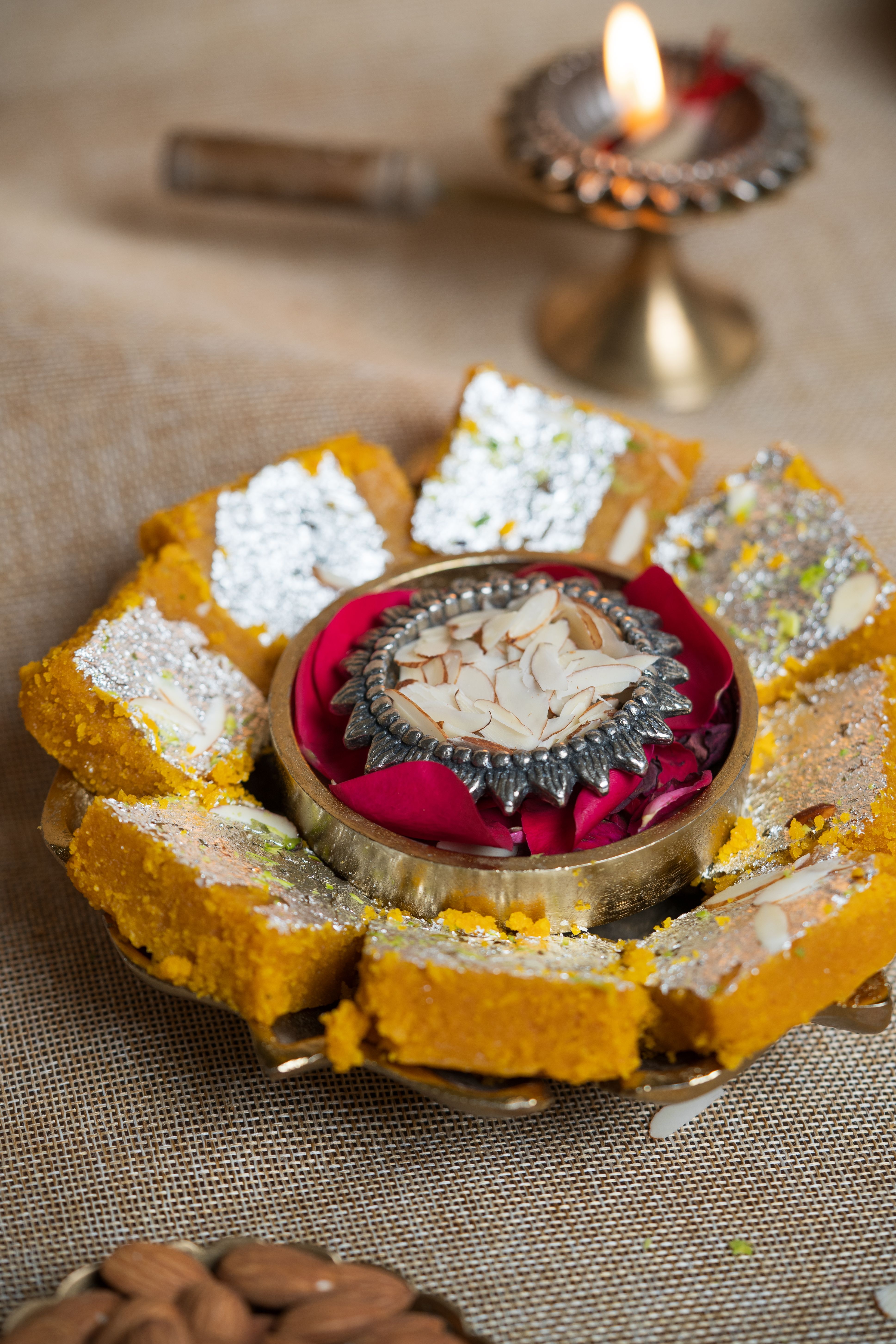
Common Ingredients
- gram flour
- ghee
- sugar
- milk
- cardamom
- almonds
- pistachios
- saffron
Specific recipes may vary.
Incompatible with 10 of 11 diets
Diet Ratings
Mohanthal is a traditional Indian sweet made primarily from gram flour (besan) and sugar, both of which are high-carbohydrate ingredients that are fundamentally incompatible with ketosis. Gram flour contains roughly 44-50g net carbs per 100g, and sugar is pure sucrose. A typical serving of Mohanthal would deliver an enormous carbohydrate load — easily exceeding the entire daily keto carb budget in a single piece. While ghee, almonds, pistachios, and saffron are individually keto-friendly, they are minor components that cannot offset the dominant carb-heavy base. This is a dense, sugar-laden confection with no viable keto adaptation in its standard form.
Mohanthal contains two clear animal-derived ingredients: ghee (clarified butter, a dairy product) and milk. Both are unambiguously non-vegan. The remaining ingredients — gram flour, sugar, cardamom, almonds, pistachios, and saffron — are all plant-based, meaning the dish could theoretically be adapted for vegans by substituting ghee with coconut oil or vegan butter and replacing milk with a plant-based alternative, but the traditional recipe as listed is not vegan-compliant.
Mohanthal is a traditional Indian sweet made primarily from gram flour (besan), which is a legume-based flour derived from chickpeas — strictly excluded in paleo. It also contains refined sugar and dairy milk, both of which are non-paleo. While ghee occupies a gray area and cardamom, almonds, pistachios, and saffron are paleo-friendly, the foundational ingredients (gram flour, sugar, milk) are clear violations. This dish cannot be made paleo-compliant without fundamentally altering its nature.
Mohanthal is a traditional Indian sweet made primarily from gram flour (besan), ghee, and sugar — a combination that directly contradicts core Mediterranean diet principles. The dish is high in added sugars and saturated fat (ghee), placing it firmly in the 'avoid' category. While gram flour (a legume derivative) and nuts like almonds and pistachios are Mediterranean-friendly ingredients, they are overwhelmed by the large quantities of sugar and ghee that define this confection. Ghee is clarified butter — a saturated animal fat that the Mediterranean diet discourages in favor of extra virgin olive oil. The high sugar content classifies this as a heavily sweetened processed confection, which the Mediterranean diet explicitly minimizes. Cardamom and saffron are benign spices, and the nuts and legume flour offer some nutritional value, but the overall profile of this dish is incompatible with Mediterranean dietary principles.
Mohanthal is a traditional Indian sweet made almost entirely from plant-based and processed ingredients. Gram flour (chickpea flour) is a legume-derived flour, sugar is a refined plant-based sweetener, cardamom is a plant spice, almonds and pistachios are nuts, and saffron is a plant-derived spice. While ghee and milk are animal-derived, they are minor components in a dish that is fundamentally incompatible with the carnivore diet. This dish has no meaningful animal protein, is high in carbohydrates and sugar, and is dominated by plant foods that are explicitly excluded from the carnivore diet. There is virtually no debate within any carnivore community faction about a legume-flour-and-sugar-based sweet — it is universally off-limits.
Mohanthal is a traditional Indian sweet made from gram flour (a legume-based flour from chickpeas), sugar, and milk — three excluded ingredients on the Whole30. Gram flour/besan is derived from chickpeas, which are legumes and explicitly excluded. Sugar is a prohibited added sweetener. Milk is dairy and also excluded. Additionally, even if these ingredients were substituted, Mohanthal is a sweet confection that would fall under the 'no recreating junk food/baked goods/sweets' rule, violating the spirit of the program. This dish fails on multiple counts with no ambiguity.
Mohanthal is a traditional Indian sweet made primarily from gram flour (besan), which is high in GOS (galacto-oligosaccharides) — a major FODMAP. Gram flour is made from chickpeas, and even small amounts are high-FODMAP during the elimination phase. The dish also typically contains milk, which contributes lactose (another FODMAP). Sugar is low-FODMAP, ghee is low-FODMAP (fat, no FODMAPs), cardamom is low-FODMAP in typical culinary amounts, saffron is fine, and almonds and pistachios are low-FODMAP only at very small portions (10 almonds, ~15 pistachios per Monash). However, the gram flour alone is sufficient to classify this dish as high-FODMAP and unsuitable during the elimination phase.
Mohanthal is a traditional Indian sweet made primarily from gram flour, ghee, and sugar — a combination that makes it incompatible with DASH diet principles. Ghee is a clarified butter high in saturated fat, which DASH explicitly limits. The dish contains a significant amount of added sugar, which DASH also restricts. While gram flour (chickpea flour), almonds, and pistachios offer some fiber, protein, and potassium, and cardamom and saffron are neutral, these positives are heavily outweighed by the high saturated fat from ghee and the high added sugar content. This is a calorie-dense, fat-rich, sugar-heavy confection with no meaningful sodium concern but clear conflicts with DASH's limits on saturated fat and added sweets.
Mohanthal is a traditional Indian sweet made primarily from gram flour fried in ghee and bound together with large quantities of sugar. The macronutrient profile is severely imbalanced for Zone purposes: it is dominated by high-glycemic refined sugar and starchy gram flour carbohydrates, with substantial saturated fat from ghee, and virtually no lean protein. The sugar content alone makes this extremely difficult to incorporate into any Zone-balanced meal or snack — even a small serving would deliver a large carbohydrate block almost entirely from high-glycemic sources, spiking insulin sharply. Ghee is a predominantly saturated fat, which Zone methodology discourages in favor of monounsaturated fats. While the almonds and pistachios provide some favorable monounsaturated fat and minor protein, their contribution is marginal relative to the sugar and ghee. There is no lean protein component whatsoever, meaning the 40/30/30 block ratio cannot be achieved without an entirely separate protein source of significant size. The overall food is essentially a concentrated sweet confection — the kind of food Zone specifically categorizes as 'unfavorable' and advises avoiding due to its insulin-spiking, pro-inflammatory nature.
Mohanthal is a traditional Indian gram flour fudge with a mixed inflammatory profile. On the positive side, gram flour (besan) is a legume-based flour providing fiber, plant protein, and a relatively lower glycemic impact than refined wheat flour — legumes are emphasized in anti-inflammatory frameworks. Almonds and pistachios contribute vitamin E, healthy monounsaturated fats, and anti-inflammatory polyphenols. Cardamom and saffron both carry antioxidant and mild anti-inflammatory properties. However, the dish is substantially high in ghee (saturated fat) and sugar, both of which are flagged for limitation in anti-inflammatory guidelines. The caloric density and sugar load are significant concerns — added sugar drives inflammatory markers like CRP and IL-6. Ghee, while clarified butter with some butyrate content that has mild gut-friendly properties, remains a concentrated saturated fat source that anti-inflammatory protocols recommend limiting. Overall, the beneficial ingredients (gram flour, nuts, spices) are present but overshadowed by the high sugar and ghee content in a typical recipe. This is a treat best consumed occasionally and in small portions, making it a caution rather than an avoid — the gram flour and nut base partially redeem it compared to refined flour confections.
Mohanthal is a traditional Indian sweet made by roasting gram flour in large amounts of ghee, then combining it with sugar and milk to form a dense, fudge-like confection. For GLP-1 patients, it fails on nearly every key criterion. It is very high in sugar (the primary ingredient by weight after gram flour), very high in saturated fat from ghee, calorie-dense with negligible protein per serving, and low in fiber despite gram flour being the base (the roasting and sugar-binding process yields a compact, low-fiber product). The heavy fat and sugar load is likely to worsen GLP-1 side effects including nausea, bloating, and reflux. Gastric emptying is already slowed by the medication, and a dense, high-fat sweet will sit heavily and uncomfortably. The almonds and pistachios contribute trace protein and some unsaturated fat, but their quantity in a standard serving of mohanthal is too small to meaningfully improve the nutritional profile. Saffron and cardamom are benign. This is a high-sugar, high-saturated-fat, low-protein, low-fiber food — the opposite of what GLP-1 patients need. It is also ultra-calorically dense, which is especially counterproductive given reduced appetite and the need for every calorie to be nutritionally meaningful.
*See how scores were generated at our methodology page.
Nutritional profile
Six traits that cut across every diet.
Fiber & Plants
How much whole-plant food and fiber it delivers.
Healthy Fats
The quality of its fats (unsaturated, omega-3).
Whole / Unprocessed
How close it is to its natural, unprocessed form.
Gut Gentle
How easy it is on digestion (low FODMAP, few irritants).
Low Glycemic
How little it spikes your blood sugar.
Protein Density
How much protein it packs per calorie.
Controversy Index
Higher controversy = more disagreement between diets.
Diet-Specific Tips
 Anti-Inflammatory — 4/10
View tips
- Gram flour (besan) is a legume-based flour with fiber and plant protein — a modest positive
- Almonds and pistachios provide vitamin E, monounsaturated fats, and anti-inflammatory polyphenols
- Cardamom and saffron contribute antioxidant and mild anti-inflammatory phytonutrients
- High added sugar load drives pro-inflammatory markers (CRP, IL-6) — a significant negative
- Ghee is a concentrated saturated fat, limited in anti-inflammatory guidelines
- Overall caloric density and sugar-to-fiber ratio make this a treat rather than a health food
- No omega-3s, no colorful antioxidant vegetables or fruits present