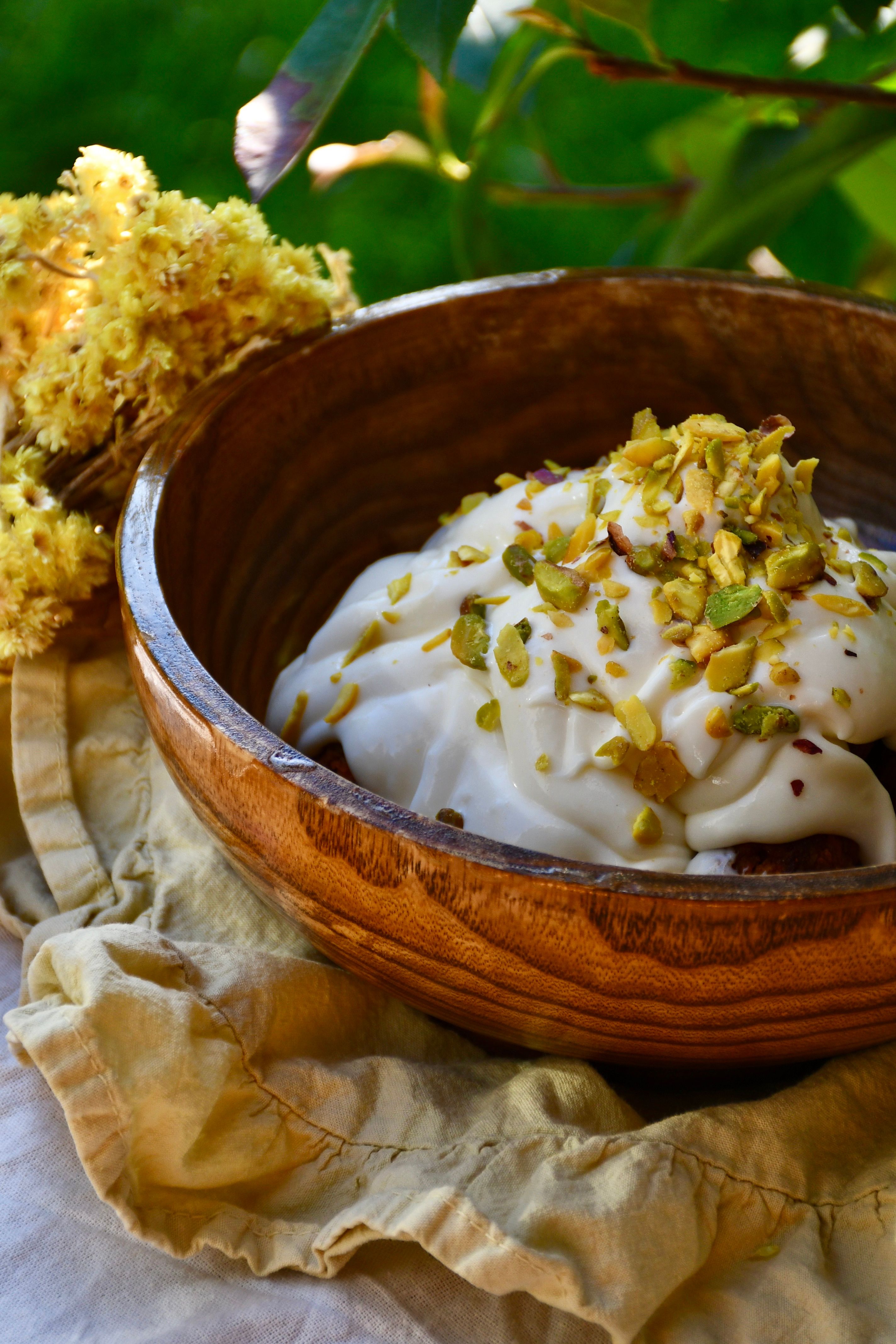
Photo: Hilal Diken / Pexels
The diets react (see scores below)
Common Ingredients
- yogurt
- sugar
- cardamom
- saffron
- pistachios
- almonds
Specific recipes may vary.
Incompatible with 6 of 11 diets
Diet Ratings
Shrikhand is fundamentally incompatible with ketogenic dietary principles. The dish is made by straining yogurt (which already contains lactose/carbs) and then mixing in significant amounts of added sugar — the defining characteristic of the recipe. A standard serving of Shrikhand contains roughly 30-50g of net carbs, predominantly from added sugar, which alone can exceed an entire day's keto carb allowance. While pistachios and almonds are keto-friendly nuts, and cardamom and saffron are negligible in carbs, they cannot offset the massive sugar load. The strained yogurt base, even without sugar, adds additional carbs from lactose. There is no practical portion size that makes this dish compatible with maintaining ketosis.
Shrikhand is a traditional Indian dessert/snack made primarily from strained yogurt (hung curd), which is a dairy product derived from cow's or buffalo's milk. Dairy is unambiguously excluded under all vegan standards. The remaining ingredients — sugar, cardamom, saffron, pistachios, and almonds — are all plant-based, but the foundational ingredient (yogurt) makes this dish non-vegan. A vegan version could theoretically be made using plant-based yogurt (coconut, soy, or almond-based), but the traditional dish as listed is not vegan-compliant.
Shrikhand is fundamentally incompatible with the paleo diet. Its two primary components — yogurt (dairy) and sugar (refined sweetener) — are both explicitly excluded from paleo eating. Yogurt is a dairy product and is not permitted under paleo guidelines, which exclude all dairy regardless of fermentation. Refined sugar is also a clear avoid. While cardamom, saffron, pistachios, and almonds are individually paleo-approved, they are minor components that cannot redeem the dish. The overall dish, as traditionally prepared, is firmly non-paleo.
Shrikhand is a strained yogurt dessert sweetened with sugar and flavored with cardamom, saffron, pistachios, and almonds. The yogurt base aligns with Mediterranean diet principles as a moderate dairy food, and the nuts (pistachios, almonds) are strongly encouraged plant foods. However, the added sugar is a concern — the Mediterranean diet minimizes added sugars, and shrikhand typically contains a substantial amount. The dish sits in a middle ground: beneficial components (dairy, nuts, spices) offset by significant added sugar, making it acceptable only occasionally and in small portions.
Some Mediterranean diet practitioners view yogurt-based desserts with nuts and aromatic spices favorably compared to ultra-processed sweets, arguing the nutrient density of strained yogurt and nuts outweighs moderate sugar use — similar to how Greek desserts like yogurt with honey are traditionally accepted in small amounts.
Shrikhand is fundamentally incompatible with the carnivore diet. While it contains yogurt as a dairy base (which is itself debated in carnivore circles), every other ingredient violates carnivore principles: sugar is a processed plant-derived sweetener, cardamom and saffron are plant spices, and pistachios and almonds are nuts — all strictly excluded plant foods. Even setting aside the dairy debate, the sugar, spices, and nuts make this dish unequivocally off-limits for any tier of carnivore eating. This is a plant-heavy dessert/snack with no meaningful animal protein and multiple carnivore-prohibited ingredients.
Shrikhand contains two excluded ingredients: yogurt (dairy) and sugar (added sugar). Both are explicitly banned on the Whole30 program. Yogurt is a dairy product, which is excluded for the full 30 days (only ghee/clarified butter is excepted from the dairy ban). Sugar is a clear added sugar, also explicitly excluded. With two hard-rule violations, this dish is firmly in the 'avoid' category with no ambiguity.
Shrikhand is traditionally made from strained yogurt (chakka), which remains high in lactose even after straining. While straining removes some whey and reduces lactose content somewhat, regular yogurt-based shrikhand still contains significant lactose — far more than the low-FODMAP threshold of approximately 1/2 cup (125g) of lactose-free yogurt or the very small amounts tolerable from regular yogurt (~2/3 cup of regular yogurt is borderline per Monash). A standard serving of shrikhand (typically 100–150g) is made from a much larger quantity of unstrained yogurt, concentrating both the solids and lactose. This makes the lactose load high enough to be problematic for most people on the elimination phase. Additionally, pistachios are high-FODMAP (GOS and fructans) at typical serving sizes — Monash rates pistachios as high-FODMAP at just 15 nuts, and shrikhand commonly contains a generous garnish. Almonds are low-FODMAP at 10 nuts but can become high-FODMAP in larger quantities. Sugar, cardamom, and saffron are low-FODMAP. Overall, the combination of high-lactose yogurt base and high-FODMAP pistachios makes this dish unsuitable during the elimination phase.
Shrikhand is a strained yogurt dessert sweetened with sugar and flavored with cardamom, saffron, pistachios, and almonds. It has several DASH-positive attributes: yogurt provides calcium and protein aligned with the low-fat dairy category, and nuts (pistachios, almonds) are explicitly encouraged on DASH for their potassium, magnesium, and healthy unsaturated fats. Cardamom and saffron are DASH-neutral spices with no sodium concern. However, the significant added sugar content is a meaningful DASH limitation — DASH recommends limiting sweets and added sugars to ≤5 servings per week, and traditional shrikhand recipes use substantial sugar (often 1:2 ratio yogurt to sugar by weight). Additionally, shrikhand is typically made with full-fat strained yogurt (chakka), whereas DASH specifies low-fat or fat-free dairy. The dish is sodium-free, which is a DASH positive, but the combined added sugar and likely full-fat dairy base prevent an 'approve' rating. Made with low-fat yogurt and reduced sugar, it would score higher.
NIH DASH guidelines explicitly limit added sugars and specify low-fat dairy, which would place traditional shrikhand under caution. However, updated clinical interpretations note that full-fat dairy may not adversely affect cardiovascular outcomes (as suggested by recent meta-analyses), and some DASH-oriented dietitians allow moderate desserts with nutrient-dense ingredients like nuts and yogurt, particularly when overall daily sugar intake is controlled.
Shrikhand is a strained yogurt dessert sweetened with significant amounts of sugar, which is its primary issue from a Zone perspective. The yogurt base provides some protein and is Zone-friendly, while pistachios and almonds contribute beneficial monounsaturated fats and are favorable Zone fat blocks. Cardamom and saffron are polyphenol-rich spices that align well with Sears' anti-inflammatory emphasis. However, the substantial added sugar makes this dish high-glycemic and difficult to fit into Zone ratios without disrupting the 40/30/30 balance — sugar is one of the few carbohydrates Dr. Sears consistently flags as unfavorable. The macronutrient ratio skews heavily toward carbohydrates (mostly from sugar) with inadequate protein relative to the carb load. In a small, carefully portioned serving (treating it as a condiment-sized snack rather than a full portion), the nuts and yogurt could anchor some Zone blocks, but the sugar remains a structural problem. This is categorically an 'unfavorable' carbohydrate dish in Zone terminology, salvageable only with strict portion control.
Some Zone practitioners argue that traditional Indian desserts like Shrikhand, consumed in very small portions (2-3 tablespoons), can fit as part of a Zone-balanced snack when paired with additional protein. Sears' later writings on polyphenols would also credit the saffron and cardamom as beneficial anti-inflammatory compounds. A Greek yogurt-based version with reduced sugar and more nuts would meaningfully improve the Zone compatibility.
Shrikhand is a strained yogurt dessert with a mixed anti-inflammatory profile. On the positive side, yogurt provides probiotics which support gut health and may reduce systemic inflammation. Cardamom and saffron both carry anti-inflammatory and antioxidant compounds. Pistachios and almonds are genuinely beneficial — rich in healthy monounsaturated fats, vitamin E, and polyphenols with documented anti-inflammatory effects. However, the dish is typically made with significant added sugar, which is a notable pro-inflammatory component. Traditional shrikhand can contain 3–5 teaspoons of sugar per serving, enough to meaningfully offset the benefits of the nuts and spices. Full-fat yogurt (often used) is in the 'limit' category per anti-inflammatory guidance. The dish lands as 'caution' rather than 'avoid' because the pro-inflammatory component (sugar) is modifiable, and the overall ingredient list is not dominated by harmful inputs — it's more of a dessert indulgence with some genuinely beneficial elements.
Some anti-inflammatory practitioners, particularly those following Dr. Weil's broader framework, may view traditionally fermented full-fat yogurt more favorably for its probiotic content and fat-soluble nutrient absorption, arguing the net effect is acceptable in moderate portions. Conversely, stricter anti-inflammatory and low-sugar protocols (like those advocated by Dr. Mark Hyman) would flag the added sugar content more harshly and likely rate this closer to 'avoid.'
Shrikhand is a strained yogurt dessert that carries meaningful nutritional tradeoffs for GLP-1 patients. The yogurt base provides moderate protein (roughly 5-8g per serving depending on how well it is strained) and is easy to digest, which are positives. Pistachios and almonds contribute small amounts of healthy unsaturated fats and additional protein. However, the dish is fundamentally sugar-forward — traditional recipes use substantial added sugar, which drives up empty calories and contributes little nutritional value per bite, a significant concern when total intake is already very limited. Fiber content is minimal. The nut garnish adds fat, though in small quantities it is unlikely to worsen GI side effects significantly. The cardamom and saffron are benign at typical amounts. If made with strained full-fat yogurt, saturated fat content rises. The core issue is the sugar load relative to protein delivery — it does not meet the standard of a high-protein, nutrient-dense food that GLP-1 patients need. A modified version using strained low-fat Greek yogurt with sharply reduced sugar could improve the rating meaningfully.
Some GLP-1-focused dietitians accept small portions of yogurt-based sweets as a practical harm-reduction strategy, particularly for patients from South Asian cultural backgrounds where dietary adherence depends on preserving familiar foods. The yogurt base and nuts do provide real nutrition, and a small serving may be preferable to higher-fat or higher-calorie traditional alternatives. Others maintain that any high-sugar snack crowds out the nutrient-dense eating GLP-1 patients require and should be avoided entirely.
*See how scores were generated at our methodology page.
Nutritional profile
Six traits that cut across every diet.
Fiber & Plants
How much whole-plant food and fiber it delivers.
Healthy Fats
The quality of its fats (unsaturated, omega-3).
Whole / Unprocessed
How close it is to its natural, unprocessed form.
Gut Gentle
How easy it is on digestion (low FODMAP, few irritants).
Low Glycemic
How little it spikes your blood sugar.
Protein Density
How much protein it packs per calorie.
Controversy Index
Higher controversy = more disagreement between diets.
Diet-Specific Tips
 Mediterranean — 5/10
View tips
- Yogurt is an acceptable moderate dairy food in the Mediterranean diet
- Pistachios and almonds are encouraged plant-based foods high in healthy fats
- Added sugar is a primary concern and contradicts Mediterranean diet principles
- Saffron and cardamom are beneficial spices with no dietary drawbacks
- Portion size and frequency are critical — occasional small servings are more acceptable
- No olive oil, whole grains, or vegetables present
 DASH — 5/10
View tips
- High added sugar content conflicts with DASH limit of ≤5 sweets per week
- Typically made with full-fat strained yogurt; DASH specifies low-fat or fat-free dairy
- Sodium-free — a significant DASH positive
- Pistachios and almonds are DASH-recommended nuts providing magnesium and potassium
- No saturated fat concerns beyond dairy fat
- Low-fat yogurt and reduced sugar preparation would improve DASH compatibility
 Zone — 4/10
View tips
- High added sugar content disrupts Zone carbohydrate ratio and is explicitly unfavorable in Zone methodology
- Strained yogurt provides protein (favorable Zone block) but is insufficient to balance the sugar-heavy carb load
- Pistachios and almonds are excellent monounsaturated fat sources — highly Zone-favorable
- Cardamom and saffron are polyphenol-rich spices aligned with Sears' anti-inflammatory framework
- No lean protein source listed, making the 30% protein target difficult to meet
- Could be made Zone-compatible with significant sugar reduction and increased yogurt-to-sugar ratio
 Anti-Inflammatory — 5/10
View tips
- High added sugar content is the primary concern — pro-inflammatory and should be limited
- Probiotics from strained yogurt support gut health and may modulate inflammatory markers
- Pistachios and almonds contribute vitamin E, healthy fats, and polyphenols — anti-inflammatory
- Cardamom offers antioxidant and anti-inflammatory phytochemicals
- Saffron contains crocin and safranal, which have demonstrated anti-inflammatory activity in research
- Full-fat dairy (typical in traditional preparation) falls in the 'limit' category
- No trans fats, artificial additives, or highly processed ingredients
- Overall profile is mixed — beneficial components undermined by sugar load typical of this dessert
 GLP-1 Friendly — 4/10
View tips
- High added sugar content reduces nutrient density per calorie — a critical concern for GLP-1 patients eating small volumes
- Yogurt base provides moderate protein, but typically far below the 15-30g per meal target
- Low fiber content offers no meaningful digestive support
- Pistachios and almonds contribute heart-healthy unsaturated fats in small amounts
- Easy to digest — strained yogurt is gentle on the slowed GLP-1 gut
- Portion-sensitive: a very small serving is more defensible than a standard dessert portion
- Can be significantly improved by using strained low-fat Greek yogurt and reducing added sugar