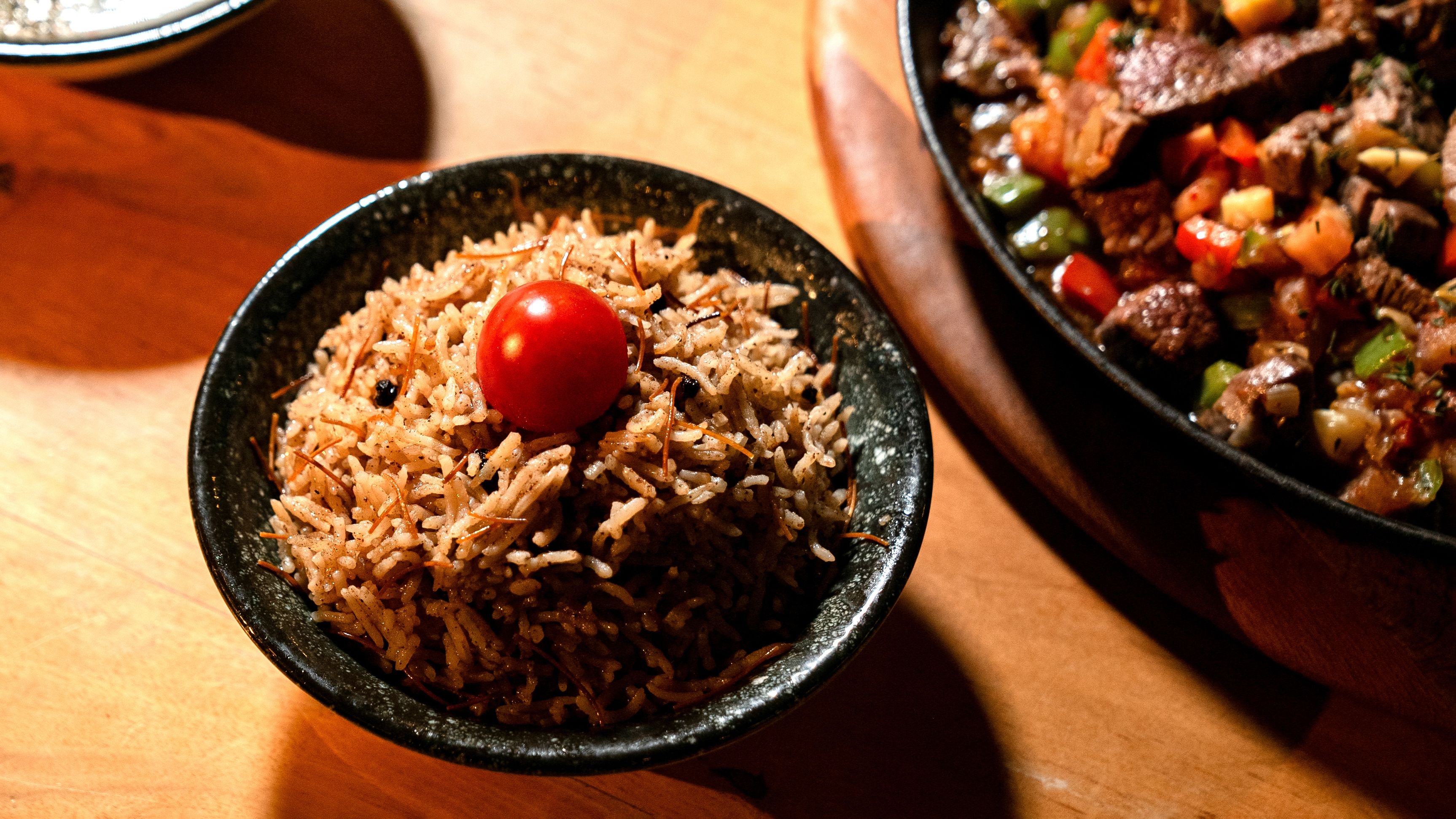
Photo: Mohamed Olwy / Pexels
Haitian
Diri ak Djon Djon
The diets react (see scores below)
Common Ingredients
- rice
- djon djon mushrooms
- lima beans
- garlic
- shallot
- thyme
- scotch bonnet
- clove
Specific recipes may vary.
Incompatible with 5 of 11 diets
Diet Ratings
Diri ak Djon Djon is a rice-based dish at its core, and rice is one of the most keto-incompatible foods available. A single cup of cooked rice contains approximately 45g of net carbs, which alone exceeds or meets the entire daily carb budget for ketosis. The addition of lima beans compounds the problem significantly — lima beans are a starchy legume with roughly 20-25g net carbs per half-cup serving. Together, the two primary carbohydrate sources in this dish make it utterly incompatible with a ketogenic diet. The aromatics (garlic, shallot, thyme, scotch bonnet, clove) and djon djon mushrooms are negligible carb contributors and would be perfectly fine on keto, but they cannot redeem a dish built on rice and legumes. There is no meaningful portion size at which this dish could fit within a daily 20-50g net carb limit.
Diri ak Djon Djon is a traditional Haitian black mushroom rice dish that is entirely plant-based in this preparation. Every ingredient — rice, djon djon (black trumpet mushrooms), lima beans, garlic, shallot, thyme, scotch bonnet pepper, and clove — is derived exclusively from plants. The djon djon mushrooms are the star ingredient, imparting a distinctive dark color and earthy, umami-rich flavor. Lima beans add plant protein and fiber, making this a nutritionally solid whole-food dish. No animal products or animal-derived ingredients are present. Note that traditional versions of this dish sometimes include seafood (shrimp or other proteins), so vegans should confirm preparation details when ordering at a restaurant, but the ingredient list as provided here is fully vegan.
Diri ak Djon Djon contains two major paleo-excluded food groups: rice (a grain) and lima beans (a legume). These are foundational violations in the paleo framework. Rice is explicitly excluded as a grain across virtually all paleo authorities, and lima beans are legumes — banned due to their lectin and phytate content. While the remaining ingredients (djon djon mushrooms, garlic, shallot, thyme, scotch bonnet, clove) are all paleo-approved, they cannot redeem a dish built on a grain-and-legume base.
Diri ak Djon Djon is a largely plant-based dish featuring rice, legumes (lima beans), mushrooms, and aromatic vegetables — a profile that aligns well with Mediterranean principles. The lima beans provide plant protein and fiber, djon djon mushrooms add umami depth with negligible fat, and the aromatics (garlic, thyme, scotch bonnet, clove) are staple Mediterranean flavor builders. The primary concern is the use of white rice rather than a whole grain. White rice is a refined grain with a higher glycemic index, which is not preferred under modern Mediterranean diet guidelines. However, it is not as harmful as added sugars or heavily processed foods, and the beans help moderate the glycemic impact. The dish contains no red meat, no added sugars, and no highly processed ingredients, making it clearly better than an 'avoid' rating, but the white rice and lack of olive oil as a fat source prevent a full 'approve.'
Some Mediterranean diet practitioners, particularly those drawing on traditional southern European and Middle Eastern cuisines, allow moderate white rice consumption (e.g., Greek pilafi, Lebanese roz), arguing that the overall dietary pattern matters more than any single ingredient. In this view, when white rice is paired with legumes and vegetables as here, the dish could merit a low-end 'approve' score.
Diri ak Djon Djon is entirely plant-based with zero animal-derived ingredients. It consists of rice (grain), djon djon mushrooms (fungi), lima beans (legume), garlic (vegetable), shallot (vegetable), thyme (herb/spice), scotch bonnet pepper (plant), and clove (spice). Every single ingredient violates carnivore diet principles. Rice and lima beans are among the most carbohydrate-dense foods excluded from carnivore. There is no animal protein, no animal fat, and no animal-derived component of any kind.
Diri ak Djon Djon contains two excluded ingredients. First, rice is a grain and is explicitly excluded on the Whole30 program. Second, lima beans are legumes and are also explicitly excluded. While djon djon mushrooms, garlic, shallot, thyme, scotch bonnet, and clove are all compliant, the foundational components of this dish — rice and lima beans — make it incompatible with the Whole30 program. There is no compliant workaround that would preserve the identity of this dish.
Diri ak Djon Djon contains multiple high-FODMAP ingredients that make it unsuitable during the elimination phase. The most problematic are: (1) garlic — high in fructans, avoid at any culinary amount; (2) shallots — high in fructans and GOS, equivalent to onion in FODMAP load; (3) lima beans (butter beans) — high in GOS and fructans, a significant FODMAP source even in small portions; (4) djon djon mushrooms — these are dried black Haitian mushrooms (Psathyrella depressus) that are not specifically tested by Monash, but mushrooms are generally high in polyols (mannitol), and djon djon is used in relatively large quantities to flavor the rice and soaking water; (5) clove — low-FODMAP at culinary doses but worth noting. Rice itself is low-FODMAP, thyme and scotch bonnet are also fine. However, the combination of garlic, shallots, lima beans, and likely high-polyol mushrooms creates an extremely high cumulative FODMAP load. Even removing one or two problematic ingredients, the dish cannot be made low-FODMAP without fundamental reformulation.
Djon djon mushrooms lack specific Monash University testing data, so their FODMAP status is estimated based on general mushroom data; some clinical FODMAP practitioners note that highly dried/concentrated mushrooms used as a flavoring agent (rather than eaten as a vegetable portion) may contribute less polyol load than a standard serving of fresh mushrooms, but this does not resolve the well-established high-FODMAP status of garlic, shallots, and lima beans in this dish.
Diri ak Djon Djon is a Haitian black mushroom rice dish with a nutritionally favorable profile for DASH. The core ingredients — rice (ideally whole grain), djon djon mushrooms, and lima beans — align well with DASH principles. Lima beans provide plant-based protein, fiber, potassium, and magnesium, all nutrients DASH explicitly emphasizes. Djon djon mushrooms contribute umami depth along with some minerals and fiber. Aromatics like garlic, shallot, thyme, scotch bonnet, and clove add flavor complexity without sodium, which is a key DASH strategy for reducing salt dependency. The dish contains no red meat, saturated fat, added sugar, or high-sodium processed ingredients as listed. The main considerations are: (1) white rice is typically used, which is refined grain — DASH favors whole grains, though white rice is not prohibited; (2) sodium content depends entirely on preparation — if salted heavily or prepared with bouillon/stock cubes (common in Haitian cooking), sodium could increase significantly. As listed with no added sodium sources, this dish rates well. Portion size matters given rice's caloric density.
NIH DASH guidelines favor whole grains over refined white rice for better fiber and glycemic impact; however, updated clinical interpretations note that when rice is paired with legumes like lima beans, the glycemic load is moderated and the overall nutrient density of the meal improves substantially, making standard white rice acceptable in this context.
Diri ak Djon Djon is a Haitian black mushroom rice dish that is predominantly a carbohydrate-heavy meal with no significant lean protein source listed. White rice is the primary ingredient and is classified as an 'unfavorable' high-glycemic carbohydrate in Zone terminology — Dr. Sears specifically recommends limiting white rice due to its high glycemic index and its tendency to spike insulin. The lima beans do contribute some protein and fiber (which reduces net carbs), but they are primarily a carb source in Zone block counting and do not provide sufficient protein to balance the meal macro ratio. The djon djon mushrooms, garlic, shallot, thyme, scotch bonnet, and clove are all Zone-favorable flavor ingredients — mushrooms and aromatics are low-glycemic and polyphenol-rich. However, the overall dish is heavily skewed toward carbohydrates with minimal protein and fat, making it very difficult to hit the 40/30/30 Zone ratio as a standalone meal. To be usable in a Zone context, it would need to be served as a small side portion alongside a lean protein (e.g., grilled fish or skinless chicken) and a monounsaturated fat source, keeping the rice portion to roughly 1/3 cup cooked. The dish is not 'avoid' because lima beans add fiber and moderate protein, and the aromatics are beneficial, but the white rice base and lack of lean protein make it a 'caution' that requires significant portioning discipline.
Diri ak Djon Djon is a Haitian black mushroom rice dish with a notably strong anti-inflammatory ingredient profile. Djon djon mushrooms (dried Haitian black mushrooms) are a functional mushroom variety whose dark pigments (melanins) and bioactive compounds suggest meaningful antioxidant and immune-modulating properties, consistent with the anti-inflammatory emphasis on cooked Asian-style mushrooms. Lima beans contribute plant-based protein, fiber, and polyphenols that support anti-inflammatory gut health. Garlic delivers allicin and organosulfur compounds with well-documented anti-inflammatory effects. Shallots provide quercetin and other flavonoids. Thyme is a polyphenol-rich herb (rosmarinic acid, thymol) with anti-inflammatory properties. Scotch bonnet pepper is very high in capsaicin, a potent anti-inflammatory compound also supported by Dr. Weil's inclusion of chili peppers on the anti-inflammatory pyramid. Clove is one of the highest antioxidant-scoring spices and contains eugenol, a COX-2 inhibitor. The main limiting factor is white rice — a refined grain with a moderate glycemic load that lacks the fiber and micronutrient density of whole grains, which the anti-inflammatory framework de-emphasizes. However, the dish as a whole is vegetable- and legume-forward with a rich herb and spice profile, positioning it well within anti-inflammatory principles despite the white rice base.
Most anti-inflammatory authorities, including Dr. Weil, would rate this dish favorably given its mushroom, legume, and spice density. However, some stricter low-glycemic anti-inflammatory protocols (e.g., Zone Diet-influenced approaches) would flag white rice as a significant concern due to its glycemic index and insulin response, which can promote inflammatory signaling — they would recommend substituting brown or black rice to achieve a higher score.
Diri ak Djon Djon is a traditional Haitian black mushroom rice dish. Its primary base is white rice, a refined grain that is low in fiber, moderate in glycemic impact, and offers little protein per calorie — a meaningful drawback for GLP-1 patients who need nutrient density in every bite. Lima beans add meaningful plant protein (roughly 7-8g per half cup cooked) and fiber (~7g), partially offsetting the rice's limitations. Djon djon mushrooms contribute umami, some micronutrients, and modest fiber. Garlic, shallot, and thyme are nutritionally benign and digestively well-tolerated. The scotch bonnet pepper is the main concern: it is a very high-heat chili that can worsen reflux, nausea, and GI irritation — all significant risks for GLP-1 patients already experiencing delayed gastric emptying. The dish is relatively low in fat and does not involve frying, which is favorable. Overall, this is a starchy, plant-based dish with moderate protein from lima beans but insufficient to anchor a GLP-1-friendly meal on its own. It could work as a side or in a small portion paired with a lean protein, but as a standalone main with no additional protein source, it falls short of GLP-1 dietary priorities.
Some GLP-1-focused dietitians may rate this more favorably given the lima beans' protein and fiber contribution and the dish's low fat profile, especially for patients struggling with appetite and GI side effects who need gentle, familiar foods. Others would flag the scotch bonnet and refined rice more strongly, particularly for patients in early dose titration when GI sensitivity is highest — individual heat tolerance varies considerably in this population.
*See how scores were generated at our methodology page.
Nutritional profile
Six traits that cut across every diet.
Fiber & Plants
How much whole-plant food and fiber it delivers.
Healthy Fats
The quality of its fats (unsaturated, omega-3).
Whole / Unprocessed
How close it is to its natural, unprocessed form.
Gut Gentle
How easy it is on digestion (low FODMAP, few irritants).
Low Glycemic
How little it spikes your blood sugar.
Protein Density
How much protein it packs per calorie.
Controversy Index
Higher controversy = more disagreement between diets.
Diet-Specific Tips
 Vegan — 5/10
View tips
- All ingredients are whole plant foods — rice, legumes, mushrooms, aromatics, and spices
- Djon djon mushrooms are fungi, not animal-derived, and are fully vegan
- Lima beans contribute plant protein, improving nutritional completeness
- No dairy, eggs, meat, or animal-derived additives present
- Traditional restaurant preparations may include shrimp — this home-style version does not
- High whole-food content earns a top-tier approval score
 Mediterranean — 6/10
View tips
- White rice is a refined grain, not a whole grain — a caution flag under modern Mediterranean guidelines
- Lima beans provide excellent plant-based protein and fiber, strongly aligned with Mediterranean principles
- Djon djon mushrooms are a whole, plant-based ingredient with nutritional value
- No red meat, no added sugars, no highly processed ingredients
- Garlic, thyme, and other aromatics are core Mediterranean flavor staples
- Absence of olive oil as the cooking fat is a mild negative; preparation method could shift the score
- Lima beans help moderate the glycemic impact of white rice
 DASH — 7/10
View tips
- Lima beans provide DASH-valued potassium, magnesium, fiber, and plant protein
- Mushrooms add nutrients and umami without sodium
- Garlic, herbs, and spices replace salt as flavor enhancers — a core DASH strategy
- White rice is a refined grain; substituting brown rice would improve DASH alignment
- No saturated fat, red meat, added sugar, or processed ingredients listed
- Sodium content is preparation-dependent — bouillon or salt additions could lower the score
- Scotch bonnet pepper adds capsaicin, which may have mild blood pressure benefits
 Zone — 4/10
View tips
- White rice is a high-glycemic 'unfavorable' carbohydrate in Zone — Dr. Sears recommends limiting or avoiding it
- No lean protein source listed; lima beans provide some protein but are primarily counted as a carb block in Zone
- Lima beans add fiber, reducing net carbs somewhat, and provide modest protein — a mild positive
- Djon djon mushrooms and aromatics (garlic, thyme, scotch bonnet, cloves) are polyphenol-rich and Zone-favorable
- Dish is carbohydrate-dominant with no fat source, making 40/30/30 ratio very difficult without pairing
- Can be incorporated as a small side dish (~1/3 cup rice portion) alongside lean protein and healthy fat to Zone-balance the meal
 Anti-Inflammatory — 7/10
View tips
- Djon djon mushrooms: functional mushroom with antioxidant melanins and immune-modulating properties — strongly anti-inflammatory
- Lima beans: high fiber, plant protein, and polyphenols — supports anti-inflammatory gut microbiome
- Garlic: allicin and organosulfur compounds reduce CRP and NF-κB inflammatory signaling
- Scotch bonnet: very high capsaicin content — strong anti-inflammatory and antioxidant
- Thyme: rosmarinic acid and thymol — well-documented anti-inflammatory herbs
- Clove: eugenol inhibits COX-2 enzymes, among the highest ORAC-scored spices
- Shallots: quercetin and anthocyanins — flavonoid-rich anti-inflammatory allium
- White rice: refined grain with moderate glycemic index — primary anti-inflammatory limitation of this dish
 GLP-1 Friendly — 5/10
View tips
- White rice is a refined grain — low fiber, low protein density, moderate glycemic load
- Lima beans provide meaningful plant protein (~7-8g per half cup) and fiber (~7g), partially compensating
- No primary animal or high-density protein source — insufficient protein as a standalone main
- Scotch bonnet pepper is high-heat and may worsen GLP-1 side effects: nausea, reflux, GI irritation
- Low fat profile and no frying — favorable for digestibility and GLP-1 GI tolerance
- Djon djon mushrooms add micronutrients and modest fiber but minimal protein
- Small portions recommended; dish works better as a side paired with lean protein