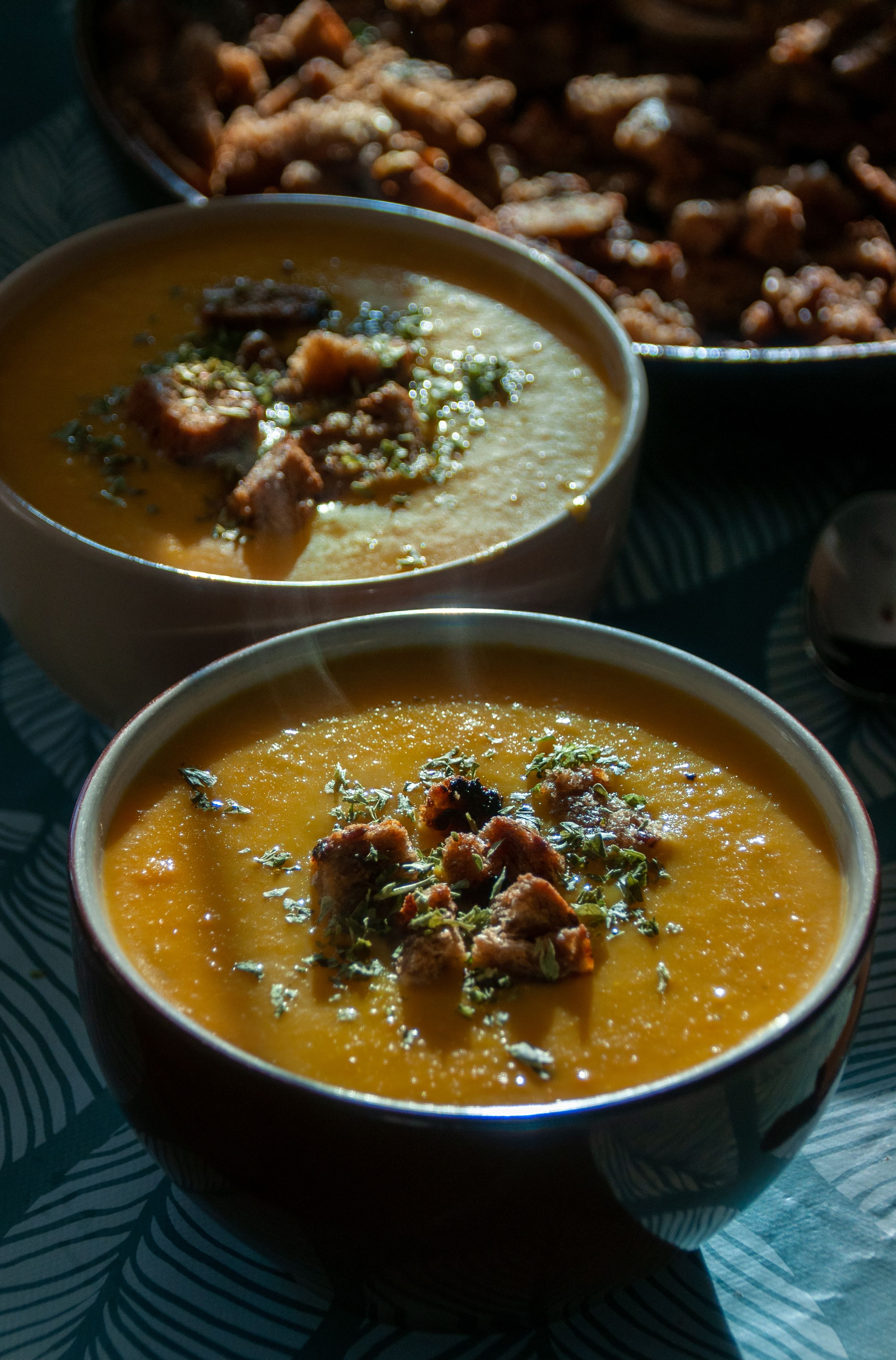
Photo: wal_ 172619 / Pexels
The diets react (see scores below)
Common Ingredients
- squash
- beef
- cabbage
- carrot
- potato
- turnip
- pasta
- celery
- scotch bonnet
- lime
Specific recipes may vary.
Incompatible with 6 of 11 diets
Diet Ratings
Soup Joumou is fundamentally incompatible with a ketogenic diet. The dish contains multiple high-carb ingredients that together would far exceed the daily 20-50g net carb limit in a single serving. Potato is a starchy vegetable with roughly 15-17g net carbs per 100g. Pasta adds significant carbohydrates (around 25-30g net carbs per small serving). Squash (likely butternut or kabocha) contributes 8-12g net carbs per cup. Carrot adds another 6-8g net carbs per serving. Even turnip, which is lower-carb than potato, still adds to the cumulative load. The combination of potato, pasta, squash, and carrot alone would easily push a single bowl well past 50g net carbs. While beef, cabbage, celery, scotch bonnet, and lime are keto-friendly components, they cannot redeem a dish structurally built around starchy and grain-based ingredients. No reasonable portion size of this traditional dish would fit within ketogenic macros.
Soup Joumou contains beef as a primary protein, which is a direct animal product and strictly excluded under vegan dietary rules. All other ingredients (squash, cabbage, carrot, potato, turnip, pasta, celery, scotch bonnet, lime) are plant-based, but the presence of beef makes this dish entirely incompatible with a vegan diet. There is no ambiguity here — beef is animal flesh.
Soup Joumou contains two clear paleo violations that disqualify it outright: pasta (a wheat-based grain product) and potato (white potato, which is discouraged under strict paleo guidelines including The Paleo Diet's official position). Pasta is a processed grain and represents one of the most straightforward 'avoid' items in all paleo frameworks — there is no credible paleo authority that permits wheat pasta. The remaining ingredients — squash, beef, cabbage, carrot, turnip, celery, scotch bonnet pepper, and lime — are all paleo-approved whole foods, and the dish's base is genuinely nutrient-dense. However, the presence of pasta alone is sufficient to render the dish non-compliant. White potato adds a secondary concern. To make this dish paleo, one would need to omit the pasta entirely and either remove the potato or substitute sweet potato.
Soup Joumou is a nutrient-rich vegetable-forward soup with excellent Mediterranean-compatible ingredients — squash, cabbage, carrot, turnip, celery, and lime align well with plant-based principles. However, beef is the primary protein, and the Mediterranean diet limits red meat to a few times per month. The inclusion of pasta (likely refined) adds another moderately problematic element. The dish is not inherently unhealthy, but the beef-centric base and refined pasta place it outside the 'approve' tier. If beef were replaced with fish or legumes and whole-grain or no pasta used, this would score much higher.
Some Mediterranean diet practitioners following a more flexible, traditional whole-foods framework might argue that a modest portion of lean beef in a predominantly vegetable broth — where vegetables constitute the bulk of the dish — is acceptable occasionally, and that the nutrient density of the soup overall offsets the red meat concern. Traditional Southern European peasant cooking also incorporated small amounts of meat as flavoring in vegetable soups rather than as a main protein.
Soup Joumou is almost entirely incompatible with the carnivore diet. While beef is the primary protein and is fully approved, it is vastly outnumbered by plant-based ingredients: squash, cabbage, carrot, potato, turnip, pasta, celery, scotch bonnet pepper, and lime. Every single one of these is explicitly excluded from the carnivore diet. Pasta is a grain-based processed carbohydrate; squash, carrot, potato, and turnip are starchy vegetables; cabbage and celery are fibrous plant matter; scotch bonnet is a plant-derived spice/pepper; and lime is a citrus fruit. The dish as prepared is fundamentally a vegetable-and-starch soup that happens to contain beef — the exact opposite of a carnivore meal. There is no meaningful way to adapt this dish to carnivore without removing every ingredient except the beef, at which point it would no longer be Soup Joumou.
Soup Joumou is a beloved Haitian New Year's soup that is otherwise rich in Whole30-compliant ingredients (squash, beef, cabbage, carrot, turnip, celery, scotch bonnet, lime). However, the traditional recipe includes pasta, which is a grain-based food explicitly excluded on the Whole30. Grains in any form — including pasta/noodles — are on the forbidden list. Without the pasta, a modified version of this soup would be largely compliant, but as traditionally prepared with pasta, it must be rated 'avoid'.
Soup Joumou contains several ingredients that individually require careful FODMAP management, and together create cumulative FODMAP load concerns. Butternut squash is low-FODMAP at 1/3 cup but becomes high in polyols (sorbitol) at larger servings — in a soup where squash is a dominant ingredient, safe portions are difficult to achieve. Pasta (wheat-based) is high-FODMAP due to fructans and is a significant concern unless substituted with gluten-free pasta; however, Monash notes that small servings (~1/2 cup cooked) of regular pasta may be borderline due to dilution effects, but this is contested. Cabbage is low-FODMAP at 1 cup, carrot is safely low-FODMAP, potato is low-FODMAP at 1 medium serving, and beef is FODMAP-free. Celery is a polyol concern (mannitol) at servings above 1/4 stalk. Turnip is low-FODMAP at small portions but becomes high-FODMAP at larger amounts. Scotch bonnet pepper is low-FODMAP (capsaicin is not a FODMAP), and lime juice is low-FODMAP. The compounding issue is that this dish is a hearty stew where multiple moderate-FODMAP ingredients are consumed simultaneously in larger-than-minimum quantities. Wheat pasta is likely the most critical concern during strict elimination phase, and squash volume would need close monitoring.
Monash University would rate some individual ingredients as conditionally low-FODMAP at controlled portions, but clinical FODMAP practitioners typically flag wheat pasta as avoid-level during strict elimination and would note that the cumulative polyol load from squash, turnip, and celery together makes this dish difficult to make safe without significant ingredient substitution. A modified version with gluten-free pasta and portion-controlled squash would score considerably higher.
Soup Joumou is a nutrient-rich Haitian stew featuring many DASH-friendly ingredients: squash, cabbage, carrot, turnip, celery, and potato provide excellent potassium, magnesium, fiber, and vitamins. Lime adds flavor without sodium. However, the dish raises caution for two main reasons: (1) Beef is a red meat that DASH limits — traditional recipes typically use bone-in beef or tougher cuts (e.g., beef shank, chuck) that are higher in saturated fat than lean poultry or fish; (2) Traditional preparation can be quite high in sodium from added salt and bouillon, which is a concern for both standard and low-sodium DASH targets. The pasta adds refined carbohydrates, which DASH tolerates in small amounts but does not emphasize. On the positive side, the vegetable base is exceptional — the ratio of vegetables to meat is favorable, and the dish is not processed. With lean beef trimmed of fat, portion control on pasta, and careful sodium management (limiting added salt, avoiding bouillon cubes), this dish can be made moderately DASH-compatible. As traditionally prepared in many Haitian households, the sodium and saturated fat content tips it into caution territory.
NIH DASH guidelines categorically limit red meat regardless of cut, but updated clinical interpretations increasingly distinguish between lean cuts of beef (e.g., round or sirloin trimmed of fat) and fatty cuts — some DASH-informed dietitians would approve a vegetable-heavy soup like this if prepared with lean beef and low-sodium broth, noting the exceptional micronutrient density of the vegetable base.
Soup Joumou is a nutrient-rich traditional Haitian dish with several Zone-favorable ingredients, but its overall macronutrient profile presents meaningful challenges. On the positive side, squash, cabbage, carrot, celery, turnip, scotch bonnet, and lime are all low-glycemic, polyphenol-rich vegetables that Zone strongly endorses. However, the dish simultaneously includes two high-glycemic carbohydrate sources — potato and pasta — which Dr. Sears classifies as 'unfavorable' carbs that spike insulin and are difficult to incorporate into Zone ratios. The beef protein is acceptable in lean cuts (e.g., sirloin) but fatty cuts common in traditional Joumou (often bone-in or stew beef) add saturated fat that Zone limits. As served traditionally, the carbohydrate load from potato and pasta together likely far exceeds a Zone-compliant 9g net carb per block target per serving, making it hard to balance the 40/30/30 ratio without significant modification. A modified version — removing potato and pasta, using lean beef, and increasing vegetable volume — could bring this soup into Zone compliance and score much higher (7-8). As traditionally prepared, it requires careful portion discipline.
Some Zone practitioners and Sears' later writings take a more flexible view, noting that traditional whole-food soups with abundant vegetables, even when containing some high-glycemic starch, can fit within Zone principles if the starchy components are small in proportion to the overall bowl. In a large vegetable-forward broth, a modest amount of potato or pasta may represent only 1-2 carb blocks, keeping the meal manageable with appropriate lean protein and monounsaturated fat additions. Viewed this way, Soup Joumou could be rated as a solid caution (5-6) rather than a low caution (4).
Soup Joumou is a nutrient-rich Haitian dish with a genuinely mixed anti-inflammatory profile. On the positive side, squash is an excellent source of carotenoids (beta-carotene) and antioxidants, making it a strong anti-inflammatory base. Cabbage, carrot, turnip, celery, and scotch bonnet pepper all contribute meaningful phytonutrients, fiber, and anti-inflammatory compounds — notably capsaicin from the scotch bonnet, which has documented anti-inflammatory activity. Lime adds vitamin C and flavonoids. The vegetable density of this soup is a genuine strength. However, beef is the primary protein, and anti-inflammatory guidelines consistently recommend limiting red meat due to its saturated fat content and arachidonic acid, which can promote inflammatory pathways (elevated CRP, IL-6). The pasta and potato add refined/high-glycemic carbohydrates that are considered neutral to mildly pro-inflammatory. The dish as traditionally prepared does not include omega-3-rich ingredients, extra virgin olive oil, or key anti-inflammatory spices like turmeric or ginger that would elevate its profile. Overall, the exceptional vegetable base moderates the pro-inflammatory impact of the beef, but the dish cannot be fully approved due to red meat as the central protein and the presence of refined carbohydrates.
Some anti-inflammatory practitioners, particularly those influenced by Dr. Terry Wahls and ancestral nutrition frameworks, would view grass-fed beef more favorably — arguing it provides anti-inflammatory nutrients like zinc, selenium, and conjugated linoleic acid (CLA), and that the rich vegetable load in this dish more than compensates. Conversely, stricter plant-forward anti-inflammatory protocols would rate this lower, emphasizing that any red meat as the primary protein warrants an 'avoid' regardless of vegetable accompaniments.
Soup Joumou is a nutrient-dense Haitian stew with genuine strengths and notable concerns for GLP-1 patients. On the positive side, it is vegetable-forward (squash, cabbage, carrot, turnip, celery) providing meaningful fiber and micronutrients, and the broth base supports hydration. The beef provides protein, though the cut matters significantly — traditional recipes often use tougher, fattier cuts like beef chuck or shank, which are higher in saturated fat and harder to digest, both problematic on GLP-1 medications. The pasta and potato add refined or starchy carbohydrates that contribute calories with limited protein or fiber payoff, competing for limited stomach space. The scotch bonnet pepper is a meaningful concern — it is one of the hotter chili peppers and may worsen reflux, nausea, or GI discomfort, which are already common GLP-1 side effects. Lime juice is fine and may aid palatability. Overall, this is a wholesome traditional dish that can work for GLP-1 patients in modified form, but the standard preparation has enough drawbacks to warrant caution rather than approval.
Some GLP-1-informed dietitians would view the broth-based, vegetable-rich format favorably and consider this an approvable soup if prepared with a lean beef cut and scotch bonnet used sparingly or omitted — the soup format itself aligns well with GLP-1 dietary principles. Others would flag the combination of starchy vegetables, pasta, and fatty beef as too calorie-dense and GI-risky in a single dish, particularly around injection day when nausea sensitivity peaks.
*See how scores were generated at our methodology page.
Nutritional profile
Six traits that cut across every diet.
Fiber & Plants
How much whole-plant food and fiber it delivers.
Healthy Fats
The quality of its fats (unsaturated, omega-3).
Whole / Unprocessed
How close it is to its natural, unprocessed form.
Gut Gentle
How easy it is on digestion (low FODMAP, few irritants).
Low Glycemic
How little it spikes your blood sugar.
Protein Density
How much protein it packs per calorie.
Controversy Index
Higher controversy = more disagreement between diets.
Diet-Specific Tips
 Mediterranean — 4/10
View tips
- Beef is the primary protein — red meat is limited to a few times per month in the Mediterranean diet
- Rich array of vegetables (squash, cabbage, carrot, turnip, celery) strongly aligns with Mediterranean principles
- Pasta is likely refined, adding a moderately non-compliant carbohydrate source
- No olive oil listed as a fat source
- Legumes absent — a missed opportunity to increase Mediterranean compatibility
- Lime and scotch bonnet add flavor without sugar or unhealthy fats — neutral to positive
 DASH — 5/10
View tips
- Red meat (beef) is limited on DASH — saturated fat content depends heavily on cut used
- Exceptional vegetable diversity (squash, cabbage, carrot, turnip, celery, potato) provides potassium, magnesium, and fiber
- High sodium risk from traditional preparation using added salt and bouillon cubes
- Refined pasta adds carbohydrates — whole-grain pasta substitution would improve DASH alignment
- Lime juice as a flavoring agent supports sodium reduction strategy
- Scotch bonnet pepper adds heat and flavor without sodium, supporting DASH-compatible seasoning
- Large vegetable-to-meat ratio is favorable compared to most red meat dishes
- Low-sodium version with lean beef trim and no bouillon would score significantly higher (7-8)
 Zone — 4/10
View tips
- Potato and pasta are both 'unfavorable' high-glycemic carbs in Zone methodology — their simultaneous presence significantly elevates the glycemic load
- Squash, cabbage, carrot, turnip, celery, scotch bonnet, and lime are all Zone-favorable low-glycemic vegetables and polyphenol sources
- Beef quality matters significantly: lean cuts (sirloin, round) are acceptable Zone protein; fatty stew cuts increase saturated fat burden
- As traditionally served, carbohydrate blocks from potato + pasta + squash + carrot likely exceed Zone ratios without careful portioning
- Anti-inflammatory potential is high due to vegetable diversity and scotch bonnet capsaicin, which aligns with Sears' polyphenol emphasis
- Lime juice adds polyphenols and acidity without meaningful carb contribution — a Zone-positive element
- Easy to modify toward Zone compliance by omitting pasta and potato and increasing lean protein portion
 Anti-Inflammatory — 5/10
View tips
- Squash provides strong carotenoid and antioxidant content — a beneficial anti-inflammatory base
- Scotch bonnet pepper contributes capsaicin, a well-documented anti-inflammatory compound
- Diverse vegetables (cabbage, carrot, turnip, celery) add fiber, polyphenols, and micronutrients
- Lime adds vitamin C and flavonoids
- Beef is a red meat — anti-inflammatory guidelines recommend limiting due to saturated fat and arachidonic acid
- Pasta and potato introduce refined/high-glycemic carbohydrates with a mildly pro-inflammatory potential
- No omega-3-rich ingredients or key anti-inflammatory spices (turmeric, ginger) present
- Preparation method (broth-based soup) is favorable — not fried or heavily processed
 GLP-1 Friendly — 5/10
View tips
- Beef cut is critical — fatty cuts (chuck, shank) add saturated fat and are harder to digest; lean cuts (sirloin, round) would improve the rating
- Scotch bonnet pepper may worsen GLP-1-related reflux and nausea — a significant concern
- Broth-based format supports hydration and easy digestibility, a genuine positive
- Squash, cabbage, carrot, turnip, and celery provide fiber and micronutrients
- Pasta and potato reduce protein and fiber density per calorie, occupying limited stomach capacity
- Protein contribution is moderate but cut-dependent; a standard bowl is unlikely to deliver 15-30g protein without a generous beef portion
- Traditional preparation may include added fat or bone-in cuts that raise the fat content further
- Portion sensitivity is high — a small bowl skews more favorably than a large traditional serving