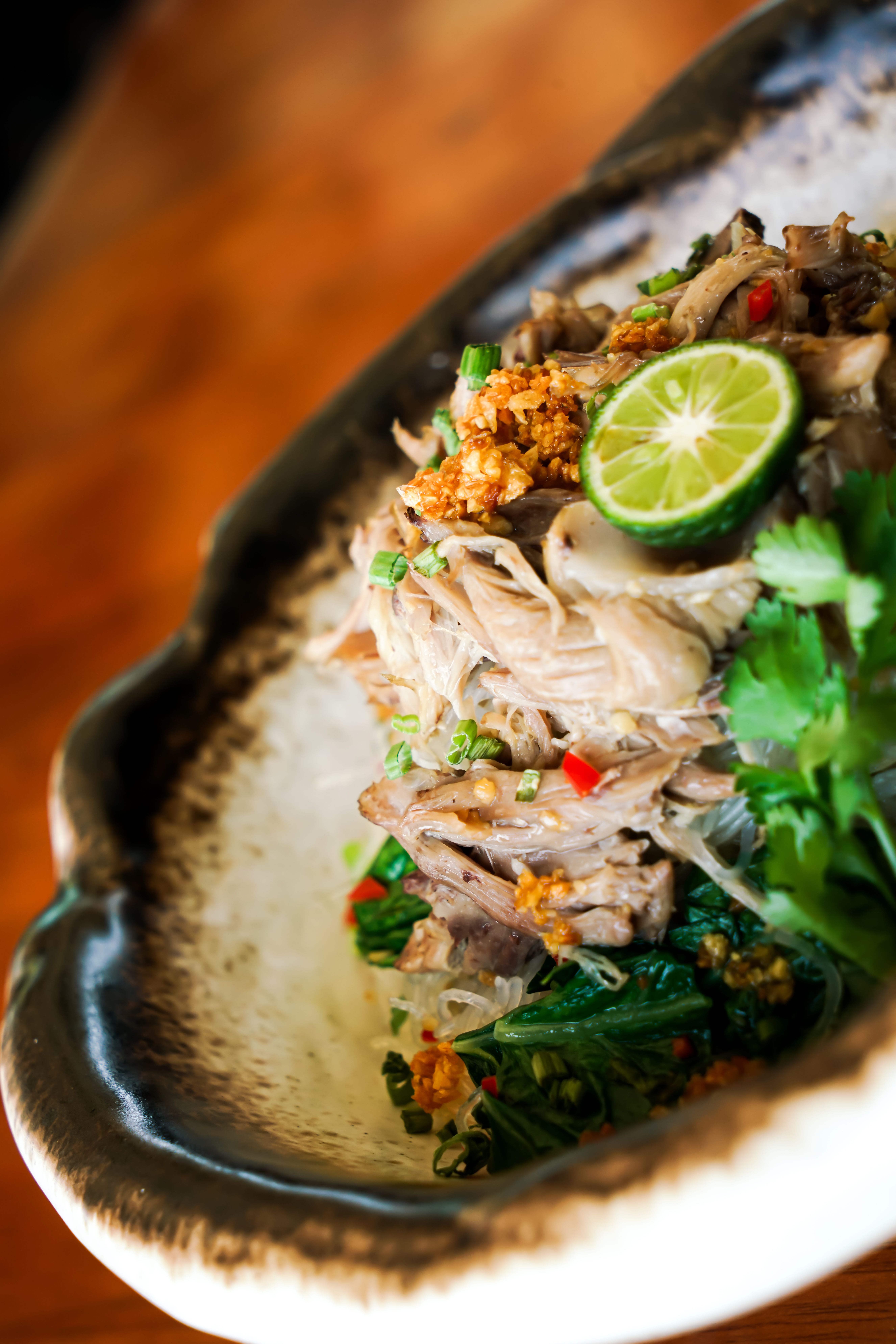
Photo: Scenehaus Production / Pexels
The diets react (see scores below)
Common Ingredients
- pork shoulder
- hawaiian salt
- banana leaves
- liquid smoke
- ti leaves
Specific recipes may vary.
Incompatible with 3 of 11 diets
Diet Ratings
Kalua Pig is an excellent keto food. Pork shoulder is a high-fat, high-protein cut with virtually zero carbohydrates. The preparation method — slow-cooking with Hawaiian salt, banana leaves, and ti leaves — adds no meaningful carbs or sugars. Liquid smoke is used in trace amounts and contributes negligible carbs. Banana and ti leaves function as wrapping/flavoring agents during cooking and are not consumed, so their carb content is irrelevant. The result is a naturally fatty, tender pulled pork with essentially zero net carbs per serving, perfectly aligning with keto macros.
Kalua Pig is definitively non-vegan. The primary and dominant ingredient is pork shoulder, a direct animal product (pig flesh). There is no ambiguity here — this is a meat-centered dish with no plant-based substitutes present. The remaining ingredients (Hawaiian salt, banana leaves, liquid smoke, ti leaves) are all plant-based or mineral-derived, but they serve only as seasoning and wrapping for the pork. The dish cannot be considered vegan in any interpretation of vegan principles.
Kalua Pig is largely paleo-friendly at its core — pork shoulder is an excellent unprocessed protein source fully aligned with paleo principles. Banana leaves and ti leaves are natural wrapping materials with no dietary concern. However, two ingredients create friction: (1) Hawaiian salt is still salt — added salt is excluded by strict paleo protocols (Cordain's original framework), though many modern paleo practitioners accept unrefined mineral-rich salts like sea salt and pink Himalayan salt in moderation; (2) liquid smoke is a processed flavoring additive, and while it is made from condensed wood smoke and contains no grains or legumes, it is an industrial processed product that contradicts the whole-food, unprocessed spirit of paleo. Together, these two ingredients push the dish into caution territory rather than a clean approve.
Many modern paleo practitioners, including Mark Sisson and followers of the Primal Blueprint, accept unrefined natural salts (sea salt, Hawaiian red salt) as acceptable mineral sources, and some pragmatic paleo voices tolerate liquid smoke as a negligible natural-derived flavoring. Under this interpretation, Kalua Pig could reasonably score as an approve with the pork and natural wrapping leaves carrying the dish.
Kalua Pig is centered on pork shoulder, a fatty red/processed meat that directly conflicts with Mediterranean diet principles. Red meat is limited to only a few times per month, and pork shoulder is particularly high in saturated fat. The preparation method (slow-cooked, salt-heavy) offers no redeeming Mediterranean qualities — there is no olive oil, no vegetables, no legumes, no whole grains, and no plant-forward elements. Liquid smoke and heavy salt further distance this dish from whole, minimally processed Mediterranean staples. While the banana and ti leaves used in cooking are plant-derived, they contribute no nutritional benefit to the dish itself. This is essentially a meat-centric preparation that epitomizes what the Mediterranean diet discourages.
Kalua Pig is primarily pork shoulder with Hawaiian salt — both carnivore-compliant ingredients. However, banana leaves and ti leaves are plant materials used as cooking wrappers and flavor infusers, meaning plant compounds leach into the meat during cooking. Liquid smoke is a processed additive derived from condensed wood smoke, which is debated even outside carnivore circles for potential carcinogenic compounds. The pork and salt core is solid, but the plant leaf contact and liquid smoke additive pull this away from strict carnivore approval. Many practitioners would eat this dish pragmatically, especially at a restaurant, but it would not be considered a 'clean' carnivore preparation.
Strict carnivore purists would flag the banana and ti leaves as plant-derived flavor contributors that violate the 'animal products only' rule, and would reject liquid smoke as a processed plant-derived additive. A truly carnivore version would be pork shoulder slow-cooked with salt only, no plant wrappers or smoke flavoring.
Kalua Pig as described is a straightforward Whole30-compliant dish. Pork shoulder is an allowed protein, Hawaiian salt is simply sea salt with no additives, banana leaves and ti leaves are natural plant wrappers used for cooking and impart flavor without contributing excluded ingredients, and liquid smoke is a Whole30-compatible flavoring (it is simply condensed smoke vapor with no excluded additives in its standard form). There are no grains, legumes, dairy, added sugars, or other excluded ingredients present. This is a whole, minimally processed preparation that aligns well with the spirit of the Whole30 program.
Kalua Pig is an excellent low-FODMAP dish. Pork shoulder is a plain protein with no FODMAPs. Hawaiian salt (sea salt) contains no FODMAPs. Banana leaves and ti leaves are used as cooking wrappers and impart flavor without contributing any FODMAP compounds. Liquid smoke is a flavoring derived from condensed smoke and contains no FODMAPs at the small quantities used. There are no high-FODMAP ingredients such as onion, garlic, wheat, or legumes in this traditional Hawaiian preparation. The slow-cooking method does not introduce any FODMAP concerns.
Kalua Pig is a traditional Hawaiian dish made from pork shoulder, which is a high-fat, high-saturated-fat cut of red meat — both directly contrary to DASH diet principles. DASH explicitly limits red meat and saturated fat. Hawaiian salt (sea salt) is used in substantial quantities for both curing and seasoning, resulting in very high sodium content, often exceeding 1,000–1,500mg per serving, which conflicts with DASH's sodium limits of 1,500–2,300mg/day. Pork shoulder typically contains 8–12g of saturated fat per serving, well above DASH's guidance to limit saturated fat to 6% of total calories. While banana leaves and ti leaves are used as aromatic wrappers and contribute no nutritional concern, the core protein and salt components make this dish fundamentally incompatible with DASH guidelines. Liquid smoke adds negligible sodium but is also associated with processed flavor enhancers that DASH does not emphasize.
Kalua Pig is slow-cooked pork shoulder — a flavorful but moderately fatty cut. Pork shoulder contains both lean protein and a notable amount of saturated fat, making it less ideal than skinless chicken or fish but still workable in Zone portions. The ingredients themselves are Zone-neutral: Hawaiian salt, banana leaves, ti leaves, and liquid smoke add no carbohydrates, sugar, or problematic fats. The dish is essentially pure protein and fat with zero carbohydrates, which means it cannot stand alone as a Zone meal — it must be paired with low-glycemic vegetables (e.g., cabbage, mixed greens) and a monounsaturated fat source to hit the 40/30/30 target. The saturated fat content of pork shoulder is the primary concern; a typical serving will run higher in saturated fat than Zone-preferred lean proteins. However, if trimmed and portioned to approximately 3 oz (one Zone protein block equivalent of ~21g protein), it can fit into a balanced Zone meal. Traditional Hawaiian plate service often pairs kalua pig with rice and poi — both high-glycemic carbs — which would push the overall meal out of Zone balance. Assessed on the protein itself, it is a usable but 'unfavorable' Zone protein.
Some Zone practitioners and later Sears anti-inflammatory writings take a more relaxed view of saturated fat from whole-food animal sources, distinguishing it from processed saturated fat. Under this view, naturally slow-cooked pork shoulder with no additives could be treated more favorably, especially given its clean ingredient profile and absence of processed seed oils or sugar. Strict early Zone (Enter the Zone) would rate it lower due to saturated fat content.
Kalua Pig is a traditional Hawaiian dish centered on slow-cooked pork shoulder, which places it squarely in the 'limit' category of anti-inflammatory frameworks. Pork shoulder is a relatively fatty cut with meaningful saturated fat content, and red/processed meats are consistently flagged as pro-inflammatory due to arachidonic acid, heme iron, and saturated fat contributing to elevated CRP and IL-6 markers. However, it is not as inflammatory as highly processed meats (sausage, bacon) or red meat per se — pork occupies a gray zone. The preparation method is noteworthy: traditional Kalua Pig is cooked with banana leaves and ti leaves, which are natural wrappings that impart no harmful compounds and may even contribute minor antioxidant properties through steam infusion. Hawaiian salt is simply mineral-rich sea salt — acceptable in moderation, though high sodium intake can be indirectly inflammatory. Liquid smoke is a common modern shortcut and, while generally considered safe in small amounts, is a processed additive that some anti-inflammatory practitioners caution against due to trace compounds from smoke condensation. The dish contains no anti-inflammatory stars (no omega-3s, antioxidant-rich vegetables, herbs, or olive oil), but also lacks trans fats, refined sugars, or seed oils. Overall, this is a minimally processed, whole-food preparation of a fatty pork cut — acceptable occasionally but not a dish that supports an anti-inflammatory dietary pattern as a regular staple.
Kalua pig is made from pork shoulder, a fatty cut that is high in saturated fat. A 3-oz serving provides roughly 20-22g of protein, which is solid, but the fat content (typically 12-18g per serving depending on how much rendered fat is retained) is a significant drawback for GLP-1 patients. High-fat meals slow gastric emptying further — compounding the GLP-1 mechanism — and increase risk of nausea, bloating, and reflux. The preparation method (long slow cook with salt, banana and ti leaves, liquid smoke) contains no fiber, no meaningful micronutrients beyond the pork itself, and the dish is essentially protein plus saturated fat with empty calories from fat. It is not fried, not spicy, and easy to chew and digest texturally, which prevents it from scoring lower. If consumed, it should be a small portion with fat trimmed or drained, paired with high-fiber sides (vegetables, legumes). Lean protein alternatives like chicken breast or fish are strongly preferred.
Some GLP-1-focused dietitians accept fatty pork cuts in moderation, noting that protein adequacy is the top priority and pork shoulder still delivers meaningful protein per serving — particularly useful for patients struggling to meet protein targets. Others are stricter, arguing that the high saturated fat load disproportionately worsens GI side effects in GLP-1 patients and that the protein-to-fat ratio is too unfavorable compared to available alternatives.
*See how scores were generated at our methodology page.
Nutritional profile
Six traits that cut across every diet.
Fiber & Plants
How much whole-plant food and fiber it delivers.
Healthy Fats
The quality of its fats (unsaturated, omega-3).
Whole / Unprocessed
How close it is to its natural, unprocessed form.
Gut Gentle
How easy it is on digestion (low FODMAP, few irritants).
Low Glycemic
How little it spikes your blood sugar.
Protein Density
How much protein it packs per calorie.
Controversy Index
Higher controversy = more disagreement between diets.
Diet-Specific Tips
 Keto — 9/10
View tips
- Pork shoulder is high in fat and protein with zero net carbs
- Banana and ti leaves used as cooking wrappers only — not eaten
- Hawaiian salt adds no carbs
- Liquid smoke used in trace amounts, negligible carb impact
- No added sugars, grains, or starchy ingredients
- Traditional preparation is inherently whole and unprocessed
- Naturally fits keto macronutrient targets of high fat, moderate protein, near-zero carbs
 Paleo — 5/10
View tips
- Pork shoulder is a clean, unprocessed paleo-approved protein
- Banana leaves and ti leaves are natural and raise no paleo concerns
- Hawaiian salt (added salt) is excluded by strict Cordain-school paleo but accepted by many modern paleo frameworks
- Liquid smoke is a processed additive that conflicts with whole-food paleo philosophy
- No grains, legumes, dairy, refined sugar, or seed oils present
 Carnivore — 5/10
View tips
- Pork shoulder is an excellent carnivore protein source
- Hawaiian salt is acceptable — pure mineral salt
- Banana leaves and ti leaves are plant materials that infuse plant compounds into the meat during cooking
- Liquid smoke is a processed additive derived from wood, not an animal product
- No sugars, grains, or major plant-based fillers present
- Practically consumed by many carnivore practitioners as a close approximation, especially when dining out
 Whole30 — 9/10
View tips
- Pork shoulder is a fully compliant Whole30 protein
- Hawaiian salt is natural sea salt — compliant
- Banana leaves and ti leaves are natural cooking wrappers with no excluded ingredients
- Liquid smoke in its standard form contains no excluded additives and is Whole30 compatible
- No sugars, sweeteners, grains, legumes, or dairy present
- Dish aligns with Whole30's whole-food, minimally processed philosophy
 Low-FODMAP — 9/10
View tips
- Pork shoulder is a plain protein — zero FODMAPs
- Hawaiian salt (sea salt) is FODMAP-free
- Banana leaves and ti leaves are cooking aromatics/wrappers with no FODMAP content
- Liquid smoke used in small quantities is FODMAP-safe
- No onion, garlic, wheat, or other high-FODMAP ingredients present
- Simple traditional preparation with no hidden FODMAP sources
 Zone — 5/10
View tips
- Pork shoulder is a moderate-fat cut with meaningful saturated fat — less ideal than Zone-preferred lean proteins like chicken breast or fish
- Zero carbohydrates — must be paired with low-glycemic vegetables to form a Zone-balanced meal
- Clean, minimal ingredient profile with no sugar, processed oils, or high-glycemic additives
- Traditional accompaniments (white rice, poi) are high-glycemic and would disrupt Zone ratios if included
- Portion control critical: ~3 oz trimmed serving keeps protein blocks in range while limiting saturated fat load
- Good source of complete protein; the slow-cook method produces a lean-ish shredded texture that makes portioning easier
 Anti-Inflammatory — 4/10
View tips
- Pork shoulder is a fatty cut high in saturated fat — falls in the 'limit' category per anti-inflammatory guidelines
- No trans fats, refined sugars, seed oils, or artificial additives in traditional preparation
- Banana leaves and ti leaves are natural, clean wrappings with no pro-inflammatory contribution
- Liquid smoke is a processed additive; some anti-inflammatory practitioners recommend avoiding it
- Hawaiian salt is unrefined but dish may be high in sodium overall
- No meaningful anti-inflammatory ingredients present (omega-3s, polyphenols, antioxidant vegetables, herbs)
- Pork is neither red meat nor lean poultry — occupies an intermediate position in anti-inflammatory frameworks
 GLP-1 Friendly — 4/10
View tips
- High saturated fat from pork shoulder — worsens GLP-1 GI side effects
- Adequate protein per serving (~20-22g per 3oz) — meets per-meal target
- No fiber content — must be paired with fiber-rich sides
- Not fried, not spicy, soft texture — easier on digestion than many avoid-tier meats
- Portion sensitivity — small servings with fat drained reduce risk
- No added sugar, no carbonation, no alcohol — no additional red flags
- Lean alternatives (chicken breast, fish, tofu) strongly preferred over this cut