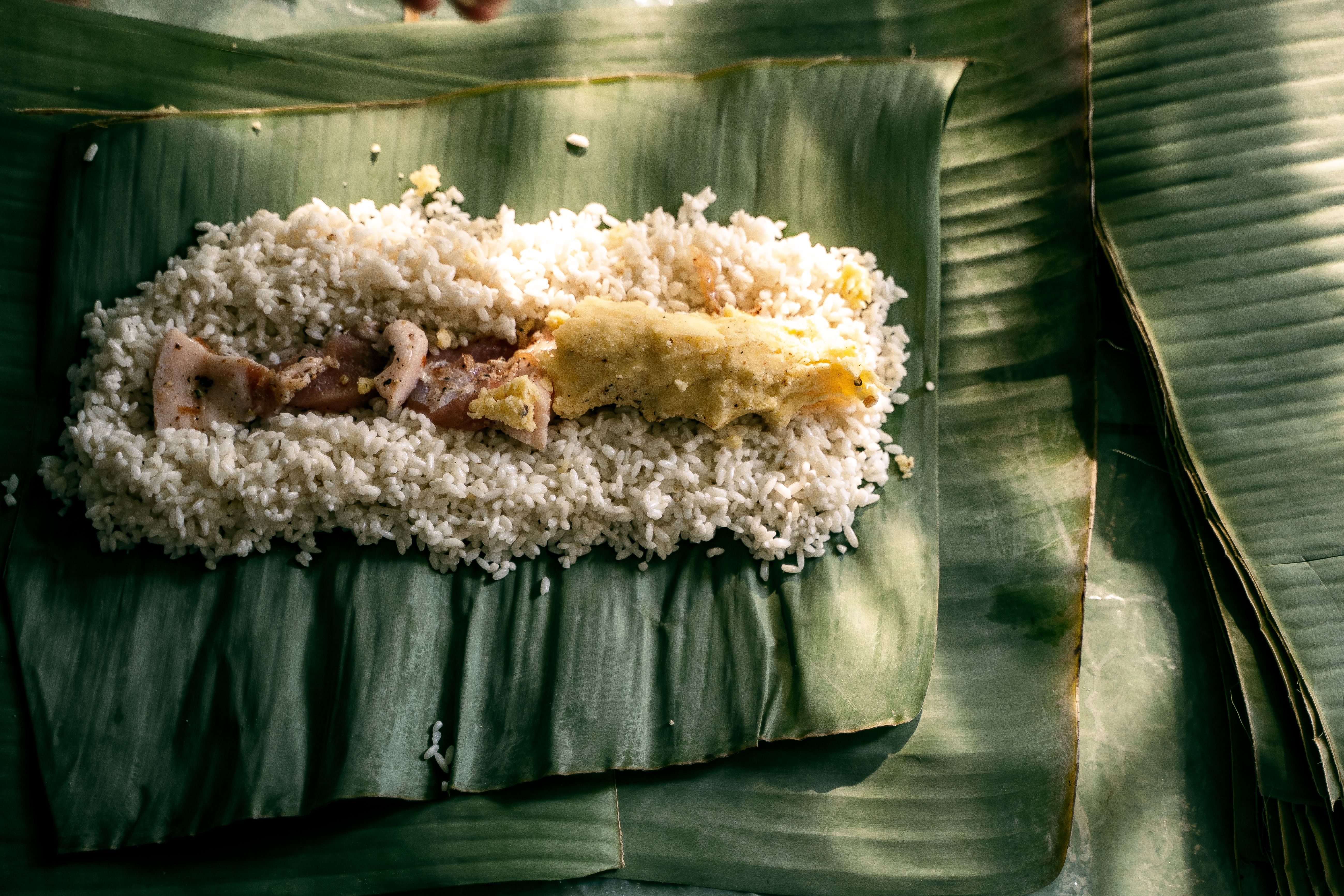
Photo: Vietnam Tri Duong Photographer / Pexels
The diets react (see scores below)
Common Ingredients
- pork
- butterfish
- taro leaves
- ti leaves
- hawaiian salt
Specific recipes may vary.
Incompatible with 6 of 11 diets
Diet Ratings
Laulau is a traditional Hawaiian dish of pork and butterfish wrapped in taro leaves and ti leaves, then steamed. The protein and fat components (fatty pork and butterfish) are excellent for keto. Ti leaves are inedible wrappers discarded before eating, contributing zero carbs. The primary concern is taro leaves: unlike taro root (which is very high-starch and keto-incompatible), taro leaves are leafy greens with significantly lower net carbs — roughly 1-3g net carbs per cup cooked. In a standard laulau serving, the taro leaf content is moderate and the net carbs are manageable, likely 3-6g per bundle. However, some recipes or restaurant versions may include more taro leaf than expected, and strict keto practitioners should be mindful of cumulative carb intake across the day. Overall, Laulau is a reasonably keto-friendly dish with portion awareness, making it a 'caution' rather than a clear approve due to uncertainty in serving size and the non-trivial carb contribution of taro leaves.
Some strict keto practitioners flag any taro-family ingredient as a red flag due to the high-carb nature of taro root, and may avoid Laulau out of caution even though leaves differ nutritionally from the root. Conversely, lazy keto adherents often approve Laulau freely, arguing the net carb load per serving is well within daily limits.
Laulau is a traditional Hawaiian dish that contains multiple animal products. Pork is a direct animal flesh product, and butterfish (black cod) is a fish — both are clearly excluded from a vegan diet. Taro leaves and ti leaves are plant-based wrappers, and Hawaiian salt is a mineral, but the presence of both pork and fish makes this dish unambiguously non-vegan. There is no meaningful debate within the vegan community about this dish.
Laulau contains mostly paleo-friendly ingredients — pork and butterfish are approved proteins, and taro leaves are a nutritious leafy green acceptable in paleo. Ti leaves are used as a wrapper and not consumed. However, Hawaiian salt (added salt) is explicitly excluded under paleo rules as an additive/processed seasoning. This single ingredient pushes the dish into 'avoid' territory per strict paleo guidelines, though the margin is close given how otherwise clean the ingredient list is.
Many modern paleo practitioners (including Mark Sisson and the Whole30 framework) treat small amounts of natural, unrefined salt like Hawaiian sea salt as acceptable, arguing that minimally processed mineral-rich salts bear little resemblance to industrially refined table salt and were accessible to coastal hunter-gatherer populations. Under this interpretation, Laulau would rate as a strong 'approve.'
Laulau is a traditional Hawaiian dish featuring pork wrapped in taro leaves and steamed in ti leaves. While it contains some positive elements — taro leaves are nutrient-dense leafy greens, and butterfish (black cod) is a fatty fish rich in omega-3s — the dish is primarily pork-forward, which is red/fatty meat that the Mediterranean diet limits to a few times per month. The pork used in traditional laulau is typically pork butt or belly, high in saturated fat, which directly conflicts with Mediterranean dietary principles emphasizing lean proteins and plant-based fats. The absence of olive oil as the primary fat and the dominance of fatty pork as the protein source push this dish into the 'avoid' range. The butterfish component is a genuine positive, but it plays a secondary role.
Some Mediterranean diet interpreters might score this slightly higher given the presence of dark leafy greens (taro leaves) and omega-3-rich butterfish, arguing that the traditional, whole-food, minimally processed preparation method aligns with Mediterranean principles of unprocessed eating. A flexible interpretation could place this in 'caution' territory if portion sizes of pork are modest.
Laulau is fundamentally incompatible with the carnivore diet. While it contains carnivore-approved ingredients (pork, butterfish, and Hawaiian salt), the dish is defined by taro leaves, which are a plant food and a primary component of the meal — not merely a trace additive. Ti leaves are used as a wrapper for steaming and are also plant-derived. Taro leaves are starchy, plant-based, and contain oxalates, which carnivore practitioners specifically seek to eliminate. The dish cannot be considered carnivore-compliant because the plant ingredients are structural and integral to the dish as traditionally prepared, not optional garnishes.
Laulau is a traditional Hawaiian dish consisting of pork and butterfish wrapped in taro leaves and ti leaves, seasoned with Hawaiian salt, then steamed. Every ingredient is Whole30-compliant: pork and butterfish are whole animal proteins explicitly allowed on the program; taro leaves are vegetables; ti leaves are used as a wrapper and not consumed; and Hawaiian salt is simply natural sea salt, which is explicitly permitted. There are no grains, legumes, dairy, added sugars, or any other excluded ingredients. This is a clean, whole-food preparation that aligns well with the spirit of the Whole30 program.
Laulau is a traditional Hawaiian dish where pork and butterfish are wrapped in taro leaves and ti leaves, then steamed. Analyzing each ingredient: Pork (plain) is low-FODMAP and safe. Butterfish (black cod or similar) is a plain fish and low-FODMAP. Hawaiian salt is sodium chloride with no FODMAPs. Ti leaves are used as an outer wrapper and are not consumed, so they pose no FODMAP concern. The main uncertainty is taro leaves — Monash University has not specifically tested taro leaves (as distinct from taro root). Taro root itself is rated as low-FODMAP at 1/2 cup (75g) but becomes moderate at larger servings due to GOS. Taro leaves are a leafy green and nutritionally distinct from the root; leafy greens are generally low-FODMAP, but without specific Monash data on taro leaves, there is meaningful uncertainty. The protein components are clearly safe, but the untested nature of taro leaves as a primary wrapping ingredient (consumed in significant quantity) warrants caution rather than full approval.
Monash University has not specifically tested taro leaves, making this assessment reliant on extrapolation from taro root data and general leafy green principles. Some FODMAP practitioners may consider taro leaves safe given their leafy green classification, while others may advise avoidance during strict elimination due to the lack of direct testing data.
Laulau is a traditional Hawaiian dish of pork and butterfish wrapped in taro leaves and ti leaves, steamed or baked. While taro leaves are a DASH-positive ingredient (rich in potassium, calcium, magnesium, and fiber — analogous to other dark leafy greens), the dish is problematic for DASH adherence for several reasons. First, pork in laulau is typically fatty cuts (pork butt or belly), contributing significant saturated fat that DASH explicitly limits. Second, butterfish (black cod or sablefish) is high in fat — while its fat profile is healthier (omega-3s), the combination with fatty pork pushes overall saturated fat intake higher. Third, and most critically, Hawaiian salt (alaea salt) is used generously in traditional preparation, contributing substantial sodium — a single laulau serving can contain 600–1,200mg of sodium depending on preparation, a significant portion of the DASH daily limit of 2,300mg (and over half the 1,500mg low-sodium DASH target). The overall dish profile — high saturated fat from fatty pork, high sodium from Hawaiian salt — conflicts with core DASH principles. The positive contribution of taro leaves is insufficient to offset these concerns.
Some DASH-oriented clinicians may note that butterfish contributes beneficial omega-3 fatty acids and that taro leaves provide meaningful potassium and magnesium that partially align with DASH goals. If prepared with lean pork and reduced Hawaiian salt, the dish could potentially be upgraded to 'caution' territory, as updated DASH interpretations sometimes allow moderate omega-3-rich fatty fish even when calorie-dense.
Laulau is a traditional Hawaiian dish of pork and butterfish wrapped in taro leaves and steamed in ti leaves. From a Zone perspective, the dish has both favorable and unfavorable elements. The taro leaves (luau leaves) are the most Zone-friendly component — leafy greens are excellent low-glycemic carbohydrate sources and are rich in polyphenols. Butterfish (black cod/sablefish) is an outstanding source of omega-3 fatty acids, aligning perfectly with Sears' anti-inflammatory emphasis. However, the pork used in traditional laulau is typically fatty pork butt or shoulder, which carries significant saturated fat — a concern in classic Zone methodology. The fat profile of the overall dish skews toward saturated fat rather than the preferred monounsaturated fats. Additionally, laulau as traditionally served provides protein and fat but virtually no Zone-balanced carbohydrates beyond the taro leaves, making it difficult to hit the 40/30/30 ratio as a standalone meal. It would need substantial low-glycemic vegetable sides to complete a Zone plate. The dish is not inherently problematic — it's whole-food, minimally processed, and salt is the only additive — but the fatty pork and ratio imbalance require careful portioning and meal planning to fit Zone guidelines.
Some Zone practitioners following Sears' later anti-inflammatory work (Toxic Fat, The Mediterranean Zone) would be more lenient about the saturated fat from pork, especially since laulau is a whole-food, unprocessed preparation with no seed oils, additives, or refined carbohydrates. The omega-3 richness of butterfish partially offsets the saturated fat concern. Additionally, the taro leaves, while modest in quantity, provide meaningful polyphenol content. In later Zone writings, Sears shifted emphasis toward polyphenol-rich, anti-inflammatory whole foods — by that framing, laulau with lean pork adjustments and vegetable sides could approach a moderate Zone approval.
Laulau is a traditional Hawaiian dish of pork and butterfish wrapped in taro leaves and ti leaves, then steamed. The profile is genuinely mixed from an anti-inflammatory standpoint. On the positive side, butterfish (typically black cod/sablefish in Hawaii) is rich in omega-3 fatty acids, placing it among the more beneficial fatty fish. Taro leaves are highly nutritious, rich in vitamins A and C, polyphenols, and antioxidants — similar to other dark leafy greens emphasized in anti-inflammatory diets. Ti leaves serve as a cooking wrapper and contribute minimally nutritionally. Hawaiian salt is unrefined and mineral-rich, though high sodium intake is generally something to moderate. The problematic element is the pork, which is typically a fatty cut (pork butt/shoulder) with significant saturated fat content — a category the anti-inflammatory framework places in the 'limit' range. The dish is steamed, which is a favorable cooking method that avoids oxidized fats from high-heat frying. Overall, laulau is not a strongly pro-inflammatory dish, but the pork's saturated fat load prevents a clear approval. The combination of anti-inflammatory butterfish and nutrient-dense taro leaves alongside the pork creates a mixed profile best suited for occasional rather than regular consumption.
Some anti-inflammatory practitioners (aligned with Dr. Weil's more flexible framework) would note that pork in traditional whole-food preparations — especially steamed without added refined oils or sugars — is far less concerning than processed meats, and that the overall dish's nutrient density from taro leaves and omega-3-rich butterfish may tip it toward approval for generally healthy individuals. Conversely, stricter anti-inflammatory and autoimmune protocols (e.g., AIP-influenced approaches) would flag both pork's saturated fat and arachidonic acid content as reasons to limit or avoid the dish more firmly.
Laulau is a traditional Hawaiian dish of pork and butterfish (black cod) wrapped in taro leaves and steamed in ti leaves. While it contains genuine protein and nutrient-dense taro leaves, the fat profile is the critical problem for GLP-1 patients. Traditional laulau uses fatty cuts of pork (pork butt or shoulder), which are high in saturated fat, and butterfish (black cod/sablefish) is one of the fattiest fish available — roughly 15-18g fat per 3oz serving, predominantly from rich oils. The combination results in a dish that is very high in total fat per serving. High-fat meals directly worsen GLP-1 side effects: nausea, bloating, reflux, and prolonged gastric distress are all amplified because GLP-1 medications already slow gastric emptying, and fat is the slowest macronutrient to digest. The taro leaves do contribute fiber and micronutrients, which is a genuine positive, and the steaming preparation avoids added oils — but the intrinsic fat content of the protein sources is the issue, not cooking method. The sodium from Hawaiian salt is also a consideration for patients managing blood pressure alongside GLP-1 therapy. This dish in its traditional form is a poor fit for GLP-1 patients, particularly those in early phases when GI side effects are most pronounced.
Some GLP-1-focused dietitians may note that butterfish provides beneficial omega-3 fatty acids and that the taro leaves offer meaningful fiber and micronutrients, arguing that a smaller portion could be acceptable for patients who have stabilized on their medication and tolerate higher-fat meals without significant GI symptoms. However, the consensus among obesity medicine RDs is that the combined fat load of fatty pork and sablefish in a single dish poses too high a risk of triggering nausea and reflux to recommend even in moderation during active GLP-1 treatment.
*See how scores were generated at our methodology page.
Nutritional profile
Six traits that cut across every diet.
Fiber & Plants
How much whole-plant food and fiber it delivers.
Healthy Fats
The quality of its fats (unsaturated, omega-3).
Whole / Unprocessed
How close it is to its natural, unprocessed form.
Gut Gentle
How easy it is on digestion (low FODMAP, few irritants).
Low Glycemic
How little it spikes your blood sugar.
Protein Density
How much protein it packs per calorie.
Controversy Index
Higher controversy = more disagreement between diets.
Diet-Specific Tips
 Keto — 5/10
View tips
- Pork is high-fat, zero-carb — ideal for keto
- Butterfish is high in healthy fats and protein with zero carbs
- Taro leaves (not taro root) are leafy greens with low net carbs (~1-3g per cup cooked)
- Ti leaves are inedible wrappers, contribute no carbs
- No added sugars, grains, or starches in traditional preparation
- Net carbs per bundle estimated 3-6g depending on serving size
- Cumulative taro leaf carbs across a full day's meals require monitoring
 Whole30 — 9/10
View tips
- Pork is a compliant protein on Whole30
- Butterfish (black cod) is a compliant seafood
- Taro leaves are compliant vegetables
- Ti leaves are used as a cooking/wrapping vessel, not eaten
- Hawaiian salt is natural sea salt, explicitly allowed
- No excluded ingredients (no grains, legumes, dairy, or added sugars)
- Simple, whole-food traditional preparation honors the spirit of Whole30
 Low-FODMAP — 6/10
View tips
- Pork is low-FODMAP — safe
- Butterfish (plain fish) is low-FODMAP — safe
- Hawaiian salt contains no FODMAPs
- Ti leaves used as outer wrapper only, not consumed — no concern
- Taro leaves lack specific Monash University FODMAP testing data
- Taro root is low-FODMAP at small servings but taro leaves are nutritionally distinct
- Extrapolation from leafy greens suggests low-FODMAP potential, but unconfirmed
 Zone — 5/10
View tips
- Fatty pork (shoulder/butt) is high in saturated fat, unfavorable in classic Zone methodology
- Butterfish (sablefish) is rich in omega-3 fatty acids, strongly aligning with Zone anti-inflammatory principles
- Taro leaves are low-glycemic, polyphenol-rich leafy greens — an excellent Zone carbohydrate source
- Dish is minimally processed with no refined carbohydrates, seed oils, or added sugars
- Macronutrient ratio is protein/fat-heavy with insufficient carbohydrates to achieve 40/30/30 as a standalone meal
- Needs supplemental low-glycemic vegetables or fruit to balance Zone blocks
- Traditional preparation with lean pork substitution would significantly improve Zone compatibility
 Anti-Inflammatory — 5/10
View tips
- Butterfish (sablefish/black cod) is high in omega-3 fatty acids — a strong anti-inflammatory asset
- Taro leaves are nutrient-dense dark leafy greens rich in antioxidants and vitamins A and C
- Pork (fatty cut, typically shoulder/butt) contributes significant saturated fat — a 'limit' category food
- Steaming is a health-favorable cooking method that avoids oxidized fats
- No refined carbohydrates, added sugars, seed oils, or artificial additives
- High sodium from Hawaiian salt warrants moderation, especially for inflammatory conditions linked to hypertension