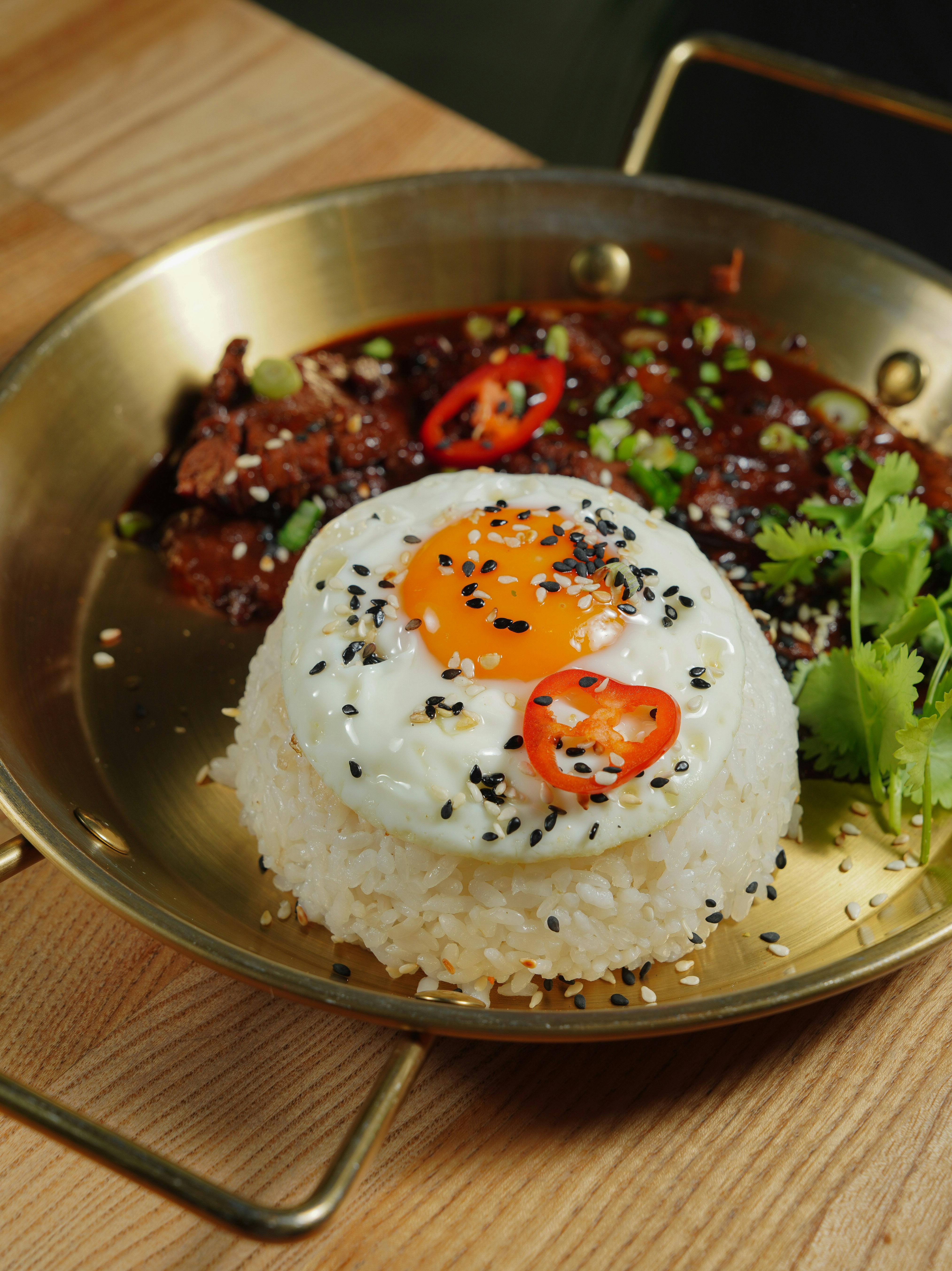
The diets react (see scores below)
Common Ingredients
- rice
- ground beef
- eggs
- brown gravy
- onion
- butter
- soy sauce
- black pepper
Specific recipes may vary.
Incompatible with 9 of 11 diets
Diet Ratings
Loco Moco is fundamentally incompatible with ketogenic eating. The dish is built on a base of white rice, which is a high-glycemic grain delivering approximately 45g of net carbs per cup — easily blowing the entire daily keto carb budget in a single serving. Brown gravy typically contains flour or starch as a thickening agent, adding additional carbs. The remaining ingredients (ground beef, eggs, butter, onion, soy sauce, black pepper) are largely keto-friendly or negligible in carbs, but they cannot redeem a dish whose foundational ingredient is a high-carb grain. There is no realistic portion adjustment that makes Loco Moco keto-compatible while remaining recognizable as the dish.
Loco Moco contains multiple animal products that are strictly excluded from a vegan diet. Ground beef is animal flesh, eggs are an animal product, butter is a dairy derivative, and brown gravy is typically made with beef drippings or meat-based stock. There is no ambiguity here — this dish is fundamentally built around animal ingredients at every layer: protein, topping, sauce, and cooking fat.
Loco Moco is fundamentally incompatible with the paleo diet. Rice, the dish's base and most prominent ingredient, is a grain and is excluded under all mainstream paleo frameworks. Soy sauce contains both soy (a legume) and wheat (a grain), adding two more disqualifying ingredients. Butter is a dairy product, excluded by strict paleo standards. Brown gravy is typically made with wheat flour and often contains added salt, preservatives, and other processed ingredients. While ground beef and eggs are fully paleo-approved, and onion and black pepper are fine, the non-negotiable paleo violations — rice, soy sauce, and dairy butter — make this dish an avoid at the dish level. There is no meaningful way to call Loco Moco paleo-compatible without reconstructing it entirely.
Loco Moco is fundamentally incompatible with Mediterranean diet principles. The dish centers on ground beef, which falls into the 'red meat' category that Mediterranean guidelines restrict to only a few times per month. It is built on white rice (a refined grain), topped with brown gravy (typically made with refined flour, sodium-heavy bases, and often butter or beef fat), and uses butter as a cooking fat rather than olive oil. The combination of red meat, refined grains, high-sodium processed gravy, and saturated fat from butter stacks multiple dietary violations simultaneously. While eggs are an acceptable moderate food in the Mediterranean diet, they cannot redeem the overall profile of this dish. The onion is the only truly Mediterranean-friendly ingredient present.
Loco Moco is fundamentally incompatible with the carnivore diet. The dish is built on a rice base, which is a grain and strictly excluded. It also contains onion (plant), soy sauce (fermented soy — a legume with plant additives), and brown gravy (typically made with flour or starch thickeners). While ground beef, eggs, and butter are carnivore-approved components, they are minor elements within a dish that is structurally plant-based. The dish cannot be considered carnivore-compatible in its traditional form — it would require a near-total reconstruction to qualify.
Loco Moco contains multiple excluded ingredients that make it clearly non-compliant with Whole30. Rice is a grain and is explicitly excluded from the program. Soy sauce contains soy (a legume) and typically wheat (a grain), both of which are banned — coconut aminos would be the compliant substitute. Butter is a dairy product and is excluded (only ghee/clarified butter is permitted). Brown gravy is typically made with wheat flour as a thickener and often contains dairy, additional soy, or other non-compliant additives. The dish is fundamentally built on rice, making it structurally incompatible regardless of how other components are swapped.
Loco Moco contains several high-FODMAP ingredients that make it problematic during the elimination phase. Onion is one of the highest-FODMAP foods (fructans) and is a core ingredient in the dish. Brown gravy is typically made with wheat flour as a thickener, adding fructans, and often contains onion and garlic powder as well. Soy sauce traditionally contains wheat, contributing additional fructans. Butter at small amounts is low-FODMAP, rice is safe, eggs are safe, and plain ground beef is safe — but the combination of onion, wheat-based gravy, and soy sauce creates multiple high-FODMAP hits that cannot reasonably be avoided without fundamentally altering the dish. Even if soy sauce were swapped for tamari and gravy made gluten-free, onion remains a core structural component of traditional Loco Moco that is difficult to omit.
A modified version of this dish could potentially reach 'caution' status: using white rice, plain ground beef patty, fried egg, tamari instead of soy sauce, gluten-free cornstarch-thickened gravy made without onion or garlic, and garlic-infused oil for flavor. However, as traditionally prepared with onion and standard brown gravy, this dish is not appropriate for the elimination phase. Many FODMAP practitioners would flag this dish immediately due to onion being essentially unavoidable in restaurant or home preparation.
Loco Moco is fundamentally at odds with DASH diet principles across multiple dimensions. The dish centers on ground beef (red meat, higher in saturated fat), which DASH explicitly limits. Brown gravy is typically high in sodium and often contains saturated fat. Soy sauce adds a significant sodium load — even a small amount (1 tablespoon = ~900mg sodium) can push the dish close to or beyond the daily DASH sodium ceiling of 1,500–2,300mg. Butter contributes saturated fat. The combination of these ingredients creates a meal high in sodium, saturated fat, and cholesterol, which directly conflicts with DASH's core goals of reducing hypertension risk. While rice and eggs are more neutral or conditionally acceptable in DASH, they don't offset the problematic components. The dish as traditionally prepared represents nearly everything DASH is designed to minimize.
Loco Moco is a challenging dish from a Zone Diet perspective. The foundation is white rice — a high-glycemic, unfavorable Zone carbohydrate that causes rapid insulin spikes, exactly what the Zone seeks to avoid. A typical serving contains a large portion of rice (1–2 cups, roughly 45–90g net carbs), which would require an enormous amount of protein and fat to balance into a 40/30/30 ratio — far more than a standard serving provides. The ground beef provides protein but is a fattier cut than Zone-ideal lean proteins (skinless chicken, fish), and the brown gravy adds sodium and likely contains cornstarch or flour, adding more high-glycemic carbs. The egg is actually Zone-favorable as a lean protein source. Butter adds saturated fat rather than preferred monounsaturated fat. Soy sauce is a minor concern for sodium. The dish entirely lacks vegetables — the Zone calls for 8 servings of low-glycemic vegetables daily, and Loco Moco contributes none. Onion is present but minimal. To make this Zone-compatible, one would need to replace white rice with cauliflower rice, use lean ground beef or turkey, replace butter with olive oil, and swap brown gravy for a lower-carb alternative — essentially deconstructing the dish entirely. As traditionally prepared, it scores very low due to the rice-dominant carbohydrate load and poor macro balance, though it is not a zero-nutrition processed food, preventing it from scoring 1–2.
Some Zone practitioners note that a small portion of Loco Moco — particularly the egg and lean beef components — can serve as Zone protein blocks, and that the dish's overall protein content is reasonable. In Sears' later work emphasizing polyphenols and anti-inflammatory eating, eggs gained more favor. A modified Loco Moco with a reduced rice portion (treating it as a single carb block, ~1/3 cup cooked) alongside a large vegetable side could theoretically fit Zone macros, which is why some practitioners would rate this 'caution' rather than near-avoid territory.
Loco Moco is a classic Hawaiian comfort dish built around a combination of ingredients that collectively present a strongly pro-inflammatory profile. Ground beef is the primary protein — red meat is on the 'limit' list in anti-inflammatory eating, and in this dish it is not a minor component but the centerpiece. Brown gravy is typically made with beef drippings or butter, refined flour, and often packaged seasoning mixes containing additives, sodium, and sometimes hydrogenated fats — all problematic. Butter adds saturated fat. White rice (the standard in this dish, even if brown rice were substituted) is a refined carbohydrate with a high glycemic index that can spike blood sugar and downstream inflammatory markers. Eggs are a moderate-confidence mixed item, but here they do not offset the heavier pro-inflammatory contributors. The onion is a mild positive (quercetin), and black pepper and soy sauce are neutral to mildly positive, but these minor positives do not meaningfully shift the overall profile. The dish is high in saturated fat, built on refined carbohydrates, centered on red meat, and features gravy as a sauce — a combination that aligns closely with the dietary patterns most consistently associated with elevated CRP and IL-6 in research. This is not a dish that can be easily moderated into anti-inflammatory compliance within its traditional form.
Loco Moco is a mixed-profile dish for GLP-1 patients. On the positive side, it contains meaningful protein from ground beef and eggs — a standard serving can deliver 25-35g of protein, which supports the #1 dietary priority. However, the dish carries several significant drawbacks. Ground beef is a fatty red meat; unless using a very lean grind (90%+ lean), fat content per serving is high, which can worsen nausea, bloating, and reflux — core GLP-1 side effects. Brown gravy is typically butter- and fat-based, adding saturated fat with minimal nutritional value. White rice is the default in traditional Loco Moco and is a refined grain with low fiber and high glycemic load; even if swapped for brown rice, the portion is usually large (1-2 cups), making it a high-carb, low-fiber-density base. Butter in the preparation adds additional saturated fat. The overall dish is heavy, calorie-dense, and slow to digest — a problematic combination when gastric emptying is already slowed by GLP-1 medication. It is not inherently disqualifying if modified (lean ground beef, brown rice, reduced gravy, smaller portion), but the traditional preparation lands firmly in caution territory.
Some GLP-1-focused dietitians would rate this lower (toward avoid) specifically because the combination of fatty meat plus butter-based gravy plus a large refined carbohydrate base represents exactly the heavy, high-fat meal profile most likely to trigger nausea and prolonged gastric discomfort in GLP-1 patients. Others note the egg-and-beef protein core is genuinely useful and that smart modifications (lean beef, brown rice, lighter gravy, half-portion) can make this an acceptable occasional meal — so individual tolerance and preparation method drive significant disagreement here.
*See how scores were generated at our methodology page.
Nutritional profile
Six traits that cut across every diet.
Fiber & Plants
How much whole-plant food and fiber it delivers.
Healthy Fats
The quality of its fats (unsaturated, omega-3).
Whole / Unprocessed
How close it is to its natural, unprocessed form.
Gut Gentle
How easy it is on digestion (low FODMAP, few irritants).
Low Glycemic
How little it spikes your blood sugar.
Protein Density
How much protein it packs per calorie.
Controversy Index
Higher controversy = more disagreement between diets.
Diet-Specific Tips
 Zone — 5/10
View tips
- White rice is a high-glycemic unfavorable Zone carbohydrate causing rapid insulin response
- Large rice portion dominates carbohydrate load, making 40/30/30 ratio very difficult to achieve
- Completely lacks Zone-favorable low-glycemic vegetables
- Ground beef is a fattier protein source versus Zone-preferred lean proteins
- Brown gravy likely contains additional high-glycemic thickeners (flour/cornstarch)
- Egg is a Zone-favorable protein component — a positive element
- Butter adds saturated fat instead of preferred monounsaturated fats
- Dish would require near-complete ingredient substitution to become Zone-compliant
 GLP-1 Friendly — 4/10
View tips
- High protein potential from eggs and ground beef (25-35g in standard serving)
- Ground beef is a fatty red meat — saturated fat worsens GLP-1 GI side effects
- Butter-based brown gravy adds saturated fat with low nutritional return
- White rice is a refined grain — low fiber, high glycemic load, typically served in large portions
- Overall dish is heavy and slow to digest, compounding slowed gastric emptying
- Portion size is a major concern — traditional Loco Moco is large-format and not small-serving-friendly
- Modifiable: lean beef, brown rice, reduced gravy, and half-portions improve the profile significantly