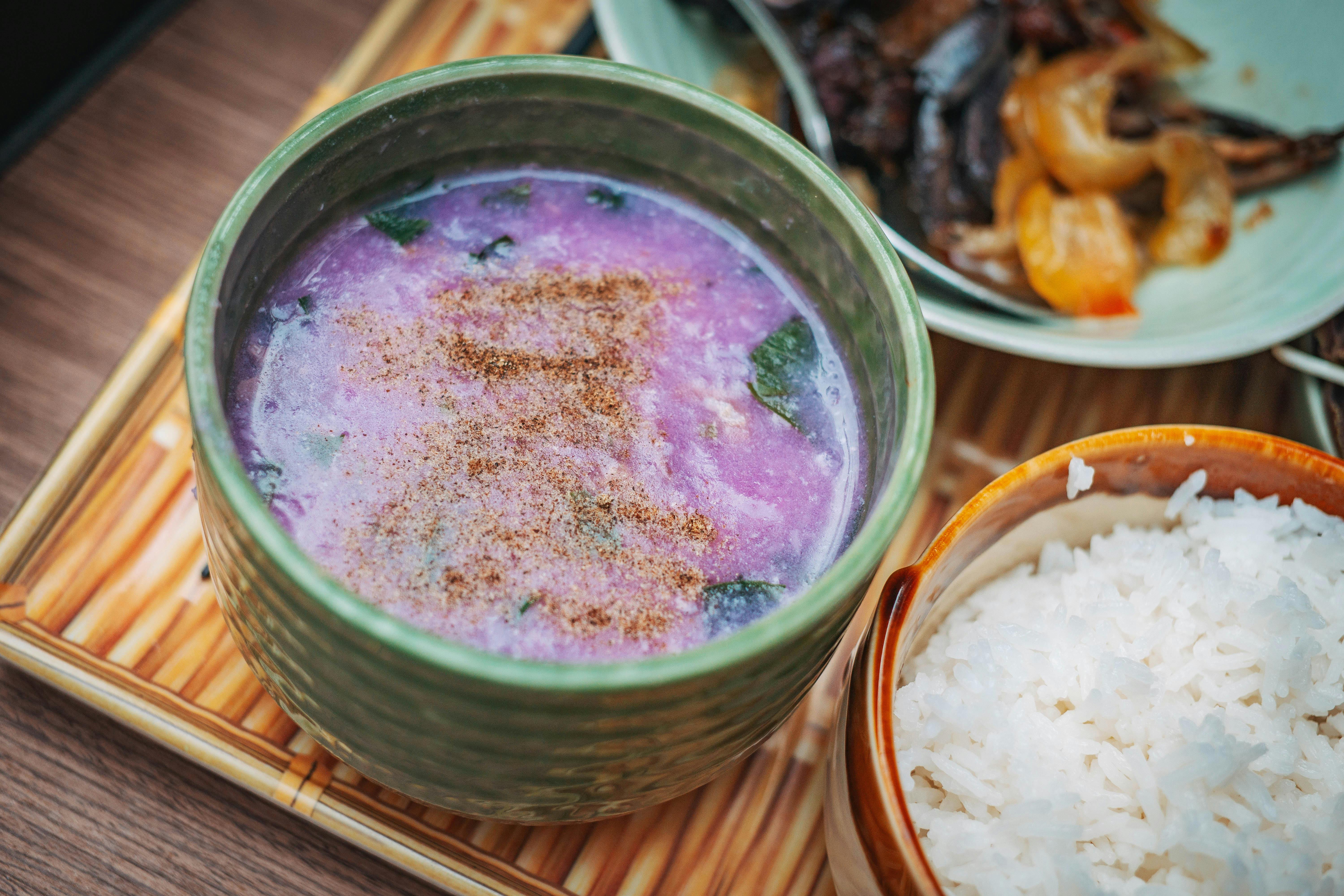
Photo: FOX ^.ᆽ.^= ∫ / Pexels
The diets react (see scores below)
Common Ingredients
- cooked taro corm
- water
- salt
- poi starter
- ti leaf
Specific recipes may vary.
Incompatible with 3 of 11 diets
Diet Ratings
Poi is made primarily from cooked taro corm, which is a starchy root vegetable with extremely high net carbohydrate content. A single cup of poi contains approximately 65g of net carbs, far exceeding the entire daily keto limit of 20-50g in one serving. Taro is fundamentally incompatible with ketosis as a starchy staple food. The fermentation process (using poi starter) does not meaningfully reduce the carbohydrate load. There is no fat content and no protein to offset the carb impact. This dish would immediately disrupt ketosis for virtually any keto practitioner.
Poi is a traditional Hawaiian staple made entirely from plant-based ingredients. Cooked taro corm is a whole-food starchy vegetable, water and salt are vegan staples, poi starter is a fermentation culture derived from taro itself (not animal-based), and ti leaf is used as a wrapper or serving vessel. All components are fully plant-derived with no animal products or animal-derived ingredients. As a minimally processed whole food, it scores highly on the vegan spectrum.
Poi is a traditional Hawaiian staple made from fermented/mashed taro corm. While taro itself is a tuber generally accepted in paleo (similar to sweet potato), poi as prepared here contains added salt, which is explicitly excluded under paleo rules. The 'poi starter' also indicates fermentation, and the traditional preparation is a heavily processed paste quite unlike simply eating a whole tuber. The salt alone disqualifies it from approval. The base ingredient — taro — is paleo-friendly, but the finished dish as listed is not compliant.
Some paleo practitioners would argue that taro is a whole-food tuber available to ancestral Pacific Islander populations, and that fermented foods support gut health. Mark Sisson and advocates of ancestral/traditional diets sometimes make allowances for minimally processed fermented tubers; in that view, poi made without salt might achieve 'caution' status.
Poi is made from taro corm, a whole-food starchy root vegetable with a low-to-medium glycemic index, high fiber, and rich micronutrient profile including potassium and vitamins. It aligns well with Mediterranean diet principles emphasizing whole, plant-based foods, legumes, and complex carbohydrates. Taro is analogous to other root vegetables and whole grains encouraged in the Mediterranean pattern. The dish is minimally processed, contains no added fats, sugars, or refined ingredients, and is essentially a whole-food plant-based side dish. The slight fermentation from the poi starter may add probiotic benefit, further supporting gut health in line with Mediterranean dietary goals.
Some Mediterranean diet purists may note that taro is not a traditional Mediterranean ingredient and that starchy root vegetables, while acceptable, are less emphasized than non-starchy vegetables and whole grains like bulgur or farro. Modern clinical interpretations of the Mediterranean diet may prefer whole grains as the primary carbohydrate staple over starchy tubers, suggesting poi be consumed in moderation rather than freely.
Poi is a traditional Hawaiian dish made entirely from plant-derived ingredients. The primary ingredient is taro corm, a starchy root vegetable, which is completely excluded on the carnivore diet. All other components — water (neutral), salt (acceptable), poi starter (fermented taro), and ti leaf (a plant) — are either plant-based or plant-derived. There is zero animal product content in this dish. This is as far from carnivore-compatible as a food can be.
Poi is a traditional Hawaiian fermented paste made from cooked taro corm, water, salt, and optionally a poi starter culture and ti leaf. All listed ingredients are technically Whole30-compliant: taro is a starchy root vegetable (allowed), water and salt are unrestricted, ti leaf is a plant used as a wrapper/flavoring, and a poi starter is simply a small amount of previously fermented poi used to inoculate the batch. The fermentation process produces lactic acid bacteria, similar to kombucha or sauerkraut, which are not excluded. However, the 'poi starter' introduces trace fermentation byproducts including very small amounts of alcohol as a natural byproduct of fermentation, which places this in a gray zone. More practically, poi is a very starchy, paste-like food that some practitioners debate in terms of spirit of the program — it functions somewhat like a grain-based porridge substitute in the diet, even though taro is a vegetable. Traditional poi does not contain any explicitly excluded Whole30 ingredients.
Official Whole30 guidelines permit all vegetables including starchy ones like taro, and fermented foods are generally acceptable. However, some community members and practitioners argue that poi's thick, paste-like, carbohydrate-dense nature mimics a comfort starch in a way that may not honor the program's intent to reset eating habits, similar to how compliant 'nice cream' or smoothie bowls are sometimes discouraged for testing the spirit of the rules.
Poi is made primarily from cooked taro corm, which is the main FODMAP concern. Taro contains fructans and GOS, and Monash University has tested taro root, rating it as low-FODMAP at a small serving of approximately 75g (about 1/2 cup) but high-FODMAP at larger servings. Traditional poi is eaten in moderate to generous portions as a staple starchy side dish in Hawaiian cuisine, making overconsumption of FODMAPs a realistic concern. The fermented nature of poi (using poi starter and allowing lactic acid fermentation) may reduce FODMAP content somewhat — similar to how sourdough fermentation reduces fructans in bread — but this effect has not been specifically quantified for poi by Monash. Water, salt, and ti leaf (used for wrapping/flavoring) are FODMAP-free. The fermentation variable and typical serving sizes create practical ambiguity.
Monash University has limited direct testing of poi as a fermented preparation; the available data is for plain cooked taro root. Some FODMAP practitioners may caution avoidance during strict elimination due to the moderate-to-high GOS and fructan content of taro at realistic serving sizes, while others may allow small portions of 75g or less. The fermentation process in traditional poi could plausibly reduce FODMAPs but no published Monash data confirms this.
Poi is a traditional Hawaiian staple made primarily from taro corm, a starchy root vegetable that aligns well with DASH diet principles. Taro is rich in potassium, magnesium, and dietary fiber — nutrients DASH specifically emphasizes. It is naturally low in fat and contains no saturated fat or cholesterol. The fermentation process (via poi starter) may add modest probiotic benefit. The primary DASH concern is the added salt, which can vary considerably by preparation; traditional poi is often lightly salted or unsalted, keeping sodium low and making it DASH-compatible. Ti leaf is used as a wrapper/liner and is not consumed. Overall, poi fits well as a whole-food, plant-based starchy side dish in the spirit of DASH, comparable to other starchy vegetable servings. Portion control matters, as taro is calorie-dense, but it is not inherently problematic on DASH.
NIH DASH guidelines do not specifically address poi or taro, so its classification is extrapolated from the vegetable/starchy vegetable category; some DASH clinicians may classify taro with starchy vegetables requiring moderation (similar to potatoes) rather than non-starchy vegetables, which could temper enthusiasm, while updated DASH interpretations generally support fermented whole foods and would view poi favorably.
Poi is a traditional Hawaiian staple made from cooked and pounded taro corm. While taro is a whole food starchy vegetable, it has a moderate-to-high glycemic index (around 53-56 GI) and is primarily a dense carbohydrate source with minimal protein or fat. In Zone terms, taro is classified similarly to other starchy root vegetables — usable as a carbohydrate block but 'unfavorable' compared to low-glycemic vegetables. A half-cup of poi (~100g) provides roughly 25-30g total carbohydrates (net carbs after modest fiber ~22-26g), which is approximately 2.5-3 carb blocks with very little offsetting protein or fat. To use poi in a Zone meal, it must be paired with lean protein (e.g., fish, chicken) and a monounsaturated fat source, and portion size must be strictly controlled. The fermentation via poi starter may slightly lower the glycemic impact and adds beneficial probiotics — a modest plus from Sears' anti-inflammatory perspective. However, poi offers no lean protein and negligible fat, making it purely a carbohydrate component that requires careful balancing. It is not in the same category as colorful, fiber-rich vegetables that Zone strongly favors, but it is a whole food without processing or added sugar, keeping it out of the 'avoid' range.
Some Zone practitioners and Sears' later anti-inflammatory writings give more flexibility to traditional whole-food carbohydrate sources with cultural significance, particularly fermented ones. Fermented poi has a lower glycemic load than plain cooked taro and contains polyphenols and prebiotics, which align with Sears' later Zone Diet evolution emphasizing gut health and polyphenol intake. A strict early-Zone reading would label taro as 'unfavorable' due to its starch density, but a more nuanced reading treats small portions of minimally processed traditional foods as acceptable carb blocks.
Poi is a traditional Hawaiian fermented staple made from cooked taro corm. Taro itself is a nutrient-dense whole food with meaningful amounts of fiber, resistant starch, potassium, vitamin E, and B vitamins. Its glycemic index is moderate to moderately high depending on preparation, but the resistant starch content (which increases with fermentation) supports gut microbiome health and may blunt postprandial glucose spikes compared to refined carbohydrates. The fermentation process introduces beneficial lactic acid bacteria, which aligns with anti-inflammatory gut health principles. Taro also contains polyphenols and antioxidants including cryptoxanthin and quercetin derivatives. However, taro is still a starchy carbohydrate with limited omega-3, polyphenol, or direct anti-inflammatory compound profile compared to top-tier anti-inflammatory foods. The salt content is modest and not a meaningful concern in typical portions. Ti leaf is used as a wrapper/vessel and does not contribute nutritionally. Overall, poi is a minimally processed, whole-food, fermented starchy side dish — a meaningful step above refined carbohydrates, but not strongly anti-inflammatory in its own right.
Some anti-inflammatory practitioners, particularly those following lower-carbohydrate or glycemic-focused frameworks, would flag poi's starchy carbohydrate load and moderate-to-high glycemic index as potentially pro-inflammatory, especially for metabolically compromised individuals. Conversely, researchers studying traditional Hawaiian diets have noted that populations consuming traditional poi-based diets show favorable inflammatory and metabolic markers, suggesting the whole dietary context and fermentation benefits may outweigh glycemic concerns.
Poi is a traditional Hawaiian staple made from fermented or fresh-pounded taro. It is naturally very low in fat, low in sodium, and easy to digest — all positives for GLP-1 patients dealing with nausea, reflux, or slowed gastric emptying. Taro provides modest dietary fiber (approximately 2-3g per half-cup serving) and resistant starch, which supports gut health and blood sugar stability. However, poi is primarily a carbohydrate food with virtually no protein, making it a poor standalone choice for GLP-1 patients whose #1 priority is hitting 100-120g of protein daily. Nutrient density per calorie is moderate at best — it provides some fiber and micronutrients (potassium, vitamin B6) but no meaningful protein contribution. Its naturally soft, smooth texture and gentle digestibility are genuine advantages when GI side effects are active. As a small side dish paired with a high-protein main (e.g., grilled fish or chicken), poi can serve a reasonable supporting role, but it should not displace protein-forward foods in a calorie-restricted eating window.
Some GLP-1-focused dietitians view poi favorably due to its exceptional digestibility, low fat content, and resistant starch profile, which may benefit gut microbiome health and glycemic response — factors some clinicians weight heavily for metabolic patients. Others caution that even small servings of starchy, low-protein sides compete for limited stomach capacity that should be prioritized for protein-dense foods, making poi a lower-value choice in a reduced-appetite context.
*See how scores were generated at our methodology page.
Nutritional profile
Six traits that cut across every diet.
Fiber & Plants
How much whole-plant food and fiber it delivers.
Healthy Fats
The quality of its fats (unsaturated, omega-3).
Whole / Unprocessed
How close it is to its natural, unprocessed form.
Gut Gentle
How easy it is on digestion (low FODMAP, few irritants).
Low Glycemic
How little it spikes your blood sugar.
Protein Density
How much protein it packs per calorie.
Controversy Index
Higher controversy = more disagreement between diets.
Diet-Specific Tips
 Vegan — 9/10
View tips
- Taro corm is a whole-food plant ingredient
- Poi starter is a taro-based fermentation culture, not animal-derived
- Ti leaf is a plant (Cordyline fruticosa) used for serving/wrapping
- No dairy, eggs, meat, or animal-derived additives
- Minimally processed, aligns well with whole-food plant-based principles
- Salt and water are universally vegan
 Mediterranean — 8/10
View tips
- Taro is a whole, minimally processed plant food — strongly aligned with Mediterranean principles
- High fiber content supports digestive health and satiety
- No added sugars, refined grains, or saturated fats
- Fermentation from poi starter may offer probiotic benefits
- Not a traditional Mediterranean ingredient — extrapolated from plant-food principles
- Low in fat, making it complementary to olive oil-based accompaniments
 Whole30 — 5/10
View tips
- Taro is a Whole30-compliant starchy vegetable
- Salt and water are unrestricted
- Ti leaf is a compliant plant-based flavoring/wrapper
- Poi starter introduces natural fermentation — no explicitly excluded ingredients
- Fermented foods are generally compatible with Whole30
- Poi's dense, paste-like, high-starch character may test the spirit of the program
- No added sugars, grains, legumes, dairy, or other explicitly excluded ingredients present
 Low-FODMAP — 5/10
View tips
- Taro corm is the primary ingredient and contains fructans and GOS — low-FODMAP only at ≤75g per Monash
- Traditional poi servings typically exceed the 75g low-FODMAP threshold for taro
- Fermentation (poi starter) may reduce FODMAP content but is unquantified for poi specifically
- Water, salt, and ti leaf are FODMAP-free and do not contribute to FODMAP load
- Limited Monash University testing specifically on fermented poi vs. plain cooked taro
- Portion control is critical — small servings may be tolerable during elimination phase
 DASH — 7/10
View tips
- Taro is rich in potassium, magnesium, and fiber — core DASH nutrients
- Naturally low in fat and free of saturated fat
- Salt content varies by preparation; low-salt versions are highly DASH-compatible
- Fermentation via poi starter may offer probiotic benefit
- Taro is a starchy vegetable — portion control recommended
- Ti leaf is a wrapper, not consumed, so it does not affect nutritional profile
- Whole, minimally processed traditional food aligned with DASH whole-food emphasis
 Zone — 4/10
View tips
- Moderate-to-high glycemic index for a root vegetable (~53-56 GI)
- Dense starch source — requires strict portion control (~1/4 cup per carb block)
- No protein or fat — must be paired with lean protein and monounsaturated fat
- Fermentation via poi starter may modestly reduce glycemic response and adds probiotics
- Whole food with no added sugar, processing, or trans fats — avoids worst Zone offenders
- Classified as 'unfavorable' carb in Zone terminology, similar to other starchy vegetables
- Anti-inflammatory polyphenols in taro align modestly with Sears' later writings
 Anti-Inflammatory — 6/10
View tips
- Taro is a whole, minimally processed starchy vegetable with fiber and resistant starch
- Fermentation adds beneficial lactic acid bacteria supporting gut microbiome and reducing inflammation
- Contains polyphenols and antioxidants (cryptoxanthin, quercetin derivatives)
- Moderate-to-high glycemic index may be a concern in isolation but blunted by resistant starch
- No omega-3 fatty acids, trans fats, refined sugars, or additives
- Traditional whole-food preparation with no processed ingredients
- Modest nutritional density compared to top anti-inflammatory foods (leafy greens, fatty fish, etc.)
 GLP-1 Friendly — 5/10
View tips
- No meaningful protein content — fails the #1 GLP-1 dietary priority
- Low fat — positive for GLP-1 side effect management
- Moderate fiber from taro (~2-3g per serving) — modest contribution toward daily target
- Excellent digestibility — smooth texture is gentle on slowed gastric motility
- Resistant starch may support glycemic stability and gut health
- Low nutrient density per calorie relative to GLP-1 needs
- Acceptable only as a small side paired with high-protein main dish
- Portion-sensitive: small servings are fine; larger portions displace protein opportunity