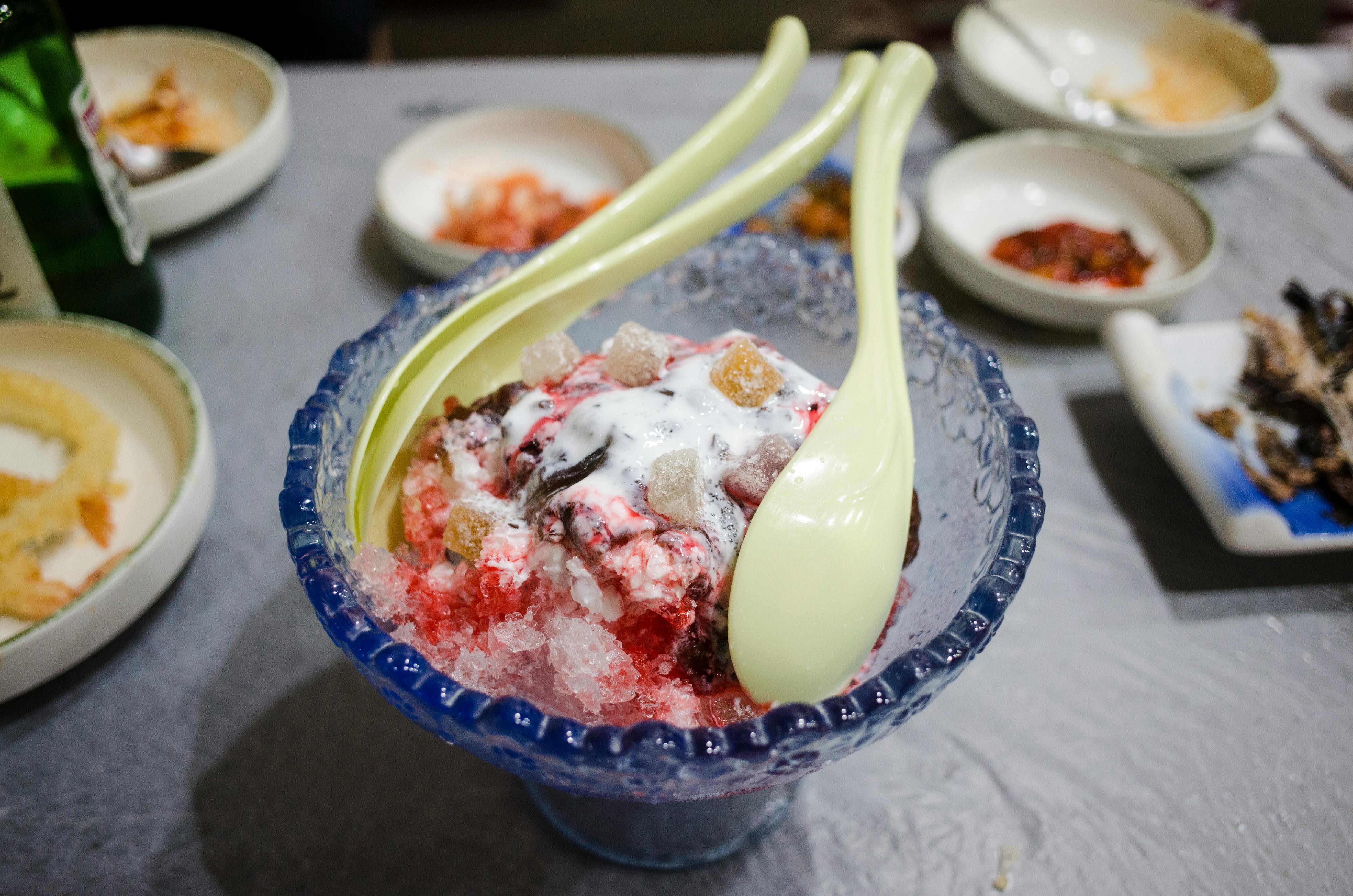
The diets react (see scores below)
Common Ingredients
- shaved ice
- fruit syrup
- condensed milk
- azuki beans
- mochi
- vanilla ice cream
Specific recipes may vary.
Incompatible with 11 of 11 diets
Diet Ratings
Shave Ice is one of the most keto-incompatible desserts imaginable. Every single ingredient violates ketogenic principles: fruit syrup is pure sugar, condensed milk is loaded with sugar and carbs, azuki beans are high-carb legumes, mochi is made from glutinous rice flour (extremely high carb), and vanilla ice cream contains sugar. A standard serving would deliver well over 80-100g of net carbs, obliterating any daily keto budget multiple times over. There is no portion size that makes this dish keto-compatible.
This version of Shave Ice contains multiple animal-derived ingredients that disqualify it from vegan compliance. Condensed milk is a dairy product (concentrated cow's milk with sugar), and vanilla ice cream is dairy-based (containing milk and eggs). These two ingredients alone make this dish clearly non-vegan. The remaining ingredients — shaved ice, fruit syrup, azuki beans, and mochi (in its basic form) — are plant-based and would be vegan-compliant. A fully vegan version of Shave Ice is achievable by substituting condensed coconut milk or sweetened condensed oat milk for the condensed milk, and using a dairy-free/egg-free ice cream alternative. Mochi should also be verified as plain mochi is vegan, but some varieties may contain dairy fillings.
Shave Ice as served in Hawaii is a deeply non-paleo dessert. Every component beyond the ice itself is problematic: fruit syrup is typically made with refined sugar or high-fructose corn syrup; condensed milk is a heavily processed dairy product loaded with refined sugar; azuki beans are legumes, which are explicitly excluded from the paleo diet; mochi is made from glutinous rice flour, a grain product; and vanilla ice cream is a dairy-based, sugar-laden processed food. There is not a single ingredient in this dish that earns paleo approval in its standard commercial form. This represents essentially every major paleo exclusion category stacked into one dessert.
Shave ice is a highly processed, sugar-laden dessert that fundamentally contradicts Mediterranean diet principles. Fruit syrup is primarily added sugar with minimal nutritional value. Condensed milk adds significant saturated fat and sugar. Vanilla ice cream contributes more sugar and saturated fat. The dish contains no olive oil, no whole grains, no legumes in meaningful form (azuki beans appear as a sweet topping, not a nutritious staple), and no vegetables or fruits in whole form. This is an occasional indulgence food with essentially no alignment to Mediterranean dietary patterns.
Shave Ice is entirely incompatible with the carnivore diet. The dish consists almost entirely of plant-derived and heavily processed ingredients: shaved ice with fruit syrup (sugar and plant-based flavorings), azuki beans (legumes, explicitly excluded), mochi (rice-based, a grain product), and condensed milk (heavily sweetened dairy with added sugar). The only marginally animal-derived component is vanilla ice cream (dairy) and condensed milk, but both are loaded with sugar and plant additives, disqualifying them even under the most lenient carnivore interpretations. There is no animal protein present, no animal fat, and no redeeming carnivore-compatible element. This is a sugar-dominant dessert snack with zero alignment to carnivore principles.
Shave Ice as traditionally prepared in Hawaii contains multiple excluded ingredients. Fruit syrup typically contains added sugar. Condensed milk is dairy and contains added sugar. Azuki beans are legumes, which are excluded from Whole30. Mochi is made from rice (a grain), which is excluded. Vanilla ice cream is dairy and contains added sugar. This dish fails on nearly every component simultaneously.
Hawaiian shave ice as traditionally prepared contains multiple high-FODMAP ingredients that make it unsuitable during the elimination phase. Condensed milk is very high in lactose and should be avoided entirely. Azuki (adzuki) beans are high in GOS (galacto-oligosaccharides), a major FODMAP category, and are high-FODMAP even in small servings. Mochi, made from glutinous rice flour, is generally considered low-FODMAP in small servings, but commercial mochi often contains high-FODMAP additives or fillings. Vanilla ice cream contains lactose and is high-FODMAP at a standard serving. Fruit syrups are frequently made with high-fructose corn syrup or concentrated fruit juice containing excess fructose or fructans. Only the shaved ice itself is inherently FODMAP-free. With at least three to four clearly high-FODMAP components (condensed milk, azuki beans, ice cream, and likely the syrup), this dish is not suitable for the elimination phase without major modification.
Shave ice as commonly served in Hawaii is a high-sugar dessert that conflicts directly with core DASH diet principles. The fruit syrup is a concentrated sugar syrup (not real fruit), providing substantial added sugar with no nutritional benefit. Condensed milk adds saturated fat and significant sugar. Vanilla ice cream contributes saturated fat, cholesterol, and more added sugar — DASH specifically limits full-fat dairy and sweets. Azuki beans are a rare redeeming ingredient with fiber and potassium, but they are often sweetened (as in anko paste), negating much of their benefit. Mochi is a refined starch with high glycemic impact and added sugar. The overall dish is essentially a multi-layered sugar bomb with saturated fat, representing exactly the category of sweets and sugary foods that DASH explicitly limits. There is no meaningful source of the key DASH nutrients (potassium, calcium from low-fat sources, magnesium, or fiber in meaningful quantities) in this preparation.
Shave ice as prepared here is essentially a concentrated sugar delivery vehicle with virtually no Zone-compatible qualities. The foundation is shaved ice with fruit syrup — pure high-glycemic sugar with no fiber, no protein, and no fat to blunt the glycemic response. Condensed milk adds saturated fat and significant sugar. Mochi (glutinous rice flour) is a very high-glycemic refined starch. Vanilla ice cream contributes more sugar and saturated fat. Azuki beans are the only ingredient with any Zone merit (they provide some protein and fiber), but they are present in a minor role and cannot offset the massive glycemic load of the other components. There is no lean protein, no monounsaturated fat, and no low-glycemic carbohydrate source in this dish. The macronutrient ratio is wildly skewed toward simple carbohydrates and sugar, making it nearly impossible to incorporate into any Zone-balanced meal or snack. This is exactly the type of food Dr. Sears identifies as driving unfavorable eicosanoid production through rapid insulin spikes.
Shave ice as prepared here is a high-sugar, low-nutrient dessert with essentially no anti-inflammatory value. Fruit syrup is typically made with high-fructose corn syrup or refined sugar and artificial flavors/colors — a direct 'avoid' under anti-inflammatory guidelines. Condensed milk is high in added sugar and full-fat dairy, both on the 'limit' list. Vanilla ice cream adds more refined sugar, saturated fat, and full-fat dairy. Mochi, made from refined white rice flour and sugar, contributes refined carbohydrates with no fiber. Azuki beans are the sole redemptive ingredient — they contain polyphenols, fiber, and are a whole legume — but they appear in a minor, garnish-like role and cannot offset the inflammatory load of the rest of the dish. The overall profile is dominated by added sugar, refined carbohydrates, and saturated fat, all of which drive pro-inflammatory pathways (elevated CRP, insulin spikes, AGE formation). There is no meaningful source of omega-3s, antioxidants, polyphenols, or fiber at a scale that would move the needle.
Shave ice in this full preparation is a poor choice for GLP-1 patients. The base is essentially flavored sugar water with no protein, no meaningful fiber, and negligible micronutrients — a textbook example of empty calories. The fruit syrup adds a significant sugar load, driving blood sugar spikes that GLP-1 medications are partly meant to mitigate. Condensed milk adds saturated fat and additional sugar. Vanilla ice cream compounds the fat and sugar problem. Mochi, made from glutinous rice flour and sugar, contributes refined carbohydrates with minimal nutritional value and can be difficult to chew and digest in small bites. Azuki beans are the sole redeeming ingredient — they offer modest protein and fiber — but they appear as a topping in small quantities and cannot offset the overall nutritional profile. With reduced appetite on GLP-1 medications, every bite must deliver nutritional value; this dish delivers almost none. There is no meaningful protein, no appreciable fiber, high sugar, moderate saturated fat, and poor digestive value. It scores a 2 rather than a 1 only because azuki beans provide trace nutritional benefit and the dish is not fried or alcohol-based.
*See how scores were generated at our methodology page.
Nutritional profile
Six traits that cut across every diet.
Fiber & Plants
How much whole-plant food and fiber it delivers.
Healthy Fats
The quality of its fats (unsaturated, omega-3).
Whole / Unprocessed
How close it is to its natural, unprocessed form.
Gut Gentle
How easy it is on digestion (low FODMAP, few irritants).
Low Glycemic
How little it spikes your blood sugar.
Protein Density
How much protein it packs per calorie.
Controversy Index
Higher controversy = more disagreement between diets.