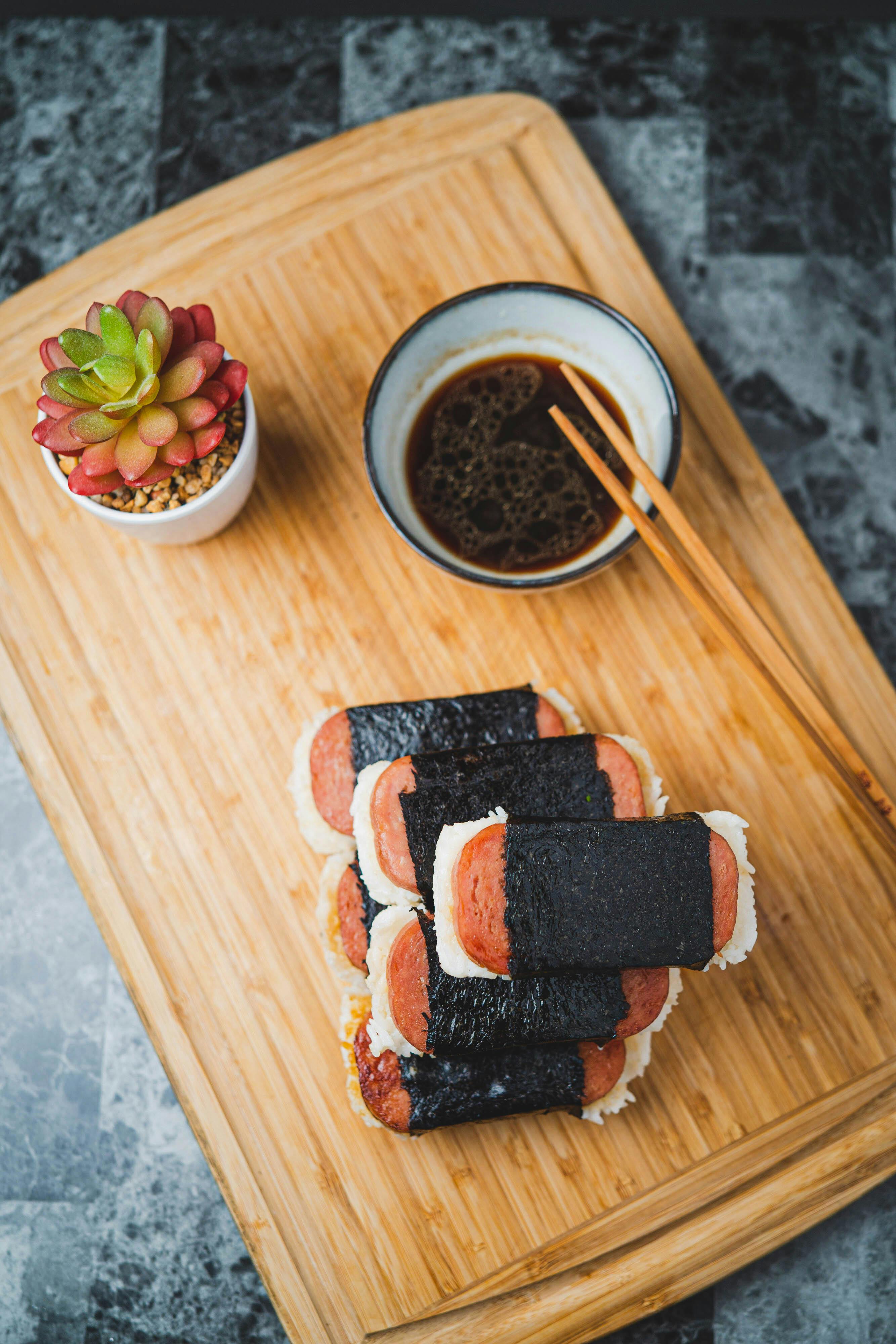
Hawaiian
Spam Musubi
The diets react (see scores below)
Common Ingredients
- spam
- rice
- nori
- soy sauce
- sugar
- mirin
Specific recipes may vary.
Incompatible with 10 of 11 diets
Diet Ratings
Spam Musubi is fundamentally incompatible with a ketogenic diet. The primary issue is white rice, which is a high-glycemic grain that alone can contain 30-45g of net carbs per serving — enough to exceed or nearly exhaust an entire day's keto carb budget in a single snack. Compounding this, the sauce contains added sugar and mirin (a sweet rice wine), both of which contribute additional sugars and carbohydrates. While Spam itself is a processed pork product that is relatively low in carbs and high in fat and sodium, and nori is keto-friendly, these two ingredients are overwhelmed by the carb-heavy rice and sugary glaze. This dish is a classic rice-based snack food with no practical way to bring it into ketogenic compliance without fundamentally reconstructing it (e.g., cauliflower rice substitution).
Spam Musubi is clearly not vegan. The primary ingredient, Spam, is a canned pork meat product — a direct animal product that is categorically excluded under any definition of veganism. Pork is animal flesh, making this dish incompatible with a vegan diet. The remaining ingredients (rice, nori, soy sauce, sugar, mirin) are plant-based, but the presence of Spam as the centerpiece protein renders the entire dish non-vegan.
Spam Musubi is one of the least paleo-compatible dishes imaginable, violating virtually every core paleo principle simultaneously. Spam is a heavily processed meat product containing pork, salt, water, modified starch, sugar, and sodium nitrite — a far cry from the unprocessed animal proteins paleo endorses. Rice is a grain, explicitly excluded from the paleo diet. Soy sauce contains both wheat (a grain) and soy (a legume), two of the most prohibited paleo ingredients. Sugar is refined and excluded. Mirin is a sweet rice wine, combining both grain and refined sugar. Nori (dried seaweed) is the only ingredient that could be considered paleo-compliant. With five out of six ingredients being clear paleo violations — including processed meat, a grain, a legume-grain hybrid condiment, and refined sugar — this dish scores at the absolute bottom of the paleo scale.
Spam Musubi is fundamentally at odds with Mediterranean diet principles on multiple fronts. Spam is a highly processed canned pork product loaded with sodium, saturated fat, and preservatives — the antithesis of the Mediterranean diet's emphasis on minimally processed, whole foods. Red/processed meat is already limited to a few times per month in the Mediterranean framework, and processed meats like Spam are effectively discouraged entirely. The rice used is refined white rice rather than a whole grain. The sauce contains added sugar, and the overall dish lacks olive oil, vegetables, legumes, or other plant-forward Mediterranean staples. Nori is the only ingredient with any Mediterranean-adjacent nutritional merit. This dish represents processed, high-sodium, high-saturated-fat eating that Mediterranean diet authorities consistently flag as harmful.
Spam Musubi is fundamentally incompatible with the carnivore diet. While Spam is a pork-based processed meat, this dish is dominated by plant-derived and processed ingredients: rice (grain), nori (seaweed/plant), soy sauce (fermented soy — legume), sugar, and mirin (rice wine with sugar). Even the Spam itself contains sugar, potato starch, and modified starch as additives, making it a poor carnivore choice on its own. The dish as a whole is a carbohydrate-heavy snack with only incidental animal content, failing virtually every carnivore principle simultaneously.
Spam Musubi contains multiple Whole30-excluded ingredients, making it clearly non-compliant. Rice is an excluded grain. Soy sauce contains soy (an excluded legume) and typically wheat (an excluded grain). Sugar is an excluded added sweetener. Mirin is a sweet rice wine that contains both alcohol and sugar. Spam itself is a highly processed pork product that typically contains modified potato starch and other additives that may not be compliant. Even setting aside all other issues, the dish is structurally a rice-based snack block — a category of food that violates the whole-food spirit of the Whole30 program. There is no compliant version of this dish without a complete reconstruction that would make it unrecognizable.
Spam Musubi contains mostly low-FODMAP ingredients: white rice (low-FODMAP), nori (low-FODMAP), and Spam (processed pork — generally low-FODMAP in standard servings, though it contains additives). The main concerns are soy sauce and the glaze. Traditional soy sauce contains wheat (fructans), making it technically high-FODMAP, though the quantity used per serving is typically very small — often just a tablespoon or less spread across multiple pieces. At such small amounts, fructan load from soy sauce may be negligible. Sugar and mirin (rice wine) are low-FODMAP at typical culinary doses. Spam itself contains modified starch, salt, and pork — no significant FODMAPs at a standard serving (1-2 slices). The dish is borderline: at one standard musubi piece with a light soy glaze, total FODMAP load is likely manageable, but the wheat in soy sauce introduces fructans that technically make this non-compliant during strict elimination. Using tamari (gluten-free soy sauce) would make this clearly low-FODMAP.
Monash University notes that regular soy sauce contains wheat but the small quantity used per serving keeps fructan levels low; however, many clinical FODMAP practitioners recommend avoiding all wheat-containing soy sauce during the elimination phase and substituting tamari to remove ambiguity. The verdict depends heavily on portion size and glaze quantity.
Spam Musubi is fundamentally incompatible with DASH diet principles. The primary ingredient, Spam, is a heavily processed pork product with extremely high sodium content — a single serving of Spam (about 56g) contains approximately 790mg of sodium, meaning one musubi can easily deliver 900–1,100mg of sodium when combined with soy sauce and mirin. This represents roughly 40–75% of the entire DASH daily sodium budget in a single snack. Beyond sodium, Spam contains significant saturated fat and is a processed red/pork product, both of which DASH explicitly limits. The soy sauce adds additional sodium on top, and the sugar and mirin introduce added sugars. While the rice provides some whole-grain-adjacent carbohydrate and nori offers minerals, these positives are entirely overwhelmed by the processed meat and sodium load. This dish hits multiple DASH 'avoid' triggers simultaneously: high sodium, processed meat, saturated fat, and added sugar.
Spam Musubi is a poor fit for the Zone Diet across nearly every macronutrient dimension. The primary carbohydrate source is white rice, one of the highest-glycemic carbs explicitly flagged as 'unfavorable' by Dr. Sears, with a very high net carb density and minimal fiber to slow absorption. The sauce layer adds refined sugar and mirin (sweetened rice wine), compounding the glycemic load. The protein source — Spam — is processed pork luncheon meat that is high in saturated fat, very high in sodium, and far from the lean protein ideal the Zone prescribes. A typical Spam Musubi piece delivers roughly 35-40g of high-GI carbohydrates, 6-7g of protein (mostly from processed fatty pork), and significant saturated fat — essentially the inverse of a Zone-favorable snack. There is no monounsaturated fat, no fibrous low-GI vegetable content, and no way to rebalance this dish into Zone ratios without fundamentally reconstructing it. Nori provides negligible nutrition in this context. This dish represents a convergence of the Zone's most discouraged food categories: refined high-GI starch, added sugar, and fatty processed meat.
Spam Musubi is built around Spam, a heavily processed canned pork product — precisely the type of food anti-inflammatory frameworks universally flag. Spam is high in sodium, saturated fat, and contains preservatives including sodium nitrite, which is associated with pro-inflammatory and carcinogenic activity in research. It is a processed meat, placing it in the category anti-inflammatory diets most strongly advise against. The rice is refined white rice, offering little fiber and a high glycemic load that can spike blood sugar and downstream inflammatory markers. The glaze (soy sauce, sugar, mirin) adds refined sugar and significant sodium. Nori is the one bright spot — seaweed is rich in antioxidants and trace minerals with some anti-inflammatory support — but it represents a negligible proportion of the dish's nutritional impact. The overall profile is dominated by a processed, high-sodium, preservative-laden meat with refined carbohydrates and added sugar, making this a dish anti-inflammatory nutrition strongly advises avoiding.
Spam Musubi is a poor fit for GLP-1 patients across nearly every priority dimension. Spam is a highly processed pork product with high sodium (~790mg per 2-oz serving), high saturated fat (~6g per serving), and moderate but not impressive protein (~7g per serving). The dish is built around white rice, a refined carbohydrate with negligible fiber and low nutrient density per calorie — problematic given that GLP-1 patients eat significantly fewer total calories and need every bite to count. The glaze (soy sauce, sugar, mirin) adds sugar and sodium with no nutritional benefit. Fat content from Spam is likely to worsen GLP-1 GI side effects including nausea, bloating, and reflux. The sodium load is a concern for cardiovascular health in a population already at elevated metabolic risk. Fiber is essentially zero. As a snack, it delivers mostly refined carbs, saturated fat, and sodium — the opposite of the protein-dense, fiber-rich, nutrient-dense profile GLP-1 patients need.
*See how scores were generated at our methodology page.
Nutritional profile
Six traits that cut across every diet.
Fiber & Plants
How much whole-plant food and fiber it delivers.
Healthy Fats
The quality of its fats (unsaturated, omega-3).
Whole / Unprocessed
How close it is to its natural, unprocessed form.
Gut Gentle
How easy it is on digestion (low FODMAP, few irritants).
Low Glycemic
How little it spikes your blood sugar.
Protein Density
How much protein it packs per calorie.
Controversy Index
Higher controversy = more disagreement between diets.
Diet-Specific Tips
 Low-FODMAP — 5/10
View tips
- White rice is low-FODMAP and the primary ingredient
- Regular soy sauce contains wheat (fructans) — technically high-FODMAP, but quantity per serving is very small
- Nori is low-FODMAP
- Spam is processed pork with minimal FODMAP-relevant additives at standard serving sizes
- Sugar and mirin are low-FODMAP at typical culinary doses
- Substituting tamari for soy sauce would make this dish clearly low-FODMAP
- Standard serving (1-2 musubi pieces) keeps overall FODMAP load moderate