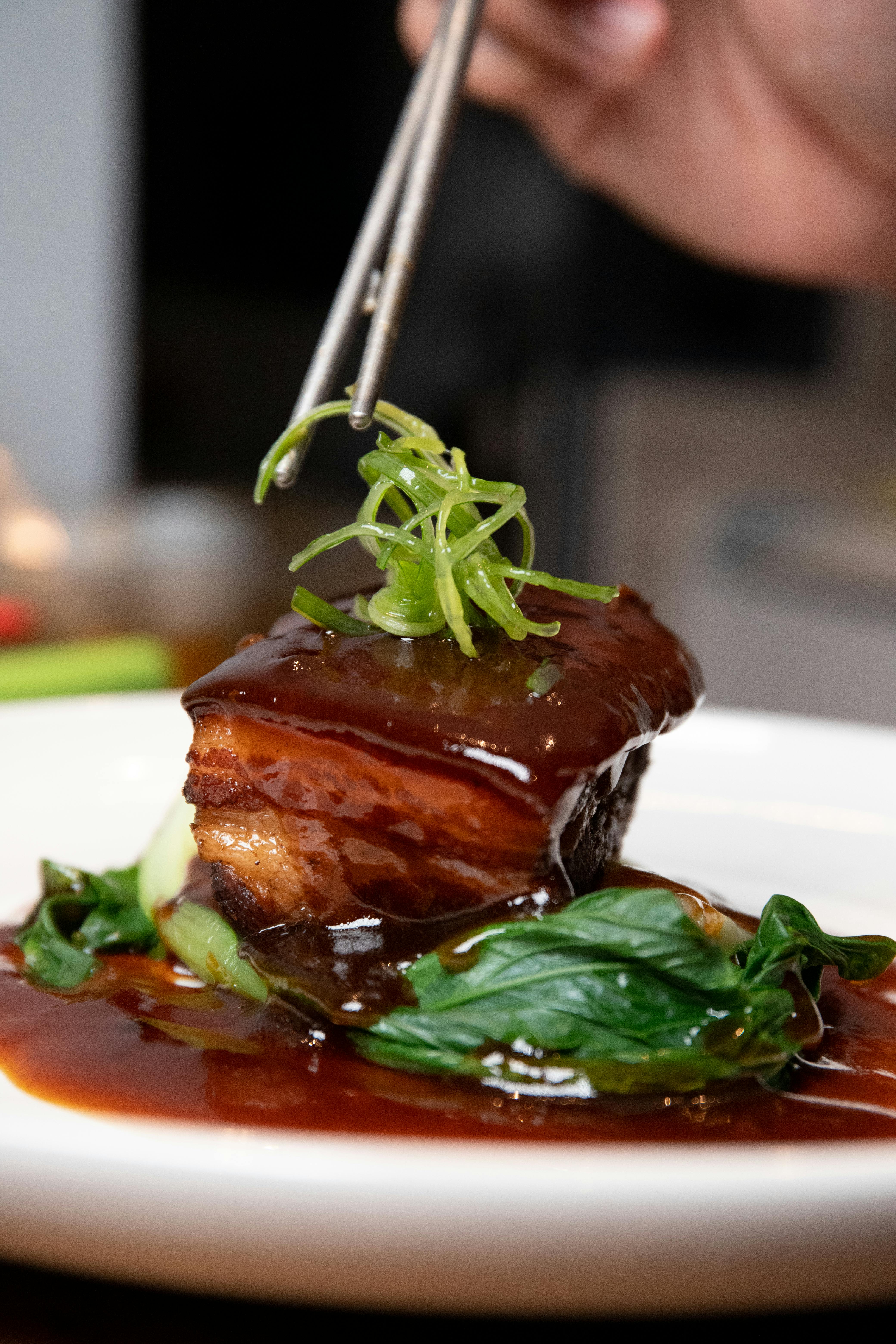
Photo: AMANDA LIM / Pexels
Chinese
Chairman Mao Red Braised Pork
The diets react (see scores below)
Common Ingredients
- pork belly
- rock sugar
- soy sauce
- shaoxing wine
- ginger
- star anise
- dried chilies
- scallions
- cinnamon
Specific recipes may vary.
Incompatible with 10 of 11 diets
Diet Ratings
Chairman Mao Red Braised Pork is fundamentally incompatible with ketogenic eating in its traditional form. The dish relies heavily on rock sugar as a core braising ingredient — not merely as a seasoning but as a structural flavor component that creates the characteristic glossy, caramelized sauce. Rock sugar is pure sucrose and directly breaks ketosis. Shaoxing rice wine adds additional fermented grain-based sugars and carbohydrates. Soy sauce contributes minor carbs but is less problematic. The pork belly itself is an excellent keto protein/fat source, and the aromatics (ginger, star anise, cinnamon, dried chilies, scallions) are keto-friendly in these amounts. However, the sugar and wine together likely contribute 15-25g+ of net carbs per standard serving, making the dish as traditionally prepared a ketosis-breaker. A keto adaptation is theoretically possible by substituting rock sugar with erythritol or monk fruit and using dry sherry or broth instead of Shaoxing wine, but the authentic dish cannot be approved.
Chairman Mao Red Braised Pork is built entirely around pork belly as its primary protein and centerpiece ingredient. Pork is an animal product (mammal flesh), which is categorically excluded under vegan dietary rules. There is no ambiguity here — this dish is fundamentally incompatible with a vegan diet. The remaining ingredients (rock sugar, soy sauce, shaoxing wine, ginger, star anise, dried chilies, scallions, cinnamon) are all plant-based, but they serve only as a braising medium for the pork and cannot redeem the dish's vegan status.
Chairman Mao Red Braised Pork contains multiple non-paleo ingredients that disqualify it outright. Soy sauce is a fermented soy (legume) and wheat-based condiment — excluded on both counts. Rock sugar is a refined/processed sugar. Shaoxing wine is a grain-based alcohol (fermented rice wine), making it a processed grain derivative. While pork belly, ginger, star anise, dried chilies, scallions, and cinnamon are all paleo-approved, the foundational flavoring agents of this dish — soy sauce, rock sugar, and Shaoxing wine — are firmly off the paleo list. There is no practical way to make a traditional version of this dish paleo-compliant without fundamentally altering its character.
Chairman Mao Red Braised Pork is fundamentally incompatible with Mediterranean diet principles. The dish centers on pork belly, one of the fattiest cuts of red meat, which is high in saturated fat and should be limited to only a few times per month in a Mediterranean diet. The preparation method involves braising in significant amounts of rock sugar (added sugar) and soy sauce (highly processed, high-sodium condiment), further distancing it from Mediterranean guidelines. The cooking fat is not olive oil, and the entire flavor profile and technique are built around ingredients that contradict core Mediterranean principles: excessive saturated fat from pork belly, added refined sugars, and no plant-forward emphasis. While the aromatics like ginger, star anise, and scallions have some merit, they cannot offset the fundamental incompatibility of the dish's primary components.
While pork belly is an excellent carnivore food (fatty, animal-derived, high approval), this dish is disqualified by numerous plant-based and processed ingredients. Rock sugar is pure plant-derived sugar. Soy sauce is a fermented soy (legume) product. Shaoxing wine is grain-based alcohol. Ginger, star anise, dried chilies, scallions, and cinnamon are all plant-derived spices and aromatics — all excluded on carnivore. This dish is essentially a braised pork recipe where the pork is merely one component of a heavily plant-seasoned, sugar-laden preparation. No adaptation short of stripping all seasonings except salt would make this carnivore-compatible.
This dish contains multiple Whole30-excluded ingredients. Soy sauce contains soy (a legume, excluded) and typically wheat (a grain, excluded). Shaoxing wine is an alcoholic beverage, which is explicitly excluded from the Whole30 program. Rock sugar is an added sugar, also excluded. These are foundational ingredients in the dish, not optional garnishes, making this recipe incompatible with Whole30 as written. The remaining ingredients — pork belly, ginger, star anise, dried chilies, scallions, and cinnamon — are all Whole30-compliant.
Chairman Mao Red Braised Pork contains several high-FODMAP ingredients that make it unsuitable during the elimination phase. Scallions (green onions) — particularly the white bulb portions — are high in fructans and are commonly used throughout cooking in this dish. Star anise contains anethole and is high-FODMAP at culinary quantities used in braising. Shaoxing rice wine can contribute fructans depending on quantity. Rock sugar (sucrose-based) is technically low-FODMAP in small amounts, but the cumulative FODMAP load across scallions, star anise, and potentially the soy sauce (which may contain wheat-based fructans unless certified tamari/GF) creates a high-FODMAP dish overall. Pork belly, ginger, cinnamon, dried chilies, and regular soy sauce (in small amounts) are individually low-FODMAP or borderline, but the combination of problematic ingredients — especially scallions and star anise used as primary flavor bases in a braise — tips this firmly into avoid territory.
Some FODMAP practitioners note that long braising may leach some FODMAPs into the braising liquid (which can be discarded or reduced), and that using only the green tops of scallions instead of bulbs could lower FODMAP load. However, as traditionally prepared, this dish contains multiple high-FODMAP ingredients that are not easily substituted without fundamentally altering the recipe, and Monash University rates star anise as high-FODMAP at amounts typical in Chinese braising recipes.
Chairman Mao Red Braised Pork is fundamentally incompatible with DASH diet principles across multiple dimensions. Pork belly is one of the fattiest cuts of meat available, extremely high in saturated fat and total fat — directly contradicting DASH's explicit guidance to limit saturated fat and avoid fatty/red meats. Soy sauce contributes very high sodium (typically 800–1,000mg per tablespoon), and this dish uses it as a primary braising liquid, likely pushing a single serving well over the DASH daily sodium target of 1,500–2,300mg. Rock sugar adds significant refined/added sugar, another category DASH explicitly limits. The combination of high saturated fat, high sodium, high added sugar, and processed condiments makes this dish a near-comprehensive violation of DASH eating plan guidelines. The aromatic spices (ginger, star anise, cinnamon, chilies, scallions) are DASH-friendly, but they cannot redeem the dish's core nutritional profile.
Chairman Mao Red Braised Pork is a challenging dish for the Zone Diet on multiple fronts. Pork belly is the primary protein, but it is extremely high in saturated fat and overall fat content — far from the lean protein ideal (skinless chicken, fish, egg whites) that Zone recommends. A typical serving delivers a heavily skewed fat-to-protein ratio, making it very difficult to hit the 30% protein / 30% fat calorie target without the fat portion dominating. Rock sugar is a significant added sugar, raising the glycemic load of the dish and pushing it toward the 'unfavorable' carb category. The braising liquid (soy sauce, Shaoxing wine, rock sugar) further adds sugars and sodium. On the positive side, the aromatics (ginger, scallions, star anise, cinnamon, dried chilies) are polyphenol-rich and anti-inflammatory, which aligns with Sears' later anti-inflammatory emphasis. In theory, an extremely small portion of pork belly could be incorporated into a Zone block structure, but the practical reality is that the dish's fat and sugar profile makes Zone-compliant portioning very difficult and unsatisfying. It scores low within 'caution' rather than 'avoid' because pork itself provides protein blocks and the dish is not nutritionally empty.
Some Zone practitioners following Sears' later work (The OmegaRx Zone, The Mediterranean Zone) note that his position on saturated fat softened somewhat, acknowledging that not all saturated fat is equally harmful. In this framing, a small portion of red braised pork alongside a large serving of low-glycemic vegetables could technically be assembled into a Zone-ratio meal. However, the rock sugar addition remains a clear unfavorable element with no such rehabilitation in Sears' writing.
Chairman Mao Red Braised Pork is built around pork belly, one of the fattiest cuts of red meat available, braised in rock sugar — a combination that is deeply problematic from an anti-inflammatory perspective. Pork belly is high in saturated fat and arachidonic acid, a precursor to pro-inflammatory eicosanoids. The rock sugar adds significant refined/added sugar to the dish, which promotes inflammatory pathways including elevated CRP and IL-6. Red meat itself is in the 'limit' category, but pork belly represents the worst end of that spectrum due to its fat content. On the positive side, the dish does include genuinely anti-inflammatory spices — ginger, star anise, dried chilies, cinnamon, and scallions — which carry polyphenols, gingerols, capsaicin, and cinnamaldehyde. Soy sauce provides some umami compounds, and Shaoxing wine contributes minimally. However, these beneficial spice additions are overwhelmed by the dish's foundational ingredients: high-saturated-fat pork belly and added sugar, both of which are listed as items to limit or avoid under every major anti-inflammatory framework. This is a dish built on pro-inflammatory pillars, with anti-inflammatory garnish.
Chairman Mao Red Braised Pork is built around pork belly, one of the fattiest cuts available, with fat content typically ranging from 35-50% of calories per serving. The braising liquid is heavily sweetened with rock sugar, adding significant empty calories and spiking glycemic load. This combination of high saturated fat and high sugar directly conflicts with the two most critical GLP-1 dietary rules: avoiding high-fat foods that worsen nausea, bloating, and reflux due to slowed gastric emptying, and avoiding high-sugar foods. The rich, fatty braising sauce coats the meat and concentrates both fat and sugar. Dried chilies and star anise may additionally irritate a GI tract already sensitized by GLP-1 medication. While the dish does contain trace protein from the pork, the protein-to-fat ratio is extremely poor compared to lean alternatives. Soy sauce and Shaoxing wine add sodium and alcohol respectively, both of which carry additional cautions for GLP-1 patients. This dish is likely to cause significant GI distress and provides poor nutritional value per calorie for patients on GLP-1 medications.
*See how scores were generated at our methodology page.
Nutritional profile
Six traits that cut across every diet.
Fiber & Plants
How much whole-plant food and fiber it delivers.
Healthy Fats
The quality of its fats (unsaturated, omega-3).
Whole / Unprocessed
How close it is to its natural, unprocessed form.
Gut Gentle
How easy it is on digestion (low FODMAP, few irritants).
Low Glycemic
How little it spikes your blood sugar.
Protein Density
How much protein it packs per calorie.
Controversy Index
Higher controversy = more disagreement between diets.
Diet-Specific Tips
 Zone — 5/10
View tips
- Pork belly is very high in saturated fat and total fat, far exceeding Zone's lean protein standard
- Rock sugar adds significant glycemic load and is classified as an unfavorable, high-glycemic carbohydrate
- The fat-to-protein calorie ratio in pork belly makes hitting 30/30 macro targets extremely difficult
- Shaoxing wine and soy sauce add additional sugars and sodium to the braising liquid
- Aromatics (ginger, cinnamon, star anise, chilies, scallions) are polyphenol-rich and anti-inflammatory, a Zone positive
- Theoretically portionable in very small quantities but practically very hard to fit into Zone block structure
- Dish lacks the low-glycemic vegetable base that Zone meals require