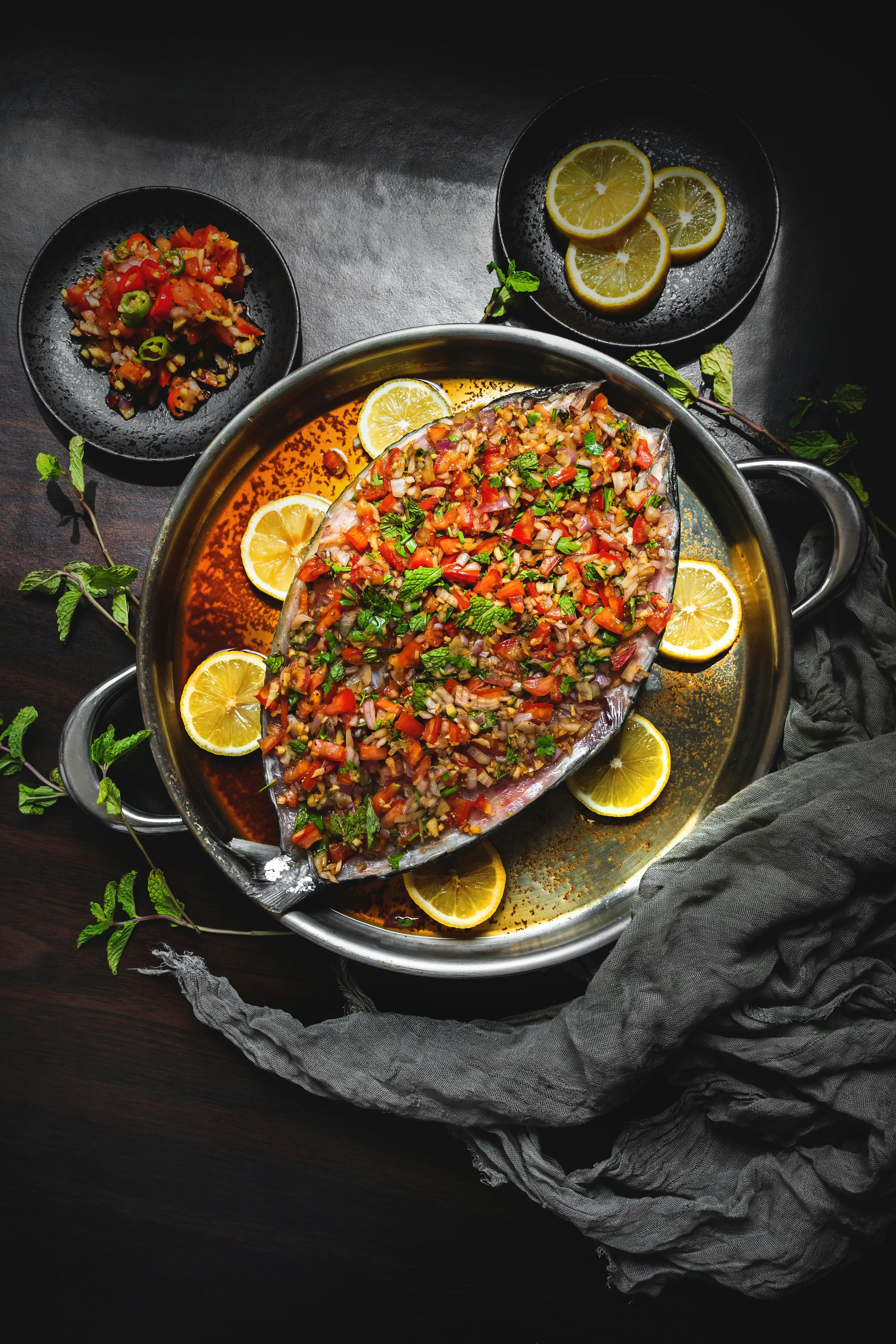
Photo: Eiliv Aceron / Pexels
Chinese
Steamed Fish Head with Chili
The diets react (see scores below)
Common Ingredients
- fish head
- pickled red chilies
- garlic
- ginger
- scallions
- soy sauce
- shaoxing wine
- fermented black beans
Specific recipes may vary.
Incompatible with 5 of 11 diets
Diet Ratings
Steamed Fish Head with Chili is primarily a high-protein, low-fat dish built around a keto-compatible protein source. The fish head itself is excellent for keto — rich in collagen, healthy fats, and zero carbs. However, several ingredients introduce carb and sugar concerns: Shaoxing wine contains residual sugars and carbs (roughly 5-8g per tablespoon used in cooking), fermented black beans carry moderate carbs (~5g per 2 tbsp), soy sauce has minimal but non-zero carbs, and pickled red chilies may contain added sugar depending on the brand. The cumulative carb load from these condiments in a standard restaurant portion could push net carbs to 8-15g per serving, making it manageable within a daily keto budget but not freely consumable. Home preparation with keto substitutions (dry sherry or rice vinegar instead of Shaoxing wine, careful label-checking on pickled chilies) would significantly improve compatibility.
Strict keto practitioners would flag Shaoxing wine as a hard exclusion due to its grain-derived alcohol and residual sugar content, and would also raise concerns about fermented black beans' carb contribution and potential hidden sugars in commercial pickled chilies — arguing the dish as typically prepared in restaurants is too unpredictable to include regularly.
Steamed Fish Head with Chili contains fish head as its primary ingredient, which is unambiguously an animal product. Fish is explicitly excluded from a vegan diet. All other ingredients (pickled red chilies, garlic, ginger, scallions, soy sauce, Shaoxing wine, fermented black beans) are plant-based, but the core animal ingredient makes this dish entirely incompatible with vegan dietary principles.
While the fish head itself is a perfectly paleo protein source, this dish contains multiple non-paleo ingredients that disqualify it. Soy sauce is a fermented soy and wheat product — excluded on two counts (legume and grain). Shaoxing wine is a grain-based rice wine (a processed grain alcohol). Fermented black beans are a legume product and also typically contain added salt. Pickled red chilies often contain added salt and vinegar preservatives. These are not minor or debatable ingredients — they are core to the dish's flavor profile and cannot simply be omitted. The base protein is sound, but the dish as prepared is incompatible with paleo standards.
The core ingredient is fish, which is strongly encouraged in the Mediterranean diet (2-3 times weekly). Fish head is nutritionally rich in omega-3s, collagen, and protein. The aromatics (garlic, ginger, scallions) are plant-based and align well with Mediterranean principles. However, several ingredients give pause: soy sauce is a high-sodium condiment not part of the Mediterranean tradition; Shaoxing wine is a non-Mediterranean alcohol; fermented black beans add significant sodium and are outside the Mediterranean pantry; and pickled chilies may contain added preservatives. The dish is steamed (a healthy cooking method, analogous to Mediterranean poaching or baking), uses no refined grains or added sugars, and contains no red meat or saturated fat. The primary concern is the high sodium load from multiple fermented/preserved condiments and the non-Mediterranean flavor profile, which doesn't disqualify it but warrants moderation. Overall, this is a fish-forward, plant-accompanied dish that fits Mediterranean principles at a functional level, despite its Chinese culinary framing.
Some Mediterranean diet researchers, particularly those focused on the broader 'prudent dietary pattern,' would fully approve any steamed fish dish regardless of seasoning origin, arguing that fish consumption frequency and cooking method matter more than condiment tradition. Others, applying stricter Mediterranean authenticity, might score this lower due to the high sodium content from soy sauce and fermented black beans, which conflicts with the diet's emphasis on minimally processed, low-sodium foods.
While fish head is a carnivore-approved animal protein, this dish is heavily laden with plant-based and processed ingredients that make it incompatible with the carnivore diet. Pickled red chilies, garlic, ginger, and scallions are all plant foods excluded on carnivore. Soy sauce is a fermented soy (legume) product, Shaoxing wine is a grain-derived alcohol, and fermented black beans are legumes — all strictly prohibited. The fish itself is the only carnivore-compatible ingredient, but as prepared in this dish, it cannot be separated from the disqualifying components. This is fundamentally a plant-seasoning-forward Chinese preparation that conflicts with core carnivore principles.
This dish contains multiple Whole30-excluded ingredients. Soy sauce is a soy-based product (soy is a legume and explicitly excluded). Shaoxing wine is an alcoholic beverage (alcohol is excluded). Fermented black beans are legumes (explicitly excluded). Pickled red chilies may also contain added sugar or sulfites, though sulfites are no longer a concern per 2024 rule changes. The combination of soy sauce, Shaoxing wine, and fermented black beans makes this dish clearly non-compliant in its standard preparation.
This dish contains multiple high-FODMAP ingredients that make it unsuitable during the elimination phase. Garlic is one of the highest-FODMAP foods (fructans) and is a primary flavoring agent here. Fermented black beans are high in GOS and fructans. Scallions (green tops are low-FODMAP, but white bulb portions commonly used in cooking are high in fructans). Shaoxing wine may contain small amounts of residual sugars. While fish head itself is a protein and inherently low-FODMAP, and ginger is low-FODMAP, the combination of garlic and fermented black beans as core flavoring ingredients makes this dish a clear avoid during elimination. There is no practical way to omit these ingredients without fundamentally changing the dish's character.
Steamed fish head is a lean protein source and the steaming method is DASH-friendly, aligning well with DASH's emphasis on fish and low-fat cooking techniques. Fish head provides beneficial omega-3 fatty acids and minerals. However, the dish's sodium load is a significant concern: soy sauce is very high in sodium (one tablespoon contains ~900mg), pickled red chilies add additional sodium from the pickling brine, fermented black beans are a high-sodium fermented ingredient, and Shaoxing wine contributes modest sodium. Combined, these ingredients can push a single serving well beyond DASH's 2,300mg daily sodium limit, let alone the stricter 1,500mg low-sodium DASH target. The garlic, ginger, and scallions are DASH-positive aromatics. The overall dish framework is sound, but the high-sodium condiments and fermented ingredients are problematic without modification.
NIH DASH guidelines clearly restrict high-sodium condiments like soy sauce and fermented/pickled ingredients; however, some DASH-oriented clinicians note that when these condiments are used sparingly in a shared dish with large portions of lean fish and vegetables, per-serving sodium may be manageable — substituting low-sodium soy sauce and rinsing fermented black beans could bring this dish into a more favorable DASH range.
Steamed Fish Head with Chili aligns reasonably well with Zone principles but has notable caveats. Fish is an excellent Zone protein source — lean, rich in omega-3 fatty acids, and anti-inflammatory, which Sears strongly endorses. The aromatics (garlic, ginger, scallions, chilies) are Zone-favorable low-glycemic vegetables that also contribute polyphenols. However, fish head is fattier than lean fish fillets, containing more skin and collagen-rich tissue along with higher saturated fat content than, say, cod or tilapia fillet. The condiments introduce complexity: soy sauce adds sodium but minimal macronutrient impact; Shaoxing wine contributes a small glycemic load from alcohol-derived sugars; fermented black beans are a sodium-heavy fermented ingredient that, while low-glycemic, requires portioning care. Pickled red chilies may contain added sugar depending on preparation. The dish lacks an obvious fat block from monounsaturated sources and would need a Zone-balanced complement (e.g., a side of stir-fried vegetables with a drizzle of olive oil or some avocado) to complete the 40/30/30 ratio. The carbohydrate content is inherently low from the ingredients listed, so pairing with appropriate low-GI carb servings (leafy greens, cucumber, etc.) is necessary for a complete Zone meal.
Some Zone practitioners would rate this higher (approve, 7-8) because fish is categorically one of Sears' most recommended proteins, and the dish is essentially a protein-forward, low-carb preparation with anti-inflammatory aromatics. The omega-3 richness of fish heads (including fatty tissue around cheeks and collar) could be viewed as a Zone advantage rather than a drawback. Others would maintain the caution rating, noting that the fish head's higher fat content — including some saturated fat — and the condiment profile (sodium, trace sugars from Shaoxing wine and pickled chilies) require careful portion control to stay in the Zone.
Steamed Fish Head with Chili has a solid anti-inflammatory foundation. Fish head is rich in omega-3 fatty acids (especially from the fatty collar, cheek, and brain tissue), collagen, and minerals — all broadly favorable. The steaming method avoids added inflammatory fats entirely, preserving the fish's nutritional integrity. Garlic, ginger, and chili are well-established anti-inflammatory spices, each with documented effects on inflammatory markers (gingerols in ginger, allicin in garlic, capsaicin in chili). Fermented black beans contribute beneficial polyphenols and probiotics that support gut health, which is increasingly linked to systemic inflammation modulation. Scallions provide quercetin and other flavonoids. The main concerns are the sodium-heavy condiments: soy sauce and fermented black beans add significant salt, and Shaoxing wine is alcohol (non-red wine alcohol is noted as something to limit). Pickled chilies may also contain added salt and preservatives depending on the brand. None of these rise to 'avoid' territory — they are moderate concerns in the context of an otherwise anti-inflammatory dish. For people with hypertension or autoimmune conditions, the sodium load warrants attention.
Most anti-inflammatory authorities would broadly approve of this dish given its omega-3-rich fish base and anti-inflammatory spice profile. However, some practitioners following stricter anti-inflammatory or autoimmune protocols (e.g., AIP-adjacent frameworks) flag fermented soy products and high-sodium fermented condiments as potential gut irritants or contributors to systemic inflammation in sensitive individuals. The alcohol in Shaoxing wine is also a point of contention — Dr. Weil's pyramid limits alcohol to optional moderate red wine, and updated research increasingly suggests any alcohol amount carries inflammatory risk.
Steamed fish head is a protein-rich, low-fat cooking method that aligns well with GLP-1 dietary principles — steaming avoids added fats and supports easy digestibility. Fish head provides lean protein and omega-3 fatty acids, and the aromatics (garlic, ginger, scallions) are GLP-1-friendly and may even help with nausea. However, several factors push this into caution territory. First, pickled red chilies are a meaningful spice load that can worsen GLP-1-related reflux, nausea, and gastric discomfort, especially given slowed gastric emptying. Second, fermented black beans and soy sauce together contribute significant sodium, which can drive fluid retention and worsen the dehydration risk GLP-1 patients already face. Third, Shaoxing wine contains alcohol, which is flagged as an avoid ingredient due to empty calories — though the quantity used as a cooking ingredient is small and much of the alcohol cooks off, it is not zero. Fourth, fish head is gelatinous and fatty compared to lean fish fillets, with more collagen-rich tissue and higher fat content than, say, steamed cod or tilapia; it is still lower fat than most meats but not a top-tier lean protein source. The dish has real nutritional merit but requires individual tolerance assessment, particularly around chili load and sodium.
Some GLP-1-focused dietitians would rate this dish more favorably, emphasizing that steamed preparation, whole-food ingredients, and omega-3 content make it nutritionally superior to most restaurant main dishes. The disagreement centers on individual GI tolerance to chili and fermented ingredients — patients with stable GI adaptation to their medication may tolerate this well, while those in early weeks or with ongoing nausea should approach with caution.
*See how scores were generated at our methodology page.
Nutritional profile
Six traits that cut across every diet.
Fiber & Plants
How much whole-plant food and fiber it delivers.
Healthy Fats
The quality of its fats (unsaturated, omega-3).
Whole / Unprocessed
How close it is to its natural, unprocessed form.
Gut Gentle
How easy it is on digestion (low FODMAP, few irritants).
Low Glycemic
How little it spikes your blood sugar.
Protein Density
How much protein it packs per calorie.
Controversy Index
Higher controversy = more disagreement between diets.
Diet-Specific Tips
 Keto — 5/10
View tips
- Fish head is a zero-carb, fat-rich protein source highly compatible with keto
- Shaoxing wine adds residual sugars and carbs — a meaningful concern in standard portions
- Fermented black beans contribute moderate carbs (~5g per serving)
- Pickled red chilies may contain added sugar depending on preparation/brand
- Soy sauce adds minimal but non-zero carbs and sodium
- Total estimated net carbs per serving: 8-15g, manageable but requires budget awareness
- Home preparation allows substitutions to reduce carb load significantly
 Mediterranean — 6/10
View tips
- Fish is the primary protein — strongly encouraged 2-3 times per week
- Steaming is a healthy, low-fat cooking method compatible with Mediterranean principles
- Garlic, ginger, and scallions are beneficial plant-based aromatics
- Soy sauce and fermented black beans add significant sodium — not Mediterranean staples
- Shaoxing wine is outside Mediterranean tradition (though fermentation itself is valued)
- No red meat, added sugars, refined grains, or saturated fats present
- Pickled chilies may contain preservatives, adding to processed ingredient concern
 DASH — 4/10
View tips
- Fish head is a lean, DASH-approved protein source rich in omega-3s
- Steaming is an ideal DASH cooking method with no added fat
- Soy sauce is very high in sodium (~900mg per tablespoon), a major DASH concern
- Fermented black beans are high in sodium from fermentation and salting
- Pickled red chilies add additional sodium from pickling brine
- Shaoxing wine contributes minor sodium
- Garlic, ginger, and scallions are DASH-positive whole food ingredients
- Overall dish sodium likely exceeds DASH daily targets in a single serving
- Low-sodium soy sauce substitution would significantly improve DASH compatibility
 Zone — 6/10
View tips
- Fish is a top-tier Zone protein with strong omega-3 anti-inflammatory profile
- Fish head is fattier than lean fillets — higher saturated fat and collagen content requires portion awareness
- Aromatics (garlic, ginger, scallions, chilies) are Zone-favorable low-glycemic, polyphenol-rich additions
- Fermented black beans and soy sauce are high-sodium condiments with minimal macronutrient impact
- Shaoxing wine and pickled red chilies may contribute trace sugars — minor concern but worth noting
- Dish is low in carbohydrates overall and low in monounsaturated fat — needs Zone-balancing accompaniments
- No trans fats or high-glycemic ingredients; generally anti-inflammatory preparation method (steamed)
 Anti-Inflammatory — 7/10
View tips
- Fish head is rich in omega-3 fatty acids, collagen, and anti-inflammatory minerals
- Steaming method adds no inflammatory fats and preserves nutrient integrity
- Garlic, ginger, and chili pepper are well-supported anti-inflammatory spices
- Fermented black beans contribute polyphenols and gut-supportive probiotics
- High sodium load from soy sauce, fermented black beans, and pickled chilies is a concern
- Shaoxing wine contributes alcohol, which is classified as 'limit' in anti-inflammatory frameworks
- Pickled ingredients may contain preservatives or additives depending on preparation
 GLP-1 Friendly — 5/10
View tips
- Steamed preparation avoids added fats — a strong positive for GLP-1 digestibility
- Fish head provides lean protein and omega-3 fatty acids, supporting muscle preservation
- Pickled red chilies pose a meaningful reflux and nausea risk for GLP-1 patients
- High combined sodium from soy sauce and fermented black beans increases dehydration risk
- Shaoxing wine contributes a small but non-zero alcohol load
- Fish head has higher fat and collagen content than lean fish fillets — less ideal than white fish
- Ginger is a GLP-1-friendly ingredient that may actively help with nausea management
- Dish works well in small portions given its strong flavors and high satiety from protein