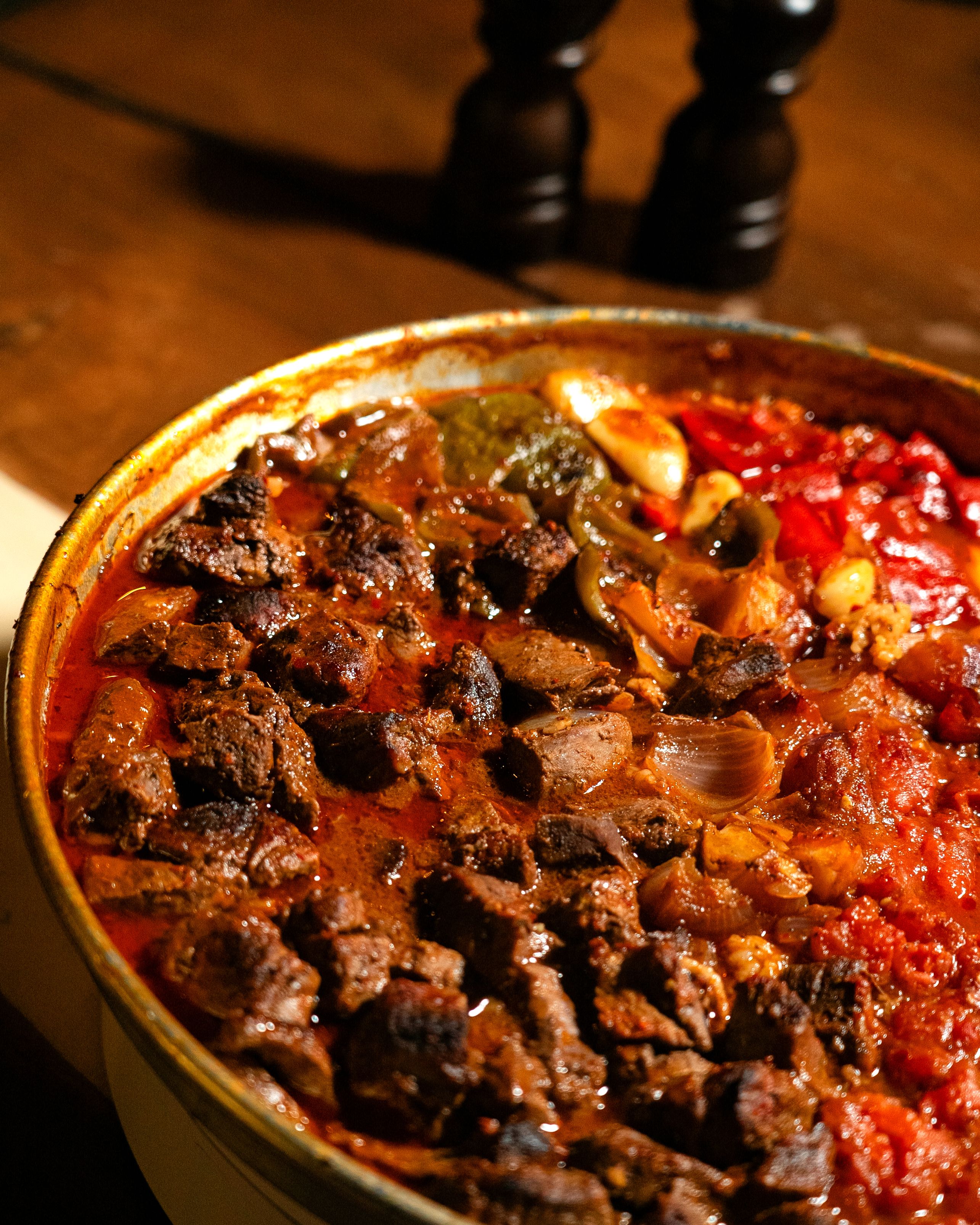
Photo: Mohamed Olwy / Pexels
The diets react (see scores below)
Common Ingredients
- beef
- onion
- paprika
- potatoes
- bell pepper
- tomato
- caraway
- garlic
Specific recipes may vary.
Incompatible with 5 of 11 diets
Diet Ratings
Hungarian Goulash is fundamentally incompatible with ketogenic eating due to its inclusion of potatoes, which are a high-starch vegetable contributing a significant carb load. A standard serving of goulash with potatoes can easily contain 30-50g of net carbs from potatoes alone, blowing the daily keto budget in a single dish. Tomatoes and onions add further carbs. While the beef base and spices (paprika, caraway, garlic) are keto-friendly, and bell peppers are manageable in small amounts, the potatoes are a dealbreaker. No reasonable portion size makes this dish keto-compatible without fundamentally altering the recipe by removing potatoes.
Hungarian goulash contains beef as its primary protein, which is an animal product and strictly excluded from a vegan diet. There is no ambiguity here — beef is slaughtered animal flesh, making this dish entirely incompatible with veganism. The remaining ingredients (onion, paprika, potatoes, bell pepper, tomato, caraway, garlic) are all plant-based, but the presence of beef alone disqualifies the dish entirely.
Hungarian Goulash is largely paleo-friendly — beef, onion, paprika, bell pepper, tomato, caraway, and garlic are all whole, unprocessed foods well within paleo guidelines. The sticking point is the white potatoes, which are the central carbohydrate in this dish. White potatoes are a genuinely debated ingredient in the paleo community: Loren Cordain's original framework excluded them due to glycoalkaloid content and high glycemic index, while Mark Sisson, Whole30, and many modern paleo practitioners now accept them as a whole-food tuber. Because white potatoes are common in goulash but not universally accepted, the dish lands in caution territory rather than a clean approve. If sweet potatoes were substituted, this would score higher. The rest of the ingredient list is exemplary paleo eating.
Strict Cordain-school paleo (The Paleo Diet) discourages white potatoes due to saponins and glycoalkaloids. However, Mark Sisson (The Primal Blueprint) and the Whole30 program both include white potatoes as acceptable whole foods, making this a mainstream point of divergence rather than a fringe opinion.
Goulash is a Hungarian beef stew where beef is the primary and dominant protein. The Mediterranean diet strictly limits red meat to only a few times per month, making a beef-centered dish a poor fit. Many of the supporting ingredients — onion, garlic, bell pepper, tomato, potatoes — are plant-based and Mediterranean-friendly, and the dish is a whole-food preparation with no processed or refined components. However, the core identity of the dish is red meat in substantial quantities, which directly contradicts Mediterranean dietary principles. The spice profile (paprika, caraway) is fine, but cannot offset the fundamental issue of beef as the starring ingredient.
Some Mediterranean diet practitioners argue that occasional red meat dishes made with abundant vegetables in a broth or stew format — especially when portion sizes are controlled — can fit within a flexible Mediterranean eating pattern a few times per month. The vegetable-forward supporting cast (tomato, bell pepper, onion, garlic, potatoes) and whole-food preparation method partially align with Mediterranean values, and traditional populations bordering the Mediterranean (e.g., in the Balkans) did incorporate modest amounts of red meat stews into their diets.
Goulash is overwhelmingly plant-based by ingredient count and volume. While beef is the primary protein and is carnivore-approved, the dish contains onion, paprika, potatoes, bell pepper, tomato, caraway, and garlic — all plant-derived ingredients that are strictly excluded from the carnivore diet. The potatoes alone are a high-carbohydrate vegetable, and the tomatoes, bell peppers, and onions are nightshades or high-FODMAP plants that carnivore practitioners specifically avoid. The spices (paprika, caraway) are plant-derived. This dish cannot be adapted to carnivore without fundamentally changing its identity — removing the plant ingredients would leave only plain beef, which is no longer goulash. There is no meaningful carnivore-compatible version of this dish as described.
Hungarian goulash as listed contains entirely Whole30-compliant ingredients. Beef is an allowed protein, onion, potatoes, bell pepper, tomato, and garlic are all compliant vegetables, and paprika and caraway are allowed spices. There are no excluded ingredients — no grains, legumes, dairy, added sugar, or alcohol. This is a whole-food, minimally processed dish that aligns perfectly with the spirit of the Whole30 program.
Traditional Hungarian goulash contains multiple high-FODMAP ingredients that make it unsuitable during the elimination phase. Onion is one of the highest-FODMAP foods in existence (high in fructans) and is a foundational ingredient in goulash — it cannot be omitted without fundamentally changing the dish. Garlic is similarly a top offender for fructans. These two ingredients alone would disqualify the dish. Potatoes are generally low-FODMAP at moderate servings, beef is low-FODMAP, paprika and caraway are low-FODMAP as spices in typical quantities, bell pepper is low-FODMAP at standard servings, and tomato is low-FODMAP at around 65g. However, the onion and garlic are structural to this dish and present in quantities that make avoidance during elimination phase clear-cut.
Hungarian goulash contains several DASH-friendly ingredients — onion, bell pepper, tomato, garlic, potatoes, paprika, and caraway are all vegetables and spices that align well with DASH principles, providing potassium, fiber, and antioxidants. However, the primary protein is beef (typically a fatty cut like chuck), which is red meat with saturated fat — a category DASH explicitly limits. The dish is not inherently high in sodium if prepared at home without added salt, which is a meaningful distinction. Portion control of the beef component is key: if lean beef is used in modest amounts (3 oz), the dish becomes more compatible. The vegetable-heavy profile partially offsets concerns. As commonly prepared, though, the generous beef content and potential for higher saturated fat intake push this into 'caution' territory rather than approval.
NIH DASH guidelines limit red meat broadly due to saturated fat and cholesterol concerns, placing goulash in 'caution' at best. However, updated clinical interpretations note that lean cuts of beef (e.g., round or sirloin) in controlled portions (≤3 oz) can fit within DASH's lean protein allowance, and the dish's dominant vegetable and spice profile closely mirrors DASH's emphasis on produce — some DASH-oriented dietitians would approve a lean, low-sodium version.
Hungarian Goulash presents a mixed Zone Diet profile. On the positive side, it contains several Zone-favorable ingredients: bell peppers and tomatoes are low-glycemic vegetables rich in polyphenols, onions and garlic provide anti-inflammatory benefits, and paprika (especially Hungarian paprika) is polyphenol-rich. However, the dish has two significant Zone concerns. First, potatoes are explicitly listed by Dr. Sears as an unfavorable, high-glycemic carbohydrate to avoid — they spike insulin and are difficult to balance within Zone blocks. Second, beef is not inherently problematic in Zone, but goulash typically uses fattier cuts (chuck, shank) that carry more saturated fat than the lean proteins Sears prefers. The carb load from potatoes makes the 40/30/30 ratio very difficult to achieve in a traditional preparation. A modified version — replacing potatoes with additional low-glycemic vegetables (zucchini, mushrooms) and using a leaner beef cut — could be made Zone-compatible, but the traditional dish as described scores in caution territory.
Some Zone practitioners argue that goulash can be adapted to Zone compliance by reducing potato quantity and pairing with Zone-favorable vegetables. Sears' later writings emphasize overall meal ratios over categorical exclusions — potatoes are 'unfavorable' but not truly forbidden, meaning a small-portion goulash alongside a large low-GI vegetable side could approach Zone balance.
Hungarian goulash presents a mixed anti-inflammatory profile. On the positive side, the dish is rich in anti-inflammatory spices and vegetables: paprika (high in capsaicin and carotenoids), garlic (allicin, anti-inflammatory), onion (quercetin), bell pepper (vitamin C, carotenoids), tomato (lycopene), and caraway (antioxidant compounds). These collectively contribute meaningful polyphenol and antioxidant activity. However, the primary protein is beef — red meat — which is categorized as 'limit' in anti-inflammatory frameworks due to saturated fat content and arachidonic acid, which can promote inflammatory eicosanoids. The dish does not typically include significant amounts of omega-3 fatty acids or other strongly anti-inflammatory fats, and potatoes are a moderate-glycemic starch. The overall impact depends heavily on the cut of beef used (leaner cuts are less problematic), portion size, and cooking fat. Prepared with a lean cut of beef, no added butter or lard, and generous spicing, goulash can be a reasonable occasional meal — not ideal but not deeply pro-inflammatory either. The vegetable-to-meat ratio and the potent spice profile partially offset the concerns around red meat.
Some anti-inflammatory practitioners following Dr. Weil's pyramid would consider this a perfectly acceptable occasional dish, emphasizing the strong anti-inflammatory spice and vegetable base (paprika, garlic, tomato, bell pepper) and noting that moderate red meat consumption is 'limit' not 'avoid.' Conversely, stricter anti-inflammatory and autoimmune protocol (AIP) advocates would flag both the red meat (arachidonic acid, saturated fat) and nightshade vegetables (paprika, bell pepper, tomato, potatoes — solanine/lectins) as pro-inflammatory, potentially rating this dish more negatively for sensitive individuals.
Hungarian goulash is a paprika-spiced beef and vegetable soup that offers meaningful nutritional value but presents several considerations for GLP-1 patients. On the positive side, it contains a moderate protein source (beef), fiber-contributing vegetables (bell pepper, tomato, onion), and a broth-based format that supports hydration and easy digestion relative to heavier stews. However, traditional goulash uses fattier cuts of beef (chuck, shank) which raise the saturated fat load — a concern for GLP-1 side effects like nausea and reflux. Potatoes add starchy carbohydrates with limited protein density. Paprika in moderate amounts is generally fine, but the spice level and fat content are the primary variables that determine tolerability. The dish can be made GLP-1-friendly by using lean beef (round or sirloin), controlling portion size of potatoes, and keeping fat content low during cooking. As served in a traditional preparation, it sits solidly in the caution range.
Some GLP-1-focused dietitians view lean versions of beef-based soups favorably given the combined protein and hydration benefits, and would approve a modified goulash made with lean cuts. Others flag all fatty red meat preparations — even soup — as likely to worsen gastric emptying delays and nausea, and would rate traditional goulash closer to avoid. The disagreement centers on cut selection and preparation fat content rather than the dish concept itself.
*See how scores were generated at our methodology page.
Nutritional profile
Six traits that cut across every diet.
Fiber & Plants
How much whole-plant food and fiber it delivers.
Healthy Fats
The quality of its fats (unsaturated, omega-3).
Whole / Unprocessed
How close it is to its natural, unprocessed form.
Gut Gentle
How easy it is on digestion (low FODMAP, few irritants).
Low Glycemic
How little it spikes your blood sugar.
Protein Density
How much protein it packs per calorie.
Controversy Index
Higher controversy = more disagreement between diets.
Diet-Specific Tips
 Paleo — 5/10
View tips
- Beef is a core paleo protein — fully approved
- White potatoes are the primary gray-area ingredient, debated across paleo authorities
- Paprika, garlic, onion, bell pepper, tomato, and caraway are all paleo-approved whole foods
- No grains, legumes, dairy, seed oils, or processed ingredients present
- Substituting sweet potatoes would resolve the main point of contention
- Dish is unprocessed and prepared from whole ingredients — aligns with paleo philosophy
 Whole30 — 6/10
View tips
- Beef is a fully approved Whole30 protein
- All vegetables (onion, potato, bell pepper, tomato, garlic) are compliant
- Paprika and caraway are compliant spices
- No grains, dairy, legumes, or added sugar present
- Traditional preparation uses no excluded ingredients
- Whole, unprocessed dish that honors the Whole30 philosophy
 DASH — 5/10
View tips
- Beef (red meat) is limited on DASH due to saturated fat content
- Vegetables (onion, bell pepper, tomato, garlic, potatoes) are core DASH foods and dominate the ingredient list
- Paprika, caraway, and garlic are sodium-free flavor enhancers consistent with DASH's preference for herbs and spices over salt
- Sodium level depends heavily on preparation — home-cooked with no added salt scores significantly higher than restaurant or canned versions
- Lean beef cuts in modest portions (≤3 oz) improve DASH compatibility
- Potatoes provide potassium, a key DASH nutrient, but are starchy — portion awareness recommended
- No high-sodium processed ingredients in the listed recipe
 Zone — 4/10
View tips
- Potatoes are explicitly classified as an unfavorable high-glycemic carbohydrate in Zone methodology — a significant strike against this dish
- Bell peppers, tomatoes, onion, and garlic are Zone-favorable low-glycemic vegetables and polyphenol sources
- Paprika is a polyphenol-rich spice aligned with Sears' anti-inflammatory focus
- Beef is the protein base — goulash typically uses fattier cuts, adding saturated fat beyond Zone-preferred lean protein guidelines
- Caraway and garlic are neutral/positive from a Zone anti-inflammatory perspective
- Traditional preparation makes achieving 40/30/30 ratio difficult without significant recipe modification
 Anti-Inflammatory — 5/10
View tips
- Red meat (beef) is pro-inflammatory at high consumption — saturated fat and arachidonic acid are concerns
- Paprika is rich in carotenoids and capsaicin with strong antioxidant and anti-inflammatory properties
- Garlic provides allicin and organosulfur compounds with well-documented anti-inflammatory effects
- Bell pepper, tomato, and onion add polyphenols, carotenoids, quercetin, and lycopene
- Caraway seeds contain antioxidant flavonoids and anti-inflammatory compounds
- Potatoes are a moderate-glycemic starch with limited anti-inflammatory value
- No omega-3 fats present; dish is nutritionally heavy on the protein/starch side
- Nightshade ingredients (paprika, bell pepper, tomato, potato) may be problematic for autoimmune-sensitive individuals
 GLP-1 Friendly — 5/10
View tips
- Beef cut matters significantly — fatty chuck worsens GLP-1 side effects, lean round or sirloin improves the rating
- Broth-based soup format supports hydration and easier gastric emptying — a positive for GLP-1 patients
- Moderate protein per serving but not high-density; potatoes dilute protein-to-calorie ratio
- Paprika and spice level generally tolerable but may trigger reflux in sensitive patients
- Saturated fat from traditional beef cuts is the primary concern
- Portion-sensitive: a small bowl is preferable to a large serving given slowed gastric emptying